Table of Contents
Topic Summary
Understand the Scale of UAE's Equine Market
The UAE equine sector generates staggering investment, with approximately AED 2.1 billion spent annually on racehorse training alone. Equestrian clubs add another AED 367 million in yearly spending, making this one of the world's most active horse markets.
Choose Your Core Business Activity Carefully
The official classification 0142.01 covers raising horses, donkeys, mules, and hinnies for any commercial purpose, including racing, endurance sport, showing, and export. Knowing exactly which activity your business falls under shapes your licensing, facility requirements, and target customers.
Pick the Right Horse Breed for Your Goals
Thoroughbreds suit entrepreneurs targeting the lucrative racing market, while purebred Arabians open doors to international showing, endurance competition, and export as breeding stock. Working equines like donkeys and mules serve a separate but steady regional demand.
Tap Into a Thriving Global Equine Supply Chain
A horse-raising business in Dubai connects you to a broader ecosystem of vets, nutritionists, bloodstock agents, and transport specialists. The global horse feed market alone is projected to reach USD 21.66 billion by 2030, with the UAE named as a key demand driver.
Leverage Deep Government and Cultural Support
The Arabian horse is a national symbol in the UAE, and government backing for the sector runs deep, from officially supported studbooks to internationally televised race meetings with prize purses exceeding USD 30 million. This institutional support reduces market risk for new entrants.
Study World-Class Operations Already in Dubai
Godolphin and Shadwell Stud, two of the largest thoroughbred breeding programmes on earth, are both based in Dubai and set the benchmark for the industry. Studying their models alongside established Arabian studs like Ajman Stud and Al Asayl gives new operators a clear picture of best practice.
Recognize Long-Term Healthcare Investment Trends
The global equine healthcare market is forecast to grow from USD 4.56 billion in 2025 to USD 10.40 billion by 2033, signalling sustained spending on the animals at the heart of this industry. Entrepreneurs who build strong veterinary and nutrition partnerships early will be better positioned for long-term profitability.
How To Start a Horse & Equine Raising Business In Dubai
Few industries sit at the intersection of cultural heritage, national prestige, and serious commercial investment quite like the equine sector in the UAE. Horses here are not simply livestock, they are a centuries-old symbol of Bedouin identity, a tool of diplomacy, and the foundation of a thriving modern industry that draws money and attention from across the globe.
The scale of that industry is striking. According to Equerry & Co¹, annual spending by equestrian clubs in the UAE averages AED 367 million (around USD 100 million), and approximately AED 2.1 billion (close to USD 570 million) is spent each year on training racehorses alone. That investment flows through an entire ecosystem: veterinarians, nutritionists, breeders, transport specialists, and bloodstock agents all depend on a steady supply of well-bred horses.
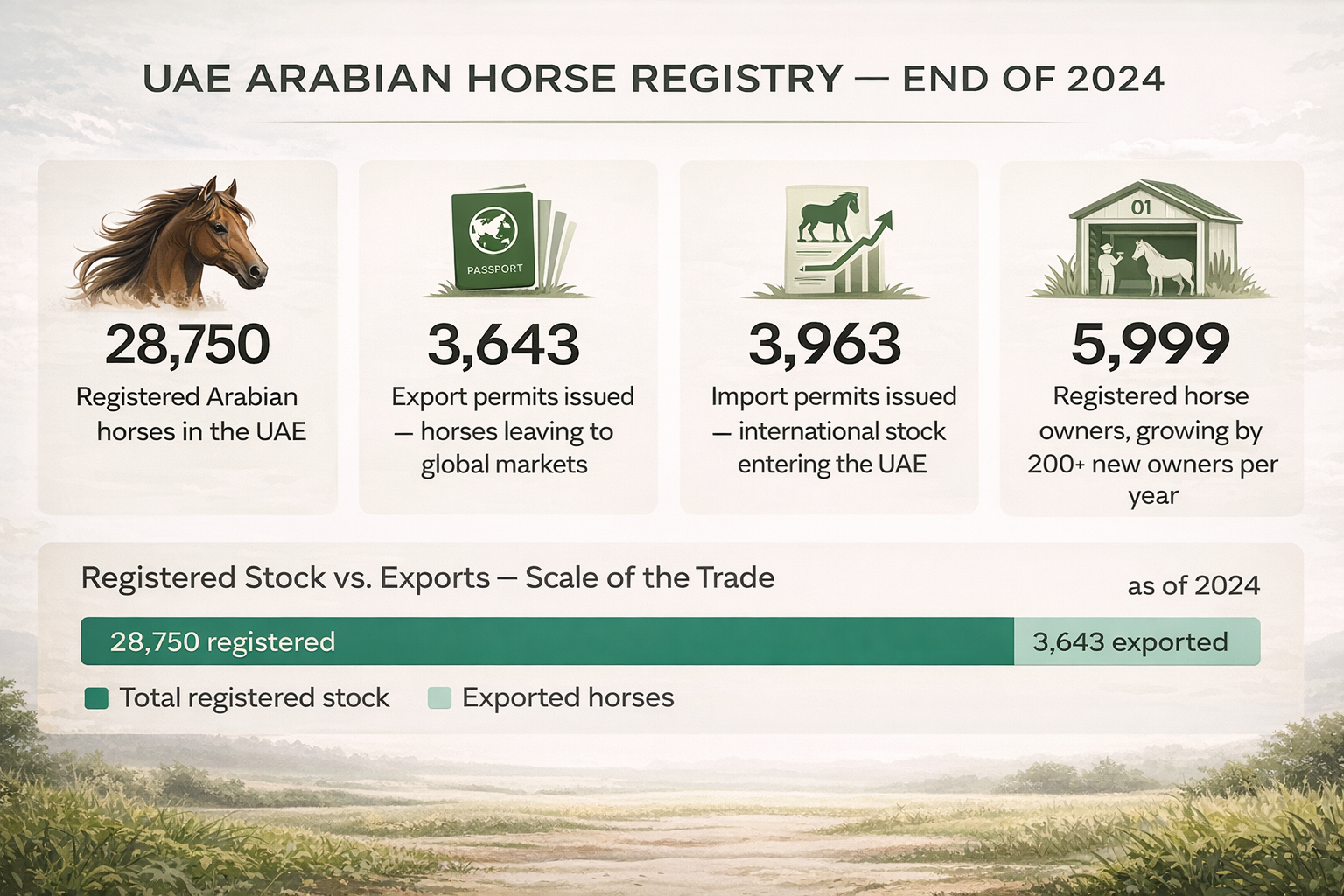
Globally, the sector is expanding fast. According to Mordor Intelligence³, the global horse feed market is valued at USD 16.04 billion in 2025 and is projected to reach USD 21.66 billion by 2030, with the UAE named alongside the US, UK, and Australia as a key driver of demand for premium equine nutrition. At the same time, the global equine healthcare market is projected to grow from USD 4.56 billion in 2025 to USD 10.40 billion by 2033, according to Grand View Research⁴, signalling sustained long-term investment in the animals at the heart of this industry.
For entrepreneurs, the UAE is one of the most attractive places in the world to enter this space. Demand for quality horses is constant, the infrastructure is world-class, and the cultural importance of the Arabian horse means government support for the sector runs deep.
Who is this for?
| Bloodstock investors | Breeders & stud operators | Equine entrepreneurs |
|---|---|---|
| Those looking to breed, acquire, and trade horses in one of the world's most active equine markets. | Specialists in equine genetics wanting to establish or expand a breeding programme in the UAE. | Business builders ready to supply the UAE's insatiable demand for quality horses across racing, endurance, and showing. |
0142.01 - Raising of horses and other equines
Under this activity, you are in the business of raising and breeding horses, donkeys, mules, and hinnies from birth through to the point they are ready for sale, competition, or transfer. That includes the full cycle of keeping, feeding, conditioning, and reproducing equines for any commercial purpose (racing, endurance sport, showing, breeding stock export, or working animal supply).
Crucially, it includes racing horses specifically, meaning a breeding operation focused on producing thoroughbred or purebred Arabian racehorses sits squarely within this classification.
In the UAE, this is not a niche pursuit. The Arabian horse is a national symbol, and the country has built one of the most sophisticated equine ecosystems in the world around it, from government-supported studbooks to internationally televised race meetings with prize money exceeding USD 30 million.
| Thoroughbreds | Arabian horses | Endurance horses | Donkeys & mules |
|---|---|---|---|
|
Racing horse breeding Breeding and raising thoroughbred racehorses from foal to competition-ready, including bloodstock management. |
Purebred Arabian breeding Raising purebred Arabians for racing, endurance competition, international showing, and export as breeding stock. |
Long-distance competition stock Breeding and conditioning horses specifically for the UAE's highly active endurance racing circuit, one of the world's busiest. |
Working equines Raising donkeys, mules, and hinnies for agricultural, transport, or working purposes across the region. |
| FAMOUS UAE OPERATIONS | FAMOUS UAE STUDS | UAE CONTEXT | REGIONAL CONTEXT |
| Godolphin (Sheikh Mohammed), Shadwell Stud. These are two of the world's largest thoroughbred breeding programmes, both based in Dubai. | Ajman Stud, Al Asayl Stud, Al Aryam Arabians. These are producers of internationally awarded show and race horses. | Over 2,000 active endurance horses registered in the UAE. This is more per capita than France, a country 8x its population. | Growing demand across the broader GCC and MENA region for working equines in agriculture and rural logistics. |
There is one important boundary to this classification, however.
If your business is operating a racing stable (taking horses in for training, managing race entries, and running competitive operations on behalf of owners), that is a separate activity and falls outside this group. The same applies to riding stables offering lessons or horse hire. This license covers the raising and breeding side of the business: producing the horses, not running them in competition or offering them as a service to others.
In short: if you are bringing horses into the world, growing them, and selling or transferring them, you are in. If you are training or racing horses on behalf of clients, that is a different business.
Third-Party Approval:
No third-party approval is required for this business activity.
Anti-Money Laundering Compliance:
This business activity is exempt from AML compliance requirement.
Reference
³ Mordor Intelligence — Horse Feed Market Share, Size & Growth Outlook to 2030
⁴ Grand View Research — Equine Healthcare Market Size, Share & Growth Report 2034