
Table of Contents
Frequently Asked Questions
What does a local shares and bonds broker do?
A local shares and bonds broker executes client buy and sell orders in shares and bonds listed or issued in the UAE, on the Dubai Financial Market and Abu Dhabi Securities Exchange.
Which UAE exchanges do local brokers trade on?
Local brokers operate on the Dubai Financial Market and the Abu Dhabi Securities Exchange, handling equities, bonds, sukuk, and other domestically listed instruments.
Can local shares and bonds brokers handle IPO subscriptions?
Yes. They handle subscription orders, allocation, and aftermarket execution for primary market IPOs, follow-on offerings, and rights issues by UAE-listed issuers.
Who invests through UAE local securities brokers?
Investors include UAE residents, high-net-worth individuals, family offices, asset managers, and foreign institutional investors, who account for around half of Dubai Financial Market trading value.
What instruments do local shares and bonds brokers trade?
They trade UAE-listed company shares, sovereign and corporate bonds, federal and emirate-level sukuk, and other domestic fixed income instruments traded on UAE exchanges.
Topic Summary
UAE Capital Markets Are Booming Right Now
Net foreign investment into UAE capital markets reached AED 18.7 billion in 2025, with average daily trading climbing 24.16 percent year on year to AED 2.21 billion. The Dubai Financial Market alone recorded AED 133 billion in annual traded value, making this one of the most active periods in the market's history.
Every Trade Requires a Licensed Broker
The Securities and Commodities Authority mandates that every broker trading on the Dubai Financial Market or Abu Dhabi Securities Exchange hold a valid licence, maintain segregated client accounts, and pass audited compliance checks. There is simply no legal route to place client orders on these exchanges without going through an authorised firm.
Foreign Investor Demand Outpaces Broker Supply
In 2024, the Dubai Financial Market added 138,262 new investors, with 85 percent of them being foreign nationals who now account for half of all trading on the exchange. Most arrive without an existing local broker, creating a clear gap that independent brokerage firms are well positioned to fill.
IPO Activity Creates a Specialist Opportunity
Dubai hosted some of the world's largest IPOs in recent years, including Talabat's AED 7.5 billion listing, the world's biggest technology IPO of 2024. Brokers specialising in subscription orders, allocation management, and aftermarket execution can capture significant fee revenue during high-volume primary listings.
Bank-Owned Brokers Still Dominate, Leaving Room to Compete
Most brokerage activity on UAE exchanges currently flows through a small group of firms owned by major banks, which limits choice for retail clients, family offices, and institutions seeking independent execution. This concentration creates genuine commercial space for new entrants offering specialised or more agile services.
Meydan Free Zone Offers a Cost-Efficient Licensing Base
Meydan Free Zone provides 100 percent foreign ownership, zero corporate tax on qualifying income, full profit repatriation, and a fully digital licensing process starting from AED 12,500. These conditions make it a practical and financially attractive base for launching a securities brokerage targeting UAE capital markets.
Three Distinct Broker Models Suit Different Strategies
Entrepreneurs can enter the market as domestic equity brokerages serving retail and institutional clients, as IPO subscription specialists managing primary market flow, or as debt capital market brokers executing trades in sovereign bonds, corporate bonds, and sukuk. Each model addresses a different segment of the growing UAE investor base.
How to Start a Local Shares and Bonds Brokerage Business in Dubai with Meydan Free Zone
Every IPO on the Dubai Financial Market, every bond listing on the Abu Dhabi Securities Exchange, and every share traded between two UAE residents passes through the same gate: a licensed broker. The activity is unglamorous in description, but it is the entire mechanical layer that makes UAE capital markets investable, and its commercial gate has just been thrown wider open by one of the strongest years on record for domestic equity and debt issuance.
Net foreign investment into UAE capital markets reached AED 18.7 billion in 2025, while average daily trading climbed 24.16 percent year on year to AED 2.21 billion, according to the Capital Market Authority¹.
Dubai Financial Market reached an average daily trading value of AED 524 million across the year, supported by AED 133 billion in annual traded value², while in 2024 the same exchange raised AED 10.48 billion through three IPOs including Talabat's AED 7.5 billion listing, the world's largest technology IPO of that year. The Central Bank of the UAE recorded DFM market capitalisation reaching AED 953.2 billion in the second quarter of 2025 alone, with the index up 21.7 percent on an annual basis³.
The UAE's two main exchanges are no longer regional sideshows. They are deep, foreign-investor-active markets, hosts to some of the world's largest IPOs, and the channel through which most domestic capital allocation to UAE equities and bonds now flows.
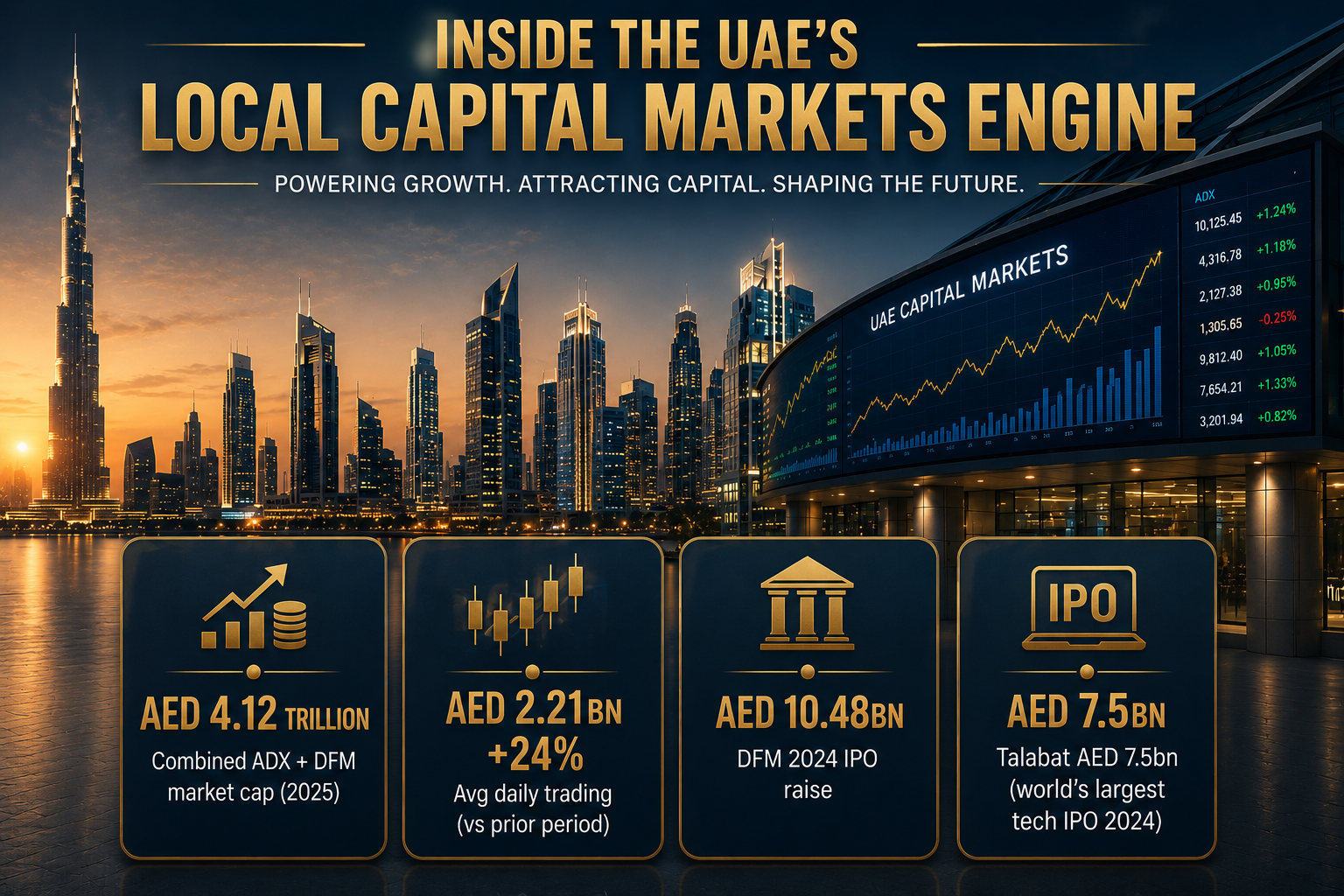
Sources: Capital Market Authority via Khaleej Times (2026); Century Financial (2025); Central Bank of the UAE (2025).
The Securities and Commodities Authority licenses every broker that trades on the Dubai Financial Market and the Abu Dhabi Securities Exchange. A broker needs capital backing, segregated client accounts, and audited compliance before it can place a single client order. The standards are demanding, but that is what earns these markets their credibility. It also means there is no way to trade on them except through an authorised broker.
Dubai Trade License from AED 12,500
Get Your LicenseThe demand is wider than the current brokers can serve. In 2024, the Dubai Financial Market alone added 138,262 new investors, and 85 percent of them were foreign nationals². Foreign investors now account for half of all trading on the exchange², placing orders from London, Mumbai, Riyadh, and Singapore, and most of them arrive without an existing local broker.
They are not the whole picture either. UAE residents are investing, institutions are building portfolios, and family offices are buying into the government companies that keep going public. Most of this activity still runs through a small group of brokers owned by the major banks, which leaves real room for independent firms to compete.
From retail-focused trading houses and HNWI advisory desks to IPO subscription specialists and institutional execution platforms, the UAE listed market rewards brokers built to handle local flow at scale.
Who is this for?
- Domestic equity brokerages: Firms executing buy and sell orders for retail and institutional clients across DFM- and ADX-listed shares, providing market access, research, and trade settlement services to investors based in the UAE and abroad.
- IPO subscription specialists: Brokers handling subscription orders, allocation, lock-up administration, and aftermarket execution for primary listings on UAE exchanges, including high-volume technology, real estate, and government privatisation issuances.
- UAE debt capital market brokers: Operators executing trades in UAE-issued sovereign bonds, corporate bonds, and sukuk on behalf of institutional clients, banks, and asset managers tracking domestic fixed income exposure.
Meydan Free Zone offers 100% foreign ownership, zero percent corporate tax on qualifying income, full profit repatriation, and a fully digital licensing process, providing a regulated and cost-efficient base from which to operate as a securities broker in one of the most active capital markets in the region.
Free Business Setup Cost Calculator
Calculate Now6612.90 - Local Shares & Bonds Brokers
Under this activity, you are licensed to execute buy and sell orders in shares and bonds listed or issued in the UAE, on behalf of clients. The broker is the regulated intermediary connecting investors with the Dubai Financial Market, the Abu Dhabi Securities Exchange, and the UAE's sovereign and corporate bond market. Revenue is earned through commissions, spreads, and execution fees on client orders, not through dealing on own account.
| UAE Equity Execution | UAE Bond and Sukuk Brokerage | IPO and Primary Market Subscription | Aftermarket Settlement and Reporting |
|---|---|---|---|
| Execution of client buy and sell orders in shares listed on the Dubai Financial Market and the Abu Dhabi Securities Exchange, for retail, HNWI, and institutional investors based in the UAE and abroad. | Execution of client orders in UAE-issued sovereign bonds, federal and emirate-level sukuk, listed corporate bonds, and other domestic fixed income instruments traded on UAE exchanges. | Handling of subscription orders, allocation, refund processing, and aftermarket execution for primary market IPOs, follow-on offerings, and rights issues by UAE-listed issuers. | Trade matching, settlement coordination with UAE clearing infrastructure, regulatory transaction reporting, and client confirmation for completed UAE-listed share and bond transactions. |
| MARKET SIZE AND LIQUIDITY | FOREIGN INVESTOR PARTICIPATION | REGULATORY ANCHOR | IPO PIPELINE |
| Combined ADX and DFM market capitalisation reached approximately AED 4.12 trillion in 2025 per Capital Market Authority data1, with average daily trading of AED 2.21 billion, up 24.16 percent year on year. | Foreign investors accounted for 50 percent of DFM trading value and 21 percent of its market capitalisation in 20242, with 85 percent of newly onboarded DFM investors being non-UAE nationals. | The Securities and Commodities Authority (SCA) licenses all brokers operating in UAE-listed securities, requiring Category 3 authorisation, capital adequacy, segregated client accounts, and full AML and KYC compliance. | Government privatisations including DEWA, ADNOC Gas, ADNOC Logistics & Services, Parkin, and Dubai Taxi Corporation have expanded the listed universe, with Talabat's AED 7.5 billion 2024 listing marking the world's largest technology IPO of that year3. |
There are clear boundaries on this activity. Local shares and bonds brokerage does not cover dealing in markets on own account, which falls under a separate financial intermediation classification. It excludes portfolio management on a fee or contract basis, which is a distinct regulated activity. It also excludes brokerage in foreign-listed securities, commodities, currencies, and locally listed derivatives, each of which carries its own ISIC sub-code and SCA licensing track.
Business Activities List
Explore Over 2,500+The line is precise. If your business executes client orders in shares listed on the Dubai Financial Market, the Abu Dhabi Securities Exchange, or bonds and sukuk issued by UAE entities, you are in. If you manage discretionary portfolios, deal for your own book, or trade in foreign securities, commodities, or currencies, you are not.
Third-Party Approval: Pre-approval from the Securities and Commodities Authority (SCA) is required before the trade license is issued.
Anti-Money Laundering Compliance: This business activity is subject to UAE Anti-Money Laundering and Counter-Terrorism Financing compliance requirements.
Citations
¹ Capital Market Authority, reported by Khaleej Times. UAE Capital Markets See Strong Issuance and Rising Foreign Investment in 2025. Khaleej Times, 2026.
² Century Financial. DFM and ADX: A Complete Guide to UAE's Leading Stock Exchanges. Century Financial, 2025.
³ Central Bank of the UAE. UAE Monetary, Banking & Financial Markets Developments Q2 2025. CBUAE, August 2025.