
Table of Contents
Frequently Asked Questions
What activity code covers aircraft cleaning services in Dubai
Aircraft cleaning services in Dubai are classified under activity code 8129.95. This code encompasses interior and exterior aircraft cleaning, cabin sanitation, lavatory servicing, and ground-level detailing.
It is important to confirm that this exact code is listed on your licence application during the trade name reservation stage. Misclassification at this step can cause significant delays in the approval process.
Can a foreign national own 100% of an aircraft cleaning business in Dubai
Yes. 100% foreign ownership is permitted under UAE Federal Law No. 26 of 2020 on Commercial Companies, meaning foreign investors do not require a local Emirati partner to establish this business.
This applies to both mainland and free zone structures, giving investors flexibility in choosing the jurisdiction that best suits their operational and commercial model.
What is the difference between a mainland and free zone licence for this activity
A mainland licence issued by the Dubai Department of Economy and Tourism (DED) provides direct access to airport contracts and UAE government entities, making it the preferred option for operators targeting commercial airlines at Dubai International Airport (DXB) or Al Maktoum International Airport (DWC).
A free zone licence, such as one issued through Meydan Free Zone, typically offers faster initial setup and 100% ownership, and is better suited to private aviation or sub-contracting models.
Regardless of jurisdiction, any operations conducted on airport aprons require separate approvals from Dubai Airports and compliance with GCAA airside access protocols.
What approvals are needed to operate airside at Dubai International Airport
Operating airside at DXB requires approval from Dubai Airports and strict adherence to General Civil Aviation Authority (GCAA) airside access protocols. These approvals are separate from your trade licence and must be obtained in addition to it.
All staff working airside must hold valid airside passes, which require background checks, a valid Emirates ID, and GCAA clearance. This process runs parallel to, not concurrent with, the licence application, so it should be factored into your overall setup timeline.
What are the chemical and hazardous substance compliance requirements for aircraft cleaning operators
Cleaning chemicals and agents used in aircraft cleaning must comply with UAE environmental and aviation safety standards. Hazardous substance handling is governed by MOHAP guidelines, which set specific requirements for storage, labelling, and staff handling procedures.
Operators should review the MOHAP requirements before finalising their equipment and supply chain, as non-compliance can affect both licence approval and ongoing operations.
What are the staffing and Emiratisation obligations for this business
MOHRE registration is mandatory before hiring any staff. Emiratisation quotas apply once your headcount crosses defined thresholds, meaning larger operations will be required to employ a proportion of UAE nationals.
Operators should review current requirements directly via the MOHRE portal before finalising their staffing model, as quota thresholds and ratios are subject to regulatory updates.
Who are the primary clients for aircraft cleaning services in Dubai
Primary clients include commercial airlines, private aviation operators, MRO (maintenance, repair, and overhaul) facilities, and cargo carriers. These are typically not one-off engagements — contracts are structured as recurring service agreements on a per-turn or monthly retainer basis.
Contracts are negotiated either directly with airlines or through primary ground handling companies. Operational proximity to Dubai International Airport (DXB) and Al Maktoum International Airport (DWC) is a key factor in winning and servicing these contracts.
Why is Dubai considered a commercially viable location for starting an aircraft cleaning business
Dubai International Airport handles over 86 million passengers annually and ranks among the world's top three busiest airports by international passenger traffic, creating sustained and contracted demand for specialist aircraft cleaning operations.
The aviation sector contributes approximately 15% of Dubai's GDP, reflecting the scale of the ecosystem that supports this type of business. Combined with 100% foreign ownership rights and a clear licensing pathway, Dubai offers a strong commercial and regulatory foundation for new entrants in this sector.
Start an Aircraft Cleaning Services Business in Dubai
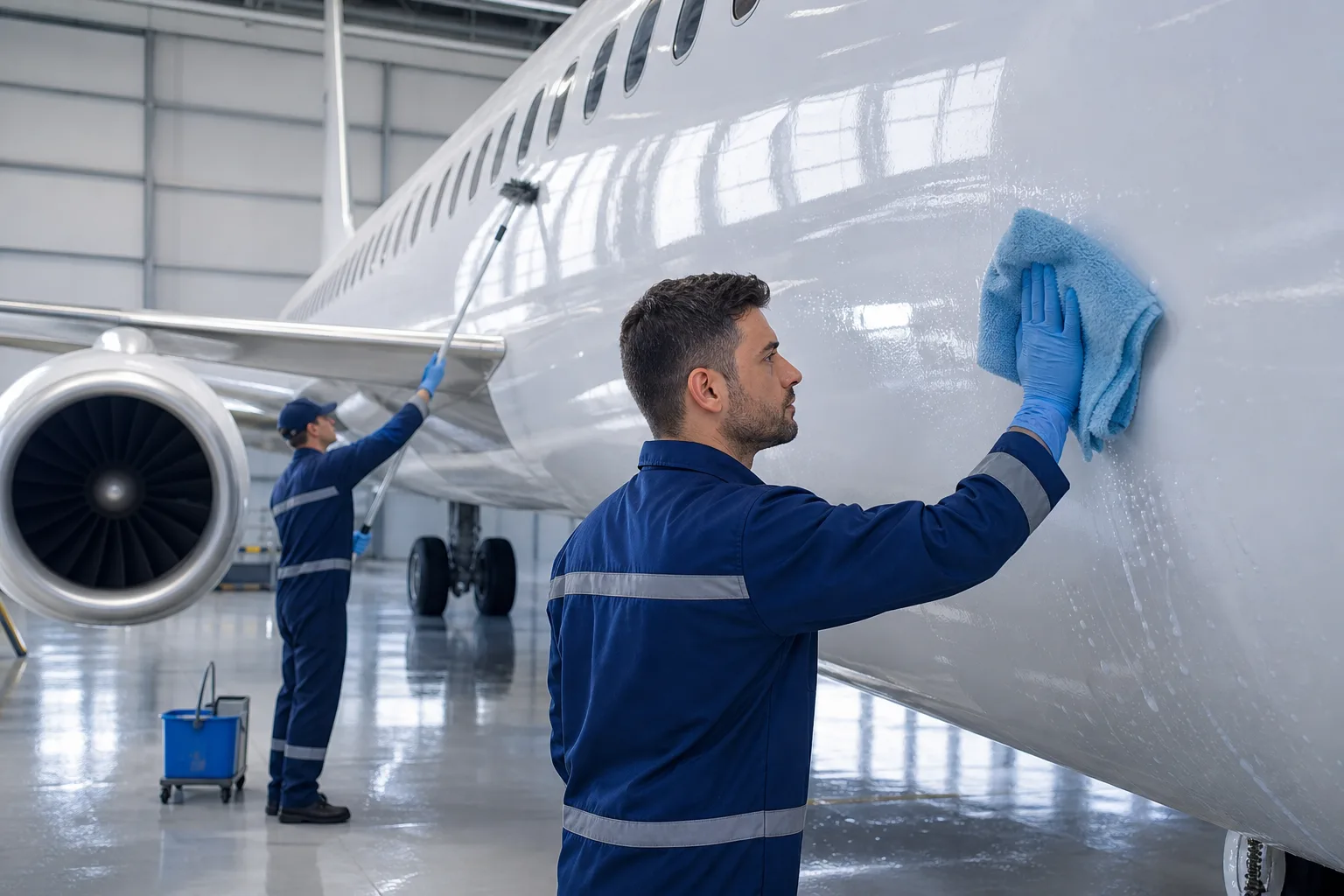
Dubai International Airport handles more than 86 million passengers a year. Every aircraft that turns around needs its cabin cleaned, its lavatories serviced and its exterior kept in condition. That is skilled work against a tight clock, and airlines pay for it under contract rather than by the hour.
This guide covers what activity code 8129.95 lets you do, the approvals that sit on top of your license, how to set up, and what the work costs to run. The trade license is the quick part. Airside access is the part that takes time.
Key Stats at a Glance
| Activity code | 8129.95, Aircraft Cleaning Services |
|---|---|
| What it covers | Interior and exterior aircraft cleaning, cabin sanitation, lavatory servicing and ground-level detailing |
| Airport traffic | Dubai International Airport ranks among the world’s top 3 busiest airports by international passenger traffic – Statista |
| Aviation and GDP | The sector contributes about 15% of Dubai’s GDP – Invest in Dubai |
| Foreign ownership | 100% permitted under UAE Federal Law No. 26 of 2020 on Commercial Companies |
| License options | Free zone and mainland both available for this activity |
| Extra approvals | Dubai Airports permit and GCAA airside access for apron work |
| Typical timeline | License in 2 to 4 weeks; airside passes add 4 to 8 weeks |

What This License Covers
Activity code 8129.95 covers interior and exterior aircraft cleaning, cabin sanitation, lavatory servicing and ground-level detailing. It is a specialist slot inside the wider ground handling world, separate from general cleaning and run to aviation rules rather than commercial ones.
Make sure that exact code is on your application when you book your trade name. The wrong code holds up approval, and unpicking it later is slower than getting it right first time.
Who Your Clients Will Be
- Commercial airlines
- Private aviation operators
- MRO facilities, meaning maintenance, repair and overhaul
- Cargo carriers
These are not one-off jobs. Contracts are recurring service agreements, priced per turn or as a monthly retainer, and they are signed either with airlines direct or through the primary ground handlers. Nobody here buys on a phone call. They run formal tenders, they want you on their approved vendor list first, and they sign long contracts once they trust you.
Where you sit matters as much as what you charge. Serving Dubai International Airport (DXB) and Al Maktoum International Airport (DWC) needs real access to both, so where your license is registered and where your crews are based affect whether you can win the work and then deliver it.
Mainland or Free Zone
| Factor | Mainland (DET) | Free Zone (Meydan Free Zone) |
|---|---|---|
| Who you sell to | Open UAE market and government entities | Private aviation, cargo and sub-contract work |
| Foreign ownership | 100% for most activities since the 2021 reforms | 100% yours |
| Setup route | Apply through DET | Apply online, remote setup possible |
| Apron work at DXB | Usually the cleaner route | Needs a specific airport authority agreement |
| Dubai Airports and GCAA approval | Needed | Needed |
The 2021 reforms removed the local agent condition for most mainland activities, so the mainland is more open to foreign founders than it used to be. If your plan involves working directly with government entities or airport operators, mainland is the cleaner route.
A free zone license suits operators focused on private aviation, cargo work or sub-contract work for the primary ground handlers. The cost gap between the two is small. Access is the real variable, so let your clients decide it, not the price.
[blockCTACostCalculator]
Step by Step Setup Guide
- Step 1, pick your jurisdiction: Mainland through DET for direct airport and government contracts. Meydan Free Zone for full ownership and a faster start, which suits private aviation and sub-contract work.
- Step 2, book your trade name and confirm the code: Make sure 8129.95 is listed on the application before anything else moves.
- Step 3, send in your first application: Mainland applicants go through DET e-Services. Free zone applicants use the zone portal.
- Step 4, sort your premises: A registered address is needed. Airside work also needs a separate operating permit from Dubai Airports, which is not the same thing as your trade license.
- Step 5, apply for airside passes for every operational member of staff: This stage is usually the longest in the whole process, so start it early.
- Step 6, register with MOHRE, open a bank account and get WPS payroll in place: All three should be done before your first hire, not after.
A license typically issues within 2 to 4 weeks. Airside access approvals add 4 to 8 weeks, depending on how many people you are clearing and how busy the background checks are.
Compliance and What You Need in Place
Dubai Airports and the GCAA
Any work on the apron at DXB needs approval from Dubai Airports and General Civil Aviation Authority airside access protocols followed to the letter. These sit on top of your trade license, not inside it. The wider framework is set out on the Dubai Municipality, Waste Department.
Airside passes
Every member of staff who goes airside needs a valid pass. That means background checks, a valid Emirates ID and GCAA clearance. The process runs alongside your license application rather than after it, so build the time into your plan.
Cleaning chemicals
Chemicals and agents must meet UAE environmental and aviation safety standards. Hazardous substance handling follows MOHAP guidelines, which set out storage, labelling and how your people handle the stuff. Check those before you fix your supply chain.
Insurance
Liability cover for airside work is not optional. Major carriers will not award a contract without it, and the cover has to be written for an aviation setting rather than a general commercial one. Budget for it early.
Certification airlines ask for
Winning airline work usually means ISO 9001, and often compliance with the IATA Ground Operations Manual as well. Both take time to earn. Run them alongside your license application, not after it.
Staff
MOHRE registration comes before hiring. Emiratisation targets apply once your headcount passes the relevant level, and the levels get updated, so check the current position before you fix your staffing plan.
What It Costs to Run
Labour is the dominant line. Specialist crews, supervisors and airside-cleared staff make up most of what you spend month to month, and cleared staff are harder to replace than general cleaners.
Kit is the other big number. Pressure washers, cabin cleaning units and ground support vehicles are all up-front costs. Margins depend on volume: per-turn pricing works at scale, and without a reliable contract pipeline the numbers are tight.
Market Opportunity
Dubai International Airport handles more than 86 million passengers a year and ranks among the world's top three busiest airports by international passenger traffic. Aviation contributes about 15% of Dubai's GDP. That is the scale of the ecosystem this business sells into, and it is why demand here is contracted rather than seasonal.
IMARC Group puts the global aircraft cleaning services market on a steady growth path as air traffic recovers, which favours Dubai operators given the traffic through DXB. Add full foreign ownership and a clear licensing path and the case for basing here is easy to make.
Conclusion
Aircraft cleaning in Dubai is a contract-driven business tied to one of the busiest aviation hubs in the world. Getting in needs airside approvals, compliance across several authorities, and enough credibility to win airline work. It is regulated, it needs proper kit and trained staff, and it is hard to break into. That last part is good news once you are in.
Three things decide how smoothly this goes: airside passes for your crews, aviation liability cover, and the certifications airlines ask for. Sort those and the rest is routine.
[blockCTAContact]
Compliance
THIRD-PARTY APPROVAL
This activity requires pre-approval from the DCAA (Dubai Civil Aviation Authority) before a business license can be issued by Meydan Free Zone.
ANTI-MONEY LAUNDERING COMPLIANCE
This business activity is exempt from AML compliance requirements.