
Table of Contents
Frequently Asked Questions
What does this activity cover?
It covers the retail sale of traditional Arab and Gulf garments through specialised stores, including abayas, kanduras, thobes, bishts, kaftans, jalabiyas, and related headwear.
Who are the typical customers?
Emirati and Gulf nationals, expatriate residents shopping for Ramadan and Eid, wedding parties, and tourists buying traditional dress and keepsakes across the UAE.
Can the store offer made-to-measure traditional wear?
Yes. Retailing made-to-measure and tailored traditional garments alongside ready-to-wear pieces falls within the scope of an Arab wear store under this activity.
Does this activity include selling fabric or textiles?
No. Selling textiles and fabrics by the metre falls under a separate retail activity. This activity covers finished traditional garments sold through specialised stores.
Is approval required for activity 4771.86 specifically?
No third-party approval is required for activity 4771.86. The activity is also exempt from AML compliance requirements.
Topic Summary
Tap Into a Booming Global Market
The global Islamic clothing market was valued at USD 84.98 billion in 2024 and is projected to reach USD 140.59 billion by 2033. The UAE is one of its strongest growth drivers, making it an ideal base for Arab wear trading.
Sell Both Everyday and Occasion Wear
Arab wear stores serve dual demand: plain daily abayas and kanduras bought year-round, plus ornate Eid, wedding, and National Day pieces. Stocking both categories keeps revenue steady across seasons.
Reach a Diverse, High-Spending Customer Base
Buyers include Emirati and Gulf nationals, expatriate residents, wedding parties, and tourists. The UAE accounted for 48.15 percent of GCC luxury goods spending in 2025, with clothing as the leading category.
Stock the Full Range of Traditional Garments
A licensed Arab wear trading business can retail abayas, kanduras, thobes, bishts, kaftans, jalabiyas, sheilas, headwear, and related accessories. Covering this breadth lets you serve every occasion and customer type.
Benefit From Peak Seasonal Demand Spikes
Sales surge before Ramadan, Eid, National Day, and wedding season, then hold steady on daily-wear purchases throughout the year. This predictable calendar allows smart inventory and staffing planning.
Use Meydan Free Zone for a Cost-Efficient Setup
Meydan Free Zone offers 100 percent foreign ownership, zero corporate tax on qualifying income, full profit repatriation, and a fully digital licensing process. These conditions lower the cost and complexity of launching in Dubai.
Get Licensed Under the Correct Trading Activity
Activity code 4771.86 covers Arab Wear Trading, specifically authorising retail of traditional Arab and Gulf garments through specialised stores. Registering under the right activity ensures full legal compliance from day one.
How to Start an Arab Wear Trading Business in Dubai with Meydan Free Zone
Step into a Dubai mall the week before Eid and the abaya boutiques are three-deep at the counter. Fathers picking out kanduras for their sons, a bride-to-be choosing a hand-embroidered piece, a tourist trying on her first kaftan in front of the mirror. Traditional dress in the UAE is not heritage kept in a cupboard. It is everyday wear, formal wear, and gift-giving all at once, and it sells hardest exactly when the calendar turns.
Arab wear in the UAE draws on a market where modest and traditional dress is daily clothing, not occasional costume. The global Islamic clothing market, which covers abayas, kanduras, kaftans, and thobes, was worth USD 84.98 billion in 2024 and is projected to reach USD 140.59 billion by 2033, growing at nearly 6 percent a year, with the UAE among its strongest drivers, according to Grand View Research1.
Closer to home, the UAE alone accounted for 48.15 percent of GCC luxury goods spending in 2025, where clothing is the leading category, according to Mordor Intelligence2. For an Arab wear retailer, that is two kinds of sale in one shop: the everyday abaya a customer replaces through the year, and the special piece she buys for Eid or a wedding.
[blockCTAmPlus]
How Deep the Everyday Demand Runs
Arab wear trading in the UAE serves a market where traditional and modest dress is worn every day and bought as both staple and statement, inside the Gulf's biggest premium-apparel economy.
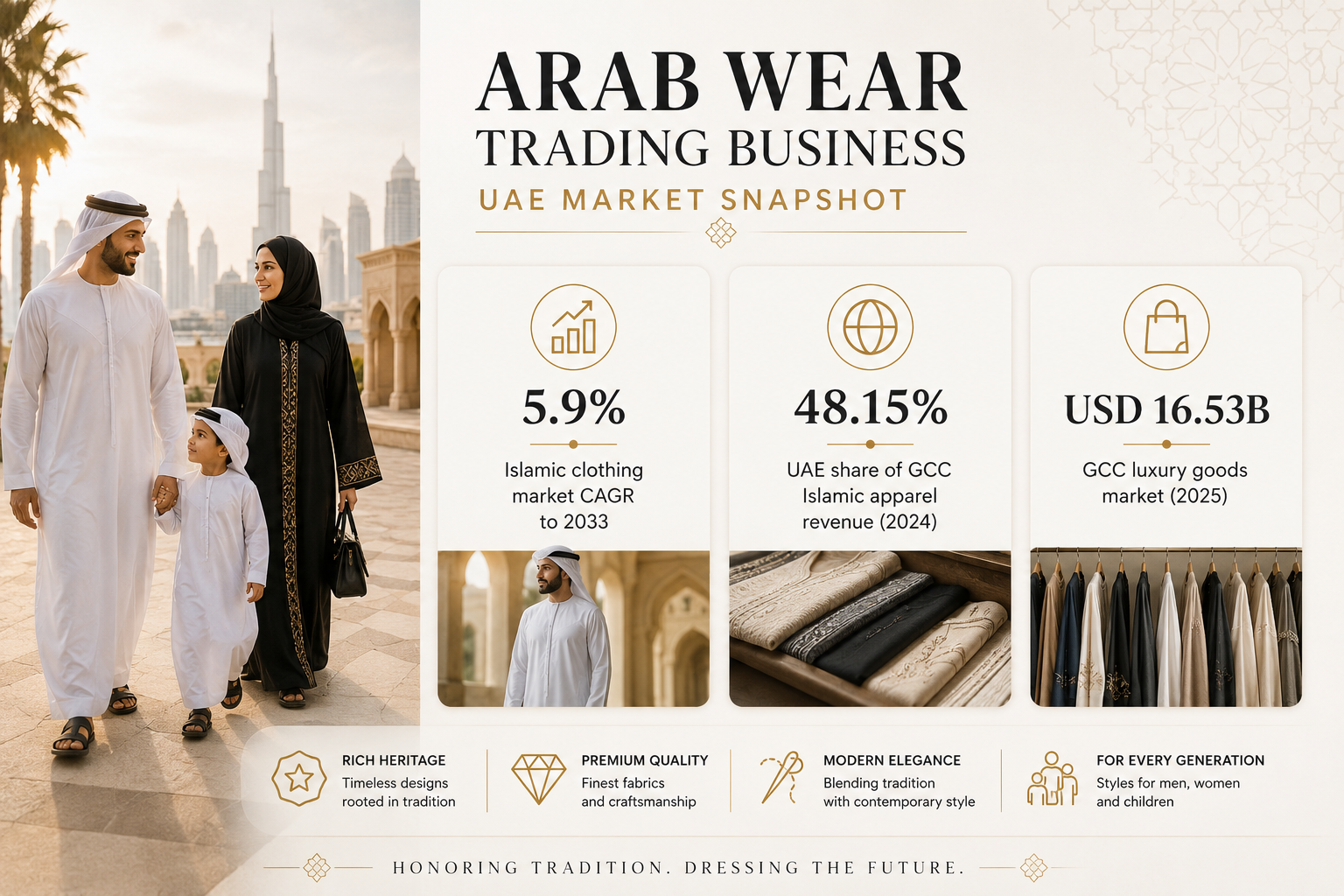
Sources: Grand View Research (2025); Mordor Intelligence (2026).
An Arab wear retailer sells traditional Gulf and Arab garments through a specialised store or showroom. Stock typically spans abayas, kanduras and thobes, bishts, kaftans and jalabiyas, sheilas and headwear, and the accessories worn with them. The buyers are mixed: Emirati and Gulf nationals choosing everyday and formal pieces, expatriate residents shopping for Ramadan and Eid, wedding parties commissioning special outfits, and tourists buying keepsakes.
Some of it is routine daily wear and some is once-a-year occasion spend, so a strong store stocks both the plain everyday pieces and the ornate occasion ones.
Walk into an abaya boutique in a Dubai mall on a Thursday evening and watch the range of reasons people are there. A regular collects two new everyday abayas. A mother and daughter choose matching Eid pieces. A groom's family orders bishts for the wedding. A visitor wants one beautiful kaftan to take home.
The staff move between off-the-rack sizing and made-to-measure, between plain black daily wear and crystal-trimmed occasion pieces, between Arabic and English. Demand swells before Ramadan, Eid, National Day, and wedding season, then holds steady the rest of the year on daily wear. In a market where the garment is both routine and ceremonial, the shops that hold customers stock the simple and the spectacular alike.
From the everyday black abaya to the embroidered Eid piece to the wedding bisht, Arab wear stores dress daily life and every big occasion in the UAE.
[blockCTATradeLicense]
Who is this for?
- Abaya and traditional wear boutiques: Operators of specialised stores retailing abayas, kanduras, and Gulf traditional garments.
- Modest fashion retailers: Businesses curating contemporary modest-wear ranges for residents and visitors.
- Occasion and bridal traditional-wear stores: Retailers focused on Eid, wedding, and formal traditional-dress collections.
Meydan Free Zone offers 100% foreign ownership, zero percent corporate tax on qualifying income, full profit repatriation, and a fully digital licensing process, providing a regulated and cost-efficient base from which to operate an Arab wear trading business in the Gulf's largest and most occasion-driven traditional-clothing market.
4771.86 - Arab Wear Trading
Under this activity, your business is licensed to retail traditional Arab and Gulf garments through specialised stores.
The activity is specifically for the retail sale of traditional Arab and Gulf garments in specialised stores. Retail sale of textiles and fabrics by the metre falls under a separate activity (4751). Manufacturing the garments and wholesale distribution to other businesses each fall under their own activities.
The line is precise. If your business retails finished traditional Arab garments to customers through a specialised store, you are in. If you sell textiles and fabrics by the metre, or manufacture or wholesale the garments rather than retail them, a different activity applies.
[blockCTABizActivityList]
Third-Party Approval: No third-party approval is required for this business activity.
Anti-Money Laundering Compliance: This business activity is exempt from AML compliance requirements.
Footnotes
1 Grand View Research. Islamic Clothing Market Size & Share Report. Grand View Research, 2025.
2 Mordor Intelligence. GCC Luxury Goods Market Size & Share Report. Mordor Intelligence, 2026.