

Table of Contents
Frequently Asked Questions
1. What is financial consultancy in the UAE?
Financial consultancy provides advisory services on cash flow, working capital, trade finance, treasury operations, financial planning, and structuring without performing SCA-regulated investment advice or fund management activities.
2. Who needs financial consultancy services in the UAE?
UAE SMEs, mid-market businesses, corporates managing trade finance and treasury operations, family businesses planning succession, and HNW or expatriate individuals seeking practical financial planning support.
3. Does financial consultancy require SCA approval?
Financial consultancy under this activity code does not require SCA approval as it covers non-securities advisory work. Securities-related advisory needs the separate SCA-regulated financial advisory activity.
4. How big is the UAE SME sector?
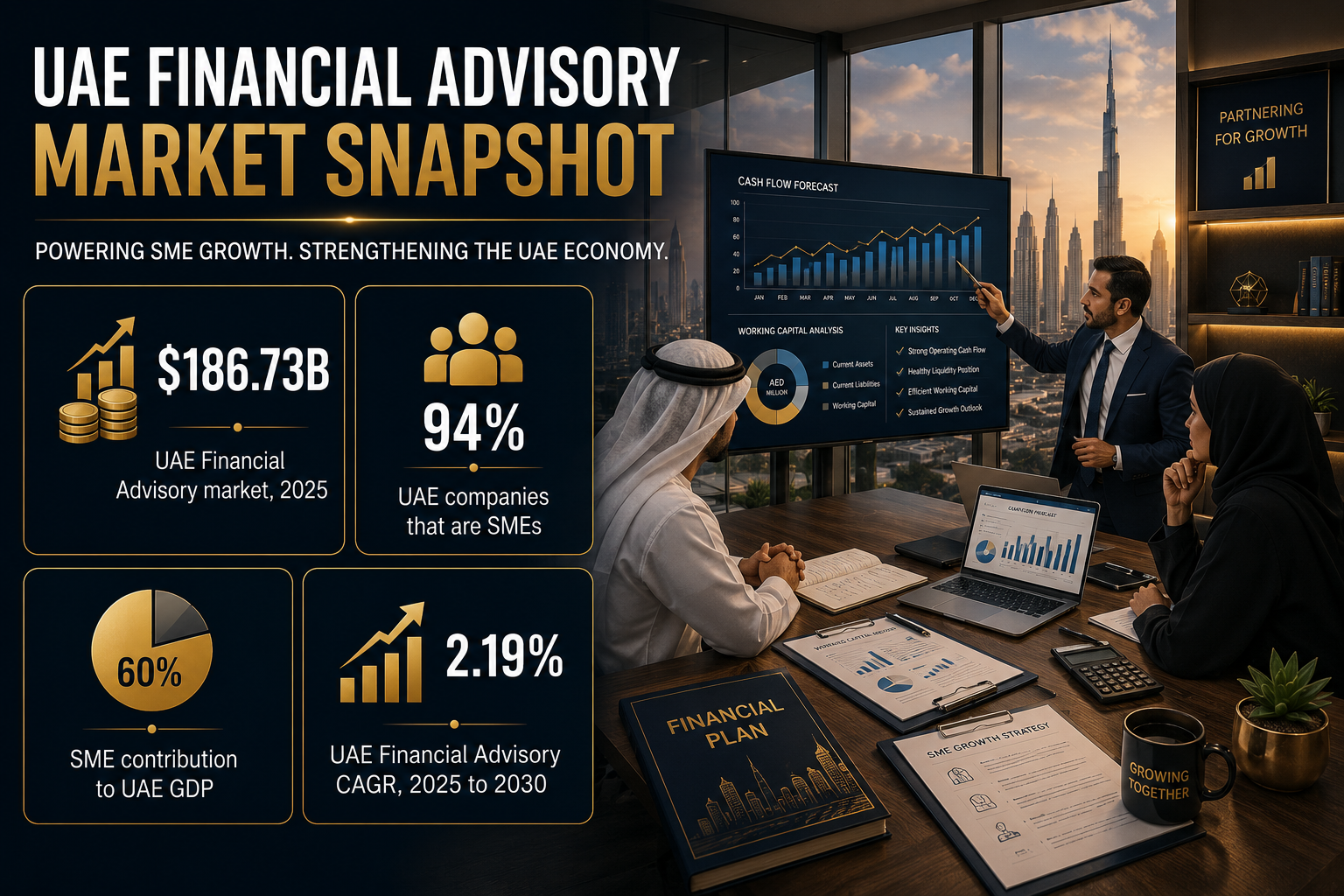
UAE SMEs represent more than 94% of UAE companies and contribute around 60% of UAE GDP per Ministry of Economy data, generating sustained demand for financial consultancy services.
5. What is the difference between financial consultancy and financial advisory?
Financial consultancy covers broader non-securities advisory (cash flow, working capital, trade finance). Financial advisory specifically covers securities recommendations and capital markets work requiring SCA pre-establishment approval.
Topic Summary
Understand Exactly What Activity Code 6619.14 Covers
This license permits practical financial consultancy including cash flow forecasting, working capital, trade finance, treasury operations, and financial planning. It does not cover securities advice, insurance broking, or fund management, so no Securities and Commodities Authority approval is required.
Target the Massive SME Market First
Small and mid-sized businesses make up more than 94% of UAE companies and contribute close to 60% of GDP, yet most run without an in-house finance team. This creates consistent demand for outsourced forecasting, working capital management, and trade finance support.
Sell Retainers, Not One-Off Reports
SME clients face recurring cash flow challenges every month, not once a year, making retainer arrangements a natural fit. These clients want practical outcomes like payroll clearing on time, not lengthy advisory documents.
Serve Corporates With Trade and Treasury Expertise
Larger clients need help structuring letters of credit, supply chain financing, foreign exchange management, and treasury operations. UAE non-oil foreign trade exceeded AED 1.7 trillion in just the first half of 2025, signaling strong ongoing demand for this work.
Choose Meydan Free Zone for Full Ownership and Tax Benefits
Meydan Free Zone offers 100% foreign ownership, zero corporate tax on qualifying income, and a fully digital remote setup process. For consultants delivering services on retainer rather than from a fixed local office, this structure offers clear practical advantages over a mainland license.
Factor In the UAE's Evolving Tax Environment
UAE corporate tax came into effect in June 2023, and VAT has been in place since 2018, creating new complexity that businesses need help navigating. Financial consultants who understand tax and VAT structuring for corporate groups add immediate, tangible value to their client base.
Enter a Growing Market With No Regulatory Gatekeeping
The UAE financial advisory market is valued at USD 186.73 billion in 2025 and is projected to grow at 2.19% annually through 2030. Because activity code 6619.14 requires no third-party regulator approval, this is one of the more straightforward financial services licenses to obtain.
How to Start a Financial Consultancy Business in Dubai with Meydan Free Zone
A business can win every contract, invoice every client on time and still come up short on payroll. The profit is real, it is just tied up: in invoices nobody has paid, in stock that has not sold, in a letter of credit that has not cleared yet.
Closing that gap is what financial consultancy does, and almost every business here needs help with it eventually. This guide covers what activity code 6619.14 permits, who buys it, and how it differs from the securities work that needs regulator approval.
Key Stats at a Glance
| Activity code | 6619.14, Financial Consultancy |
|---|---|
| What it covers | Cash flow, working capital, trade finance, treasury operations, financial planning and structuring |
| What it excludes | Activities of insurance agents and brokers, and management of investment funds |
| Third-party approval | None needed, because this covers non-securities advisory work |
| SME base | More than 94% of UAE companies and around 60% of GDP – Ministry of Economy |
| Trade flows | UAE non-oil foreign trade exceeded AED 1.7 trillion in the first half of 2025 |
| Wider market | UAE financial advisory market at USD 186.73 billion in 2025, growing 2.19% a year through 2030 – Statista |
| Tax backdrop | UAE corporate tax effective June 2023, with the VAT framework in place since 2018 |
| Anti-money laundering | This activity is exempt from AML compliance duties |
What This License Covers
Code 6619.14 licenses you to provide financial consultancy to businesses and individuals. That is practical, hands-on work: cash flow forecasting, working capital, trade finance, treasury operations, financial planning and structuring.
The important distinction is what it is not. This does not cover securities recommendations or capital markets work, which is why no approval from the Securities and Commodities Authority applies. If your model involves investment advice on securities, that is a separate activity with a pre-establishment approval attached. It also excludes insurance broking and fund management.
Who Your Clients Will Be
- Small and mid-market businesses: cash flow forecasting, working capital, business financial planning and operational efficiency
- Corporates on trade and treasury: trade finance structuring, supply chain financing, letters of credit, treasury operations and foreign exchange management
- Family businesses and individuals: succession planning and ownership structuring, plus financial planning for high-net-worth and expatriate clients and tax and VAT structuring for corporate groups
The bulk of the market is the first group. Small and mid-sized businesses are more than 94% of all UAE companies and generate close to 60% of GDP, and most of them run lean with no in-house finance team. They outsource forecasting, working capital and trade finance because there is nobody internally to do it.
That shapes how you sell. These clients do not want a report, they want next month's payroll to clear. Retainers work well here, because the problem recurs every month rather than once a year.
Mainland or Free Zone
| Factor | Mainland (DET) | Free Zone (Meydan Free Zone) |
|---|---|---|
| Third-party approval | None for this activity | None for this activity |
| Foreign ownership | Set by DET rules for the activity | 100% yours |
| Corporate tax | Standard UAE corporate tax applies | 0% on qualifying income |
| Licensing process | Apply through DET | Fully digital, remote setup possible |
| Best suited to | A visible local office serving nearby businesses | Retainer consultancy delivered on site or remotely |
Because no third-party approval applies, this is one of the simpler financial activities to license, and the jurisdiction choice comes down to how you want to reach clients rather than to regulatory gates.
Meydan Free Zone gives you full foreign ownership, no corporate tax on qualifying income and a licensing process that runs entirely online. Small business clients care whether you turn up and understand their numbers, not where your license sits. Let your clients decide it, not the price.
[blockCTACostCalculator]
Step by Step Setup Guide
- Step 1, check you are in the right code: 6619.14 covers non-securities advisory. If you plan to make securities recommendations, that is financial advisory and analysis, a separate activity needing SCA approval first.
- Step 2, decide your specialisation now: Small business consultancy, trade finance, family business structuring and tax advisory each need different credibility, and mixing all four dilutes the pitch.
- Step 3, book your trade name: Use the free company name check to confirm availability.
- Step 4, send in your setup documents: Passport copies for every shareholder and director, plus a No Objection Certificate if another employer sponsors your UAE visa.
- Step 5, collect your trade license: The process is fully digital and no third-party approval applies, so this is quick by financial-sector standards.
- Step 6, line up your accounting and tax partners: Much of this work sits next to bookkeeping and tax filing, so mAccounting is worth a look.
- Step 7, open a bank account and process visas: mResidency covers the residency side.
Compliance and What You Need in Place
Know where the line sits
Non-securities advisory is inside 6619.14. Investment recommendations on securities and capital markets work are outside it and need Securities and Commodities Authority approval under a different code. A client asking you to recommend a share is asking for something this license does not cover.
Keep clear of audit and accounting practice
Financial consultancy sits beside audit and accounting practice, not inside it. Partner with licensed firms for the work you cannot do yourself rather than stretching your own scope to keep a client happy.
Fund management is out
As with the advisory code, managing investment funds falls under fund management activities and is excluded here.
Corporate tax and VAT
UAE corporate tax took effect in June 2023 and the VAT framework has been in place since 2018. A lot of consultancy demand comes straight from those two, so keep your own knowledge current or the advice ages badly.
Anti-money laundering
This activity is exempt from AML compliance duties. That said, if you advise on trade finance and letters of credit you will be close to transactions where your clients have their own duties, so know their position as well as yours.
Market Opportunity
The client base is structural rather than fashionable. Ministry of Economy data puts small and mid-sized businesses at more than 94% of UAE companies and around 60% of GDP. Most run without a finance team, which is the whole reason this service exists.
Trade adds a second stream. UAE non-oil foreign trade exceeded AED 1.7 trillion in the first half of 2025, and every one of those shipments involves someone structuring a letter of credit, managing currency risk or financing a supply chain. That is technical work small companies cannot do in-house.
The wider market gives you the ceiling. Statista values UAE financial advisory at USD 186.73 billion in 2025, growing 2.19% a year through 2030, and ResearchAndMarkets puts wealth management AUM at USD 1.2 trillion. Add corporate tax compliance and a multi-generational family business base planning succession, and the demand arrives from four directions at once.
Conclusion
Financial consultancy under code 6619.14 is the practical end of financial services: no regulator gate, a fully digital setup, and a client base that makes up the overwhelming majority of UAE companies. Meydan Free Zone adds full ownership and no corporate tax on qualifying income.
Three things decide how smoothly this goes: a specialisation rather than a general offer, retainers instead of one-off projects, and a firm understanding of where your code stops and securities advisory begins. Sort those and the rest is routine.
[blockCTAContact]
Compliance
THIRD-PARTY APPROVAL
This activity requires pre-approval from the Capital Market Authority (CMA) before a business license can be issued by Meydan Free Zone.
ANTI-MONEY LAUNDERING COMPLIANCE
This business activity is exempt from AML compliance requirements.