Table of Contents
Topic Summary
UAE Is a Global Commodity Trading Powerhouse
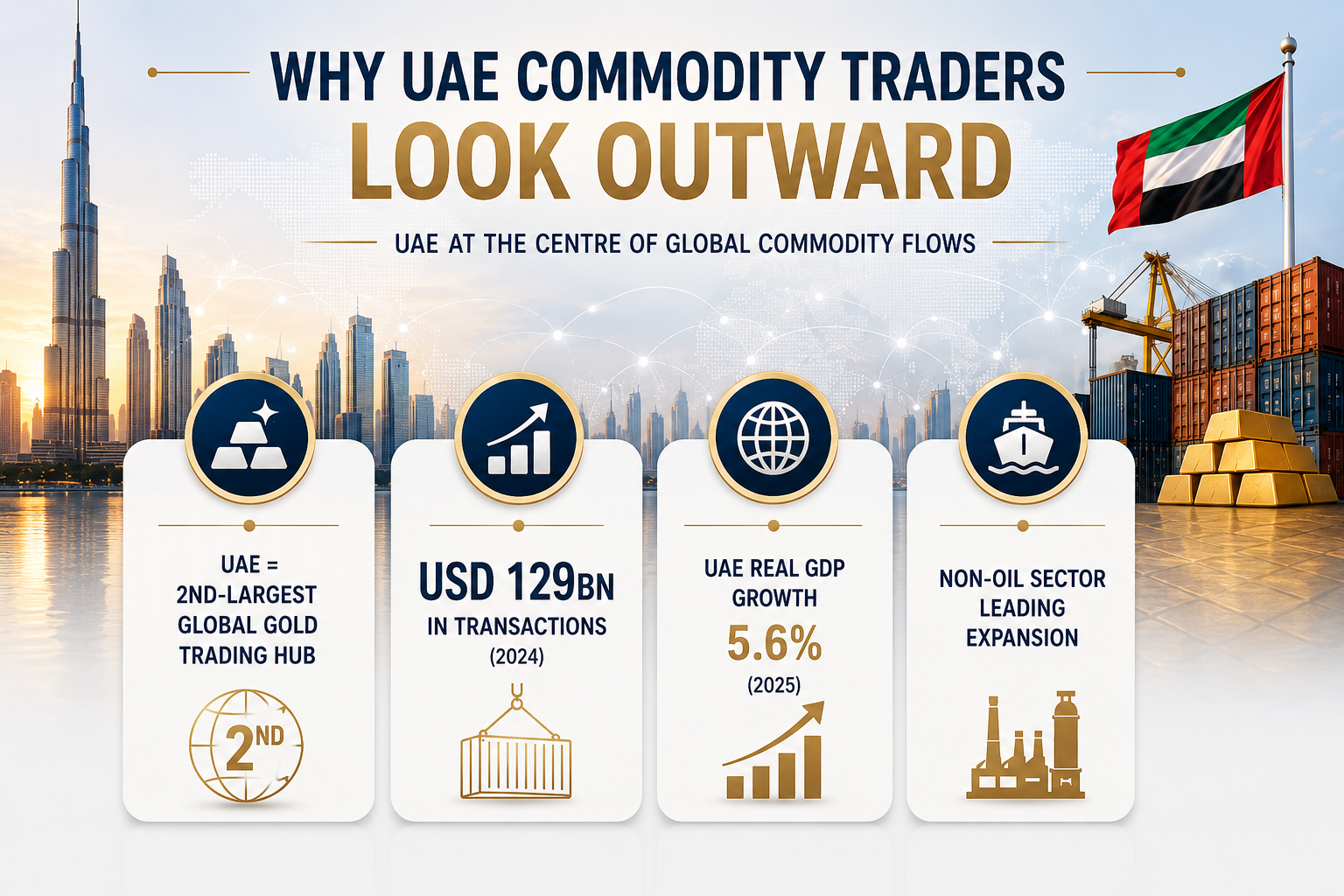
The UAE became the world's second-largest gold trading hub in 2024, handling over USD 129 billion in transactions annually. Its ports, refiners, and state energy companies create one of the most demand-rich client bases for commodity brokers anywhere in the world.
Price Risk Lives on Foreign Exchanges
Despite handling enormous physical commodity volumes, UAE traders price their risk on exchanges in London, Chicago, and New York. Licensed foreign commodities brokers are the essential link that routes UAE client orders to those distant markets.
The Securities and Commodities Authority Sets a High Bar
The SCA requires brokers to meet strict capital, segregated account, and audited compliance standards before receiving authorisation. For corporate clients hedging real exposure worth hundreds of millions, that regulatory rigour is a feature, not a burden.
Three Core Broker Types Serve Different Markets
The sector divides into energy and hydrocarbon brokers, precious and industrial metals brokers, and agricultural and soft commodity brokers. Each serves a distinct segment of UAE-based producers, refiners, and trading houses needing access to specific global exchanges.
Non-Oil Growth Keeps Widening Hedging Demand
The Central Bank of the UAE recorded 5.6 percent real GDP growth in 2025, led by non-oil sectors. As more industries expand, the pool of UAE corporates needing continuous foreign-market hedge execution grows steadily alongside them.
Meydan Free Zone Offers a Cost-Efficient Operating Base
Meydan Free Zone provides 100 percent foreign ownership, zero corporate tax on qualifying income, full profit repatriation, and a fully digital licensing process. That combination makes it a practical and regulated starting point for launching a foreign commodities brokerage in Dubai.
How to Start a Foreign Commodities Brokerage Business in Dubai with Meydan Free Zone
The UAE became the world's second-largest gold trading hub in 2024, handling more than USD 129 billion in transactions. None of those traders set prices in Dubai. They set prices on the COMEX in New York, the London Metal Exchange in London, and the Shanghai Gold Exchange in China, executing through brokers licensed to route UAE orders into foreign commodity markets.
That brokerage layer is what foreign commodities brokerage exists to provide, and the UAE's emergence as a global commodity hub has built one of the most demand-rich client bases in the world.
The UAE overtook the United Kingdom in 2024 to become the world's second-largest gold trading hub, with annual transactions exceeding USD 129 billion, according to Gulf News¹.
Behind that figure sits a dense ecosystem of UAE-based commodity participants: ADNOC and other state energy companies running multi-billion dollar oil books, jewellery houses and refiners processing precious metals at scale, and trading houses moving multi-commodity inventory through Jebel Ali Port and Khalifa Port.
The Central Bank of the UAE recorded 5.6 percent real GDP growth in 2025 with non-oil sectors leading the expansion², a backdrop that has steadily widened the population of UAE-based corporates needing continuous foreign-market hedge execution.
[blockCTAmPlus]
Why UAE Commodity Traders Look Outward
The UAE physically handles more commodity volume than most countries on the planet. The price risk on those flows, however, plays out elsewhere, on the world's deepest derivatives exchanges. Brokers licensed to access those markets are how UAE producers, refiners, and trading houses hedge their physical books.
Sources: Gulf News (2025); Central Bank of the UAE Annual Report 2025 (2025).
The Securities and Commodities Authority is the regulator that licenses brokers handling these orders. Authorisation requires capital backing, segregated client accounts, and audited compliance. The standard is high, and for a trader hedging real exposure, that is exactly the point: the major commodity exchanges only let trusted, vetted brokers execute on them.
The demand is large, and almost all of it points outward. UAE gold is shipped to more than 120 countries¹. Its oil and gas are priced against international benchmarks. The cargo moving through Jebel Ali and Khalifa Port carries price risk tied to exchanges thousands of kilometres away.
Behind that trade are corporate treasurers and trading houses managing positions worth hundreds of millions, and they need to hedge that risk on exchanges based in London, Chicago, and New York. As the UAE's non-oil economy keeps growing², that exposure spreads well beyond oil. The wider it spreads, the more brokers are needed to route those hedging orders to the right exchange, in the right time zone, at the right moment.
[blockCTAmResidency]
Who is this for?
- Energy and hydrocarbon brokers: Firms routing oil, gas, refined product, and power derivatives orders to global energy exchanges on behalf of UAE energy producers, refiners, and trading houses.
- Precious and industrial metals brokers: Operators executing UAE client orders on COMEX, the London Metal Exchange, and other global metals exchanges, serving jewellery houses, refiners, base metals processors, and commodity traders.
- Agricultural and soft commodity brokers: Brokers providing UAE clients with access to CME, ICE, and other global agricultural and soft commodity contracts for hedging food trading exposure across grains, sugar, cocoa, coffee, and cotton.
Brokers dealing in energy contracts sometimes move into physical trade, where a petrochemicals trading business in Dubai license permits handling the products directly rather than broking them.
Meydan Free Zone offers 100% foreign ownership, zero percent corporate tax on qualifying income, full profit repatriation, and a fully digital licensing process, providing a regulated and cost-efficient base from which to operate as a commodity broker serving one of the world's most active physical trade ecosystems.
6612.92 - Brokerage in Commodities Listed in Foreign Markets
Under this activity, you are licensed to execute buy and sell orders in commodity contracts listed on foreign commodity exchanges, on behalf of clients based in the UAE.
The broker connects UAE-based commodity participants with foreign futures, options, and spot commodity markets, routing orders through global counterparties, clearing brokers, and exchange infrastructure outside the UAE. Revenue is earned through commissions and execution fees on client orders, not through dealing in commodities on own account.
There are clear boundaries on this activity. Foreign commodities brokerage does not cover dealing in commodity contracts on own account, which falls under a separate financial intermediation classification. It excludes physical commodity trading, refining, storage, and logistics services, which are commercial trade activities outside the financial brokerage scope. It also excludes brokerage in shares, bonds, locally listed commodity contracts, currencies, and portfolio management services, each of which is licensed separately.
The line is precise. If your business executes client orders in commodity contracts listed on foreign exchanges, you are in. If you trade commodities physically, deal in foreign commodity contracts for your own book, or broker locally listed commodity contracts, you are not.
Third-Party Approval: Pre-approval from the Securities and Commodities Authority (SCA) is required before the trade license is issued.
Anti-Money Laundering Compliance: This business activity is exempt from UAE Anti-Money Laundering compliance requirements.
[blockCTAContact]
Footnotes
¹ Gulf News. How the UAE Became the World's Second-Largest Hub for Gold Trade. Gulf News, May 2025.