
Table of Contents
Frequently Asked Questions
What does this activity cover?
It covers the retail sale of protective and safety clothing through specialised stores, including high-visibility vests, coveralls, flame-resistant and chemical-resistant garments, and protective work wear.
Who are the typical customers?
Construction firms, oil and gas and manufacturing operators, facilities and logistics companies, and tradespeople equipping their workforce with protective clothing across the UAE.
Can the store supply bulk and branded protective wear?
Yes. Bulk supply and logoed or company-branded protective garments and vests fall within the scope of a protective garments store under this activity.
Does this activity include safety equipment like helmets or goggles?
The activity centres on protective clothing and vests. Standalone safety-equipment retail such as helmets, goggles, or respirators falls under separate classifications.
Is approval required for activity 4771.89 specifically?
No third-party approval is required for activity 4771.89. The activity is also exempt from AML compliance requirements.
Topic Summary
Tap Into a Billion-Dollar Safety Market
The Middle East personal protective equipment market was valued at USD 5.6 billion in 2024, with protective clothing making up its largest segment at 25.5 percent. Globally, industrial protective clothing topped USD 16.8 billion the same year, signaling strong and sustained demand.
Sell Gear That Is Never Optional
Protective garments are mandatory on every UAE construction, energy, and industrial worksite, making demand compliance-driven rather than discretionary. This means orders are large, regular, and tied to workforce size and safety audits rather than seasonal trends.
Stock the Right Range of Products
A protective garments and vests trader typically carries high-visibility vests and jackets, coveralls, flame-resistant clothing, chemical-resistant wear, and weather and impact protection gear. Having the correct safety rating in sufficient quantity is what wins and keeps major accounts.
Serve Business Buyers, Not Individual Shoppers
Your customers are construction firms, oil and gas operators, manufacturers, logistics companies, and facilities managers ordering in bulk to outfit entire crews. Repeat business is built in, as employers reorder whenever they hire new staff or face an upcoming inspection.
Set Up Under Activity Code 4771.89
Meydan Free Zone licenses protective garments and vests trading under activity code 4771.89, covering retail of protective and safety garments through specialised stores. This gives your business a clearly defined, regulated scope of trade from day one.
Benefit From Meydan Free Zone Advantages
Meydan Free Zone offers 100 percent foreign ownership, zero corporate tax on qualifying income, and full profit repatriation with a fully digital licensing process. These conditions make it a cost-efficient and straightforward base for launching a protective garments trading business in Dubai.
Demand Follows the Project Pipeline, Not Fashion
Orders in this sector track construction project timelines, safety compliance calendars, and workforce growth rather than consumer trends. Suppliers that consistently stock the right ratings and can fulfill repeat orders quickly are best positioned to capture long-term accounts.
How to Start a Protective Garments & Vests Trading Business in Dubai with Meydan Free Zone
Drive past any construction site in Abu Dhabi at dawn and the first thing you see is the colour. Rows of high-visibility vests catching the headlights, hard hats, coveralls zipped to the neck before the heat arrives. On every major project in the UAE, nobody steps onto site without the gear, and someone has to keep tens of thousands of workers supplied with it.
Protective garments in the UAE are mandatory kit on a workforce that builds around the clock. The Middle East market for personal protective equipment was worth USD 5.6 billion in 2024, and protective clothing is its single largest segment at 25.5 percent, according to Grand View Research1. Worldwide, the industrial protective clothing market topped USD 16.8 billion in the same year, according to Global Market Insights2.
For a trader in protective garments and vests, the appeal is simple: the gear is compulsory on every worksite, so orders tend to be large and regular, and they are never really optional.
Fawri - Instant Business License
Setup in 60 MinutesThe Safety Kits are a Necessity
Protective garments trading in the UAE serves a building, energy, and industrial workforce for whom safety clothing is a daily requirement, not a discretionary purchase.
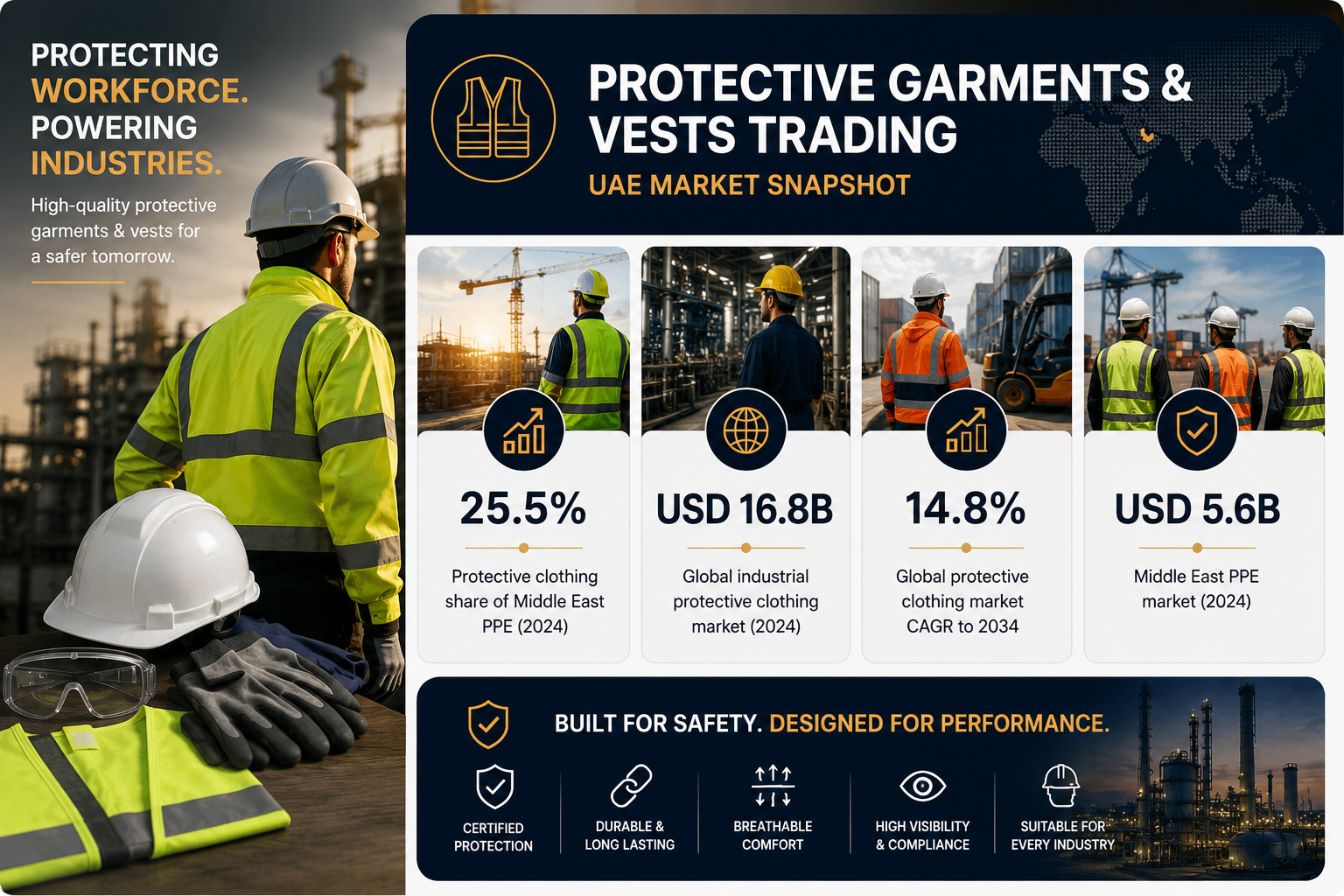
Sources: Grand View Research (2025); Global Market Insights (2025).
A protective garments and vests retailer sells safety and protective clothing through a specialised store. Stock typically spans high-visibility vests and jackets, coveralls, flame-resistant and chemical-resistant clothing, work trousers and shirts, and weather and impact protection wear. The buyers are businesses rather than individuals: construction firms outfitting site crews, oil and gas and manufacturing operators meeting safety standards, and facilities, logistics, and trades companies kitting out staff.
Orders go out by the box rather than the piece, and the same employers return every time a crew grows or the kit wears out.
Walk into a protective garments supplier in an industrial area on a weekday and the orders are rarely for one. A site supervisor collects fifty hi-vis vests in two sizes. A facilities manager replaces worn coveralls before an audit. A welder buys flame-resistant gear that meets a specific rating. The counter conversation is about standards, sizing in bulk, logos and printing for company branding, and how fast a repeat order can be filled.
Demand tracks the project pipeline and the safety calendar rather than fashion seasons, and the biggest accounts reorder whenever they hire or an inspection looms. In a market built on compliance, the suppliers that win are the ones that always have the right rating in the right quantity.
From the site induction to the pre-audit restock, protective garments stores keep the UAE's worksites dressed for the rules they run on.
Start Your UAE Company Remotely
Get in Touch NowWho is this for?
- Safety and workwear retailers: Operators of specialised stores supplying protective clothing and high-visibility wear to UAE businesses.
- Industrial and site-supply traders: Businesses serving construction, energy, and manufacturing employers with bulk protective garments.
- Specialist protective-clothing suppliers: Retailers focused on flame-resistant, chemical-resistant, and high-visibility garment ranges.
Meydan Free Zone offers 100% foreign ownership, zero percent corporate tax on qualifying income, full profit repatriation, and a fully digital licensing process, providing a regulated and cost-efficient base from which to operate a protective garments and vests trading business in a region where worksite safety clothing is mandatory and demand is built on compliance.
Your All-in-One Solutions for Business Setup in Dubai
Explore Meydan Plus4771.89 - Protective Garments & Vests Trading
Under this activity, your business is licensed to retail protective and safety garments and vests through specialised stores.
| Category | Description |
|---|---|
| Product Range | High-visibility vests and jackets, coveralls, flame-resistant and chemical-resistant clothing, work trousers, and protective wear. |
| Sourcing & Buying | Supplier sourcing, bulk and contract purchasing, range selection by safety standard, and inventory planning. |
| Supply Channels | In-store retail, bulk and corporate supply, online storefront, and delivery. |
| Store Operations | Sizing in bulk, logo printing and branding, pricing, stock management, and customer service. |
| Category | Details |
|---|---|
| Regional Market | Middle East PPE market was USD 5.6 billion in 2024¹. |
| Protective Clothing | Protective clothing was 25.5 percent of Middle East PPE in 2024¹. |
| Global Market | Global industrial protective clothing market was USD 16.8 billion in 2024². |
| Market Growth | Global protective clothing market growing at 14.8 percent CAGR to 2034². |
The activity is specifically for the retail sale of protective garments and vests in specialised stores. Retail sale of textiles and fabrics by the metre falls under a separate activity (4751). Manufacturing protective clothing and wholesale distribution to other businesses each fall under their own activities.
The line is precise. If your business retails finished protective garments and high-visibility vests to customers through a specialised store, you are in. If you sell textiles and fabrics by the metre, or manufacture or wholesale the clothing rather than retail it, a different activity applies.
Third-Party Approval: No third-party approval is required for this business activity.
Anti-Money Laundering Compliance: This business activity is exempt from AML compliance requirements.
Footnotes
1 Grand View Research. Middle East Personal Protective Equipment Market Report. Grand View Research, 2025.
2 Global Market Insights. Industrial Protective Clothing Market Report. Global Market Insights, 2025.