
Table of Contents
Frequently Asked Questions
What is activity code 7490.01 and what does it cover
Activity code 7490.01 is the official Dubai business activity classification for Translation and Interpretation Activities. It sits under ISIC Division 74 — Other Professional, Scientific and Technical Activities.
The code covers the full commercial range of language services, including
- Written document translation (legal, medical, technical, and commercial)
- Simultaneous and consecutive interpretation for conferences, courts, and negotiations
- Subtitling, transcription, and localisation services
- Language consultancy for government and corporate clients
Both individual freelancers and multi-linguist agencies operate under this single activity code. If you are charging for any of these services in Dubai, this is the licence you need.
Who needs a Translation and Interpretation Activities licence in Dubai
Anyone charging commercially for language services in Dubai requires this licence. The requirement applies to individual freelancers and full agencies alike — the activity code covers both operating models.
The client base that drives demand includes legal firms, UAE courts, government bodies, healthcare providers, media companies, and multinational corporations. All of these sectors require certified or professional language services on a recurring basis.
Operating without a formal licence carries real consequences: fines and, critically, contracts that are legally unenforceable. This makes proper licensing a commercial necessity, not just a regulatory formality.
What is the difference between setting up on the Dubai Mainland versus a Free Zone
A mainland licence issued by the Dubai Department of Economy and Tourism (DED) allows you to work directly with UAE government entities, bid on public contracts, and perform court-certified translation — often a hard requirement from legal clients. The trade-off is slightly higher setup cost and more administrative steps.
A free zone licence — such as one issued through Meydan Free Zone — offers 100% foreign ownership, faster incorporation, and lower entry costs. This route suits agencies and consultants whose clients are primarily in the private sector or international markets. You can operate remotely, hold a virtual office, and scale visa allocation as your team grows.
The UAE Government Portal outlines the distinction between mainland and free zone operating permissions in more detail. Your choice of jurisdiction shapes cost, client eligibility, visa quota, and regulatory obligations.
Is there a minimum share capital requirement for this licence
For most free zone setups, there is no mandatory minimum share capital requirement when applying for a Translation and Interpretation Activities licence under code 7490.01.
This makes the free zone route particularly accessible for individual practitioners and early-stage agencies looking to minimise upfront capital commitments while still operating legally and professionally in Dubai.
Mainland setups may carry different financial requirements depending on the specific structure chosen. It is advisable to confirm current requirements with the Dubai Department of Economy and Tourism (DED) or a licensed business setup adviser before proceeding.
Does a translation licence in Dubai allow you to sponsor employee visas
Yes. A Translation and Interpretation Activities licence is visa-eligible, covering both investor visas and employee visas. This applies whether you set up on the mainland or in a free zone.
If you intend to hire staff locally, MOHRE (Ministry of Human Resources and Emiratisation) registration is mandatory regardless of which jurisdiction you choose. This is a separate step from obtaining the trade licence itself.
Free zone licences typically allow you to scale your visa allocation as your team grows, which makes them a flexible option for agencies planning to expand headcount over time.
What additional accreditation is needed for legal translation work in UAE courts
Holding a trade licence under activity code 7490.01 is not sufficient on its own for court-facing legal translation. Ministry of Justice accreditation is a separate credential required for legal translation work accepted by UAE courts — this is distinct from the commercial trade licence.
This distinction matters significantly for practitioners targeting legal clients. Law firms and court proceedings often treat Ministry of Justice accreditation as a hard requirement, meaning unaccredited translators may be excluded from this segment of the market regardless of their language proficiency.
If court-certified translation is a core part of your intended business, pursuing Ministry of Justice accreditation alongside your trade licence should be planned from the outset.
Could translation work involving cultural or media content require additional approvals in Dubai
Yes. Certain content-related language activities — particularly those touching cultural production, media, or the arts — may fall under the remit of the Dubai Culture and Arts Authority in addition to the standard trade licence.
If your translation or localisation work intersects with publishing, cultural content, or creative media in Arabic, it is worth confirming whether additional approvals or registrations apply before commencing operations.
This is especially relevant for agencies offering Arabic localisation of creative or editorial content, where the regulatory boundary between commercial language services and cultural production can overlap.
How large is the market opportunity for translation and interpretation services
The commercial opportunity is substantial. The global language services market is projected to exceed USD 98 billion by 2030, according to Mordor Intelligence's Language Services Market Global Forecast.
In Dubai specifically, demand is structural rather than cyclical. With over 200 nationalities resident in the emirate and a legal and commercial ecosystem operating across Arabic, English, and dozens of other languages, the need for qualified language services is built into the fabric of how business and government function in the city.
Dubai's role as a global hub for trade, law, and diplomacy means translation and interpretation is consistently ranked among the most commercially viable professional services licences available in the UAE.
Translation and Interpretation Activities License in Dubai
Dubai runs on more than 200 nationalities and a legal system that works in Arabic. Every contract, court filing, medical report and product label that crosses a language line needs someone to move it across properly.
Activity code 7490.01 licenses that work. This guide covers what the code includes, who buys language services here, how mainland and free zone setup compare, the steps to get licensed, and the one accreditation that decides whether courts will accept your work.
Key Stats at a Glance
| Activity code | 7490.01 |
|---|---|
| Activity name | Translation and Interpretation Activities |
| ISIC group | Division 74, other professional, scientific and technical activities |
| License type | Professional service |
| Where you can set up | Dubai mainland through DET, or Meydan Free Zone |
| Paid-up capital | No minimum for most free zone setups |
| Setup time | 3 to 7 working days in a free zone, 5 to 10 working days on the mainland |
| Free zone fees | From AED 12,000 to AED 18,000 a year, including license and one investor visa |
| VAT threshold | AED 375,000 taxable turnover a year – Federal Tax Authority |
| Market size | Global language services set to pass USD 98 billion by 2030 – Mordor Intelligence |
What This License Covers

Code 7490.01 sits in ISIC Division 74 and covers language services sold commercially.
- Document translation, covering legal, medical, technical and commercial work
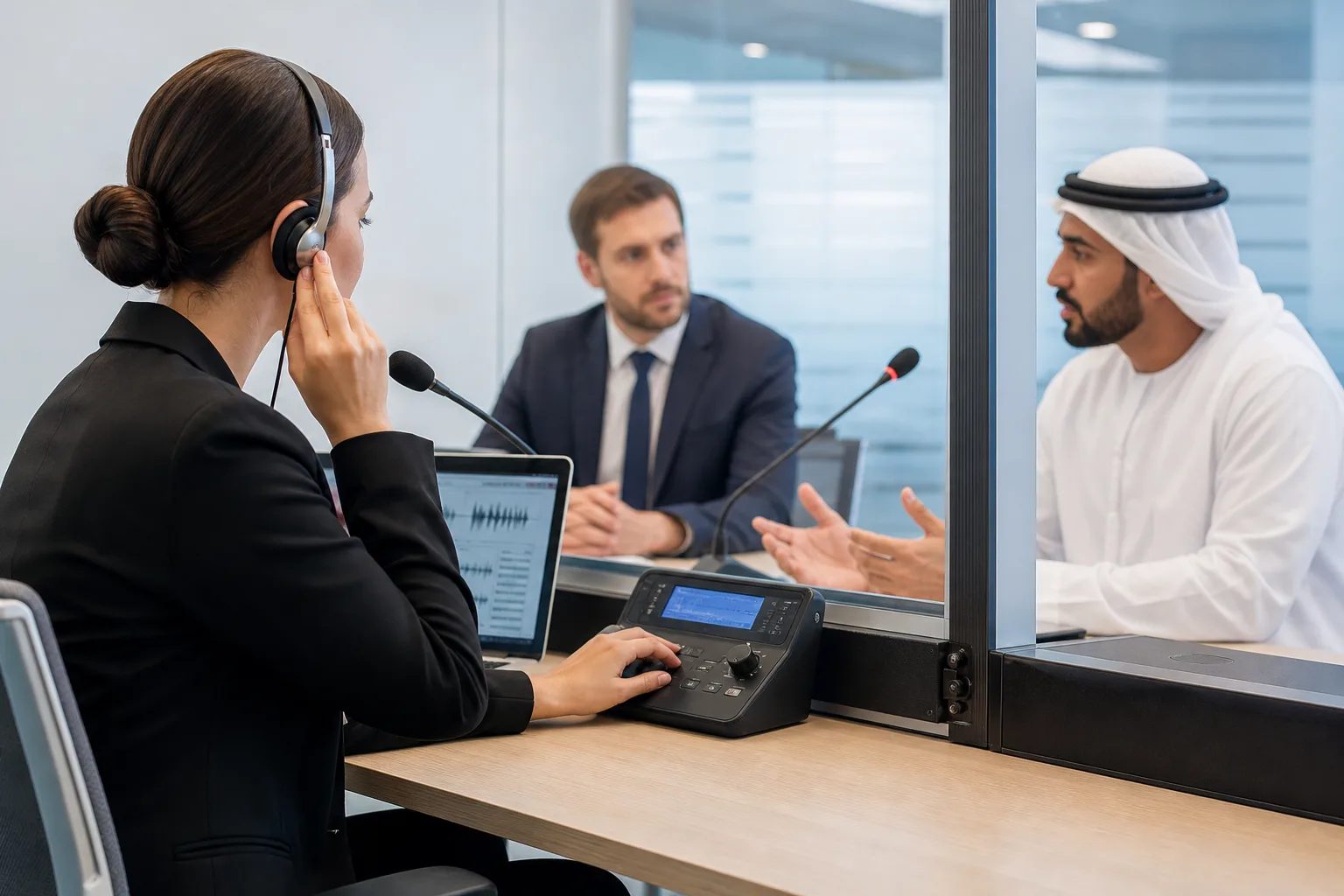
- Simultaneous and consecutive interpretation for conferences, courts and negotiations
- Subtitling, transcription and localisation
- Language consultancy for government and corporate clients
One code covers both a solo practitioner and a multi-linguist agency, so you do not need a different license as you grow.
Why the license is not optional
Charge for any of this in Dubai and you need the license. Working without one risks fines, and worse than that, it makes your contracts legally unenforceable. A client who does not have to pay you often will not.
Content that touches culture and media
Localisation work in publishing, cultural content or creative media in Arabic can fall under the Dubai Culture and Arts Authority as well as your trade license. Check before you take that kind of work rather than after.
Who Your Clients Will Be
Legal firms and the courts
The highest-value segment and the hardest to enter, because it needs accreditation on top of your license. Steady, document-heavy work once you are in.
Government bodies
Public sector translation is contract work, and mainland licensing usually comes first.
Healthcare providers
Patient records, consent forms and reports, where accuracy is not negotiable and the liability is real.
Media companies
Subtitling, transcription and localisation, often at volume and to tight deadlines.
Multinational corporations
Contracts, compliance documents and internal material, usually on a retainer once they trust you.
All five buy repeatedly rather than once, which is what makes this a business rather than a series of jobs.
Mainland or Free Zone
| Factor | Mainland (DET) | Free Zone (Meydan Free Zone) |
|---|---|---|
| Who you can serve | Government bodies, public tenders, court work | Private sector and international clients |
| Foreign ownership | Set by DET rules for the activity | 100% yours |
| Office | Physical premises, higher setup cost | Flexi-desk or virtual office |
| Setup time | 5 to 10 working days | 3 to 7 working days |
| First-year cost | Around AED 15,000 to AED 25,000 | From AED 12,000 to AED 18,000 |
When mainland earns its cost
A mainland license from the Dubai Department of Economy and Tourism (DET) lets you work directly with UAE government entities, bid for public contracts and take court-certified translation work. Legal clients often treat that as a hard condition. Note that sole establishments on the mainland also carry local service agent fees.
When a free zone is the better start
A Meydan Free Zone license gives full ownership, quicker setup and lower entry costs. It suits an agency or consultant serving private sector and international clients. You can run it remotely, hold a virtual office, and add visas as the team grows. Most free zone licenses can be set up without ever visiting Dubai.
Let your clients decide it, not the price. If the courts are your market, you already know the answer.
[blockCTACostCalculator]
Step by Step Setup Guide
- Step 1, set your scope and jurisdiction: Court and government work points to mainland through DET. Private sector and international clients point to Meydan Free Zone, which is faster and cheaper.
- Step 2, book your trade name: Check availability through the DET portal for mainland, or your free zone platform.
- Step 3, send in your documents: Passport copies, current visa status, an NOC if you are employed, and a basic business plan for free zone applications.
- Step 4, get initial approval and pick your office format: Flexi-desk, virtual office or physical space. Most translation businesses start with a flexi-desk, because there is no operational reason to take space until the team needs it.
- Step 5, pay the fees and collect the license: Allow 3 to 7 working days in a free zone, or 5 to 10 on the mainland, longer where outside approvals apply.
- Step 6, apply for visas and open a bank account: The investor visa is available once the license is issued. Allow 2 to 4 weeks for the bank, depending on the institution.
- Step 7, register with MOHRE before hiring: This applies wherever you set up, and it comes before your first employment contract.
Compliance and What You Need in Place
Ministry of Justice accreditation
This is the single most important thing on the page. Your trade license does not qualify you for legal translation accepted by UAE courts. That takes separate Ministry of Justice accreditation, including a competency assessment. Law firms and courts treat it as a hard condition, so an unaccredited translator is shut out of that segment however good their languages are. If court work is part of the plan, start the accreditation alongside the license rather than later.
No dedicated sector regulator otherwise
For general translation and interpretation there is no specialist regulator. DET or your free zone authority is the licensing body, which keeps the rest of the compliance load light.
Cultural and media content
Work touching publishing, cultural content or creative media in Arabic may need clearance from the Dubai Culture and Arts Authority.
VAT
Register once yearly taxable turnover passes AED 375,000, then file returns quarterly. Retainer clients push agencies over that line quickly.
Staff and visas
MOHRE registration is a must if you hire locally. Visa quota follows office size, with a flexi-desk package typically supporting one to six visas. Model your headcount against the quota before you choose a package, because upgrading later costs money.
Yearly upkeep
License renewal, Emirates ID renewal for each visa holder, and VAT filing. None of it is heavy, but all of it is dated.
Market Opportunity
The global language services market is projected to pass USD 98 billion by 2030 on Mordor Intelligence figures. That is the backdrop. The local picture is stronger than the global one.
Demand here is structural rather than cyclical. With more than 200 nationalities resident and business conducted across Arabic, English and dozens of other languages, translation is not a service Dubai occasionally needs. It is built into how the city's commerce, courts and government function.
The city's role in trade, law and diplomacy adds a layer on top. Conferences need interpreters, disputes need certified documents, and companies entering the market need everything localised before they can sell. That mix is why this activity consistently ranks among the more commercially sound professional licenses in the UAE.
Conclusion
Translation and interpretation is one of the simpler professional licenses to get in Dubai, and one of the easier businesses to start small. A free zone route gets you trading in days for a modest fee. A mainland license opens government and court work.
The decision that shapes everything is jurisdiction, and behind it the question of whether you want court-certified work. If you do, Ministry of Justice accreditation belongs in your plan from day one.
Get those two right and the rest of the process is paperwork.
[blockCTAContact]