Table of Contents
Frequently Asked Questions
1. What are the most common reasons a free zone application gets delayed or rejected?
The most common reasons are incomplete or inconsistent documents, the wrong business activity, trade name issues, missing regulatory approvals, unclear UBO or KYC details, and submission errors. In most cases, the problem is not the business idea itself, but gaps in the application file.
2. Can choosing the wrong business activity delay license approval?
Yes. The selected business activity determines the license scope, compliance requirements, and whether additional approvals are needed. If it doesn't match what the business actually does, the application can be delayed or sent back for clarification before the trade license is issued.
3. Can a trade name cause a free zone application to be rejected?
Yes. A trade name can create friction if it is too generic, too vague, already taken, uses unclear abbreviations or symbols, or does not align with the licensed activity or legal structure. Trade name issues are one of the most common avoidable causes of delay. The Company Name Check tool screens for compliance and red flags before submission.
4. Do some business activities require external approvals?
Yes. Some activities need clearance from sector-specific regulators before the license can move forward. This usually becomes a problem when the approval requirement is identified too late or when the regulator-facing documents are incomplete.
5. Can KYC or source-of-funds issues affect both licensing and banking?
Yes. If beneficial ownership is unclear, founder roles are inconsistent, or source-of-funds and KYC documents are weak, the application may face additional review. Even if the license proceeds, these issues can still create problems later during bank account opening.
6. How can founders reduce the risk of application delay before submission?
The best way is to pressure-test the file before submitting it. The best part? Meydan Free Zone does this for you. That means checking whether the business activity matches the real model, whether the trade name and legal structure align, whether all documents are current and consistent, and whether any approval, KYC, or source-of-funds requirements will all be addressed before submission.
7. What is mCore Bank Account Assistance, and how much does it cost?
mCore Bank Account Assistance supports founders with the bank account opening process in the UAE by helping them choose a suitable bank, initiate an application with one or more banks, and schedule an appointment with a bank relationship manager. The service fee is AED 1,500, with a timeline of one business day. Final account opening remains subject to the bank's own approval.
Topic Summary
1. Incomplete or Incorrect Documentation
Ensure all required documents are accurate, up-to-date, and properly scanned before submission. Double-check document lists provided by the free zone authority to avoid missing any essentials.
2. Mismatch Between Business Activities and License Type
Carefully select business activities that align with the license category chosen. Consult with the free zone authority or a professional advisor to confirm your activities fit the license requirements.
3. Failure to Meet Compliance and Regulatory Requirements
Stay informed about the latest compliance rules specific to the free zone. Provide any additional certifications or approvals promptly when requested by authorities during the application review.
4. Inaccurate or Inconsistent Information
Ensure that personal, shareholder, and company information is consistent across all forms and documents. Cross-verify details such as names, addresses, and contact information.
5. Delays in Responding to Authority Queries
Respond quickly and comprehensively to any requests for further information or clarification from the licensing authority. Timely communication can prevent unnecessary delays in the approval process.
Common Reasons Dubai's Free Zone Applications Get Delayed or Rejected and How To Avoid Them
Setting up a company follows a clear process: select your business activities, upload the required documents, submit the application, and proceed to license issuance. During review, authorities may occasionally request additional information or clarification.
Many founders underestimate how precise that preparation needs to be. It happens more often than most founders expect. Approximately 23% of initial license applications in Dubai face rejection or significant delays, often for reasons that could have been avoided before submission.
Incomplete or inconsistent documents remain one of the most common causes, alongside activity mismatches, trade name issues, and missing approvals. And the cost is not just time, a rejected application typically costs businesses between AED 5,000 and AED 15,000 in lost deposits, consultant fees, and opportunity costs.
The pressure to get it right the first time has only intensified as Dubai opens up. The emirate attracted 1,117 greenfield FDI projects worth AED 52.3 billion in 2024, a 33.2% year-on-year jump and a single-year record¹, retaining the global top spot for greenfield FDI for the fourth consecutive year.
At the same time, Executive Council Resolution No. 11 of 2025 now lets free zone companies operate in mainland Dubai under a DET licence or permit, with cross-jurisdiction activity projected to rise 15 to 20% in the first year². With more capital flowing in and broader operating scope on the table, the difference between a clean approval and a costly rework has rarely been bigger.
For founders ready to move, that friction can be frustrating. The business model is clear, the trade name feels right, and the goal is a clean, fast launch, not weeks spent correcting preventable errors.
Understanding why documentation and KYC requirements feel more demanding today requires a brief look at what changed across the industry.
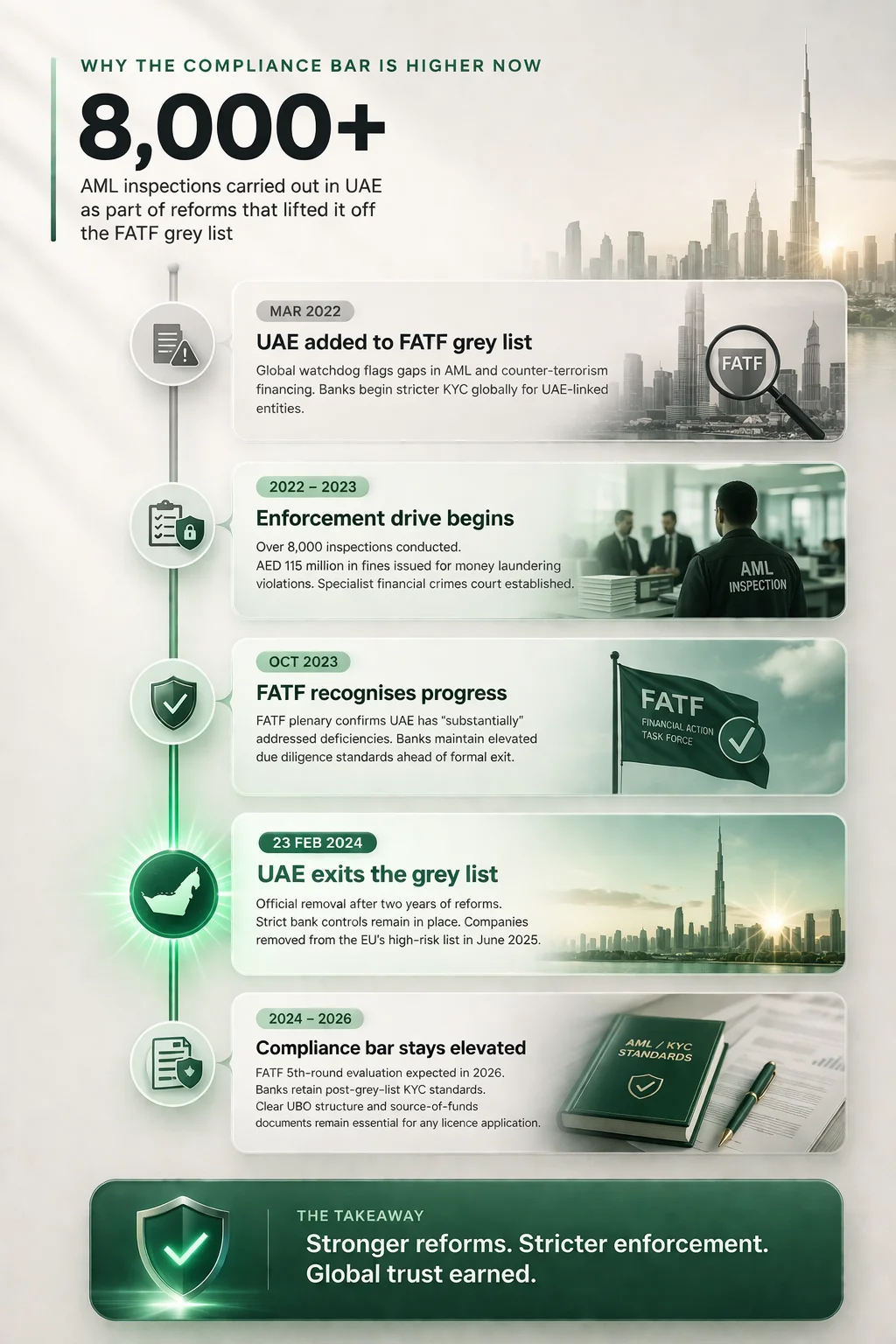
Sources: Norton Rose Fulbright · Khaleej Times · AML UAE
Understanding the common Meydan Free Zone license rejection reasons upfront makes all the difference. The setup process is fully digital, and Meydan Free Zone consultants guide founders through every step, from business activity selection to document submission and tax guidance, so mistakes get caught before they cause delays.
[blockCTACostCalculator]
Free Zone Application Rejection Reasons at a Glance
Incomplete or Inconsistent Documentation in Meydan Free Zone Applications
Most application friction starts with documentation, not strategy.
A file can look straightforward and still slow down if the supporting documents are incomplete, outdated, unclear, or inconsistent with the ownership structure or business profile.
Applications usually slow down when:
- passport copies are unclear, expired, or inconsistent across documents
- proof of address is missing or outdated
- shareholder or manager details do not match the supporting records
- visa status or residency-related documents are left out where needed
- source of funds documentation is required but not ready
Submission of incomplete, outdated, or incorrectly completed forms does not just slow licensing; it can also affect downstream processes like banking and visa applications.
The fix is simple in theory and easy to mishandle in practice: treat the application pack like a review file, not a casual upload folder. At Meydan Free Zone, consultants review every submission upfront, flagging gaps early, and making sure the file passes both the licensing and banking lens without delay.
[blockCTANameCheck]
How Business Activity Selection Affects Meydan Free Zone License Approval
This is one of the most common reasons applications get delayed.
Your selected business activity does more than describe what your company does. It determines whether the proposed operations fall within the permitted regulatory scope of the license.
Applications are typically delayed when:
- The selected business activity does not align with the real operating model
- A founder assumes one broad activity automatically covers specialised services
- Required supporting documentation for a regulated activity is missing
- Different business activity types are grouped together without clear operational logic or approvals
For example, selecting a consulting business activity while describing product-based trading operations creates a mismatch at review stage. That inconsistency can trigger clarification requests or require revision before the trade license is issued.
Meydan Free Zone consultants sit down with each founder, understand the business model, and recommend the business activity or mix of business activities that aligns with UAE compliance and long-term goals. With over 2,500 business activities available, the team makes sure the selection reflects what the business actually does, so the file does not get flagged before it even reaches review.
Trade Name and Legal Structure Issues That Delay Free Zone Licenses
Legal structure ties directly to tax position, liability, and equity logic. A trade name review is part of avoiding licensing delay or rejection. A strong name or simple structure on paper can still create friction if it does not align properly with the file being submitted, and UAE authorities have tightened vetting processes, with immediate rejections now common for restricted terms, formatting issues, or names that are too generic.
Trade name or structure friction usually appears when:
- the proposed name is too generic, too vague, or already taken
- initials, abbreviations, or symbols make the name unclear
- the name does not align with the licensed activity or setup model
- the legal structure does not match the ownership plan or intended scale
Meydan Free Zone’s Company Name Check tool screens for UAE compliance, global red flags, and anything that might trigger a licensing delay, with instant results. Once confirmed, founders can secure a Name Reservation certificate and move forward with confidence.
[blockExpertOpinion]
External Regulatory Approvals That Hold Up Meydan Free Zone License Applications
Some applications are delayed not because the founder made an obvious mistake, but because the business activity sits closer to a regulated edge than expected.
If the approval pathway is identified too late, the file can stall even when everything else is ready. The challenge is usually not the existence of regulation; it is discovering it after submission rather than before.
For example:
- Healthcare and wellness activities - such as activity code 8610.00 (Hospital Activities) require clearance from the Dubai Health Authority (DHA)
- Food and beverage operations - such as activity code 5610.02 (Cafeterias) need Dubai Municipality approval through the Food Safety Department
The usual friction points are:
- the activity requires external clearance from a federal or sector-specific regulator
- the approval path is discovered late in the process
- regulator-facing documents are incomplete or formatted incorrectly
- the founder assumes the trade license itself replaces sector-specific approval
The cleaner move is to stress-test the activity early and identify any external dependencies before the file enters review.
Meydan Free Zone guides founders on regulator mapping from the start, so you always know who owns the final approval, which business activities to choose from over 2,500 options, what documentation each regulator expects, and how to coordinate approval requirements before going live.
[blockCTAFawri]
KYC and Banking Readiness Issues That Lead to Free Zone Application Delays
A company application is not only assessed for incorporation. It also needs to hold up from a compliance and banking-readiness perspective. The UAE exited the FATF grey list in February 2024, but banks have maintained strict controls to stay aligned with international expectations, and in 2024 alone, the UAE Central Bank imposed AED 2.62 million in financial sanctions tied to compliance gaps.
Applications often face extra review or struggle to secure a bank account after licensing when:
- beneficial ownership is unclear or inconsistent across documents
- founder roles do not match across the file
- source-of-funds or source-of-wealth documentation is weak
- KYC documentation is incomplete or formatted incorrectly
- the ownership structure is more complex than the chosen setup route allows
- The licensed business activity is too broad or vague for banks to assess risk clearly
Business activity selection matters more than most founders realise.
Trade licenses with specific business activities like "wholesale trading of electronics" or "retail trading of cosmetics" are easier for banks to review than vague ones. If a founder selects "general trading" when the business actually imports and resells a specific product category, banks may flag the mismatch because of the higher perceived risk from an undefined scope, and that ambiguity slows things down.
The same logic applies to ownership. If the UBO structure, shareholder roles, or source of funds aren't consistent across every document, banks will ask questions or decline to proceed.
With Meydan Free Zone, the team preps all documents exactly the way banks need them: World-Check screening, verified source of wealth, a transparent UBO chart, and clean KYC documentation. And through the mCore Bank Account Assistance service, Meydan Free Zone helps organise your file, sends it to multiple partnered banks, and schedules appointments on your behalf, so you're not chasing banks one by one.
The result? A guaranteed IBAN pathway.
Submission and Payment Errors in Meydan Free Zone Applications
Application, approval, payment, and issuance are connected steps; a file that is nearly complete is not the same as a file that is review-ready.
Avoidable friction often comes from:
- documents uploaded in the wrong format
- steps completed out of sequence
- payment not finalised before the file moves forward
- founders assuming submission equals approval before review is complete
At Meydan Free Zone, everything is handled through a secure digital portal, from application to activation. Before the license is issued, the team double-checks that what appears on the license matches your documents, selected activities, and public-facing information, avoiding mismatches that can create friction later with banks, immigration, or third-party platforms.
Pre-Submission Checklist to Avoid Meydan Free Zone License Rejection
Most application friction is preventable if founders pressure-test the file before it enters review.
A practical pre-submission check covers the questions that actually matter:
- Does the selected activity match what the business will really do and how banks will assess it?
- Does the activity affect visa plans, compliance requirements, or third-party approvals?
- Does the legal structure match the ownership plan and future growth model?
- Is the trade name compliant, clear, and aligned with the business?
- Are all identity, address, and residency documents current and consistent?
- Are UBO, KYC, and source-of-funds details clear enough to withstand bank-level scrutiny?
- Will the business license details align cleanly with the next steps after issuance, including banking, immigration, and platform onboarding?
Meydan Free Zone business consultants walk founders through this process before submission, so the file that enters review is the file that gets approved.
[blockCTATradeLicense]
In Conclusion
The difference between a smooth launch and weeks of back-and-forth often comes down to what happens before you click submit.
Most rejections are not caused by complex regulatory issues; they stem from mismatched business activities, unclear ownership details, inconsistent documents, or trade names that do not pass compliance checks. These are fixable problems, but only if they are caught early.
Meydan Free Zone builds that review into the process from the start. Every file is stress-tested against the same criteria that licensing authorities and banks use, so founders move forward with confidence, not corrections.
Book a consultation with a setup advisor or use the cost calculator to see your full cost upfront.
Citations
¹ Townsend, Sarah. Dubai Issues New Regulation for Free Zone Companies. The National, 2025.
² Varghese, Justin. New Free Zone Mainland Operating Permit to Grow Dubai Businesses. Gulf News, 2025.
³ Norton Rose Fulbright. UAE Removed from the FATF Grey List. Norton Rose Fulbright, 2024.
⁴ AJMS Global. UAE Central Bank Imposes Over Dh18 Million Fine Against Foreign Bank Branches. AJMS Global, 2024.