Table of Contents
Frequently Asked Questions
1. What is a company merger under UAE law?
A merger is a legal process where two or more companies combine into one entity. Under Federal Decree-Law No. 32 of 2021, the merged company ceases to exist, and the surviving or new entity inherits all assets, liabilities, rights, and obligations.
2. When does a UAE merger require a competition filing?
Under Cabinet Decision No. 3 of 2025, a filing may be required if the companies' combined annual sales in the UAE exceed AED 300 million or if their combined market share exceeds 40% in the relevant market.
3. What documents do founders need before merging companies in the UAE?
Founders typically need constitutional documents, commercial licenses, shareholder approvals, a merger plan, audited financials, schedules of assets and liabilities, bank and creditor mapping, and any sector-specific approvals required by the relevant authority.
4. Do creditors have objection rights during a UAE merger?
Yes. Creditors must be notified within 10 working days of the merger approval and may object within 30 days. If a valid objection is not resolved, the creditor can ask the court to stay the merger until the claim is settled or secured.
5. Does Business Restructuring Relief apply to free zone mergers?
Not automatically. Under UAE corporate tax rules, neither party can be an exempt person or Qualifying Free Zone Person for the relief to apply. If one company qualifies as a QFZP, structuring advice is essential before proceeding.
6. Can companies in different UAE jurisdictions merge?
Yes, but it's more complex. Companies under different authorities may need to convert structures, transfer licenses, or align regulatory approvals before a legal merger can proceed. Identifying the jurisdictional path early simplifies the process.
Topic Summary
1. Definition of a Merger
A company merger under UAE law refers to the combination of two or more businesses into a single legal entity. This typically involves one company being absorbed by another or multiple companies uniting to form a new corporate structure.
2. Legal Framework
The process and implications of mergers are governed primarily by the UAE Commercial Companies Law, which outlines the procedures for mergers and the resulting legal consequences.
3. Formal Transfer of Rights and Obligations
A merger is more than just operational integration; it entails a formal and legal transfer of all rights, liabilities, assets, and obligations from the merging companies to the surviving or newly established company.
4. Cessation of Merged Entities
Upon completion of the merger, the companies involved in the merger cease to exist as separate legal entities. The surviving company or newly created company assumes all legal responsibilities and ownership rights.
5. Legal and Corporate Continuity
The surviving or new company continues business operations seamlessly under the UAE Commercial Companies Law, maintaining continuity of contracts, licences, permits, and employee rights post-merger.
Merging Two Companies in the UAE: Legal Process, Requirements, and Key Considerations
Two companies merged into one structure. That's the goal, but the path to get there involves more legal groundwork than most founders expect.
According to Global Legal Insights¹, the UAE recorded 130 M&A deals worth a combined USD 11.68 billion. By Q1 2025, EY² reported that the UAE had emerged as the top target country in MENA, with 63 deals totalling USD 20.3 billion. Merger activity is accelerating, driven by economic diversification, regulatory reform, and a growing appetite for consolidation across sectors.
But merging two companies in the UAE isn't just a commercial decision. It's a regulated legal process governed by Federal Decree-Law No. 32 of 2021 (the Commercial Companies Law), with additional oversight from the Ministry of Economy under the UAE's competition framework. Get the structure wrong or miss a filing threshold, and the transaction can stall, attract penalties, or be unwound entirely.
This guide breaks down what it actually takes to merge two companies in the UAE: the legal framework, the types of merger available, the approval process, creditor rights, and what founders and business owners need to prepare before moving forward.
Beyond the headline figures in EY's MENA M&A Insights 2025 report, one statistic captures just how concentrated regional dealmaking has become around the UAE.
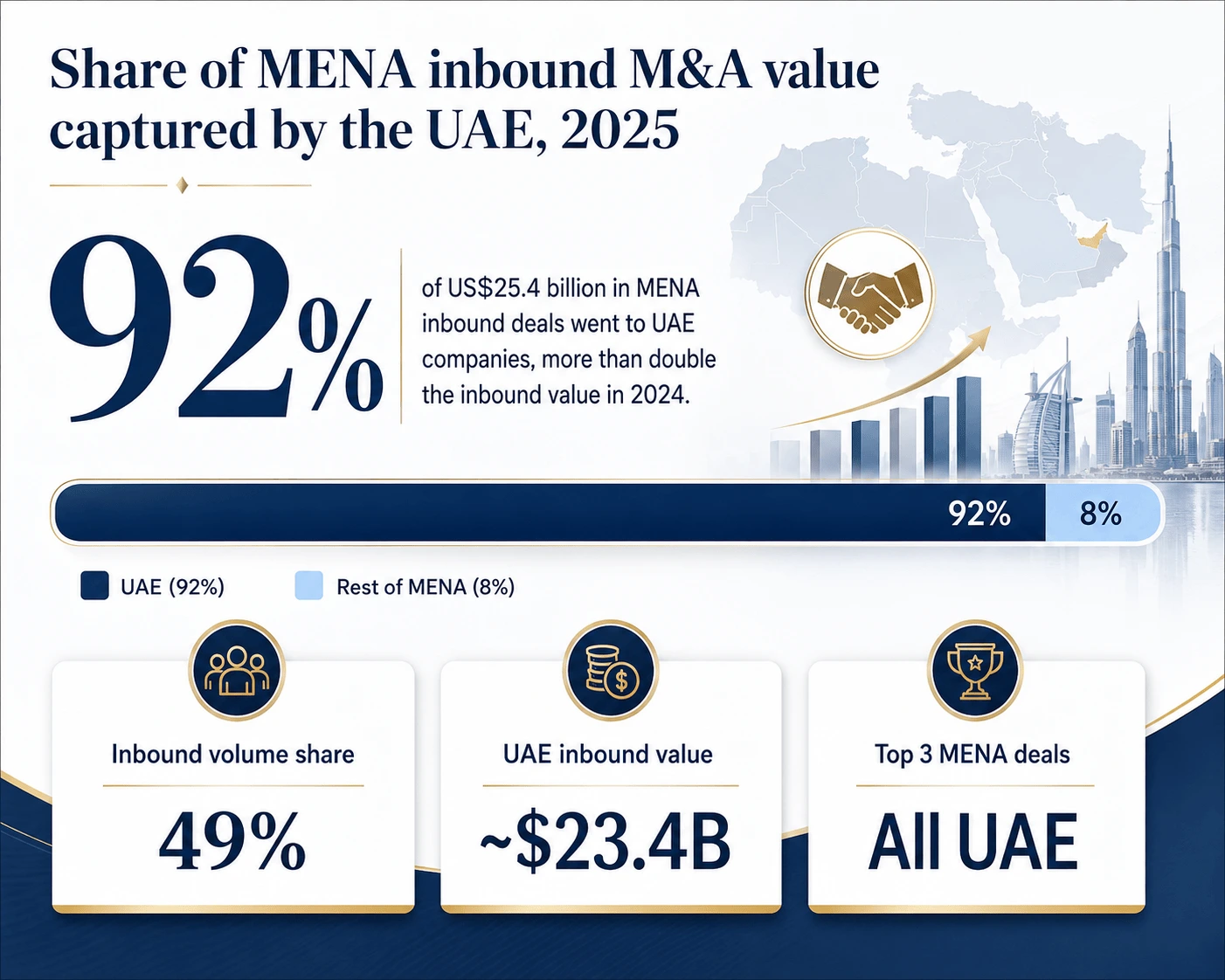
Source: Khaleej Times, February 2026, citing EY MENA M&A Insights 2025.
What Is a Company Merger Under UAE Law?
In simple terms, a merger combines two or more businesses into one legal structure. In the UAE legal framework, that usually means one company is absorbed into another, or multiple companies combine into a new company. The result is not just operational consolidation. It is a formal legal transfer of rights and obligations. Under the Commercial Companies Law, the merged company or companies cease to exist, and the surviving or new company becomes the legal successor.
For founders, that matters because a merger affects more than ownership. It can affect:
- licenses and commercial registrations
- contracts and bank mandates
- liabilities and creditor claims
- employee structures
- tax filings and accounting treatment
Cross-border deals dominate the region's M&A landscape, accounting for 54% of deal volume and 61% of total value. Meanwhile, the UAE led domestic activity in 2025 with 131 local deals, more than any other MENA country.
This is why a merger is usually considered when the goal is full consolidation, not just commercial cooperation.
When Merging Two Companies in the UAE Makes Sense
Most founders do not merge entities for cosmetic reasons. They do it when operating two companies has become harder than running one.
Common reasons include:
- consolidating duplicate costs, teams, or overhead
- simplifying ownership structures before fundraising or exit
- combining complementary businesses under one balance sheet
- reducing banking, compliance, and reporting complexity
- integrating a parent, subsidiary, or affiliate into one operating company
This tracks with global patterns. Acquirers are over 10 times more likely to announce cost synergy targets than revenue synergy targets, a sign that operational consolidation, not growth, is the primary driver for most deals.
The Legal Process for Merging Companies in the UAE
The exact mechanics vary depending on whether the companies sit under mainland rules, the same free zone, or different authorities. But the legal backbone, set out in Federal Decree-Law No. 32 of 2021, is broadly consistent.
[blockAccordionSteps]
What Founders Need Before Merging Companies in the UAE
A merger is smoother when the companies are clean before they are combined. In practice, founders usually need to line up:
| Category | What to Prepare |
|---|---|
| Corporate documents | Constitutional documents and commercial licenses. |
| Ownership | Shareholder approvals and cap table alignment. |
| Deal documentation | A merger plan or restructuring agreement. |
| Financials | Clear financial statements and management accounts. |
| Assets and contracts | Schedules of assets, liabilities, and contracts. |
| Banking and creditors | Bank and creditor mapping. |
| People | Employee and immigration implications. |
| Regulatory | Sector-specific approvals, where relevant. |
If the companies operate under different jurisdictions, the authority question becomes even more important. Some combinations are straightforward. Others require a more tailored path, especially where one company must first be converted, transferred, or restructured before a legal merger can happen.
Tax Implications of Merging Companies in the UAE
Under the UAE corporate tax law, Business Restructuring Relief can apply when one or more taxable persons transfer an entire business to another in exchange for shares, including cases where the transferor ceases to exist. But the relief has conditions:
- the transfer must follow UAE law
- both parties must be resident taxable persons (or non-residents with a UAE permanent establishment)
- neither party can be an exempt person or Qualifying Free Zone Person
- both must share the same financial year and accounting standards
- the transaction must be driven by valid commercial reasons, not fiscal ones
There are also clawback rules if certain conditions are breached within two years.
So, if one of the companies is a Qualifying Free Zone Person, don't assume merger relief will apply. That question needs structuring analysis early, not after documents are drafted.
When Competition Law Applies to a UAE Merger
For larger transactions, merger control is no longer a side note.
Under Cabinet Decision No. 3 of 2025, an economic concentration filing may be required if:
- the concerned establishments' total annual sales in the relevant UAE market exceed AED 300 million, or
- their combined market share exceeds 40% in that relevant market
That doesn't mean every founder merger triggers a competition filing. Most SME consolidations won't come close. But if the businesses are large, sectorally concentrated, or backed by groups with meaningful market share, this needs to be checked early, not assumed away.
Merging Companies in Free Zones
While the UAE Commercial Companies Law provides the legal foundation for mergers, the practical process often depends on where the companies are registered.
Companies operating under the same licensing authority may find the merger process more straightforward; their formation documents, licenses, and regulatory oversight all fall under a single jurisdiction.
When companies sit under different authorities, additional restructuring steps may be required before a merger can proceed. This can include:
- converting a company structure
- transferring licenses
- aligning shareholder records and regulatory approvals
The earlier you identify the jurisdictional question, the easier it is to plan around it.
In Conclusion
Merging two companies in the UAE is not a shortcut; it's a structured legal process with real implications for ownership, liabilities, tax, and compliance. Done well, it can turn a messy two-entity setup into something cleaner and easier to run.
The key is preparation. Know what type of merger you're pursuing, what approvals you need, and whether your jurisdictional setup helps or complicates things. If you have a company in Meydan Free Zone, your business qualifies as a Qualifying Free Zone Person, meaning Business Restructuring Relief may not apply automatically.
Weighing whether to merge, restructure, or start fresh with your Meydan Free Zone company? Meydan Free Zone's setup consultants can help map the cleanest path forward.
Citations
¹ Global Legal Insights, "Mergers and Acquisitions Laws and Regulations: UAE," 2025.
² EY, "MENA region recorded 225 M&A deals with a value of US$46B during Q1 2025," May 2025.