Table of Contents
How to Start a Foreign Securities Brokerage Business with Meydan Free Zone
A UAE investor who wants exposure to the US technology sector has two choices: buy thirty individual stocks, or buy one exchange-traded fund that holds all of them.
Most choose the fund. That instrument, like the depository receipts, listed funds, and exchange-traded derivatives traded alongside it, is a security listed on a foreign market, and connecting UAE clients to the full range of those instruments is the business of foreign securities brokerage.
The appetite is measurable. The Middle East and Africa exchange-traded funds market reached USD 22.08 billion by May 2025 and is projected to grow to USD 28.68 billion by 2030, according to Standard Chartered¹.
Demand is reinforced by wealth migration: the UAE recorded a net inflow of more than 6,700 millionaires in 2024, according to the US State Department², a population that arrives with established global portfolios and an expectation of continuous access to international markets.
[blockCTACostCalculator]
Beyond Single Stocks and Bonds
Foreign markets do not only list shares and bonds. They list funds, baskets, receipts, and exchange-traded derivatives, and demand for that wider toolkit is climbing in step with the region's growing pool of investors.
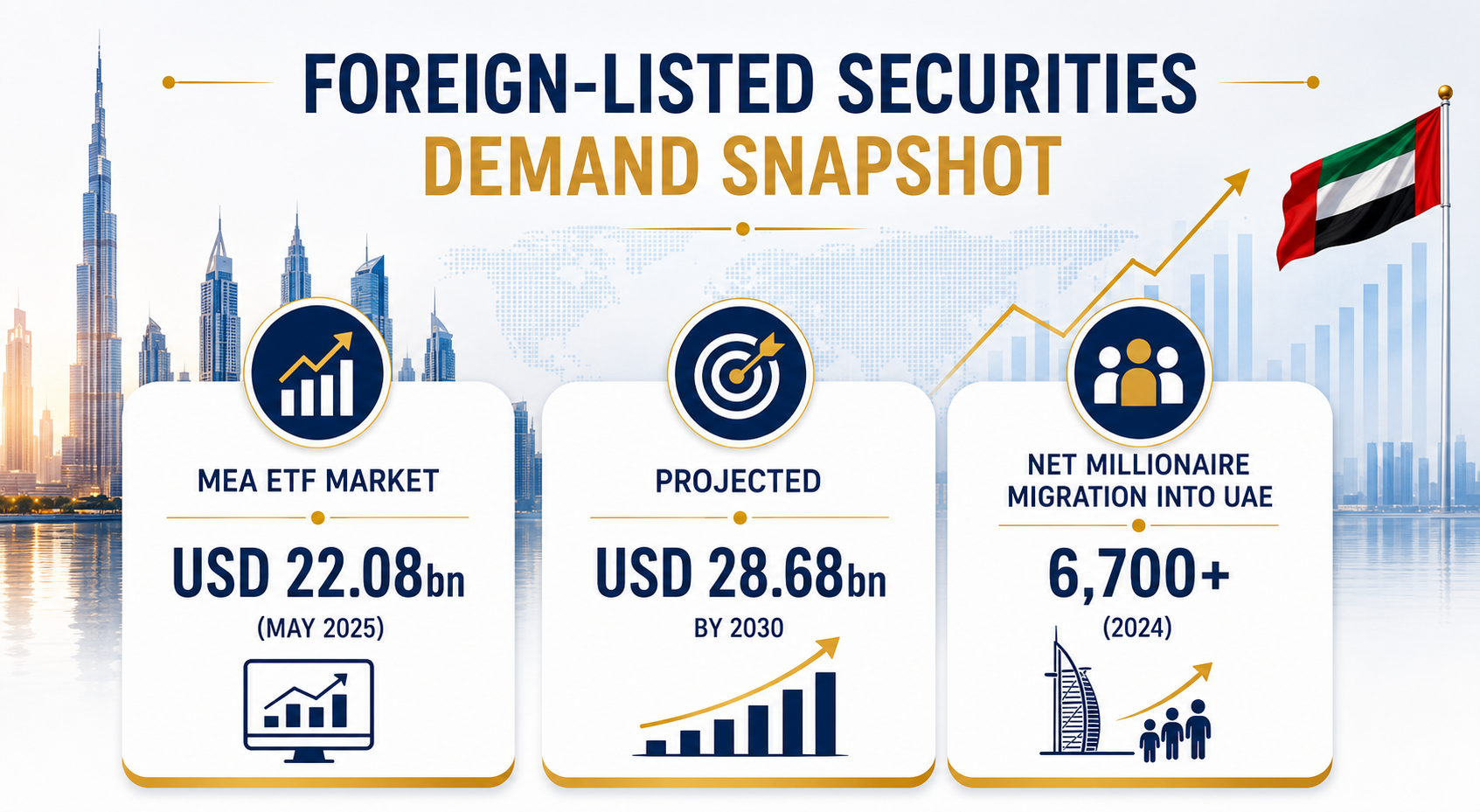
Sources: Standard Chartered (2025); US State Department (2025)
The demand is wider than the existing brokers cover, and it is not only about shares. UAE investors increasingly want exchange-traded funds for instant diversification, depository receipts to hold foreign companies in a convenient form, listed real estate trusts for property income without owning property, and exchange-traded derivatives to manage risk.
The pool of people wanting these instruments keeps growing: a resident base that is overwhelmingly expatriate, a steady inflow of high-net-worth migrants arriving with global portfolios², and family offices building positions across multiple markets and asset types. Most of that appetite is currently served by a thin layer of bank desks and offshore platforms, leaving the specialist, multi-instrument execution layer largely open.
From ETF and fund access to depository receipts and listed derivatives, the UAE foreign securities market rewards brokers built to handle the full instrument range across global exchanges.
[blockCTANameCheck]
Who is this for?
- Multi-instrument securities brokers: Firms executing client orders across the full range of foreign-listed securities, including equities, exchange-traded funds, listed funds, and depository receipts.
- ETF and fund access specialists: Brokers focused on connecting UAE clients to foreign-listed exchange-traded funds and pooled investment products for diversified global exposure.
- Listed derivatives brokers: Operators executing client orders in exchange-traded derivatives listed on foreign markets, supporting hedging and risk management for UAE-based investors and institutions.
Meydan Free Zone offers 100% foreign ownership, zero percent corporate tax on qualifying income, full profit repatriation, and a fully digital licensing process, providing a regulated and cost-efficient base from which to operate as a securities broker serving globally minded investors.
[blockCTABizActivityList]
6612.98 - Brokerage in Securities Listed in Foreign Markets
Under this activity, you are licensed to execute buy and sell orders across the range of securities listed on foreign exchanges, on behalf of clients.
The activity covers foreign-listed equities, exchange-traded funds, listed investment funds, depository receipts, exchange-traded derivatives, and real estate investment trusts. The broker is the regulated intermediary routing client orders to foreign exchanges, earning commissions and execution fees, not dealing on own account.
[blockCTATradeLicense]
There are clear boundaries on this activity. Foreign securities brokerage does not cover dealing in securities on own account, which falls under a separate financial intermediation classification. It excludes portfolio management on a fee or contract basis. It also excludes brokerage in commodities and currencies, and brokerage in securities listed on UAE markets, each of which is licensed separately.
The line is precise. If your business executes client orders in securities listed on foreign exchanges, you are in. If you deal with your own book, manage discretionary portfolios, or broker locally listed securities, commodities, or currencies, you are not.
Third-Party Approval: Pre-approval from the Securities and Commodities Authority (SCA) is required before the trade license is issued.
Anti-Money Laundering Compliance: This business activity is exempt from UAE Anti-Money Laundering compliance requirements.
[blockCTAFawri]
Footnotes
¹ Standard Chartered. Your Guide to Investing in Exchange-Traded Funds in the UAE. Standard Chartered, 2025.
² US Department of State. 2025 Investment Climate Statements: United Arab Emirates. Bureau of Economic and Business Affairs, 2025.