

Table of Contents
Frequently Asked Questions
1. What does this activity cover?
It covers trading coffee: sourcing and selling coffee beans, ground coffee, instant coffee, and capsules to cafes, retailers, offices, and consumers.
2. Who are the typical customers?
Cafes and restaurants needing supply, retailers stocking shelves, offices, and consumers buying coffee for home, across the UAE.
3. What coffee products can be traded?
Green and roasted beans, ground coffee, instant coffee, and capsules can all be sourced and sold under this activity.
4. Is this the same as wholesale of coffee in bulk?
No. Bulk wholesale of coffee, tea, cocoa, and spices is a separate activity. This activity sources and trades coffee to customers.
5. Does this include running a cafe?
No. Running a cafe that serves prepared drinks is a separate activity. This activity sources and sells coffee products, not made-to-order beverages.
Start a Coffee Trading Business with Meydan Free Zone
The UAE has fallen for coffee, from the cardamom-spiced cups of tradition to single-origin pour-overs and capsule machines at home. A coffee trading business feeds that habit, sourcing beans, grounds, and pods and selling them on to the cafes, shops, and consumers who cannot start the day without them.
Coffee has become one of the UAE's most dynamic consumer markets. The UAE coffee trade market is forecast to reach USD 1.2 billion by 2030, growing at about 8.5 percent a year, according to Ken Research1. The wider national coffee market is bigger still, worth around AED 12 billion, about USD 3.2 billion, in 2025, according to the Emirates News Agency2.
For a coffee trader, having a young, diverse and coffee-loving population that keeps drinking more, home and out, this is the exact fast-growing base of demand they are looking for.
Coffee in the UAE has gone from tradition to lifestyle, with specialty cafes, at-home brewing, and capsule machines driving consumption among a young population. The figures below show the coffee trade a trading business sells into and the size of the wider national market.
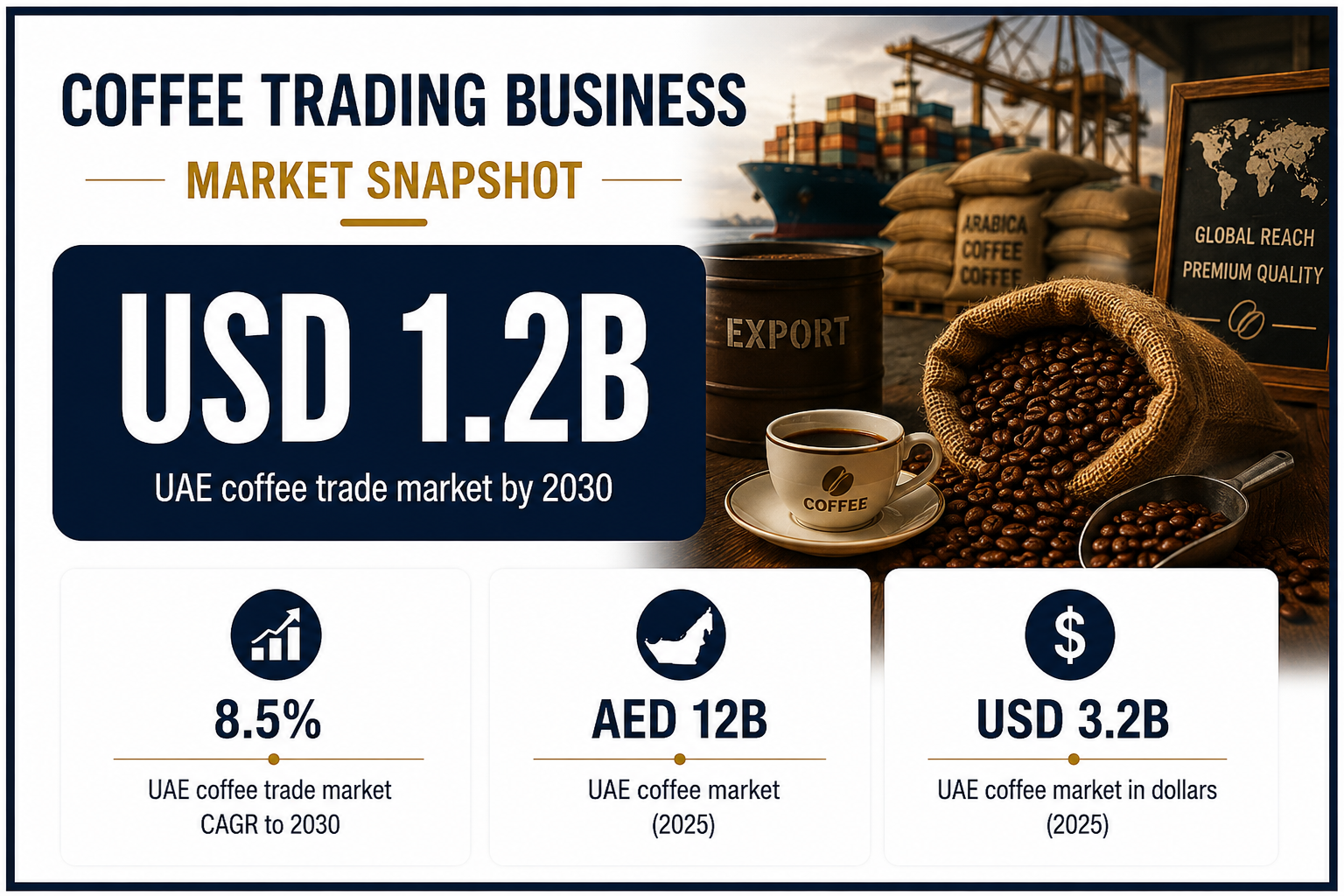
Sources: Ken Research (2026); Emirates News Agency (WAM) (2025).
[blockCTACostCalculator]
Picture a coffee trader's day. A buyer samples beans from a supplier and agrees a price for the next shipment. An order goes out to a cafe that needs its house blend restocked. A retailer picks up a range of ground coffee and capsules for its shelves.
A consumer drops in for a bag of single-origin beans. The trader earns a margin on what it sources and sells, so the work is a steady cycle of buying, ranging, and selling coffee. In a market drinking more coffee every year, the traders that win are the ones with the right range and a reputation for quality.
Whether it is beans for a cafe, capsules for an office, or a bag of single-origin for home, a coffee trading business sources coffee and sells it on to the people who drink it.
Who is this for?
- Coffee traders: Businesses sourcing and selling coffee beans, grounds, and capsules in the UAE.
- Specialty coffee suppliers: Operators supplying cafes, retailers, and offices with coffee.
- Coffee retailers and roasteries: Firms selling a range of coffee products to consumers and businesses.
Meydan Free Zone offers 100% foreign ownership, zero percent corporate tax on qualifying income, full profit repatriation, and a fully digital licensing process, providing a regulated and cost-efficient base from which to operate a coffee trading business in one of the region's fastest-growing coffee markets.
[blockCTAmPlus]
4721.75 - Coffee Trading
Under this activity, your business is licensed to trade coffee, sourcing and selling coffee beans, grounds, instant coffee, and capsules to customers.
A coffee trading business sources coffee and sells it on to buyers. The range typically spans green and roasted beans, ground coffee, instant coffee, and capsules, bought from suppliers and traded to customers through a specialised store or trading operation. The buyers are mixed: cafes and restaurants needing supply, retailers stocking shelves, offices, and consumers buying for home. It is a sourcing-and-margin business: the trader is paid to source good coffee, hold the right range, and sell it on at a competitive price.
The activity is specifically for trading coffee. Wholesale of coffee, tea, cocoa, and spices in bulk falls under a separate activity, as does running a cafe that serves prepared drinks and roasting coffee as a manufacturer.
The line is precise. If your business sources coffee and sells it to customers, you are in. If you supply coffee, tea, cocoa, and spices in bulk as a wholesaler, run a cafe serving drinks, or roast coffee as a manufacturer, a different activity applies.
[blockCTATradeLicense]
Third-Party Approval
Approval from the Food Safety Department at Dubai Municipality is required after the trade license is issued.
Anti-Money Laundering Compliance
This business activity is exempt from AML compliance requirements.
[blockCTAContact]
Citations
1 Ken Research. UAE Coffee Trade Market Outlook. Ken Research, 2026.
2 Emirates News Agency (WAM). UAE Coffee Market Data. Emirates News Agency (WAM), 2025.