







Table of Contents
Frequently Asked Questions
1. What does an e-commerce business do?
It sells products directly to customers without a physical store, taking orders online or through other non-store channels and delivering the goods to the customer.
2. How large is the UAE e-commerce market?
The UAE e-commerce market is worth around USD 12 billion in 2025 and is forecast to reach over USD 21 billion by 2030.
3. Does an e-commerce business need third-party approval?
Generally no. But if you sell regulated goods, such as cosmetics, health supplements, or certified electronics, those products require the relevant approvals before sale.
4. Can an e-commerce license sell any kind of product?
It covers retail across product categories, but some regulated goods carry their own product-approval requirements, even though the e-commerce activity itself does not.
5. Is e-commerce subject to AML requirements in the UAE?
No. This business activity is exempt from AML compliance requirements, though regulated goods sold through it may carry their own product rules.
How to Start an E-Commerce Business with Meydan Free Zone
The fastest-growing shops in the UAE have no shelves, no till, and no front door. They live on a phone screen, take orders at midnight, and ship from a warehouse the customer never sees. E-commerce is retail without the store, selling to customers wherever they are rather than waiting for them to walk in.
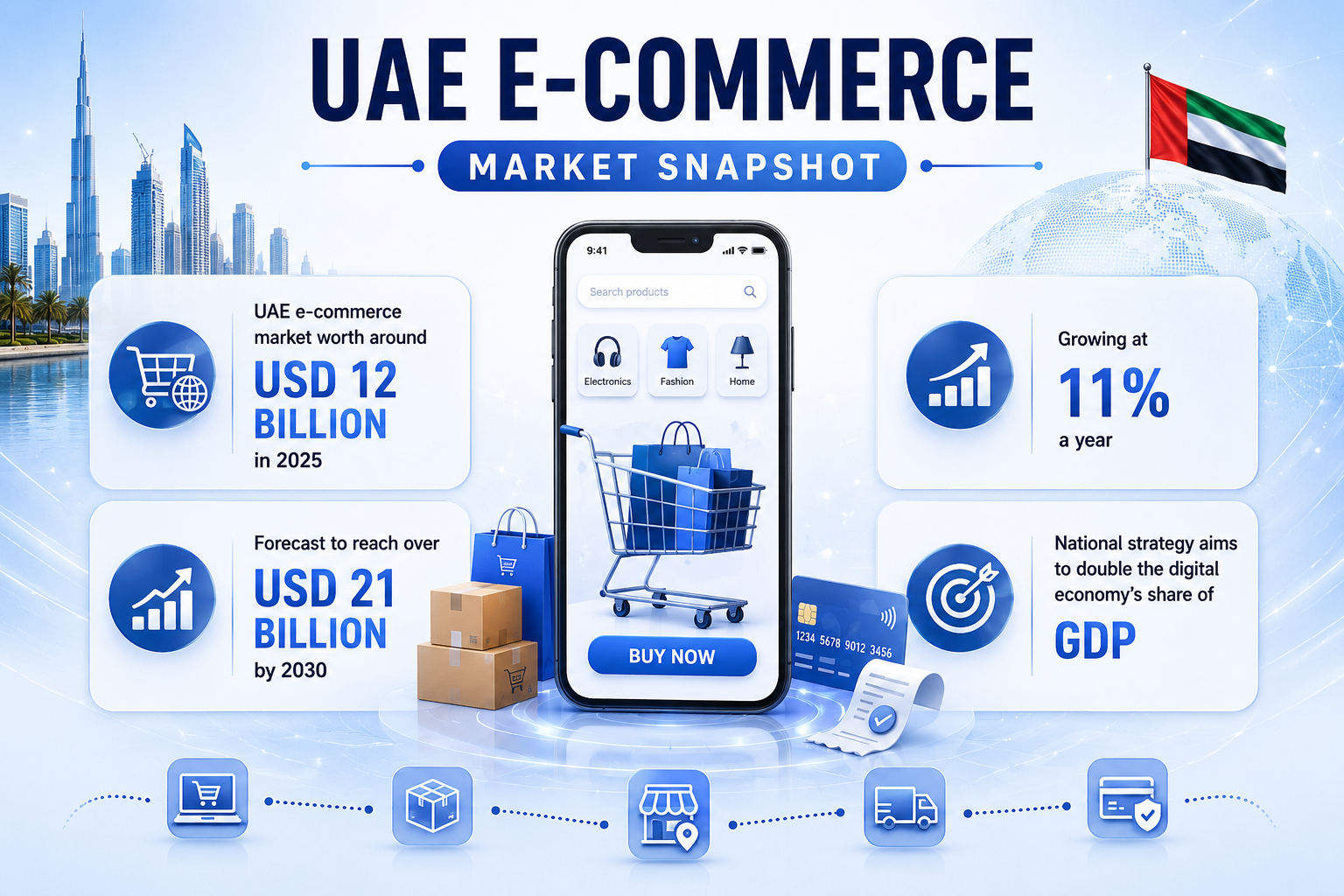
The UAE's e-commerce market is worth around USD 12 billion in 2025 and is forecast to reach over USD 21 billion by 2030, growing about 11 percent a year, according to Mordor Intelligence¹.
That growth is backed by national policy: the UAE's Digital Economy Strategy aims to roughly double the digital economy's share of GDP, from under 10 percent in 2022 toward around 20 percent within a decade, as reported by Khaleej Times². For a business, selling online is not a side channel here; it is where the market is heading.
[blockCTAFawri]
E-commerce lets a business reach the whole country, and beyond, without a single shopfront. In the UAE, a connected, affluent population and active government backing make that reach unusually valuable.
Sources: Mordor Intelligence (2026); Khaleej Times (2022).
An e-commerce business sells goods directly to customers without a physical store, taking orders online and delivering them. It is a retail business built around reach and convenience rather than location: a website or app, a catalogue of products, and a way to get them to the customer's door.
Shoppers across the country, and often beyond it, rely on e-commerce for the choice, price, and convenience that a single shop cannot match.
The demand is structural and still climbing. A young, affluent, almost entirely connected population already shops online by habit, and every year a larger share of total retail moves onto screens.
The UAE has actively built the conditions for this, from world-class logistics and digital payments to a national strategy that treats the digital economy as a growth priority.
For a seller, that means low barriers to reaching a national market and a customer base that increasingly expects to buy online first. An e-commerce business is selling into the direction the whole retail market is moving.
From a single product line to a full online marketplace, the UAE rewards e-commerce businesses that meet a connected, convenience-driven market where it already shops.
[blockCTABizSetupRemotely]
Who is this for?
- Online retailers: Businesses selling products to consumers through websites and apps.
- Marketplace and direct-to-consumer sellers: Direct-to-consumer brands and sellers operating on online marketplaces.
- Omnichannel retailers: Retailers combining online sales with other channels to reach customers anywhere.
Meydan Free Zone offers 100% foreign ownership, zero percent corporate tax on qualifying income, full profit repatriation, and a fully digital licensing process, providing a regulated and cost-efficient base from which to operate an e-commerce business in a fast-growing, government-backed online retail market.
[blockCTAmPlus]
4790.00 - E-Commerce
Under this activity, you are licensed to carry out e-commerce, the retail sale of goods to customers without a physical store.
There are clear boundaries on this activity. It is non-store retail, selling to customers without a physical shop, which distinguishes it from in-store retail.
While the activity itself needs no third-party approval, the goods sold may: regulated categories such as cosmetics, health supplements, and certain certified electronics require the relevant product approvals before they can be sold.
The activity covers the selling; the delivery of products by physical stores is classified under store-based retail.
The line is precise. If your business sells goods to customers without a physical store, online or through other non-store channels, you are in. If you run an in-store shop, the store-based retail activity applies, and any regulated goods you sell still need their own product approvals.
Third-Party Approval
No third-party approval is required for this business activity, except where regulated goods are sold, such as cosmetics, health supplements, or certified electronics, which require the relevant product approvals.
Anti-Money Laundering Compliance
This business activity is exempt from AML compliance requirements.
[blockCTAmResidency]
Citations
¹ Mordor Intelligence. UAE E-Commerce Market. Mordor Intelligence, 2026.
² Khaleej Times. UAE: Digital Economy Strategy to Double GDP Contribution to 19.4% in 10 Years. Khaleej Times (WAM), April 2022.


