Table of Contents
Frequently Asked Questions
1. What are the startup bankruptcy laws in Dubai?
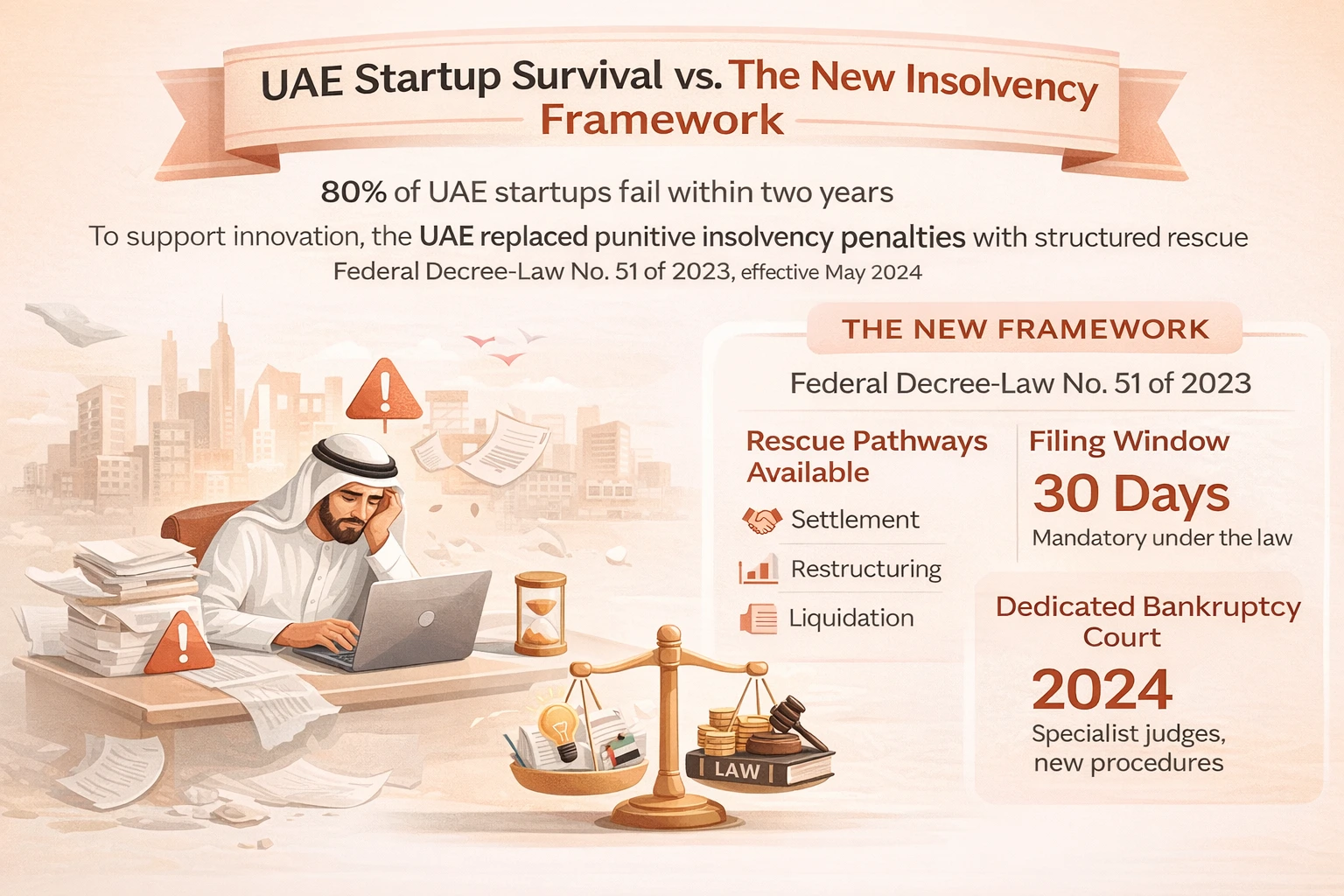
The governing legislation is Federal Decree-Law No. 51 of 2023 on Financial Restructuring and Bankruptcy, which came into force on 1 May 2024. It provides three procedures for distressed companies: Preventive Settlement, Financial Restructuring, and Bankruptcy/Liquidation.
2. Can a founder be personally liable for a company's debts in Dubai?
Yes, under certain conditions. The 2024 law extends personal liability to anyone who had actual management responsibility for the company, including de facto directors. Liability can be imposed for actions taken in the two years before insolvency if those actions involved undue risk-taking, asset disposal below market value, or gross mismanagement.
3. What is the 30-day filing rule?
A company that has stopped paying its debts or whose assets no longer cover its liabilities must file for one of the insolvency procedures within 30 working days. Failing to do so exposes directors to personal liability.
4. What is a Preventive Settlement?
A lighter-touch court-supervised process available to companies in financial difficulty that have not yet stopped paying their debts. It allows the company to continue trading whilst negotiating a settlement plan with creditors.
5. What happens to a founder's visa if a company enters insolvency?
The company license is separate from the visa, and entering insolvency proceedings does not automatically cancel a founder's UAE residence visa. However, if the company is eventually wound up and the license cancelled, visa renewal would typically require a new or alternative sponsor.
6. Does the UAE have criminal penalties for bankruptcy?
The 2016 and 2024 laws both repealed many of the criminal sanctions that applied under the old framework. The current law is not designed to criminalise financial failure. Criminal exposure arises where there is evidence of fraud, deliberate asset concealment, or intentional harm to creditors — not simply from a business becoming insolvent.
7. What financial support does Meydan Free Zone offer to help founders stay compliant and prepared?
Meydan Free Zone's mAccounting suite covers the full compliance layer — from bookkeeping and bank reconciliation to corporate tax filing, VAT registration, financial audit reports, and liquidation reporting. In the context of insolvency, having this infrastructure in place means your financial position can be accurately established for a court, a trustee, or creditors, and your directors can demonstrate the accountability the law expects.
Topic Summary
1. Updated Legal Framework
As of May 1, 2024, Federal Decree-Law No. 51 of 2023 governs insolvency, shifting the focus from simple liquidation to rescuing viable businesses through a dedicated Bankruptcy Court and modernized procedures.
2. Three Strategic Pathways
Distressed businesses can choose between Preventive Settlement (early-stage restructuring while trading), Financial Restructuring (court-supervised debt rescheduling with a moratorium), or Liquidation (orderly winding up of the company).
3. The Strict 30-Day Filing Rule
Directors must file for insolvency within 30 days of failing either the "cash flow test" (unable to pay debts) or the "balance sheet test" (liabilities exceed assets) to avoid personal liability for the company's financial decline.
4. Expanded Director Liability
Personal accountability now extends beyond formal directors to anyone managing the company (shadow directors); the court can review and penalize "undue risks" or asset stripping taken up to two years before the insolvency.
5. Critical Role of Record-Keeping
Maintaining accurate financial statements and board minutes is essential for protection; complete records allow founders to demonstrate "precautionary measures" and preserve the legal separation between company liabilities and personal assets.
Startup Bankruptcy Laws in Dubai: What Founders Need to Know
A founder watching cash flow dry up faster than expected, a co-founder wondering whether a struggling business can be rescued rather than wound up, a director worried about personal liability if the company cannot pay its debts: all three need to understand the rules that now govern financial distress in the UAE, since acting inside the right timeline can be the difference between a rescue and a personal liability claim.
This guide covers the legal framework behind business insolvency in Dubai, the three procedures available to a distressed business, the 30-day filing rule, and what a founder needs in place to stay on the right side of it.
Key Stats at a Glance
The Legal Framework Governing Business Insolvency
Federal Decree-Law No. 51 of 2023 on Financial Restructuring and Bankruptcy came into force on 1 May 2024 and now governs how a UAE business handles serious financial distress, working alongside the UAE Commercial Companies Law for company-level matters and Federal Decree-Law No. 19 of 2019 for personal insolvency involving natural persons. The current regime is built around one principle: rescue a struggling business first, and treat liquidation as the last resort rather than the default outcome.
The Three Procedures Available to a Distressed Business
Preventive settlement keeps a business trading through a negotiated plan, financial restructuring brings in a court-appointed trustee once debts genuinely cannot be paid on schedule, and bankruptcy and liquidation is the route only when restructuring itself is no longer workable.
Choosing between these three is rarely a decision a founder makes alone. A court and, in the case of financial restructuring, an appointed trustee both play a role in deciding which route fits a company's actual financial position, so early legal advice matters more here than in almost any other part of running a business, since the procedure you end up in shapes what happens to the company, your creditors, and your own personal liability.
The 30-Day Filing Rule and Director Liability
A company needs to file for one of these procedures within 30 working days of meeting either of two insolvency tests: the cash flow test, where the company has stopped paying its debts, or the balance sheet test, where assets no longer cover liabilities. Missing this 30-day window exposes directors, and anyone actually responsible for running the company, including a shadow director acting behind the scenes, to personal liability.
The Bankruptcy Court can hold these individuals liable for actions taken in the two years before the company's insolvency judgment, including taking on too much risk, selling assets below market value, paying connected parties ahead of other creditors, or serious mismanagement. A director who can show documented objections or precautionary steps taken at the time has a real defence against this liability, so keeping a paper trail of your decisions matters well before any dispute arises.
[blockCTACostCalculator]
Step-by-Step: What to Do If Your Business Is in Distress
- Step 1, run both insolvency tests: Check whether your company has stopped paying debts or whether liabilities now exceed assets.
- Step 2, act within 30 working days: File for the right procedure inside this window once either test is met.
- Step 3, choose your procedure: Preventive settlement if you are still trading, financial restructuring if debts cannot be paid, bankruptcy and liquidation if restructuring is not workable.
- Step 4, document your decisions: Keep a clear record of every step you take and every option you consider as a director.
- Step 5, work with a court-appointed trustee if needed: A trustee guides the restructuring process and negotiates your plan with creditors.
- Step 6, get your finances in order early: Use a proper bookkeeping and accounting setup so your true financial position is never a surprise.
Compliance and What You Need in Place
The 30-day filing clock
Track your company's cash position closely, since the 30-working-day filing clock starts the moment either insolvency test is met, not when you notice or decide to act.
Director liability records
Keep documented records of major financial decisions for at least 2 years, since this is the exact lookback period the Bankruptcy Court can review if your company later becomes insolvent.
How free zone setup affects your position
Setting up under Meydan Free Zone does not change your risk under these rules, so a free zone founder needs the same insolvency awareness as a mainland one, not less.
Accurate bookkeeping
Clean, current financial records make both insolvency tests easy to check at any time, so treat your bookkeeping as an early warning system rather than a year-end task.
Meydan Free Zone support
Meydan Free Zone's mAccounting bookkeeping service, starting from AED 1,000 a month, gives a founder a practical way to keep financial records current and catch signs of distress early.
Ongoing monitoring
Review your cash flow and balance sheet position regularly rather than only at year-end, since catching distress early gives you the widest choice of procedures and the best chance of a rescue.
Market Opportunity
A framework built around rescue rather than liquidation gives a genuinely struggling Dubai business real options it would not have had under an older, liquidation-first regime. A founder who understands the three procedures and the 30-day rule can move quickly toward preventive settlement or restructuring rather than watching a fixable problem turn into a forced wind-up.
For a Meydan Free Zone founder, pairing this legal awareness with a proper bookkeeping setup turns the 30-day rule from a risk into a workable checkpoint, since a business with current, accurate financials always knows exactly where it stands against both insolvency tests.
Conclusion
Startup bankruptcy laws in Dubai now favour rescue over liquidation, but only for founders who act inside the 30-day window and understand which of the three procedures fits their situation. Keeping clean financial records and documenting your decisions as a director protects both your business and your own personal position if distress ever hits.
[blockCTAContact]