
Table of Contents
Frequently Asked Questions
1. What is the minimum salary required to sponsor a domestic worker visa in Dubai?
MOHRE sets a minimum salary threshold for the sponsoring visa holder — the process cannot proceed without confirming this benchmark first. The exact figure is verified directly at the MOHRE portal, as thresholds are subject to update. Budget for government fees, health insurance, and agency or recruitment costs before contacting any candidate.
2. How long does the domestic worker visa Dubai process take from sourcing to visa stamping?
The sequence runs from sponsor eligibility verification through Entry Permit, medical fitness test, Emirates ID process, and visa stamping — plan four to eight weeks when all prerequisites are in order. The passport is retained on submission at the Tasjeel centre for one to three business days, creating personal liability if travel is booked during that window.
3. Is health insurance mandatory for domestic workers in Dubai, and who pays for it?
Health insurance is a mandatory employer obligation from the day they begin — there is no grace period extension if it lapses before renewal is processed. The sponsor bears the full cost, typically AED 1,500–3,500 annually per worker for a minimum DHA-compliant plan.
4. What does a MOHRE-compliant domestic worker contract in Dubai cover?
The signed contract covers salary, duties, days off, reasons for contract end, notice terms, and insurance start date — filed with both parties holding copies. Informal verbal terms for salary adjustments create payroll disputes that are hard to defend at MOHRE without documentation.
5. Can I hire a part-time nanny in Dubai without full visa sponsorship?
Agency supply doesn't require the employer to hold full visa sponsorship in all cases and works well for part-time arrangements or new arrivals while waiting to settle into a long-term childcare plan. However, trial periods and substitution rights vary by agency — review cancellation terms and verify agency licensing at the MOHRE portal before proceeding.
Topic Summary
1. You Become the Legal Employer Immediately
When you hire house help in Dubai, you become the employer of record — not a client using a service. The sponsor bears full obligations covering visa sponsorship, MOHRE contract filing, mandatory health insurance, and reliable wage records from sourcing to visa stamping.
2. Verify Sponsor Eligibility Before Contacting Any Candidate
The process cannot proceed without confirming the primary visa holder meets MOHRE's salary threshold, holds active health insurance, and can provide housing proof for live-in arrangements. Budget for government fees, health insurance, and agency or recruitment costs before discussing a start date.
3. Define Each Role in Writing First
A clear role states infant care, bottle sterilisation, and child routine stability — separately identifying whether driving, cleaning, or cooking are included. Blending duties avoids a clear contract and creates legal exposure.
4. The Domestic Worker Visa Sequence Is Fixed
Each step must be completed in order: verify eligibility, define the role, gather the document list, verify the candidate, file the MOHRE contract, complete the Entry Permit, then finish the medical fitness test and Emirates ID process. Skipping any step stalls the entire sequence.
5. Year-One Costs Exceed Entry Fees Alone
Government fees, health insurance, agency or recruitment costs, and the mandatory annual return ticket combine to run AED 8,000–35,000 for year one. Two health insurance policies running at the same time require separate tracking — there is no grace period extension if either lapses.
6. Records That Protect You as an Employer
Keep a signed MOHRE contract filed with both parties holding copies, wage payment records, and health insurance certificates for each domestic worker. Avoid informal verbal terms for salary adjustments — use written discussions if performance slips, and escalate to formal support channels when needed.
7. What Most Expats Discover Too Late About Renewals
When you hire a second domestic worker — a nanny or a driver — repeat the same sequence from Step 1. Set calendar reminders 90, 60, and 30 days before each renewal date, and maintain two separate MOHRE files with independent renewal timing.
Hiring a Nanny, Driver, or House Help in Dubai, UAE as an Indian Expat Family
When you hire house help in Dubai, you become an employer of record under UAE law, not a client using a service, and most Indian expat families discover too late that this distinction carries real financial consequences. The domestic worker visa Dubai sequence is fixed, the MOHRE contract is mandatory, and health insurance is not optional. This guide covers sponsor eligibility, cost benchmarks, and the records that protect you from sourcing to visa stamping.
The Core Misread Expats Make
Hiring a nanny in Dubai means becoming the legal employer of record. The sponsor bears full obligations: visa sponsorship, MOHRE contract filing, mandatory health insurance, annual return ticket, and wage records, from day one, this isn't a casual arrangement.
Market Reality for Indian Expat Families
Indian expat families often assume informal WhatsApp group referrals bypass the legal process. A candidate recommended through a Community Network still needs status verification before any offer is made. Domestic staff sourced without a MOHRE-filed contract create financial consequences, unpaid end-of-service gratuity claims, insurance rejection, and a ban on sponsoring future workers.
What the Sponsorship Structure Actually Does
The sponsor, the primary visa holder, is the official employer on record. Two separate MOHRE files are maintained when hiring a nanny and a driver; each is a distinct employer obligation with independent renewal schedules. Proceeding without transfer of a worker already on another sponsor's visa creates legal exposure, the process cannot proceed until the prior sponsor formally releases the worker.
Nanny, Driver, and Housekeeper as Distinct Functions
A clear role states infant care, bottle sterilisation, and child routine stability. A housekeeper manages cleaning, cooking, and nursery tidying, but excludes deep cleaning or driver duties. A driver operates under a different contract structure and doesn't require the employer to hold full visa sponsorship in all arrangements.
Define the Role Before Contacting Any Candidate
Live-in versus live-out terms must be stated in writing before any offer. Live-in arrangements require adequate housing proof as part of the sponsor eligibility process. A contract specifying AED 1,500 per month for a nanny covering childcare, nursery tidying, but excludes deep cleaning, protects both parties when a performance dispute arises.
Who Usually Needs Which Role
Families needing morning school runs often find a driver sourced part-time plus a housekeeper is a more practical structure than a single all-duties hire. A driver may find this arrangement operates under a different contract structure and doesn't require the employer to hold full visa sponsorship in every case, verify the arrangement type with MOHRE before you proceed.
Pre-Application Sponsor Eligibility Requirements
To sponsor a domestic worker in Dubai, the primary visa holder must meet a minimum salary threshold set by MOHRE, hold a valid UAE residence visa, maintain adequate housing for a live-in worker if applicable, and have a current tenancy contract. Eligibility must be confirmed before contacting any candidate.
Sponsor Eligibility: What the Process Cannot Proceed Without
MOHRE sets a minimum salary threshold for the sponsoring visa holder, the process cannot proceed if the primary visa holder doesn't meet this benchmark. A current tenancy contract showing adequate housing is mandatory; keep a copy ready for submission. Active health insurance for the sponsor is a prerequisite for the domestic worker visa Dubai process.
Identity Requirements and Document Preparation
Your passport copies, proof of residence visa stamped and valid, and a current tenancy contract are the baseline documents. MOHRE requires translated and attested copies of relevant documents when the worker is recruited from abroad, factor this into the timeline before you proceed. Budget for government fees, health insurance, and any agency or recruitment costs before discussing a start date with any candidate.
A Numbered Sequence: The Domestic Worker Visa Dubai Process
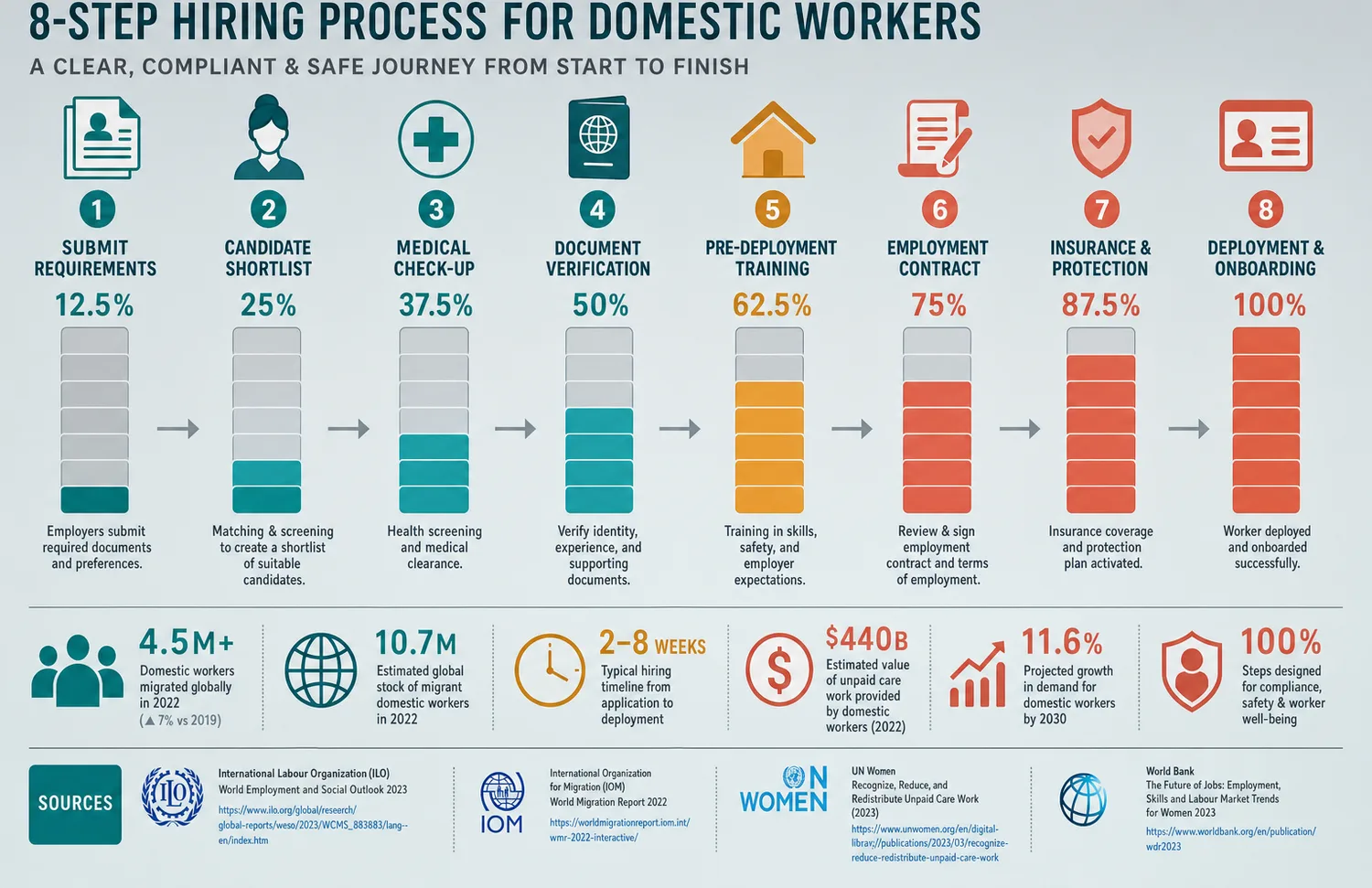
The domestic worker visa Dubai sequence runs in fixed order. Each step must be completed in sequence, skipping any step stalls the entire process.
Steps 1-4: Eligibility to Candidate Verification
- Step 1 - Verify sponsor eligibility: confirm you meet the salary threshold, hold a valid UAE residence visa, can provide proof of housing, and have active health insurance in place.
- Step 2 - Define the role in writing: set out the scope of duties (childcare, driving, cleaning), weekly days off, working hours, and notice terms in writing before you start sourcing candidates.
- Step 3 - Gather the required documents: passport copies, proof of residence, and your tenancy contract (Ejari). Incomplete submissions are the most common cause of delays.
- Step 4 - Source and verify the candidate: use a licensed Tadbeer agency or a direct referral, and verify the candidate's current visa status on the MOHRE portal before paying any fees. Unlicensed operators expose you to real legal and financial risk.
Steps 5-8: Contract, Entry Permit, Medical, and Visa Stamping
- Step 5 - Set the offer: a signed MOHRE contract filed with both parties holding copies, covering salary, duties, days off, reasons for contract end, and insurance start date.
- Step 6 - Run the Visa Application: submit the required documents and obtain the Entry Permit; for workers recruited from abroad, the Entry Permit is issued once approved.
- Step 7 - Complete the medical fitness test and Emirates ID process: the medical fitness test is mandatory before the residence visa can be stamped.
- Step 8 - Visa stamping: the residence visa is stamped inside the worker's passport, typically valid for two years; the physical Emirates ID card is in the worker's possession, this is your confirmation that the process is complete.
What to Budget for Hiring Domestic Staff in Dubai
Hiring a nanny in Dubai costs between AED 8,000 and AED 35,000 for year one, covering government fees, health insurance, medical fitness test, agency or recruitment costs, and the annual return ticket. Ongoing annual costs run from AED 6,000 to AED 12,000 per worker.
Year-One Cost Benchmarks
| Cost Component | Typical Range (AED) |
|---|---|
| Government fees (Entry Permit, medical, Emirates ID, stamping) | 3,000 – 6,000 |
| Monthly salary, housekeeper / nanny | 1,500 – 3,500/month |
| Monthly salary, driver | 2,000 – 4,000/month |
| Agency or recruitment costs | 3,000 – 10,000 |
| Annual return ticket (e.g., Philippines) | 600 – 1,500 |
| Health insurance (DHA-compliant, annual) | 1,500 – 3,500 |
One worker, first year: government fees AED 4,000 + agency AED 5,000 + health insurance AED 2,500 + return ticket AED 800 = AED 12,300 before salary.
Choosing Between Agency Supply and Direct Sponsorship
Agency supply doesn't require the employer to hold full visa sponsorship in all cases and works well for new arrivals while waiting to settle into a long-term childcare plan. Direct sponsorship means you maintain full control, payroll records, and renewal timing, but trial periods and substitution rights vary by agency.
A family comparing a direct sponsorship route against Agency Supply should review control, renewal timing, and total annual spend, not just entry fees. Verify agency licensing at the MOHRE portal; files of authorised agencies are publicly accessible. Unlicensed operators expose you to real legal risk.
Records That Protect You as an Employer
Employers must maintain signed MOHRE contracts, wage payment records, health insurance certificates, visa copies, and renewal dates for each domestic worker. These records protect against MOHRE disputes, insurance rejection, and personal liability if a worker's visa lapses before the renewal is processed.
Wage payment receipts, bank transfer records, are the method that protects the employer if a salary dispute is filed with MOHRE. Keep a one-line tracker showing submission date, renewal timing, and insurance for each worker. Avoid informal verbal terms for salary adjustments, put all changes in writing.
What Most Expats Discover Too Late About Ongoing Admin
Most expats discover too late that hiring domestic staff in Dubai creates a two-year renewal cycle for each worker's visa, a separate annual health insurance renewal, a mandatory annual return ticket obligation, and MOHRE contract compliance, all running independently per worker. Missing any one of these creates employer liability.
Set calendar reminders 90, 60, and 30 days before each renewal date, for visa, health insurance, and return ticket, for each worker independently. When you hire a second domestic worker, a nanny or a driver, repeat the same sequence from Step 1; the admin load doubles and renewal timing must be tracked independently.
Conclusion
Hiring a nanny in Dubai as an Indian expat family is a structured employer obligation, not an informal arrangement. The domestic worker visa Dubai sequence is fixed: verify sponsor eligibility, define the role, gather documents, verify the candidate, file the MOHRE contract, complete the Entry Permit and medical process, and maintain health insurance and reliable wage records from day one.
Keep two separate MOHRE files if hiring a nanny and a driver, track renewal timing independently, and maintain complete payroll records. Before contacting any candidate, confirm your sponsor eligibility at the MOHRE portal, define the role in writing, and build your document list, these three steps done in week one eliminate the delays most Indian expat families encounter mid-process.