






Table of Contents
Frequently Asked Questions
Is Dubai a good place to live for Italian expats?
Dubai works well for Italian expats who prepare properly. The 0% personal income tax is real, the Italian community of roughly 40,000 nationals is established, and the city functions efficiently once you understand it. The adjustment requires accepting that Italian-style public life does not translate, and that costs are higher than the headline suggests.
How large is the Italian community in Dubai?
Around 40,000 Italian nationals are registered in Dubai. The community is supported by the Italian Consulate General, the Camera di Commercio Italiana negli Emirati, and active social networks across the city. Italian restaurants, sports clubs, and professional groups provide practical entry points for new arrivals.
Do Italian expats need to pay tax in Italy while living in Dubai?
The UAE charges no personal income tax, but Italy taxes residents on worldwide income. Establishing genuine UAE tax residency requires meeting the 183-day presence test and satisfying Italy's exit requirements. This is not automatic, and Italian nationals with ongoing Italian income sources should take cross-border tax advice before restructuring.
Is there an Italian school in Dubai?
Yes. The Scuola Italiana di Dubai follows the Italian Ministry of Education curriculum and leads to the Diploma di Maturità, recognised at Italian universities without further examination. Teaching runs in Italian throughout, and the school community serves as a significant social hub for Italian families. Apply early, as waitlists develop particularly at entry year groups.
What is the cost of living in Dubai for an Italian family?
Dubai is not cheap. Rent is the largest cost, with a two-bedroom apartment in Dubai Marina running roughly AED 110,000 to 160,000 per year. School fees, mandatory private health insurance, and car ownership add significantly to the headline figure. The 0% income tax advantage is real but easily absorbed by higher housing, schooling, and transport costs.
Can Italian nationals drive in Dubai on their Italian licence?
Italian nationals can convert their driving licence directly to a UAE licence with no theory or road test required, once UAE residency is in place. Italy is on the approved conversion list. You need a UAE residence visa and Emirates ID before the conversion can proceed.
How does health insurance work for Italian expats in Dubai?
Health insurance is mandatory for all Dubai residents and cannot be deferred. The UAE operates on a private insurance model with no equivalent to Italy's Servizio Sanitario Nazionale. You hold a policy, choose from your insurer's network, and pay co-payments at the point of care. A comprehensive family plan typically costs AED 15,000 to 25,000 per year.
Topic Summary
No Income Tax — But Costs Are Real
Dubai charges 0% personal income tax, which changes take-home pay significantly. The catch: rent, school fees, and health insurance are all private expenses that add up fast. Model the full picture before assuming the move improves your net position.
Culture Shock Goes Beyond the Obvious
Italian expats most often report surprise at the absence of piazza culture, not the heat. Social life here is organised, not spontaneous — dinners are scheduled, friendships are built through WhatsApp groups and sports clubs, not street-level encounters.
40,000 Italians Already Call Dubai Home
The Italian community is established, active, and well-supported. The Italian Consulate General, the Camera di Commercio Italiana negli Emirati, and dedicated social networks mean you are joining infrastructure, not building it from scratch.
Residency Comes From a Sponsor, Not Presence
You cannot simply live in Dubai and become a resident. Residency ties to an employer, a company you own, or a family member — and an Emirates ID unlocks banking, utilities, and school enrolment. Get the sequence right from the start.
Where You Live Shapes Everything Else
Italian expats concentrate in Dubai Marina, JLT, and Jumeirah for walkability and social life. Families with children often move toward Arabian Ranches or Dubai Hills Estate for school access and space. School choice should drive the neighbourhood decision.
The Scuola Italiana Protects Academic Continuity
For families planning to return to Italy, the Scuola Italiana di Dubai follows the Italian Ministry curriculum and leads to the Diploma di Maturità — recognised at Italian universities without further examination. Apply 12 to 18 months ahead; waitlists are real.
Long-Term Success Requires Deliberate Community Building
Dubai's expat population turns over constantly. Italians who build durable lives here join the Consulate register early, engage with the Camera di Commercio, choose housing around school and commute rather than prestige, and treat the administrative setup as a foundation.
An Italian moving to Dubai does not land in a vacuum. Around 40,000 Italian nationals have already built careers, families, and routines here, making this one of the Gulf's more established European expat communities. But living in Dubai as an Italian expat means navigating real cultural adjustments, building community deliberately, and managing a city that rewards preparation and penalises assumptions.
What Living in Dubai Actually Means for an Italian Expat
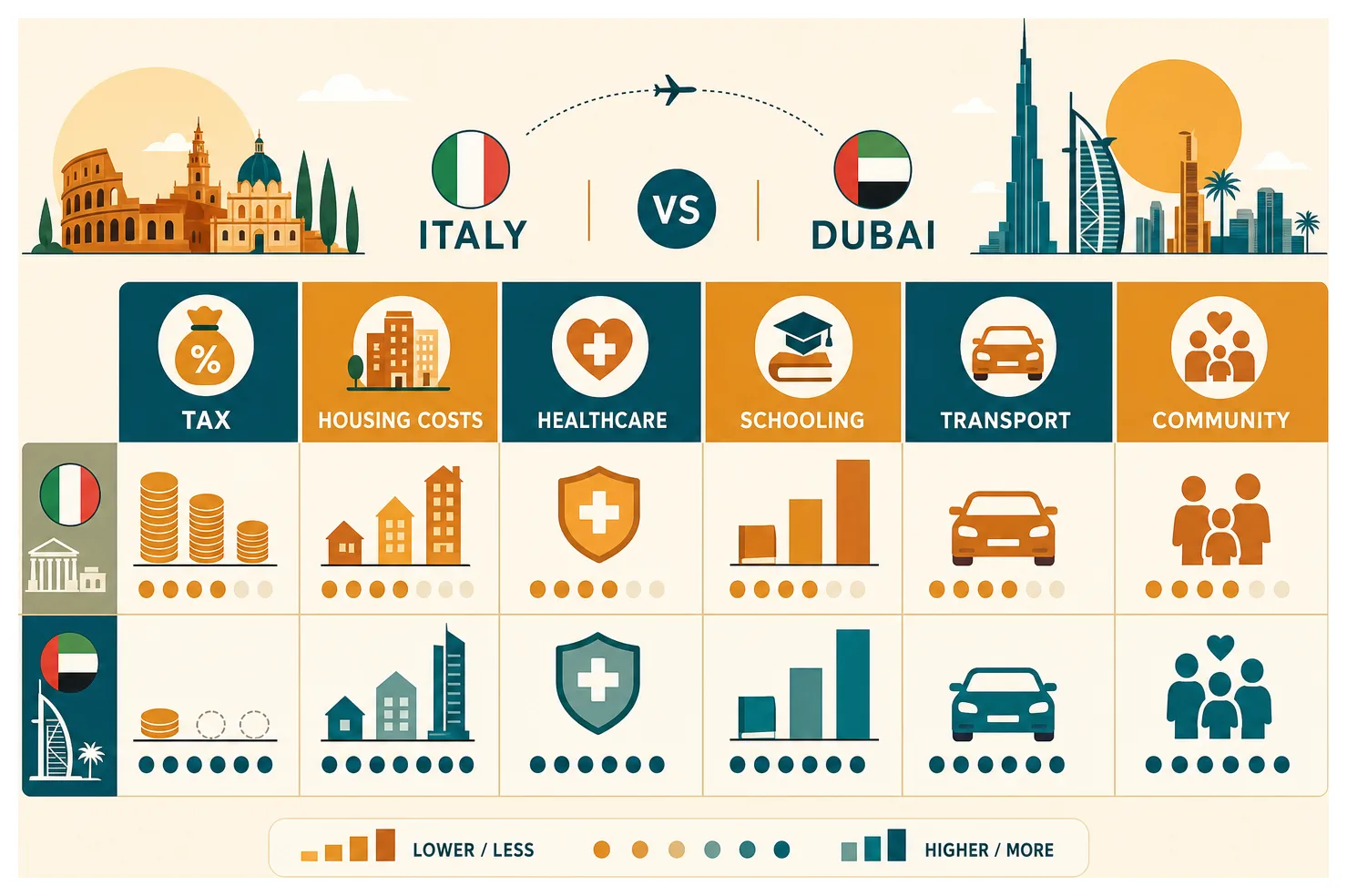
The structural differences from Italy are immediate. There's no personal income tax, a material shift from Italy's top marginal rate above 43%. Health insurance is mandatory and tied to your residency visa. Outside the Metro corridor, a car is closer to essential than optional. And alcohol, while legal, is only available at licensed venues or through licensed home delivery, not on supermarket shelves.
Residency here doesn't come from simply living in the country. It comes from a sponsor: an employer, a company you own, or a family member. A UAE trade license or employment contract is the legal foundation for the visa chain, and your Emirates ID, the card that opens up banking, healthcare, utilities, and government services, is the document you'll use for almost everything.
Culture Shock: What Italians Find Most Surprising
The heat gets mentioned first, but it's not what catches most Italian expats off guard. It's the absence of piazza culture. There's no passeggiata, no neighbourhood bar as a social anchor, no organic street-level sociability. Social life in Dubai is organised rather than spontaneous, dinner invitations, WhatsApp groups, and scheduled events replace the informal drop-in culture familiar from Italian cities.
Public behaviour norms require adjustment too. Displays of affection are discouraged. Dress codes vary sharply by location, conservative in government buildings and souks, relaxed at beach clubs and malls. During Ramadan, eating or drinking in public during daylight is not permitted, and the city's social rhythm shifts significantly. Most Italian expats find this genuinely affecting once they've experienced it firsthand.
| What Italians Notice | In Italy | In Dubai |
|---|---|---|
| Social life | Spontaneous — piazza, bar, passeggiata | Organised — WhatsApp groups, scheduled dinners, planned events |
| Public behaviour | Relaxed displays of affection, informal dress | Dress codes vary by location; affection in public is discouraged |
| Working week | Monday to Friday standard | Sunday to Thursday in many sectors; Friday is the main rest day |
| Ramadan | No equivalent public restriction | Eating and drinking in public during daylight hours is not permitted |
| Summer climate | Hot, but outdoor life continues | Extreme heat from June to September; outdoor activity largely pauses |
The working week is another adjustment. Many sectors still run Sunday to Thursday, though private companies are increasingly shifting to Monday to Friday. Friday is the main rest day. And from June to September, the extreme heat reshapes everything, outdoor life essentially pauses, and air conditioning becomes non-negotiable.
The Italian Community in Dubai
The community infrastructure is genuine and worth using from day one. The Italian Consulate General in Dubai covers the UAE's northern emirates and handles passports, civil status documents, and citizen registration. Registering through AIRE (Anagrafe degli Italiani Residenti all'Estero) is strongly recommended, it opens up emergency assistance, electoral participation, and faster document processing when you need it.
The Camera di Commercio Italiana negli Emirati runs networking events and supports Italian businesses across the Gulf. Sports clubs, particularly football and cycling groups, provide a reliable route into the community for those arriving without prior connections. WhatsApp groups and Facebook communities are genuinely active and useful for practical information: school recommendations, apartment searches, local services.
Free Company Name Check
Check NowHousing: Where Italian Expats Tend to Live
Dubai Marina, JLT, Downtown, and Jumeirah attract the highest concentration of Italian residents, areas that combine walkability, dining options, and proximity to business districts. Families with children often move toward Arabian Ranches or Dubai Hills Estate for space and school access.
The rental mechanics differ significantly from Italy. Rent is paid in advance, typically one to four post-dated cheques per year, which requires meaningful upfront capital. A two-bedroom apartment in Dubai Marina runs roughly AED 110,000 to AED 160,000 annually; a three-bedroom villa in Arabian Ranches runs AED 200,000 to AED 350,000. First-year costs are higher than the headline figure: security deposits, agency fees, Ejari registration (the mandatory tenancy registration with the Dubai Land Department), and utility connections add up quickly.
Schooling for Italian Expat Families
The Scuola Italiana di Dubai follows the Italian Ministry of Education curriculum and leads to the Diploma di Maturità, recognised at Italian universities without further examination. Teaching is in Italian throughout, with English as an additional language. The school community is also a significant social hub, for families planning to return to Italy, it's often the first choice. Apply early: waitlists develop at entry year groups, and applications 12 to 18 months ahead are not unusual.
Families open to international pathways have strong alternatives. British-curriculum schools are the most numerous in Dubai. IB programmes offer the broadest university portability for families uncertain about long-term destination. The KHDA (Knowledge and Human Development Authority) inspects and rates every private school in Dubai on a scale from Outstanding to Weak, these reports are published publicly and are a useful filter before booking tours. Annual tuition runs from around AED 25,000 at the lower end to over AED 100,000 at premium schools, with transport, uniforms, and activities adding materially on top.
Daily Life: Healthcare, Transport, and Practical Logistics
Health insurance is mandatory, it cannot be deferred, and the visa cannot be renewed without active cover. Dubai runs on a private insurance model: you hold a policy, choose from your insurer's network, and pay co-payments at the point of care. There's no equivalent to Italy's Servizio Sanitario Nazionale. A comprehensive family plan costs AED 15,000 to AED 25,000 per year, which must be factored into the full cost of living calculation from the outset.
A car is practically essential for most Italian expats. The Metro covers key corridors but doesn't reach most residential areas, schools, or business parks. Italian driving licenses convert directly to a UAE license with no theory or road test required, a genuine advantage. Salik, Dubai's electronic road toll system, deducts AED 4 per gate crossing automatically via a windscreen tag. Ride-hailing apps like Uber and Careem are reliable and widely used.
The Emirates ID is the document that opens up daily life. Banking, healthcare registration, utility connection, school enrollment, and SIM card activation all require it. DEWA (Dubai Electricity and Water Authority) connection requires the Ejari certificate, sort the tenancy registration before expecting utilities to activate. Most government services run through apps: DubaiNow and UAEICP handle the majority of routine administrative tasks once accounts are set up.
Expert Financial and Tax Compliance Services in Dubai
Explore mAccountingWorking in Dubai as an Italian National
Most Italian expats arrive on employment visas sponsored by UAE-registered companies. Self-employed Italians and entrepreneurs set up through a free zone Trade License from AED 12,500, which allows 100% foreign ownership with no local partner requirement. The investor visa that comes with a free zone trade license is self-sponsored, your status isn't tied to an employer, which provides meaningful resilience if circumstances change.
The UAE's 0% personal income tax is real. But establishing genuine UAE tax residency requires meeting the UAE's 183-day presence test and satisfying Italy's exit requirements, it's not automatic, and Italian obligations on overseas accounts and income require ongoing attention. Corporate tax applies at 9% on taxable profits above AED 375,000 for UAE-registered businesses. Take cross-border tax advice before restructuring, the exit from Italian tax residency, handled correctly, is what makes the position clean. The corporate tax support and VAT registration support available through specialist services help maintain compliance from day one.
What Italian Expats Who Stay Get Right
Those who build durable lives in Dubai tend to do a few things consistently. They join community networks, Consulate registration, Camera di Commercio events, sports clubs, in the first month, not after six months of isolation. They choose housing around school proximity and commute reality rather than prestige address. And they model the full financial picture honestly before arriving, not just the headline salary.
Dubai's tax advantage is real but easily absorbed by housing, schooling, insurance, and transport costs. An Italian family that budgets honestly, including comprehensive health insurance, school fees, car ownership, and a realistic housing cost, arrives prepared. Those who budget on salary alone discover the gap between gross and net quality of life is narrower than expected.
Living in Dubai as an Italian expat is a genuine transition. The community is established, the infrastructure works well once understood, and the financial case is solid for those who manage it carefully. The adjustment requires accepting that Italian-style public life doesn't translate here, that costs are higher than the headline suggests, and that the administrative setup demands attention upfront. Those who treat this as a serious relocation project, rather than a lifestyle experiment, tend to build something worth staying for.
If you're planning to set up a company in Dubai alongside your relocation, remote business setup is fully available, and speaking with a Meydan Free Zone advisor before you arrive helps you get the license and visa sequence right from the start, which saves significant time and cost in those first critical weeks.
Free Business Setup Cost Calculator
Calculate Now