

Table of Contents
Frequently Asked Questions
What corporate tax does a UAE free zone company pay?
0% on taxable income up to AED 375,000, around €86,250, and 9% above it. Free zone companies can access 0% on qualifying income as a Qualifying Free Zone Person, assessed annually against substance and audit conditions.
Is the free zone 0% rate automatic?
No. It requires Qualifying Free Zone Person status, which means adequate substance in the free zone, qualifying income, transfer pricing compliance and audited financial statements. The status is reviewed each year rather than granted once.
Do Italian CFC rules apply to a Dubai free zone company?
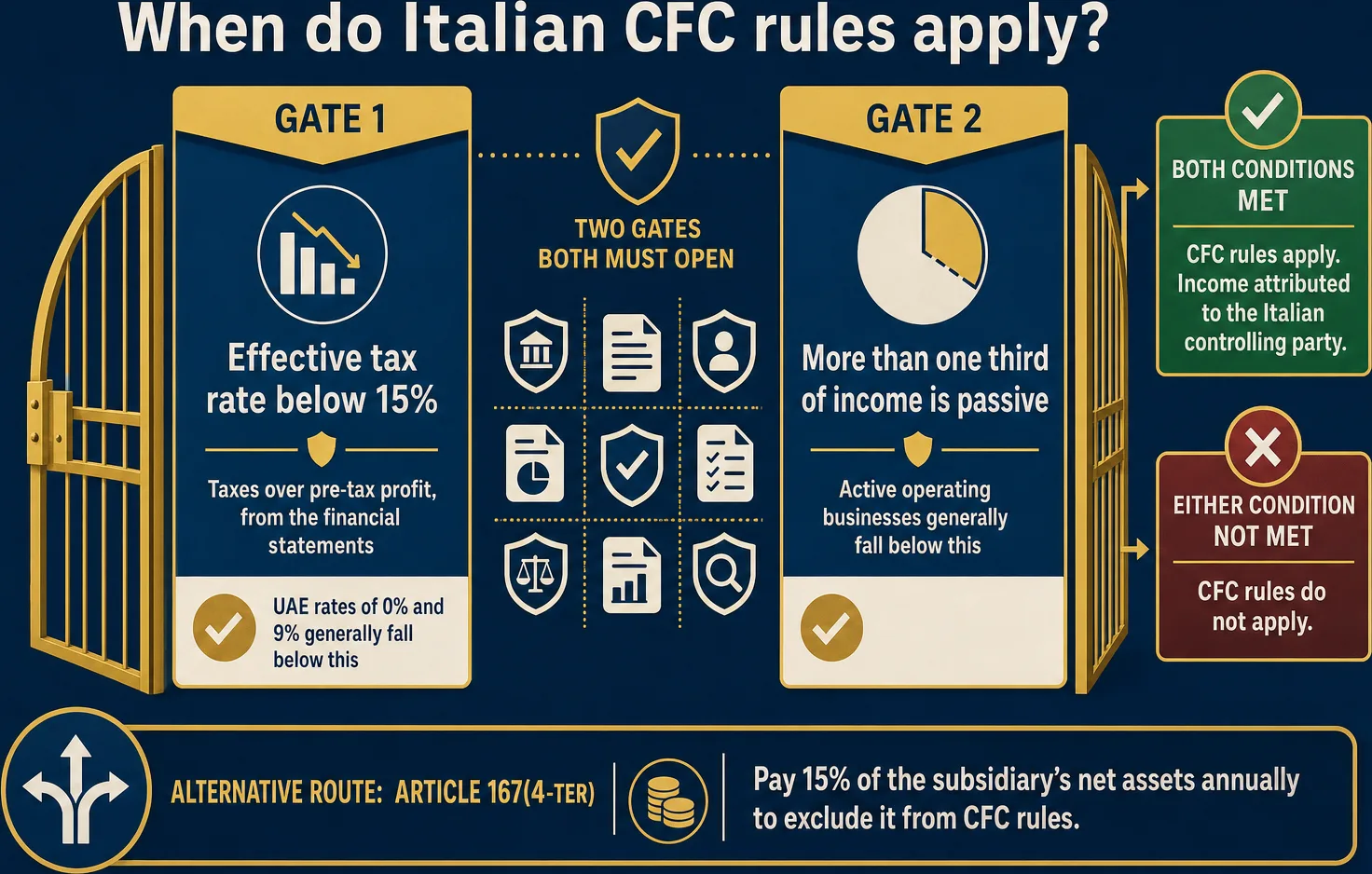
Only if both conditions are met. The effective tax rate must be below 15%, and more than one third of income must be passive. Active operating businesses generally fall outside the regime.
What is the Italian 15% substitute tax option?
Article 167(4-ter) TUIR lets the Italian controlling party pay 15% of the subsidiary's net accounting profit instead of calculating effective foreign taxation. It runs three years, renews tacitly, and requires audited certified accounts.
Does a flexi desk satisfy substance for the 0% rate?
Not usually on its own. A flexi desk fully satisfies licensing and visa requirements, but companies pursuing Qualifying Free Zone Person status generally build more operational presence, which upgrading workspace supports without changing the license.
Topic Summary
Free Zone Is Not Automatic
A UAE free zone company does not automatically get a 0% corporate tax outcome. Italian-owned companies need to test whether income is qualifying, whether substance is strong enough, and whether any mainland or related-party revenue changes the analysis.
Classify Income Before Anything
Start by mapping each revenue stream by customer location, activity, and contract type. This helps founders separate qualifying free zone income from non-qualifying income early, rather than discovering the issue after invoices are issued and the year is closed.
Check Qualifying Free Zone Status
The real question is not Italian ownership. It is whether the company meets the conditions for qualifying free zone treatment, including substance, transfer pricing compliance, clean records, and no casual assumptions about how one rule applies to all income.
Register With FTA On Time
Trade license issuance and corporate tax registration are separate tasks. Open or confirm the EmaraTax profile quickly, register with the UAE Federal Tax Authority, and save the reference details centrally so deadlines do not get missed later.
Build Books That Split Revenue
Your chart of accounts should clearly separate qualifying income, other income, costs, and related-party items. Good bookkeeping is not admin for later, it is what makes filing, tax support, and any review much easier from month one.
Watch Italy As Well
A UAE company does not by itself change your Italian tax position. Founders should plan a conversation with an Italian commercialista before year-end decisions, especially if management, distributions, or reporting duties in Italy still sit in the picture.
Treat Compliance As Ongoing
The main risk is weak execution: late registration, mixed income buckets, or unsupported free zone claims. A simple filing calendar, named owner, and document folder for contracts, invoices, and bank records can protect the corporate tax position year after year.
UAE corporate tax is often described in one number. The reality has two layers, and Italian owners need both, because Italy applies its own test alongside the UAE one.
On the UAE side, corporate tax is 0% up to AED 375,000 of taxable income, around €86,250, and 9% above it. Free zone companies can access 0% on qualifying income, but only as a Qualifying Free Zone Person, and that status is assessed every year. This guide covers what the UAE requires, what Italy checks, and how the two fit together.
Key Facts at a Glance
| Item | Detail |
|---|---|
| Standard rate | 0% to AED 375,000, around €86,250, then 9% |
| Free zone rate | 0% on qualifying income, as a Qualifying Free Zone Person |
| Status review | Assessed annually |
| Audited accounts | Required for Qualifying Free Zone Person status |
| Italian overlay | CFC rules under Article 167 TUIR |
The UAE Position
The headline rates are straightforward.
- 0% on taxable income up to AED 375,000, around €86,250
- 9% above that threshold
- No personal income tax on salary or dividends
- VAT at 5%, with registration mandatory above the turnover threshold
Free zone companies sit alongside this rather than outside it. Every free zone company registers for corporate tax and files a return. The 0% qualifying rate is a relief within the system, not an exemption from it.
Free Company Name Check
Check NowWhat Qualifying Free Zone Person Status Requires
This is the part that determines whether 0% applies, and it is a set of conditions rather than a box to tick.
A Qualifying Free Zone Person must:
- Maintain adequate substance in the free zone, with real activity, people and assets
- Derive qualifying income, as defined by the current Ministerial Decision on qualifying activities
- Not have elected to be taxed at the standard rate
- Comply with the arm's length principle and maintain transfer pricing documentation
- Prepare audited financial statements
A de minimis allowance exists for a limited proportion of non-qualifying revenue. Exceed it and the status is lost, generally for the tax period concerned and following periods.
Substance deserves particular attention. A flexi desk is entirely sufficient for licensing and visas. For companies pursuing Qualifying Free Zone Person status, it is usually not treated as adequate substance on its own, which is why workspace upgrades matter here more than elsewhere.
Qualifying and Non-Qualifying Income
| Aspect | Qualifying income | Non-qualifying income |
|---|---|---|
| Rate applied | 0% | 9% |
| Typical sources | Transactions with other free zone persons, and listed qualifying activities | Mainland UAE customers, and excluded activities |
| Substance needed | Adequate substance in the free zone | Standard corporate tax rules apply |
| Effect on status | Maintains it | Beyond the de minimis allowance, status is lost |
Because the two sit inside one company, activity mix matters. A business selling directly to mainland UAE customers generates non-qualifying income, which is one reason the mainland question comes up early in planning.
Free Business Setup Cost Calculator
Calculate NowThe Italian Overlay
Italy runs its own assessment of foreign subsidiaries, and Italian owners should understand it before setting up rather than afterwards.
Under Article 167 TUIR, controlled foreign company rules can attribute a foreign company's income to the Italian controlling party. Two conditions must both be met. The subsidiary's effective tax rate must fall below 15%, measured as taxes over pre-tax profit from the financial statements. And more than one third of its income must be passive.
Both parts matter. UAE rates of 0% and 9% sit below the 15% line, so that condition is generally satisfied. The passive income test is where most operating businesses fall outside the regime. Where passive income does not exceed one third, CFC rules do not apply regardless of the foreign tax level.
An alternative route exists. Article 167(4-ter) allows the Italian controlling party to pay a substitute tax of 15% on the subsidiary's net accounting profit, avoiding the complex calculation of effective foreign taxation. The regime was rewritten by Decree Law 84 of 2025, converted by Law 108 of 2025, with implementing rules set by the Revenue Agency in March 2026. The option runs for three years, renews tacitly, and requires audited and certified financial statements of the foreign company.
That last requirement is worth noting, because Qualifying Free Zone Person status requires audited accounts too. One set of properly audited financial statements serves both purposes.
Separately, the fiscal monitoring rules apply to Italian tax residents regardless of the CFC position.
How Meydan Free Zone Supports Compliance
The obligations are handled rather than left to you.
- mAccounting covers corporate tax registration, bookkeeping and VAT registration and filing
- Financial records are maintained to the standard audited accounts require
- Workspace can scale from the included flexi desk to a dedicated desk, shared office or dedicated office at the Meydan Business Centre, without changing the trade license
- mCore provides UAE banking, so revenue is evidenced through UAE accounts
A Meydan Free Zone license starts at AED 12,500, around €2,875 a year, and includes the flexi desk. Companies building toward Qualifying Free Zone Person status typically add workspace as the business grows.
Bringing It Together
UAE corporate tax is 0% up to AED 375,000 and 9% above, with a 0% qualifying rate available to free zone companies meeting substance, income and audit conditions.
Italian owners have a second layer to satisfy. CFC rules turn on both a 15% effective tax test and a passive income test, and a 15% substitute tax option exists for those who want simplicity. Audited accounts serve both jurisdictions. To set up with the compliance side handled, contact the Meydan Free Zone team.
This guide is general information rather than tax advice. A qualified Italian commercialista should review your position.
Start Your UAE Company Remotely
Get in Touch Now