

Table of Contents
Frequently Asked Questions
1. How does the UAE residence visa process work for US citizens moving from USA to Dubai?
Once the company's Establishment Card is issued, the company can apply for your entry permit. You then enter the UAE to complete your medical fitness test, biometrics, an Emirates ID application, & visa stamping, typically valid for two years. The full sequence from company setup to Emirates ID takes approximately 6–10 weeks.
2. Do Americans still pay US taxes after moving from USA to Dubai?
Yes. US citizens must file a Self Assessment tax return each year with the IRS regardless of where they freelance or reside. The Foreign Earned Income Exclusion (FEIE) may reduce exposure, but cross-border specialist advice is essential before you relocate.
3. What is the difference between a Free Zone & a Mainland company for Americans relocating to Dubai?
The core differences between a Free Zone & a Mainland company come down to ownership, scope of business, & office requirements. Free Zone offers 100% foreign ownership, packages tailored to consultants & tech entrepreneurs, while a Mainland company is necessary if you want to trade directly within the local UAE market.
4. Can I sponsor my spouse & children for UAE visas after moving from USA to Dubai?
Yes, once your own residence visa is stamping, typically valid for two years, & your Emirates ID is issued & in your possession, your company can apply for dependent visas. Each dependent follows the same entry permit, fitness test, & Emirates ID sequence, adding approximately AED 8,000–AED 15,000 in additional fees.
5. What is UAE Corporate Tax & does it apply to my Dubai company as a US citizen?
As of June 2023, a federal Corporate Tax of 9% applies to taxable profits exceeding AED 375,000 annually; startups below this threshold pay 0%. Registration with the Gov.ae Federal Tax Authority is mandatory, & Businesses with annual revenues over AED 375,000 must also register for VAT at 5%.
Topic Summary
1. Your Company Sponsors Your Residency
Moving from USA to Dubai means forming a UAE company first, it acts as your sponsor, unlocking your entry permit & Emirates ID. The sequence is logical & checkpoint-driven: company setup unlocks the Immigration File, which unlocks everything else.
2. Choose Free Zone or Mainland Early
The core differences between a Free Zone & Mainland come down to ownership, scope of business, & visa allocation. Choose the wrong jurisdiction upfront & reversing it costs both time & additional service fees.
3. Trade License Comes Before Anything
Submit documents, reserve the company name, & pay fees to get your Trade License & Memorandum of Association, these are proof that your company is established. Without this, the Immigration File cannot be opened & no visas can be issued.
4. In-Country Residency Steps Take 2–3 Weeks
Enter the UAE to complete your medical fitness test, biometrics, & Emirates ID application before visa stamping, typically valid for two years. Having corporate documents organized at each appointment prevents delays.
5. Family Visas Follow Your Own Residency
In fact, your spouse & children cannot be sponsored until your own Emirates ID is issued & your residence visa is stamped. Each dependent mirrors your sequence, entry permit, fitness test, biometrics, & visa stamping.
6. US Tax Obligations Don't Stop at the Border
Americans must file a Self Assessment tax return each year with the IRS regardless of where they freelance or work. Seek expert advice from a US-UAE cross-border tax advisor before committing to any structure, not after.
7. Banking Requires Careful Preparation for Americans
Opening a corporate bank account in Dubai requires careful preparation due to strict anti-money laundering (AML) & FATCA compliance requirements. Having key clients, expected revenue documentation, & corporate documents organized significantly improves approval prospects.
Moving from the USA to Dubai, UAE: Residency & Business Setup Guide
More Americans are choosing to relocate to Dubai than at any point in the past decade, drawn by 0% personal income tax, a business-friendly regulatory environment, and a geographic position that puts both European and Asian markets within a few hours' flight. But moving from USA to Dubai isn't a single application, it's a sequence. Company setup unlocks residency, residency unlocks family visas, and the jurisdiction you choose determines your cost base, visa allocation, and scope of business for years ahead.
This guide covers each stage with the specificity you need to proceed without wasted time or money.
What Moving from USA to Dubai Actually Involves
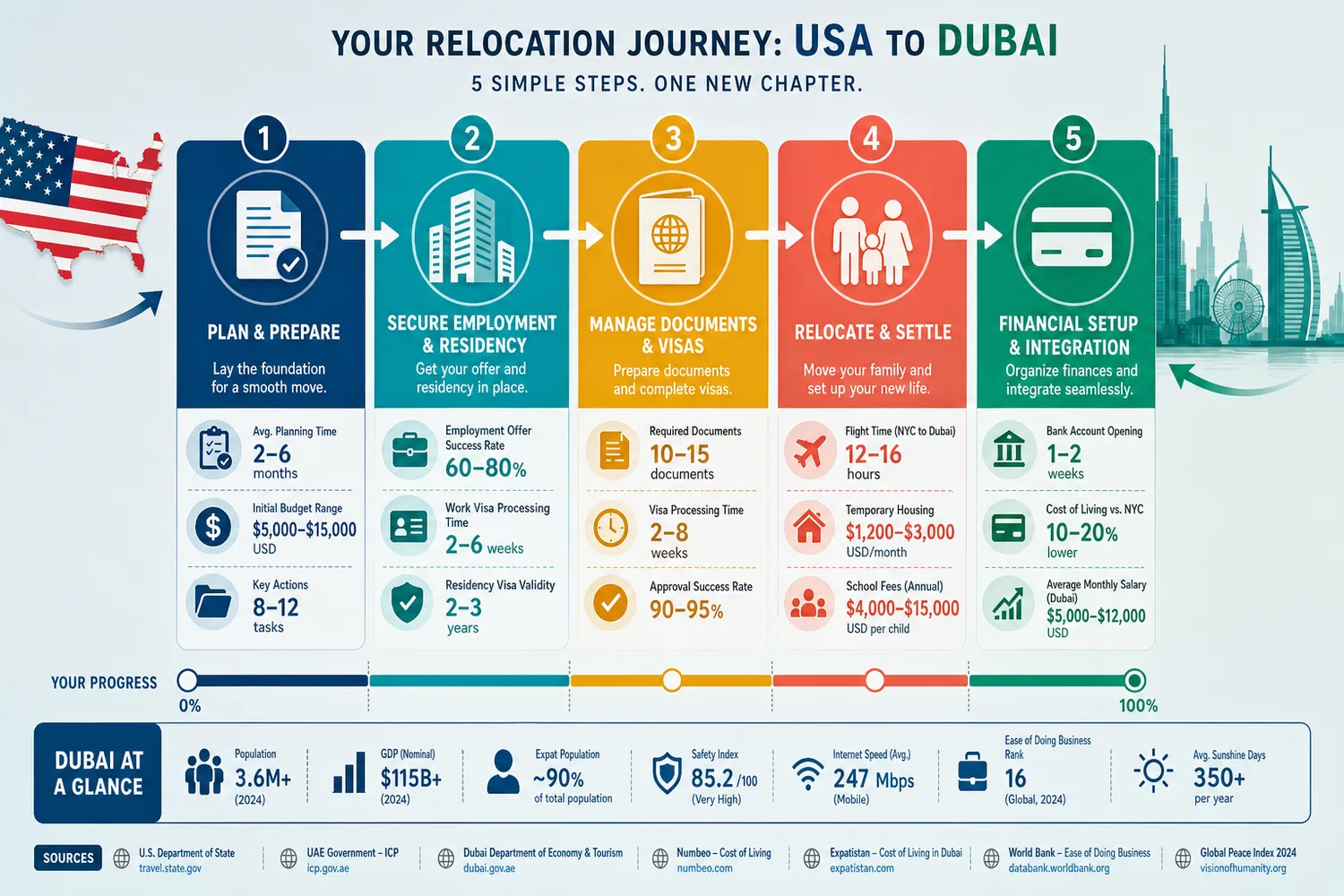
The full sequence from company setup to Emirates ID typically takes 6–10 weeks. Your UAE company acts as your legal sponsor, not an employer. The mechanics are logical and checkpoint-driven: company formation unlocks the Immigration File, which unlocks the entry permit, which unlocks in-country residency steps. Americans can't self-sponsor; a legally formed UAE entity is the standard route for founders, freelancers, and remote professionals.
Before getting into any paperwork, you'll need: a clear, color copy a white background, a professional email, and a phone number ready. Answering these questions upfront helps prevent costly mistakes, what is your business model? How many visas will you need? Do you want to trade directly within the local UAE market or primarily with international clients?
Choosing Your Jurisdiction: Free Zone or Mainland
The core differences between a Free Zone and a Mainland company come down to ownership, scope of business, office requirements, and visa allocation. Free Zones offer 100% foreign ownership and packages tailored to consultants, tech entrepreneurs, and digital nomads. A Mainland company allows you to trade directly within the local UAE market but involves more complex setup requirements.
Your business activity is the cornerstone of the entire setup, you can't just pick a generic "consulting" license; you must select a specific activity from a government-approved list. A SaaS company selling subscriptions globally is a perfect fit for a Free Zone. An American opening a local retail concept needs to assess a Mainland company model carefully.
Meydan Free Zone is a digital-first, execution-focused jurisdiction that caters heavily to consultants, tech entrepreneurs, and remote-first operators. Setup is simple, with one visa included in entry-level packages. Use their Setup Cost Calculator as a clarity tool to compare jurisdiction's fees before committing.
Step-by-Step: Company Setup and License
Choose name, and pay fees to get your Trade License and Memorandum of Association. These are proof that your company is established. The Trade License is renewed annually, factor in these recurring fees from day one.
With approvals in place and the Trade License issued, the company can open its Immigration File, also known as the Establishment Card stage. This is a critical milestone that bridges the gap between company formation and the residency process. Without this file, the company cannot sponsor anyone, following these steps in the correct order is crucial for avoiding delays.
Secure Your UAE Residence Visa: In-Country Steps
- Establishment Card issued by your Free Zone or Mainland authority — without this, the company cannot sponsor anyone
- Entry Permit applied for by the company on your behalf — the document that authorises you to enter or remain in the UAE for residency steps
- Medical fitness test completed inside the UAE, which screens for communicable diseases
- Biometrics submitted at an ICP service centre — fingerprints and photograph captured at the same stage as your Emirates ID process
- Emirates ID application filed and physical card delivered within 3–5 business days for standard processing
- Passport submitted for final visa stamping — the residence visa is affixed to a page in your passport, typically valid for two years
Family Visas: Sponsoring a Spouse and Dependents
Once your own UAE residence visa is stamped and your Emirates ID is issued, your company can apply for dependent visas for a spouse and children. Each dependent goes through the same entry permit, fitness test, biometrics, and Emirates ID sequence. Sponsoring a spouse and two children typically adds AED 8,000–AED 15,000 in additional government and service fees.
To sponsor dependents, you must hold a valid UAE residence visa and meet a minimum salary threshold set by UAE immigration. If you're still exploring UAE residency for US citizens, it's worth understanding the eligibility requirements and sponsorship rules before beginning the application process. Documents required for each dependent include: a clear, color copy of their passport, marriage certificate (attested for a spouse), and birth certificates (attested for children).
Many families relocating also begin researching hiring a nanny in Dubai as Americans to better understand sponsorship rules, employment costs, and legal requirements once they're settled
Attested documents from the US must be authenticated through the UAE Embassy in Washington D.C., factor in 2–4 weeks for this step if documents aren't already attested. As part of your relocation planning, many expat families also look into converting a US driving license in Dubai to ensure they can drive legally soon after arrival.
You also need to factor in these recurring fees to maintain your residency: Trade License renewal annually, residence visa renewal every two years, and Emirates ID renewal aligned to visa validity. Missing renewal deadlines results in fines and legal complications, good administration from day one is non-negotiable.
Tax Considerations for Americans Moving to Dubai
The UAE does not have personal income tax. However, US citizens are taxed on worldwide income by the IRS regardless of where they live. Moving from USA to Dubai does not eliminate your IRS filing obligation. The Foreign Earned Income Exclusion (FEIE) allows qualifying Americans to exclude a portion of foreign-earned income, for 2023, this threshold was USD 120,000 (IRS, 2023). Confirm the current figure with a US tax advisor.
As of June 2023, a federal Corporate Tax of 9% applies to taxable profits exceeding AED 375,000 annually, startups below this threshold are taxed at 0%, but registration with the Gov.ae Federal Tax Authority is mandatory (UAE Ministry of Finance, 2023). Businesses with annual revenues over AED 375,000 in taxable supplies must register for VAT at 5% and file regular VAT returns. Additionally, you may also compare US vs UAE tax.
The UAE does not have capital gains tax at the federal level, and dividends drawn from your UAE company are yours to keep, but passive income. A US-UAE cross-border tax specialist is essential before you proceed.
Opening a Corporate Bank Account in Dubai
Opening a corporate bank account in Dubai as a US citizen requires careful preparation. Due to strict anti-money laundering (AML) and FATCA compliance requirements, UAE banks apply thorough due diligence to US-connected accounts. FATCA requires UAE banks to report accounts held by US persons to the IRS, some banks decline US-connected accounts outright.
These typically include: Trade License, Certificate of Incorporation, Memorandum of Association, passport copies for all partners, Emirates ID, and a detailed business plan with key clients and expected revenue. The corporate bank account can add another 2–4 weeks to your timeline. Some digital-first banks process applications faster, sometimes just a few days. However, they may have transaction limits that don't suit all business models.
Next Actions: What to Do This Week
Define your business activity and jurisdiction preference, Free Zone or Mainland, before contacting any setup firm. Gather your corporate documents: passport copy, professional email, phone number ready, and a summary of your business model. Contact a US-UAE cross-border tax advisor and a licensed UAE company setup firm in parallel, both conversations should happen before you sign anything or pay any fees.
Documents that are incomplete or not attested correctly are the single most common cause of delays, get a clear digital copy and a fresh passport-style photo of every document before submission. Don't underestimate the timeline for the corporate bank account, build in 4–8 weeks and have a contingency plan for receiving client payments during this period.
Conclusion
Moving from USA to Dubai is a structured, sequential process. The company is established first, which unlocks the Immigration File, which unlocks your residence visa, which unlocks family sponsorship. Americans face additional considerations around US tax obligations and FATCA banking compliance that require specialist advice before the move, not after. With the right jurisdiction choice, correct business activity, and documents organized upfront, the full sequence from company formation to Emirates ID is achievable in 6–10 weeks.
Use the Meydan Free Zone Setup Cost Calculator to get a clear cost breakdown for your specific business activity and visa requirements, then book a consultation with a US-UAE cross-border tax advisor before committing to any structure.