
Table of Contents
Frequently Asked Questions
What does activity code 7110.36 — Buildings Electrical Engineering Services — actually cover
Activity code 7110.36 covers the intellectual and technical side of electrical engineering applied to buildings. This includes electrical system design, load calculations, wiring schematics, switchgear specification, and supervision of installation works across residential, commercial, and industrial properties.
It is classified under ISIC Division 71 — Architectural and Engineering Activities, which groups engineering advisory and design services for the built environment. The licence authorises design drawings, specifications, site supervision, and formal sign-off — but not the physical installation of electrical systems, which requires a separate contracting classification.
Typical clients holding contracts with 7110.36-licensed firms include main contractors, property developers, government project owners, and facility management companies.
What is the difference between an electrical engineering services licence and an electrical contracting licence in Dubai
This distinction is one of the most common points of confusion for new entrants. An engineering services licence (7110.36) covers design, specification, and site supervision — the consultancy and oversight functions. A Dubai Municipality electrical contracting classification covers the physical installation of electrical systems on site.
The contracting licence carries its own separate requirements, including bonding, equipment ownership, and minimum manpower criteria. The two are distinct licence categories and cannot be substituted for one another.
Many established firms hold both, either as two separate legal entities or through a dual-activity licence where the jurisdiction permits it. If your business model spans both design and physical delivery, this should be planned from the outset rather than addressed retrospectively.
Should a Buildings Electrical Engineering Services firm set up on the mainland or in a freezone in Dubai
For firms intending to bid on government projects or work directly with Dubai Municipality-approved contractors, the mainland route issued via Dubai Economy and Tourism (DET) is the standard choice. Most serious engineering consultancies active in the Dubai construction market are mainland-registered for this reason.
Freezone options — such as Meydan Free Zone — offer a more cost-efficient entry point, particularly for consultancies targeting regional or remote-delivery projects. However, freezone-licensed firms must appoint a mainland-registered consultant or obtain a civil works permit to operate directly on Dubai project sites, which adds operational friction.
If your primary market is Dubai-based construction projects, the freezone route introduces an additional compliance layer. If your work is largely advisory or regionally focused, a freezone structure may be sufficient and more economical.
Is 100% foreign ownership permitted for a mainland electrical engineering services licence in Dubai
Yes. Following the 2021 ownership reforms, 100% foreign ownership is permitted for most professional activities on the Dubai mainland, including engineering services under activity code 7110.36.
Mainland professional engineering licences are structured as civil companies, and the foreign ownership allowance applies to this structure. This removed the previous requirement for a UAE national partner holding a 51% stake, which had historically been a barrier for international engineering firms.
It is worth confirming the current position with a licensed business setup adviser, as specific conditions — such as the requirement for a qualified engineer to be designated as the technical responsible manager — still apply regardless of ownership structure.
What are the key regulatory bodies overseeing electrical engineering work on buildings in Dubai
Three principal authorities govern the technical and compliance framework for buildings electrical engineering in Dubai. Dubai Municipality sets engineering requirements for building permit submissions and oversees the approval of electrical design drawings and specifications.
DEWA (Dubai Electricity and Water Authority) establishes technical standards for electrical installations, particularly those connecting to the public grid, and must approve designs that interface with the distribution network.
Dubai Civil Defence has jurisdiction over fire safety systems, which frequently intersect with electrical engineering scope — particularly emergency lighting, fire alarm wiring, and suppression system power supplies. Compliance with all three bodies is typically required before a building permit is granted.
What is the minimum share capital required to set up a Buildings Electrical Engineering Services company in Dubai
Share capital requirements vary depending on the jurisdiction chosen. For mainland engineering firms, the typical minimum share capital is AED 300,000, though this figure can vary based on the specific legal structure and any additional activity classifications included in the licence.
Freezone requirements differ by zone and should be confirmed directly with the relevant freezone authority, as some offer lower minimum capital thresholds as part of their competitive positioning for professional services firms.
Share capital levels also have a practical bearing on visa eligibility, as the number of residency visas a company can sponsor is linked to both office space and share capital. This should be factored into setup planning if the firm intends to sponsor engineering staff from overseas.
How long does it take to obtain a Buildings Electrical Engineering Services licence in Dubai
Setup timelines vary by route. A mainland licence via Dubai Economy and Tourism (DET) typically takes 3 to 6 weeks from initial application to licence issuance, assuming all documentation — including engineer qualification verification and office lease registration — is in order.
Freezone licences can often be processed more quickly, with some zones offering streamlined digital onboarding. However, the overall timeline to being operationally ready — including DEWA and Dubai Municipality professional registration — will extend beyond the initial licence issuance regardless of route.
Delays most commonly arise from engineer credential verification, Ejari registration for the office lease, and any back-and-forth on the memorandum of association. Engaging a business setup specialist familiar with engineering licence requirements can reduce avoidable delays.
What qualifications are required for the technical responsible manager of a Buildings Electrical Engineering Services firm in Dubai
A qualified engineer with a UAE-recognised degree must be designated as the technical responsible manager for the licence. This individual carries professional accountability for the firm's engineering outputs and is the named signatory on design submissions to regulatory authorities.
A minimum of five years of relevant experience is required for this role. The degree and experience credentials must be attested and recognised by the relevant UAE authorities — typically involving attestation through the country of issue and verification by the UAE Ministry of Human Resources or equivalent body.
This requirement applies regardless of the ownership structure of the company. Even where 100% foreign ownership is exercised, the technical responsible manager role must be filled by a suitably credentialled engineer, and that individual's professional registration with Dubai Municipality is a prerequisite for the firm to submit engineering drawings for permit approval.
Buildings Electrical Engineering Services License in Dubai
Dubai's construction pipeline runs into hundreds of billions of dirhams, and every building on that list needs licensed electrical engineering services before it can open. Whether you are a contractor, a design consultant, or a specialist installer, you need the right license in place before you take on a single project.
This guide covers what the Buildings Electrical Engineering Services license covers, who needs it, how to get it, and whether a mainland or free zone setup makes more sense for your business.
Key Stats at a Glance
| License category | Professional / Engineering Services |
|---|---|
| Regulatory bodies | Dubai Municipality, Dubai Electricity and Water Authority (DEWA), Dubai Department of Economy and Tourism (DET) |
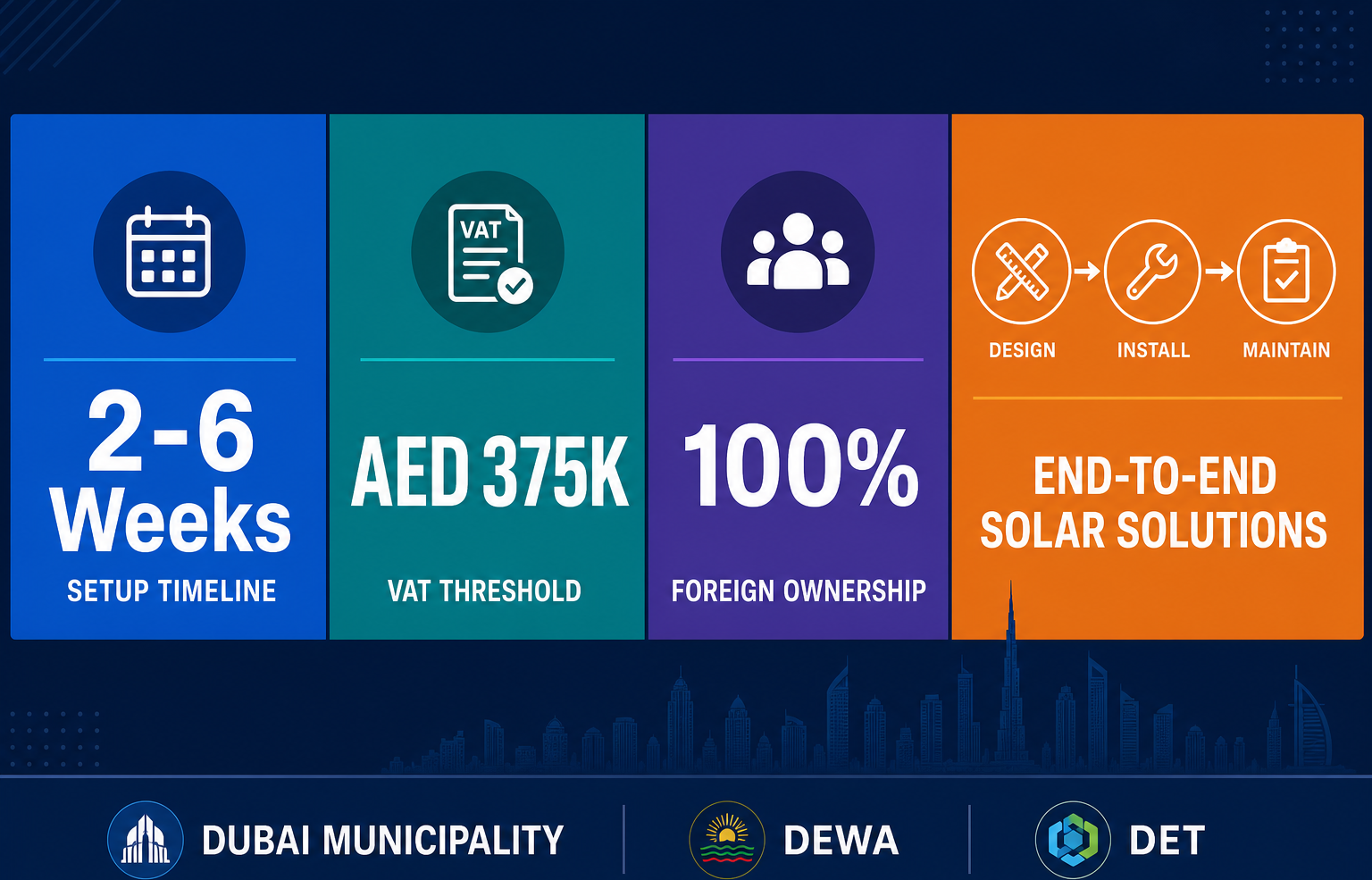
| Foreign ownership | 100% in a free zone; 100% on the mainland subject to DET approval – Invest in Dubai |
| Qualified Person (QP) | Mandatory – a registered engineer must be named on the license |
| DEWA contractor registration | Required for any installation work touching the low-voltage network |
| Typical setup timeline | 2 to 6 weeks depending on jurisdiction and QP documentation |
| VAT registration threshold | AED 375,000 annual revenue – Federal Tax Authority (FTA) |
What This License Covers
The Buildings Electrical Engineering Services license lets you design, install, test, commission, and maintain electrical systems inside buildings. That covers a wide range of work across residential, commercial, industrial, and infrastructure projects.
In practice, the scope includes:
- Electrical system design and load calculations
- LV panel installation and distribution boards
- Internal wiring, socket outlets, and lighting systems
- Emergency power systems and backup generators
- Testing, commissioning, and handover documentation
- Ongoing maintenance and periodic inspection contracts
What it does not cover
This license does not cover high-voltage (HV) network work, which needs a separate activity and DEWA HV contractor registration. It also does not cover specialist fire alarm systems or building management systems (BMS) as standalone activities. If your business does those alongside standard electrical work, you need extra activity codes added to your license.
Who sets the technical rules
Dubai Municipality sets the building regulations and technical standards that all licensed electrical contractors must follow. DEWA sets the rules for any work that connects to or affects its low-voltage distribution network. Both bodies run their own approval and registration processes, and you need to satisfy both before you can legally carry out installation work on a project in Dubai.
The Invest in Dubai portal lists approved activities and can help you confirm whether your planned scope needs one code or several.
Who Your Clients Will Be
The main buyers of electrical engineering services in Dubai are property developers, main contractors, fit-out firms, and facilities management companies. Each type of client has a different procurement process, and understanding that early saves you a lot of wasted effort.
Developers and main contractors
These clients run formal tender processes. They want you on their approved vendor list before they will even send you a tender pack. Getting onto that list takes time: you need your license in place, your DEWA registration confirmed, proof of qualified personnel, and usually a track record of completed projects. Nobody here buys on a phone call.
Government and semi-government projects
If you want to work on Dubai government projects, a municipality project, or a semi-government developer like a major infrastructure authority, you need a mainland trade license. A free zone license alone will not get you onto their vendor lists. This is one of the most important factors when deciding on your setup structure.
Facilities management firms
FM companies are a strong source of recurring work. They run long-term maintenance contracts on commercial buildings, hotels, and mixed-use developments. Once you are on their approved list and have delivered reliable work, these relationships tend to be sticky. They also tend to pay on longer cycles, so plan your cash flow accordingly.
DEWA and Dubai Municipality registration
Both registrations directly affect your ability to win work. Main contractors will ask for your DEWA contractor number before they subcontract installation work to you. Dubai Municipality registration is needed for permit applications on any building project. Without both, you are locked out of most serious contracts.
Mainland vs Free Zone: Which Setup Works for You
This is the most important decision you will make at the start. Get it wrong and you will either be locked out of the clients you want, or paying for a structure that is more complex than your business needs.
| Factor | Mainland (DET) | Free Zone (Meydan Free Zone) |
|---|---|---|
| Client access | Full UAE market including government projects | Mainly international clients and free zone businesses |
| On-site installation work | Permitted with DEWA and Dubai Municipality registration | Not permitted directly – needs a mainland entity |
| Office requirement | Physical office and Ejari required | Flexi-desk options available |
| Foreign ownership | 100% permitted subject to DET approval | 100% as standard |
| Setup cost | Higher – office lease adds to base cost | Lower entry cost; Dubai Trade License from AED 12,500 |
| Best suited for | Contractors carrying out physical installation in Dubai | Design consultants, project managers, internationally focused firms |
The honest answer for most contractors
If you plan to carry out physical electrical installation work on buildings in Dubai, you need a mainland license. That is not a preference, it is a regulatory requirement. DEWA contractor registration and Dubai Municipality permits are only available to mainland-licensed entities.
Where a free zone setup works
If your work is primarily design, consultancy, project management, or specification, and you are not physically installing anything on a UAE site, a Meydan Free Zone license gives you a fast, cost-effective setup with 100% foreign ownership and no requirement for a physical office. Some firms run both: a free zone entity for consultancy revenue and a mainland entity for on-site work.
Free Business Setup Cost Calculator
Calculate NowHow to Get Your License: Step-by-Step
- Step 1, book your trade name: Use the DET e-Services portal for a mainland company, or the Meydan Free Zone portal for a free zone setup. You can check your company name availability before you start the application.
- Step 2, confirm your activity code: Make sure the code covers your exact scope of work before you submit anything. If you plan to do both installation and maintenance, confirm both activities are on the license from day one.
- Step 3, get initial approval: DET or Meydan Free Zone issues initial approval once your name and activity are confirmed. This is not your final license, but it lets you move to the next steps.
- Step 4, secure your office address and Ejari: For a mainland company, you need a signed lease and a registered Ejari contract. Free zone applicants can use a flexi-desk arrangement through Meydan Free Zone.
- Step 5, submit your Qualified Person documentation: Dubai Municipality needs to approve the engineer named as QP on your license. Prepare their academic qualifications, professional registration documents, and relevant experience records. This step takes the most time, so start it early.
- Step 6, apply for DEWA contractor registration: If your work touches the low-voltage network, you must register as a DEWA-approved contractor. Submit your license, QP details, and supporting technical documents through DEWA's contractor portal.
- Step 7, collect your trade license and arrange visas: Once all approvals are in place, your license is issued. Arrange residence visas and Emirates ID for yourself and any staff. mResidency from Meydan Free Zone covers the full visa process if you need support with that.
Compliance: What You Need in Place Before You Start
Getting the license is step one. Staying compliant once you are operating is what protects your contracts and your name.
Qualified Person requirement
Dubai Municipality requires a registered engineer to be named on your license as the Qualified Person. This person is responsible for the technical accuracy of all work carried out under the license. If your QP leaves the business, you must replace them and update the registration before you take on new projects. Failing to do this puts your existing contracts at risk.
DEWA contractor registration
Any work that involves connection to or modification of the low-voltage distribution network needs DEWA contractor registration. This is separate from your trade license. DEWA runs its own assessment process and may require a site visit or technical interview before approving your registration.
Staff visas and MOHRE registration
All employees need valid UAE residence visas and Emirates ID. Once your headcount crosses the relevant threshold, you must register with the Ministry of Human Resources and Emiratisation (MOHRE) and meet Emiratisation duties. Check the current thresholds before you hire, as they change periodically.
VAT registration
You must register for VAT with the Federal Tax Authority once your annual revenue hits AED 375,000. Many electrical contractors cross this threshold quickly once they are on approved vendor lists. Register early rather than scrambling to catch up. The VAT registration support service through Meydan Free Zone can handle this for you.
Corporate tax
UAE corporate tax at 9% applies to taxable income above AED 375,000 for financial years starting on or after 1 June 2023. Make sure your accounting is in order from day one. The corporate tax services available through Meydan Free Zone cover registration, filing, and ongoing compliance.
Insurance
Professional indemnity and public liability insurance are standard requirements on most main contractor and developer contracts. Without them, you will not pass vendor registration. Get these in place before you start bidding.
Market Opportunity
Dubai's construction and infrastructure pipeline is one of the largest in the region, and it shows no sign of slowing down. The Dubai Urban Master Plan 2040 sets out a long-term programme of new residential communities, commercial districts, and public infrastructure. Every project on that list needs electrical engineering services.
Beyond new builds, there is a growing volume of work in smart building upgrades and energy efficiency retrofits. Older commercial buildings are being upgraded to meet new energy codes, and building owners are investing in smart metering, LED conversions, and automated building management systems. This segment runs alongside new construction rather than competing with it, which means demand is broad.
Long-term facilities management contracts are another strong revenue stream. Once you are on an FM company's approved list and have a track record of reliable work, those relationships tend to last years. The recurring nature of maintenance contracts gives you a stable base to build on.
The barriers to entry are real: DEWA registration, Dubai Municipality QP approval, and the time it takes to get onto approved vendor lists all filter out operators who are not serious. That is good news once you are through the process. Compliant, well-registered electrical contractors with a track record are not easy to replace, and clients know it.
According to Mordor Intelligence, the UAE construction sector continues to grow at a steady pace, driven by government infrastructure spending and private sector development. Electrical engineering services sit at the centre of that activity.
Conclusion
A Buildings Electrical Engineering Services license in Dubai gives you access to one of the most active construction markets in the region. But it comes with real requirements: a named Qualified Person on the license, DEWA contractor registration for installation work, Dubai Municipality compliance, and a procurement process that rewards preparation over speed.
Most contractors carrying out physical work in Dubai need a mainland trade license. If your work is consultancy or design-led, a Meydan Free Zone setup is a faster and lower-cost starting point, with the option to add a mainland entity later as your client base grows.
Speak to Meydan Free Zone to confirm the right license structure for your business before you start the application. Getting the structure right at the beginning saves significant time and cost further down the line.
Ready to Launch Your Business in Dubai?
Let's Connect