Table of Contents
Frequently Asked Questions
What is Activity Code 7110.34 and what services does it permit in Dubai
Activity Code 7110.34 is the official classification for Buildings Energy Efficiency Services under Dubai's Department of Economy and Tourism (DED) licensing framework. It falls within ISIC Division 71, covering Architectural and Engineering Activities, specifically technical testing, analysis, and engineering consultancy.
Permitted services include energy audits and baseline assessments, retrofitting advisory and feasibility analysis, green building compliance support (LEED, Estidama, WELL), HVAC optimisation assessments, and energy management system design advisory.
Important: this is a professional consultancy licence only. It does not authorise mechanical or electrical installation work, which requires a separate contracting licence.
Who needs a Buildings Energy Efficiency Services licence in Dubai
Any individual or company providing energy performance consultancy for buildings in Dubai on a commercial basis should hold this licence with Activity Code 7110.34 explicitly listed. Operating without the correct activity code can disqualify a firm from government tenders and regulated programmes.
Target clients for licensed firms include property developers, hotel groups, government-owned building portfolios, industrial facilities, and facilities management (FM) companies operating under mandatory green building frameworks.
Consultants advising on DEWA programmes such as Shams Dubai or Etihad ESCO retrofits also require this licence to participate in approved service provider panels.
Which regulatory bodies oversee energy efficiency services in Dubai
Two primary authorities govern this space. The Dubai Supreme Council of Energy (DSCE) oversees the Dubai Demand Side Management Strategy, which targets 30% energy savings by 2030. Licensed firms can apply to join DSCE-approved service provider panels. More information is available at dsce.gov.ae.
Dubai Electricity and Water Authority (DEWA) administers programmes including Shams Dubai and the Etihad ESCO retrofit initiative, actively partnering with privately licensed firms for building retrofit projects across the emirate.
Dubai Municipality issues and enforces the Green Building Regulations that apply to all new builds and major renovations, creating the compliance demand that underpins the market for licensed consultants.
What jurisdiction options exist for setting up this licence — mainland versus free zone
This licence can be established either on the Dubai Mainland through the Department of Economy and Tourism (DED) or within a free zone such as Meydan Free Zone. Each route has different implications for ownership, client access, and cost.
A mainland licence allows unrestricted work with government entities and participation in tenders issued via the Dubai Tenders Portal, which require a valid trade licence with the correct activity code listed. Free zone licences may impose restrictions on direct mainland client contracts without a local service agent or branch arrangement.
Minimum share capital varies by jurisdiction — typically AED 0 to AED 50,000 depending on the chosen setup structure.
What revenue models are available under this licence
Licensed firms can pursue several commercially distinct revenue streams. Project-based energy audits charge a fixed fee per building or portfolio, providing predictable per-engagement income. Retainer advisory contracts with FM companies or asset managers generate recurring monthly revenue.
Shared savings arrangements under the Energy Service Company (ESCO) model allow firms to earn a percentage of verified energy cost reductions over a contract period — higher risk but significantly higher upside. Compliance reporting and documentation for green building certifications (LEED, Estidama, WELL) provides a steady, lower-complexity revenue stream tied directly to regulatory mandates.
Etihad ESCO, a DEWA subsidiary, actively partners with private licensed firms, offering a structured pipeline of retrofit projects across Dubai's existing building stock.
Why is demand for energy efficiency services in Dubai considered structural rather than cyclical
UAE buildings account for roughly 70% of total electricity consumption, making energy performance a national priority rather than a discretionary market. This consumption profile means demand for efficiency services is driven by policy mandates, not construction cycles or investor sentiment alone.
Dubai's Green Building Regulations apply to all new buildings and major renovations, ensuring a baseline volume of compliance-driven work exists regardless of broader market conditions. The Dubai Clean Energy Strategy 2050 and the Dubai 2040 Urban Master Plan add long-term, government-backed demand on top of this regulatory floor.
The DSCE's target of 30% energy savings by 2030 and the pipeline from Expo City legacy assets further reinforce the structural nature of this opportunity.
How do government tenders relate to holding the correct activity code
Government tenders issued via the Dubai Tenders Portal require bidding firms to hold a valid trade licence with the relevant activity code explicitly listed. If Activity Code 7110.34 is absent from a firm's licence, it will typically be disqualified at the pre-qualification stage, regardless of technical capability.
This makes correct licence structuring a commercial prerequisite, not merely a compliance formality. Firms targeting government-owned building portfolios, municipality contracts, or DEWA-affiliated programmes must ensure their licence documentation is accurate before submitting expressions of interest or tender responses.
What green building standards are relevant to consultants operating under this licence
Consultants licensed under Activity Code 7110.34 commonly work across three internationally recognised frameworks. LEED (Leadership in Energy and Environmental Design) is widely adopted by commercial developers and hospitality groups in Dubai seeking international certification benchmarks.
Estidama is the Abu Dhabi-developed sustainability framework that has influenced UAE-wide green building thinking, with its Pearl Rating System used across certain Dubai projects. WELL certification focuses on occupant health and wellbeing alongside energy performance, increasingly requested by premium office and hospitality clients.
Dubai Municipality's own Green Building Regulations sit above these voluntary frameworks as a mandatory compliance baseline for all new construction and major renovations, making regulatory compliance advisory the most consistently in-demand service under this licence.
Buildings Energy Efficiency Services License in Dubai
Dubai's mandatory green building codes and net-zero targets have turned energy efficiency services into one of the most in-demand regulated activities in the emirate. Developers, landlords, and government bodies all need qualified advisors to meet compliance requirements, and that demand is only growing.
This guide covers what the Buildings Energy Efficiency Services license covers, who needs it, how to get it, and whether a mainland or free zone setup makes more sense for your business.
What This License Covers
This license covers a broad range of services focused on how buildings use energy. The core activities include energy audits, retrofitting advice, building performance assessments, and efficiency consulting for both residential and commercial properties.
The regulatory backdrop matters here. Dubai's Green Building Regulations and the Dubai Supreme Council of Energy set mandatory performance standards for new and existing buildings. Those standards do not enforce themselves. Developers and building owners need qualified consultants and auditors to assess, report, and advise. That is where this license comes in.
If you plan to advise on energy performance in buildings, whether as a consultant, auditor, or technical contractor, you need this license before you start. Operating without it puts you in breach of Dubai's commercial licensing rules and makes any contracts you sign legally exposed.
The activities covered include:
- Energy audits for residential and commercial buildings
- Technical assessments of building systems such as HVAC, lighting, and insulation
- Retrofitting recommendations and implementation advice
- Building performance reporting for regulatory compliance
- Efficiency consulting for developers and real estate managers
Key Stats at a Glance
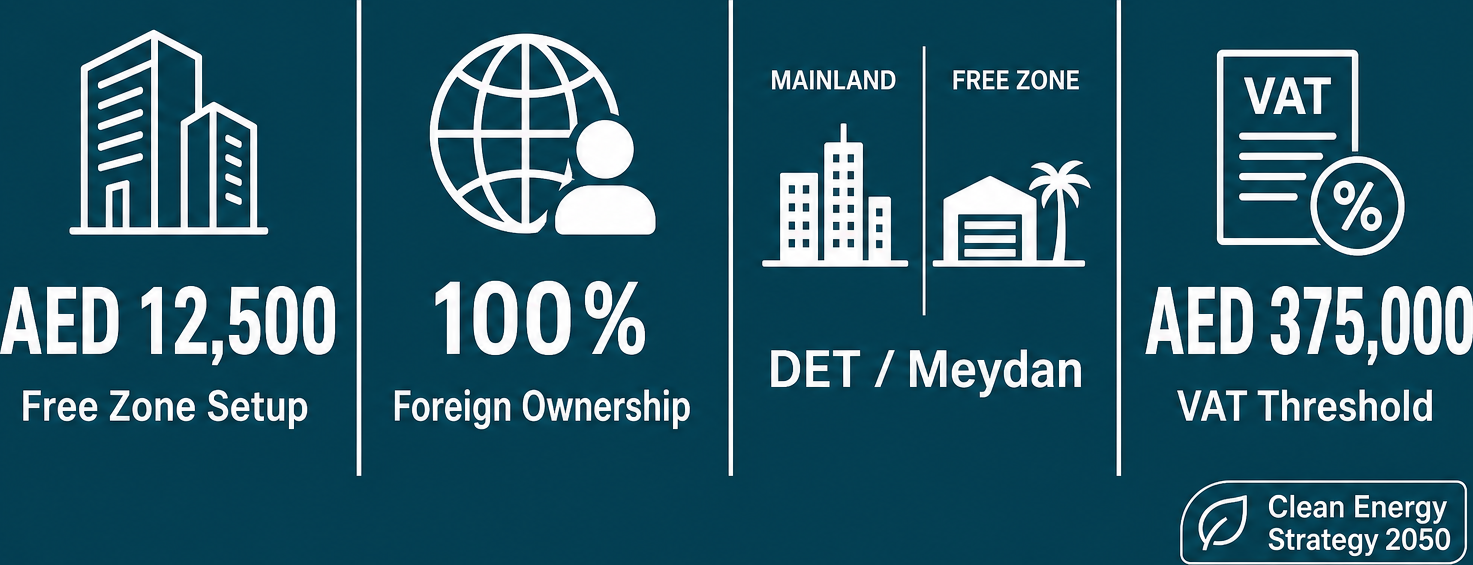
| Activity | Buildings Energy Efficiency Services |
|---|---|
| Jurisdiction options | Mainland (DET) or Free Zone (Meydan Free Zone) |
| Foreign ownership | 100% permitted – Invest in Dubai |
| Governing authorities | Dubai Supreme Council of Energy, Dubai Municipality, DEWA |
| VAT registration threshold | AED 375,000 annual turnover – Federal Tax Authority |
| Free zone setup cost | From AED 12,500 at Meydan Free Zone |
| Market outlook | UAE green building sector growing steadily, driven by Clean Energy Strategy 2050 – Mordor Intelligence |
Dubai's Clean Energy Strategy 2050 targets a significant reduction in building energy consumption across the emirate. Every new development and major retrofit is subject to green building standards. That creates a large, recurring pipeline of work for licensed energy efficiency consultants. The IMARC Group tracks the UAE's energy efficiency services sector as one of the fastest-growing professional services categories in the region.
Mainland vs Free Zone: Which Setup Works for You
This is the biggest choice you will make when setting up. The right answer depends on who your clients are, not on which option costs less.
| Factor | Mainland (DET) | Free Zone (Meydan Free Zone) |
|---|---|---|
| Client access | Open UAE market, including government bodies and large developers | Mainly international clients and free zone entities; mainland work needs a local agent or branch |
| Foreign ownership | 100% in most activities | 100% |
| Office requirement | Physical office address needed | Flexi-desk options available |
| Setup cost | Higher, varies by activity and office | Lower; Dubai Trade License from AED 12,500 |
| Speed of setup | Typically longer due to approvals | Faster; Meydan Free Zone processes are streamlined |
| Visa allocation | Tied to office size | Flexible packages available |
Mainland via DET
A mainland license from the Dubai Department of Economy and Tourism lets you work directly with UAE government bodies, Dubai Municipality, and large real estate developers. Government tenders and public sector contracts almost always need a mainland license. If your target clients are in that space, mainland is the practical choice. You will need a physical office and a slightly longer setup process, but the commercial access is worth it.
Free zone via Meydan Free Zone
If your work is consultancy and advisory rather than on-site contracting with government bodies, a free zone setup at Meydan Free Zone gives you lower costs, faster setup, and full foreign ownership. It suits firms working with private developers, international real estate funds, or corporate clients who do not need you to hold a mainland license. You can also complete much of the process as a remote business setup if you are not yet based in Dubai.
Let your clients decide the jurisdiction. If you are not sure who your first clients will be, start with a free zone setup and add a mainland branch once the pipeline is clearer.
Free Business Setup Cost Calculator
Calculate NowHow to Set Up: Step-by-Step
- Step 1, book your trade name: Use the DET e-Services portal for a mainland company, or the Meydan Free Zone portal for a free zone one. Your trade name must not conflict with an existing registered business. You can check your company name availability before you apply.
- Step 2, confirm your activity code: Make sure the Buildings Energy Efficiency Services activity is approved in your chosen jurisdiction before you go further. The Meydan Free Zone business activities list covers over 2,500 activities and is a useful starting point.
- Step 3, prepare your documents: You will need passport copies for all shareholders and directors, a business plan, and a No Objection Certificate if you are already on a UAE visa sponsored by another employer. For certain regulated activities, you may also need proof of professional qualifications at this stage.
- Step 4, get initial approval and secure your premises: Initial approval confirms the authority accepts your application in principle. For mainland setups, you then need to sign a tenancy agreement for a physical office. For Meydan Free Zone, a flexi-desk arrangement is enough to proceed.
- Step 5, pay your fees and collect your license: Once fees are settled and documents are verified, your license is issued. You can then apply for residence visas and open a corporate bank account. Meydan Free Zone's business banking support service can help you navigate the account opening process.
Compliance and What You Need in Place
Getting the license is the first step. Staying compliant is the ongoing work. Here is what you need to have in place before you start trading and as you grow.
Staff qualifications
Energy auditors and consultants operating in Dubai are expected to hold recognised qualifications. The Dubai Supreme Council of Energy sets the standards for who can carry out regulated energy assessments. Check their current requirements before you hire or subcontract. Putting unqualified staff on client sites is a compliance risk and a reputational one.
Sector-specific approvals
Depending on the exact services you offer, you may need additional approvals from Dubai Municipality or DEWA beyond your base license. If you are advising on building systems that connect to DEWA's grid or metering infrastructure, confirm whether a separate technical registration applies. Do this before you sign client contracts, not after.
Annual license renewal
Your license needs renewing every year. Missing the renewal window leads to fines and, if left long enough, license cancellation. Set a calendar reminder at least 60 days before expiry. Meydan Free Zone's mAssist service covers administrative tasks like renewal tracking so it does not fall through the cracks.
VAT registration
Once your annual turnover crosses AED 375,000, you must register for VAT with the Federal Tax Authority. Energy efficiency consulting services are standard-rated at 5%. If you are working with large clients, you may hit that threshold faster than expected. Get your VAT registration sorted early rather than scrambling when you are already over the threshold.
Corporate tax
The UAE introduced a 9% corporate tax on business profits above AED 375,000. Free zone companies can access a 0% rate on qualifying income, subject to meeting substance requirements. Meydan Free Zone's corporate tax services team can advise on whether your income qualifies and what records you need to keep.
Professional indemnity insurance
Commercial clients and government bodies in Dubai expect professional indemnity cover as a baseline. If your audit or assessment leads to a decision that causes financial loss, you need cover. This is not a legal requirement in all cases, but it is a practical one. Most serious clients will ask for it before signing a contract.
Bookkeeping and audit readiness
Keep clean financial records from day one. Free zone companies are subject to audit requirements, and corporate tax compliance needs accurate books. Meydan Free Zone's bookkeeping services are available if you want to outsource this rather than manage it in-house.
Market Opportunity
Dubai is not running green building programmes as a branding exercise. The Clean Energy Strategy 2050 and the Dubai Net Zero Carbon Buildings Standard set hard targets. Every building owner, developer, and facilities manager in the emirate faces compliance obligations. That creates real, recurring demand for licensed energy efficiency advisors.
The pipeline is broad. It covers new developments going through planning approval, existing commercial stock being retrofitted to meet updated standards, and government-owned buildings working through their own sustainability programmes. Private real estate funds with UAE portfolios also need local licensed advisors to satisfy ESG reporting duties to their investors.
Competition exists, but the barrier to entry is real. You need the right license, qualified staff, and the credibility to win tenders. Firms that build a track record early, particularly with Dubai Municipality-approved projects, are well placed as the market grows.
Conclusion
The Buildings Energy Efficiency Services license sits at the intersection of regulation and real commercial demand in Dubai. Green building rules are not optional, and every developer, landlord, and government body needs compliant advisors to meet them. The market is growing, the regulatory framework is clear, and the license is accessible to foreign-owned businesses.
Whether you set up on the mainland for government tender access or through Meydan Free Zone for a faster, lower-cost start, the fundamentals are the same: get the right license, put qualified people on the work, and stay on top of annual compliance.
Talk to Meydan Free Zone about setting up your energy efficiency consultancy. The team can confirm your activity code, walk you through the cost, and get your license moving quickly. Use the cost calculator to get an initial figure before you pick up the phone.
Ready to Launch Your Business in Dubai?
Let's Connect