
Table of Contents
Frequently Asked Questions
What is activity code 7720.00 and what does it cover in Dubai
Activity code 7720.00 covers the renting and leasing of personal and household goods — including furniture, appliances, and electronics — without any transfer of ownership. The business earns revenue from the use of assets rather than their sale.
This activity is governed by a standard trade licence and does not require specialist regulatory approval, making it one of the more accessible commercial activities available to founders in Dubai.
Who are the typical target customers for a household goods rental business in Dubai
The core customer base includes newly arrived expatriates furnishing temporary accommodation, short-term residents, and corporate relocation firms managing staff housing. With over 90% of Dubai's population of 3.6 million being expatriates, demand for rental goods is structural rather than seasonal.
Operators can serve customers through B2C rental subscriptions directly to individuals or B2B supply agreements with property managers and serviced apartment operators, giving the model considerable flexibility.
Is a specialist licence or regulatory approval required to operate household goods rental in Dubai
No specialist regulatory body governs household goods rental in Dubai. A standard trade licence issued by the Department of Economy and Tourism (DET) or a free zone authority is sufficient to operate legally under activity code 7720.00.
There are no professional qualification requirements, no sector-specific approvals, and no NOC (No Objection Certificate) requirement, making this one of the more straightforward activities to licence in the emirate.
How does VAT apply to rental income from household goods in Dubai
VAT at 5% applies to rental income generated from household and personal goods leasing. Once annual turnover reaches the mandatory registration threshold of AED 375,000, registration with the Federal Tax Authority is required.
Voluntary VAT registration is available from AED 187,500. VAT filing is conducted quarterly, and all rental invoices must be VAT-compliant from the outset of trading.
What are the key contractual obligations when renting out household goods in Dubai
Rental contracts must comply with UAE civil law obligations. Operators should clearly define liability, damage terms, deposit conditions, and return procedures in writing before any goods are handed over.
Poorly drafted contracts are cited as the most common operational risk in this sector — not regulation. Investing in clear, legally sound rental agreements from the start significantly reduces commercial exposure.
Should a household goods rental business be set up on the mainland or in a free zone
A mainland licence via DET allows direct trade with UAE residents and businesses, walk-in retail, and physical showroom operations. It suits operators running delivery fleets or physical outlets across Dubai.
A free zone licence — such as Meydan Free Zone — is better suited to lean, remote-operated, or e-commerce rental models. Meydan Free Zone includes activity 7720.00, requires no paid-up capital, supports 100% foreign ownership, and offers fast digital incorporation. For early-stage operators testing the model before committing to a physical footprint, a free zone is a practical and cost-effective entry point.
What are the steps to obtain a licence for renting and leasing household goods in Dubai
The process begins with choosing your jurisdiction — mainland (DET) or free zone — based on your target customers and operational model. You then reserve a trade name via the DET e-Services portal or your chosen free zone's online system.
Next, you submit your application with passport copies, visa status, proposed business activity code 7720.00, and shareholder details. Finally, you secure office space: free zones accept flexi-desk arrangements to keep overhead low, while mainland licences require a registered tenancy contract.
What is driving demand for household goods rental across Dubai and the wider MENA region
Dubai's high residential turnover, large transient workforce, and short-term rental culture create consistent demand for furniture and appliance rental. The city's population exceeds 3.6 million, with over 90% being expatriates — a demographic with limited appetite to purchase furniture outright on short-term contracts.
Across the broader MENA region, the furniture rental market is growing steadily, driven by urbanisation and transient workforce demand, according to IMARC Group. The short-term and furnished rental market in Dubai specifically continues to expand year-on-year, reinforcing the commercial logic for this activity.
Renting and Leasing of Personal and Household Goods License in Dubai
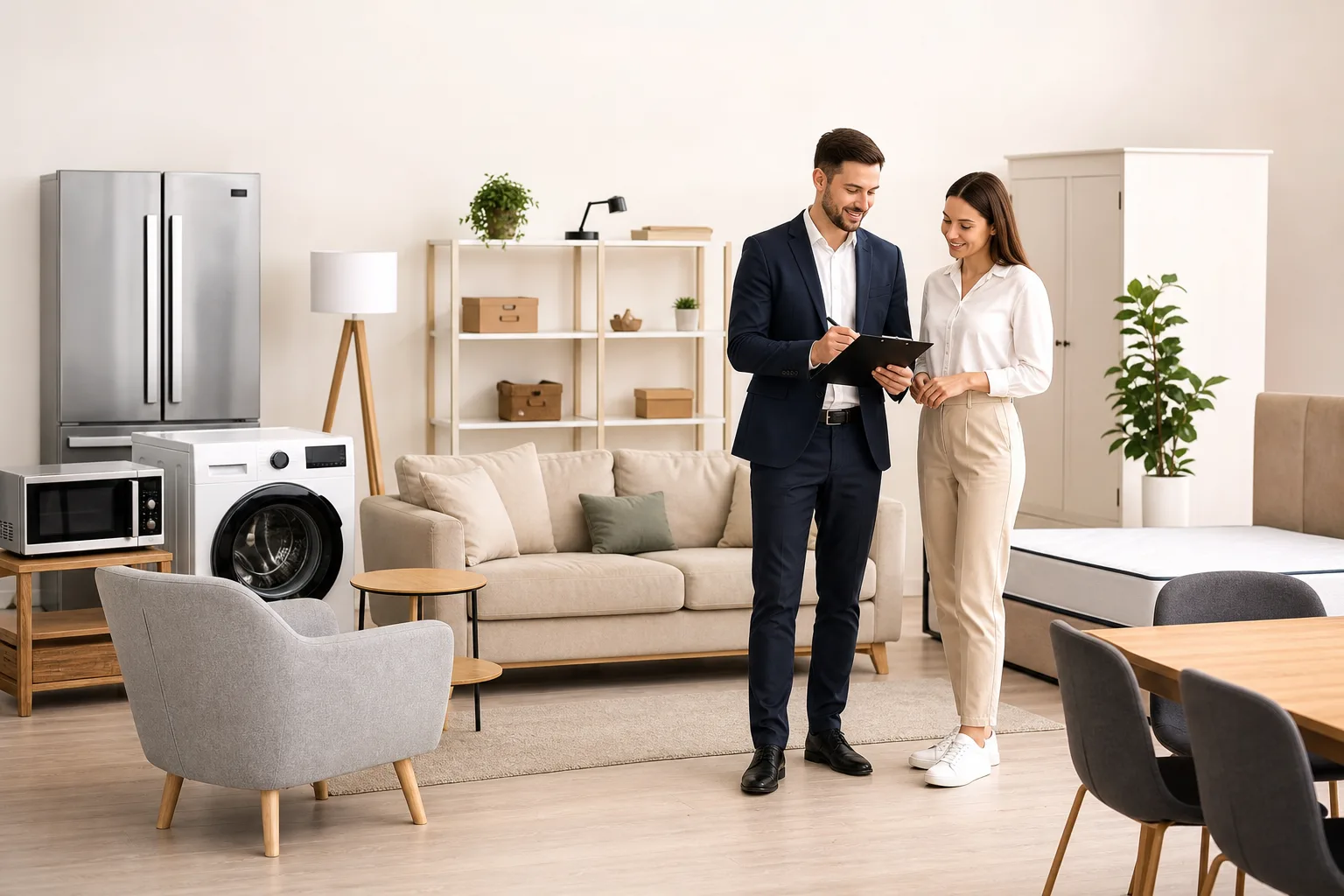
Dubai's growing expatriate population, short-term rental culture, and high residential turnover make the renting and leasing of personal and household goods a commercially viable and underserved business activity. Activity code 7720.00 covers the rental and leasing of personal and household goods — furniture, appliances, electronics, and similar items — without any transfer of ownership. The business earns from the use of assets, not their sale.
Target customers include newly arrived expats furnishing temporary accommodation, short-term residents, furnished apartment operators, and corporate relocation firms managing staff housing. The model is flexible: operators can run B2C rental subscriptions directly to individuals or B2B supply agreements with property managers and serviced apartment operators.
- Dubai's population exceeds 3.6 million, with over 90% expatriates — a core rental customer base (Dubai Statistics Center)
- The short-term and furnished rental market in Dubai continues to expand year-on-year
- The furniture rental market across MENA is growing steadily, driven by urbanisation and transient workforce demand (IMARC Group)
- No specialist regulator governs this activity — a standard trade licence is sufficient to operate
- VAT at 5% applies to rental income once the registration threshold is met
The commercial logic is straightforward. A population that moves frequently, often on short-term contracts, has limited appetite to purchase furniture outright. That gap is the business. For sector context and investment data, Invest in Dubai provides relevant market intelligence for founders assessing entry.
Business Activities List
Explore Over 2,500+Regulatory and Commercial Considerations
No specialist regulatory body governs household goods rental in Dubai. A standard trade licence issued by the Department of Economy and Tourism (DED) or a free zone authority is sufficient to operate legally. This makes 7720.00 one of the more accessible commercial activities available to founders — no professional qualifications, no sector-specific approvals, and no NOC requirement.
VAT at 5% applies to rental income. Once your turnover meets the mandatory registration threshold of AED 375,000, registration with the Federal Tax Authority is required. Voluntary registration is available from AED 187,500. VAT filing is quarterly, and rental invoices must be VAT-compliant from the outset.
| VAT Registration Type | Turnover Threshold | Filing Frequency |
|---|---|---|
| Mandatory registration | AED 375,000 | Quarterly |
| Voluntary registration | AED 187,500 | Quarterly |
Rental contracts must comply with UAE civil law obligations. Define liability, damage, deposit terms, and return conditions clearly in writing. Poorly drafted contracts are the most common operational risk in this sector — not regulation.
Free Business Setup Cost Calculator
Calculate NowMainland vs Free Zone: Which Suits This Activity
A mainland licence via DED allows direct trade with UAE residents and businesses, walk-in retail, and physical showroom operations. It suits operators running delivery fleets or physical outlets across Dubai.
A free zone licence — such as Meydan Free Zone — suits lean, remote-operated, or e-commerce rental models. Meydan Free Zone includes activity 7720.00, offers fast incorporation, requires no paid-up capital, and supports 100% foreign ownership. For early-stage operators testing the model before committing to a physical footprint, this is a practical entry point.
| Factor | Mainland (DED) | Free Zone (e.g. Meydan) |
|---|---|---|
| Trade with UAE residents & businesses | Direct | Via local agent or distributor |
| Physical showroom / retail | Permitted | Not typical |
| Office requirement | Tenancy contract via Ejari | Flexi-desk accepted |
| Paid-up capital | Varies | Not required |
| Foreign ownership | 100% permitted | 100% permitted |
| Best suited for | Delivery fleets, physical outlets | Lean, remote, or e-commerce models |
Step-by-Step Licence Setup Guide

Step 1 — Choose your jurisdiction. Decide between mainland (DED) or free zone based on your target customer base, whether you need physical retail presence, and your operational model.
Step 2 — Reserve your trade name. Check availability via the DED e-Services portal for mainland, or through your chosen free zone's online portal.
Step 3 — Submit your application. Provide passport copies, visa status, proposed business activity (7720.00), and shareholder details. Free zones typically handle this digitally.
Step 4 — Secure office space. Free zones accept flexi-desk arrangements, which keeps overhead low. Mainland licences require a tenancy contract registered via Ejari.
Step 5 — Pay licence fees and receive your licence. Meydan Free Zone typically issues licences within a few working days of document submission and payment.
Step 6 — Open a corporate bank account and register for VAT if your projected or actual turnover meets the FTA threshold.
Step 7 — Apply for investor or employment visas as required under your chosen licence package. Visa quotas vary by jurisdiction and office type.
For general business setup procedures and government requirements, the Ministry of Economy and Tourism, Establishing companies provides a reliable reference point.
Dubai Trade License from AED 12,500
Get Your LicenseOperating the Business: Practical Realities
Inventory sourcing is a core consideration. Dubai's re-export infrastructure — anchored by DP World — makes importing furniture and appliances commercially efficient. Operators can source at competitive landed costs compared to buying locally at retail.
Logistics and last-mile delivery are significant operational costs. Delivery, installation, collection, and damage assessment all require either in-house resource or a reliable third-party logistics partner. Price these into your rental rates from day one — underpricing logistics is a common early mistake.
Digital infrastructure matters. Rental management software to track asset location, contract status, and return schedules is essential once inventory scales beyond a handful of items. A clean digital presence also supports customer acquisition in a market where most searches begin online.
If you are hiring staff, compliance with MOHRE employment regulations applies, including Emiratisation quotas where relevant to your headcount and sector classification. Maintain accurate books from the outset — VAT filing and potential audit exposure make clean accounting non-negotiable.
Conclusion
Activity code 7720.00 is a straightforward, low-barrier licence that suits founders targeting Dubai's large transient population and corporate relocation market. Setup is fast, regulation is light, and the commercial opportunity is real — provided operations, logistics, and contracts are structured properly from the start. Whether you operate via mainland for direct market access or free zone for a leaner initial model, the fundamentals are the same: clean structure, solid contracts, and operationally sound logistics.
Speak with the Series M team to set up your renting and leasing licence in Dubai — mainland or free zone — with the right structure for your business model.