Table of Contents
Frequently Asked Questions
What is a commercial broker in Dubai
A commercial broker is a specialized professional who facilitates transactions between buyers and sellers, or landlords and tenants, of commercial properties such as office buildings, retail spaces, and warehouses. They act as intermediaries, negotiate transaction terms, and ensure legal compliance throughout the process.
Some commercial brokers also offer related services such as property management, market research, property valuations, and financing advice, provided these services are connected to commercial real estate transactions.
What is the difference between a commercial broker and commercial brokerage services
Commercial Brokers (activity code 4540.96) specifically focus on intermediary services within commercial real estate transactions, helping businesses and individuals buy, sell, or lease commercial properties.
Commercial Brokerage Services (activity code 4610.11) have a broader scope, covering intermediary roles between buyers and sellers of various goods — including commission agents, wholesalers, and those facilitating transactions on behalf of a principal, even online. This activity spans industries from agriculture and textiles to machinery and household goods.
What products and goods are covered under Commercial Brokerage Services (4610.11)
Commercial Brokerage Services cover a wide range of product categories. These include:
- Agricultural raw materials and food and beverages
- Textile raw materials, clothing, fur, footwear, and leather goods
- Fuels, ores, metals, and industrial chemicals
- Timber, building materials, furniture, and household goods
- Machinery, office equipment, computers, ships, and aircraft
The activity also includes wholesale auctioneering houses where products are sold to the highest bidder in an auction format.
What is excluded from the Commercial Brokerage Services activity
Certain activities fall outside the scope of Commercial Brokerage Services (4610.11). These exclusions include wholesale trade conducted in one's own name, activities of commission agents for motor vehicles, and auctions of motor vehicles.
Additionally, retail sales by non-store commission agents, activities of insurance agents, and activities of real estate agents are not covered under this business activity code.
Do commercial broker activities in Dubai require third-party approvals
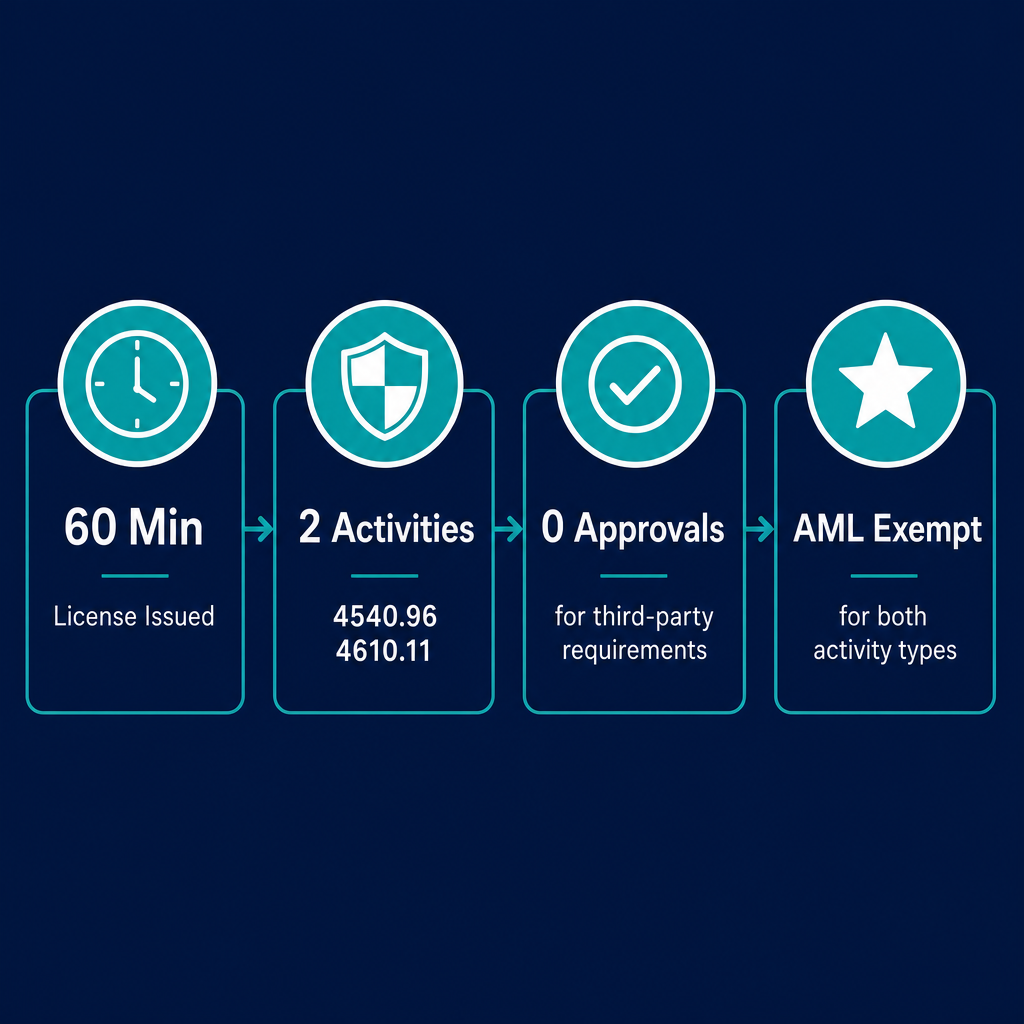
No. Both Commercial Brokers (4540.96) and Commercial Brokerage Services (4610.11) registered in Meydan Free Zone do not require any third-party approvals to operate.
This makes the licensing process more straightforward and significantly reduces the time and administrative effort needed to get your business up and running in Dubai.
Are commercial broker businesses subject to Anti-Money Laundering compliance requirements
Both business activity codes relevant to commercial brokerage in Meydan Free Zone — 4540.96 (Commercial Brokers) and 4610.11 (Commercial Brokerage Services) — are exempt from Anti-Money Laundering (AML) compliance requirements.
This exemption simplifies regulatory obligations for businesses operating under these activity codes within the free zone.
How quickly can you get a commercial broker license in Dubai through Meydan Free Zone
With Meydan Free Zone, you can obtain your commercial broker license in under 60 minutes through the Fawri license service. This fast-track option is designed to minimize delays and get your business legally operational as quickly as possible.
This rapid licensing process makes Meydan Free Zone one of the most efficient options for entrepreneurs looking to enter Dubai's commercial brokerage market without lengthy waiting periods.
What additional support does Meydan Free Zone offer to commercial broker businesses
Beyond licensing, Meydan Free Zone offers a range of tools and services to support your business growth. Through Meydan Plus (mPlus), you gain access to enhanced business support, helping you streamline operations, manage documentation, and expand your professional network.
You can also calculate your business setup costs, check your company name for free before registration, and explore over 2,500 business activities if you wish to grow or diversify your portfolio in the future.
Topic Summary
Know Which Activity Code You Need
Dubai splits commercial brokerage into two distinct codes: 4540.96 for commercial real estate and 4610.11 for goods and commodities. Choosing the wrong one means operating outside your license from your very first deal.
Understand What Each License Permits
Code 4540.96 lets you broker the buying, selling, and leasing of offices, retail spaces, and warehouses. Code 4610.11 covers intermediary trade in goods and commodities on commission for a principal, serving producers, traders, and wholesalers.
Register Both Codes on One License
Free zones like Meydan allow both broker codes to sit on a single license, saving you an amendment if your network pulls you into both markets later. Registering both at the outset is a practical way to stay flexible.
Choose Between Mainland and Free Zone Setup
A free zone license offers 100% foreign ownership, 0% corporate tax on qualifying income, and full profit repatriation — a strong fit for commission-based businesses. Mainland registration through DET may be preferable if your clients or counterparties specifically expect it.
Get Licensed in Under 60 Minutes
Through Meydan Free Zone's Fawri instant license service, a commercial broker license can be issued in under 60 minutes. Neither activity code requires third-party approvals, which removes a common bottleneck in the setup process.
Prepare for Commission-Based Cash Flow
Both brokerage models pay on deal completion rather than for time or effort, meaning income follows closings rather than hours worked. Brokers who survive their first year typically do so by building a pipeline wide enough to absorb deals that fall through.
Note the AML Exemption for Both Activities
Both commercial brokerage activity codes are currently exempt from UAE anti-money laundering compliance rules, reducing administrative burden for new operators. This is worth confirming with your licensing authority as regulations can evolve.
How to Become a Commercial Broker in Dubai
A broker gets paid for standing between two parties who need each other and cannot find each other. In Dubai that role splits across two separate activity codes, and picking the wrong one puts you outside your license from the first deal.
Code 4540.96 covers commercial real estate brokerage. Code 4610.11 covers brokerage of goods. Both are commission-driven intermediary work, and they operate in completely different markets. This guide covers what each permits, who your clients are, the setup steps, and where the boundary between them sits.
With Meydan Free Zone, you can issue your commercial broker license in under 60 mins with Fawri license.
Key Stats at a Glance
What These Two Codes Cover
Commercial Brokers, 4540.96
Intermediary services in commercial real estate. You help businesses and individuals buy, sell or lease commercial property: office buildings, retail spaces and warehouses. You sit between buyer and seller, negotiate the terms, and make sure the transaction stands up legally.
Some brokers extend into property management, market research, valuations and financing advice. Those stay tied to commercial real estate transactions rather than becoming separate businesses.
Who Your Clients Will Be
The two codes serve different rooms.
Real estate brokerage clients are businesses taking space and investors placing capital: corporates leasing offices, retailers taking units, logistics operators needing warehousing, and landlords on the other side of all three. Goods brokerage clients are producers, traders and wholesalers across agriculture, manufacturing, retail and wholesale, where your value is knowing who holds stock and who wants it, working on commission for a principal rather than on your own trading position.
Both models share one thing worth understanding early. You are paid on completion rather than for effort, so cash flow follows deal closure rather than hours worked. Brokers who survive their first year usually do so because they built a pipeline wide enough to absorb the deals that fall through.
Mainland or Free Zone
A free zone license gives 100% foreign ownership, 0% corporate tax on qualifying income and full repatriation of profits, which is a straightforwardly attractive package for a commission-based business needing no premises beyond a desk.
The practical advantage for brokers is that both codes can sit on one license. Operators often start in one market and find their network pulls them into the other, and registering both at the outset avoids an amendment later.
Where mainland becomes the answer is when your client base or your counterparties expect it, particularly on the property side. Weigh that against the ownership and tax position before you commit. Let your clients decide it, not the price.
[blockCTACostCalculator]
Step by Step Setup Guide
- Step 1, choose your activity or activities: Decide whether you are operating as a commercial broker under 4540.96, a commercial brokerage services provider under 4610.11, or both. Registering both at the start is cheaper than amending later.
- Step 2, select your license type: Options range from standard packages to instant licensing, which can have you licensed in under an hour if speed matters more than deliberation.
- Step 3, book your company name: Use a name check tool to confirm availability and compliance with UAE naming rules before you build anything around the name.
- Step 4, calculate your costs: Work out licensing fees, visa costs and service charges before committing rather than at payment stage.
- Step 5, submit your application: The process is digital end to end, which is what keeps the timeline short.
- Step 6, collect your license and start: Once approved you can operate immediately, with visas, banking and workspace as follow-on steps.
Neither activity needs third-party approvals, which is why this setup is faster than most regulated intermediary businesses.
Compliance and What You Need in Place
Approvals and AML
Neither code needs a third-party approval, and both are exempt from the anti-money laundering compliance rules applying to many intermediary activities. That shortens setup considerably, but it does not remove your ordinary duty to know who you are dealing with.
Real estate conduct
For property brokerage, transactions have to comply with local law and with Real Estate Regulatory Agency guidelines. Legal compliance is core to the broker's job rather than an afterthought, because a transaction that fails compliance fails entirely.
Staying inside your code
The exclusions on 4610.11 are specific: no trading in your own name, no motor vehicle commission work or auctions, no insurance agency, no real estate agency. If a client asks you to step across one of those lines, that is a second license rather than a favour.
Contracts and commission
Your commission terms, and the point at which they become payable, belong in writing before you introduce anybody to anybody. Where the entire revenue event is one payment on completion, an unwritten fee arrangement is the most expensive kind of informality.
Records
Keep proper transaction records. They support your commission claims, and they are what you rely on if a deal is later disputed.
Market Opportunity
Dubai's pull as a business hub is what generates the demand. Multinationals, SMEs and entrepreneurs keep arriving, and every one of them needs commercial space, which sustains constant demand for brokerage rather than a cyclical one.
The occupancy numbers show how tight that market is. Office occupancy in prime districts regularly exceeds 90%, and a market that full is one where finding suitable space is hard, which is precisely when an intermediary earns a fee. Dubai Land Department figures show commercial property transactions growing over the past decade, with billions of dirhams recorded annually.
Geography supports the goods side. Dubai sits at the crossroads of Europe, Asia and Africa, making it a natural base for companies reaching regional markets and giving a goods broker a cross-border client list rather than a local one. Finance, technology, logistics, retail and hospitality between them supply a base diverse enough that no single downturn takes the business with it.
Conclusion
Brokerage is one of the lower-barrier routes into Dubai's commercial market, with no third-party approvals and no AML load on either code.
The decision that matters is which code, or whether both. Property and goods brokerage look similar on paper and behave nothing alike in practice, and the exclusion list on 4610.11 makes the boundary a real one.
Register what you actually intend to do, put your commission terms in writing, and treat compliance as part of the service rather than paperwork around it.
[blockCTAContact]