Table of Contents
Frequently Asked Questions
1. What financial instruments can brokers trade in Dubai?
Brokers in Dubai can facilitate the trading of commodities (oil, gold), securities (stocks, bonds), currencies (forex), shares (company ownership), and bonds (debt securities).
2. Do brokers need approval to operate in Dubai?
Yes, brokers must obtain approval from the UAE Securities and Commodities Authority (SCA) before operating. Some activities require pre-license approval, while others require post-license approval.
3. What are the key responsibilities of a commodities broker?
Commodities brokers help clients trade goods like oil, agricultural products, and metals. They provide market access and expertise in navigating both local and international commodity exchanges.
4. How does anti-money laundering (AML) compliance affect brokers?
Brokers must comply with AML regulations, ensuring that they follow stringent guidelines to prevent illicit financial activities. Some activities are exempt from AML, while others are high-risk and require strict oversight.
5. What is the difference between local and foreign market brokers?
Local market brokers facilitate trading on UAE exchanges, while foreign market brokers focus on trading securities and commodities listed on international exchanges, offering broader investment opportunities.
Topic Summary
Nine Activity Codes Cover All Broker Types
Meydan Free Zone offers nine distinct brokerage codes spanning shares, bonds, commodities, securities, and currency. Choosing the right code depends on whether you plan to trade locally, internationally, or operate the marketplace platform itself.
Most Codes Require SCA Approval Upfront
Eight of the nine codes — including foreign shares, local shares, bank brokers, and securities — require Securities and Commodities Authority approval before you receive your license. Only the currencies and monetary broking code (6612.97) allows you to register first and seek approval afterward.
Currency Broking Carries the Highest Risk Rating
Code 6612.97, covering foreign exchange work and currency swaps, is flagged as the highest-risk activity due to the nature of forex transactions. It is also the only code where SCA approval comes after registration rather than before.
AML Rules Apply to Four Specific Codes
Anti-money laundering obligations attach to codes 6611.99, 6612.89, 6612.90, and 6612.91, which cover marketplace operations, foreign shares and bonds, local shares and bonds, and bank brokers. The remaining four codes are currently exempt from AML requirements.
One Code Is for Running the Marketplace Itself
Code 6611.99 is designed for operators who want to run the trading venue rather than execute trades on behalf of clients. This covers platforms where stocks, bonds, derivatives, metals, and agricultural products change hands and prices are set.
UAE Brokerage Market Is Large and Growing
The Dubai Financial Market recorded AED 124 billion in total trading value across 2023, and the SCA licenses more than 100 brokerage firms across the UAE. Rising participation from both international investors and local traders is driving continued demand for licensed brokers.
Brokers Own Nothing — They Connect Buyers and Sellers
A broker's core role is market access: you match buyers with sellers, execute the trade, and earn a commission or fee without needing to own the underlying asset. This applies across all five instrument categories — commodities, securities, currencies, shares, and bonds.
How to Become Commodities, Securities, Currency, Shares and Bonds Broker in Dubai with Meydan Free Zone
Dubai sits at the centre of capital markets in the region. The Dubai Financial Market recorded AED 124 billion in total trading value across 2023, and the Securities and Commodities Authority licenses more than 100 brokerage firms across the country. More international investors are buying into UAE markets, and more local money is moving out into global instruments. Both flows need brokers.
A broker stands between the buyer and the seller. You give clients market access, you know the products, you execute the trade, and you take a commission or a fee for it. This guide covers the nine broking codes at Meydan Free Zone, which ones need approval from the SCA before you apply and which need it after, and where anti-money laundering rules apply.
The Dubai Financial Market posted AED 124 billion in trading value for 2023, while the UAE Securities and Commodities Authority licensed more than 100 brokerage firms operating across the nine Meydan Free Zone activity codes covering shares, bonds, commodities, securities, and currency.
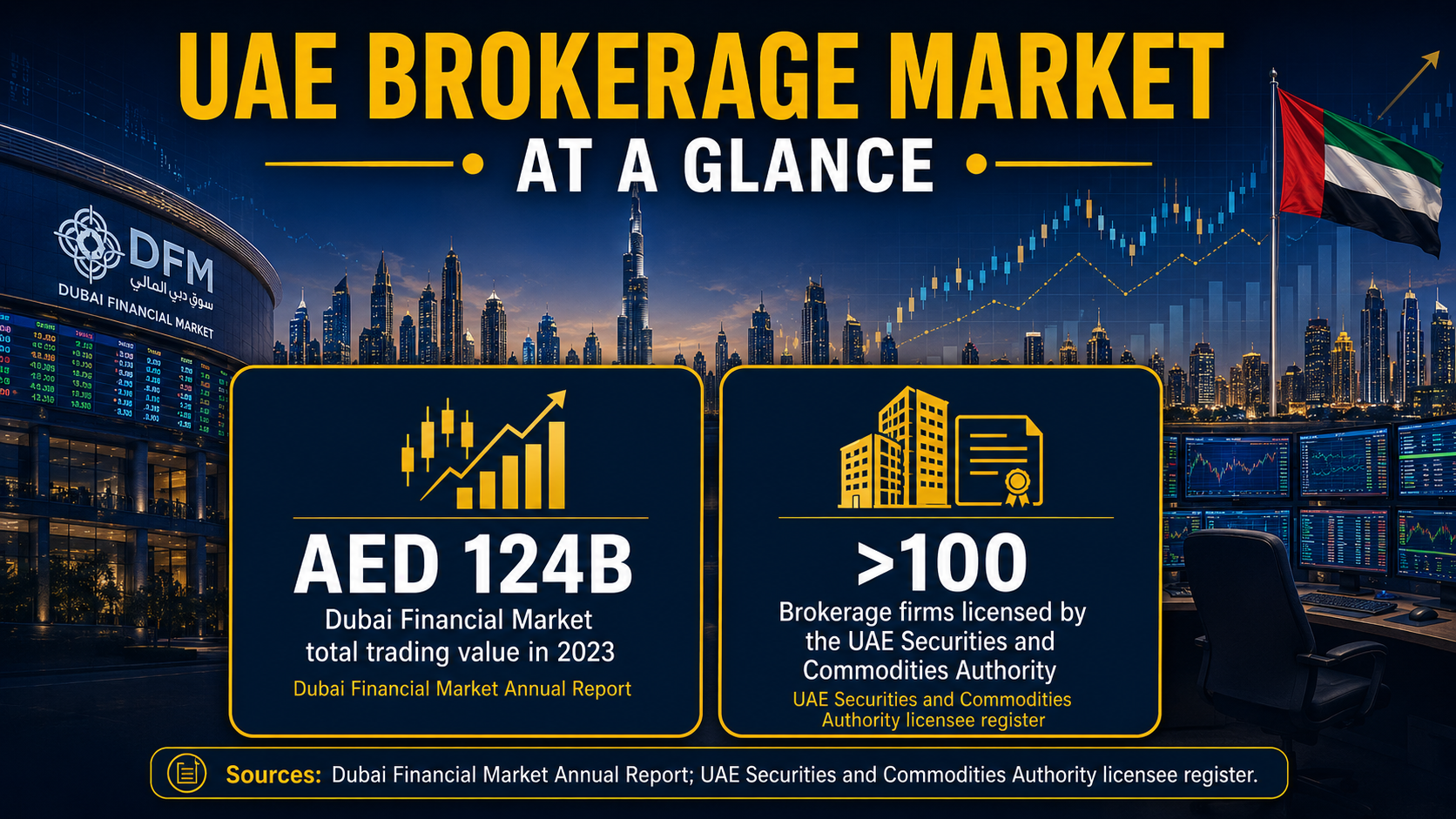
Source: Dubai Financial Market: DFM Annual Report and Market Statistics 2023 (2024);UAE Securities and Commodities Authority: Licensed Firms Register (2025)
Key Stats at a Glance
What This License Covers
Brokers under this license can help clients trade across five groups of financial instruments:
- Commodities such as oil, gold or agricultural products
- Securities such as stocks and bonds issued by companies
- Currencies in the foreign exchange markets
- Shares, meaning ownership stakes in companies
- Bonds and other debt securities
You are the middleman on the trade. You do not have to own the asset. You bring the two sides together, you execute, and you get paid for it.
One code works differently. Code 6611.99 covers running the marketplace itself, the venue where stocks, bonds, derivatives and tangible goods such as metals and agricultural products change hands. A marketplace sets prices, moves capital between buyers and sellers, and gives traders somewhere to lay off risk. If you plan to operate the platform rather than trade on it, that is your code.
Meydan Free Zone Brokerage Business Activity Codes
Nine codes sit under this heading. Use the table to find the one that matches how you plan to work, then read the approval and AML notes below it.
Who Your Clients Will Be
Your clients depend on the code you pick, but they fall into four groups:
- Individual investors trading shares, bonds or currencies for their own account
- Institutions and funds that need market access and clean execution
- Banks and their customers, where bank brokers advise and place the trades
- Businesses moving money across borders as part of normal trade
You earn from commission and fees on the trades you execute. Foreign market codes suit clients who want to spread their money across global exchanges. Local market codes suit clients who want UAE-listed shares, bonds and commodities.
Local Markets or Foreign Markets
This is the biggest choice you will make when picking a code. Local market brokers work the UAE exchanges. Your clients buy and sell shares, bonds and commodities issued or listed at home, and you win the account on your knowledge of that market. Foreign market brokers work international exchanges instead, which gives clients a wider set of instruments and a way to spread their money across several countries.
The split matters for compliance as well as clients. Both shares and bonds codes carry anti-money laundering duties, whether you work local markets or foreign ones. The commodities and securities codes for foreign and local markets are exempt. Let your clients decide which side you sit on, not the paperwork.
[blockCTACostCalculator]
Step by Step Setup Guide
- Step 1, pick your activity code: Your code decides your approval route, your AML duties and the clients you can serve. Choose it first, not last.
- Step 2, book your trade name: Use the free Company Name Check tool to see whether the name you want is available before you go further.
- Step 3, sort your SCA approval in the right order: Eight of the nine codes need SCA approval before your license is issued. Code 6612.97 gets its approval after you register.
- Step 4, get your license: With a Fawri license you can be set up in under 60 minutes. Remote setup is possible, so you do not have to be in the UAE to start.
- Step 5, put your AML controls in place: Have your checks working before you take a single client order, not after.
Compliance and What You Need in Place
Approval before your license
Eight codes need approval from the Securities and Commodities Authority before Meydan Free Zone issues your license: 6611.99, 6612.89, 6612.90, 6612.91, 6612.92, 6612.96, 6612.98 and 6612.99. Get the approval first, then apply.
Approval after you register
Code 6612.97, currencies and monetary broking, works the other way round. You register first, then get SCA approval afterwards.
Anti-money laundering
Four codes must meet AML rules: 6611.99, 6612.89, 6612.90 and 6612.91. That means knowing who your client is, checking where their money comes from, and reporting anything that looks wrong.
Codes that are exempt
Four codes are exempt from AML rules: 6612.92, 6612.96, 6612.98 and 6612.99. Exempt does not mean unwatched. The SCA still oversees how you work.
Currency broking sits at the top of the risk list
Code 6612.97 is treated as high risk because of the nature of foreign exchange work. Expect tight financial rules and close attention to your controls.
Market Opportunity
The Dubai Financial Market traded AED 124 billion across 2023. More than 100 brokerage firms hold SCA licenses across the UAE, which tells you two useful things: the market is big enough to carry a lot of firms, and it is regulated closely enough that clients look for a licensed name before they hand over money.
Growth is coming from both directions. International investors keep opening positions in UAE markets, and local capital keeps moving into global instruments. The nine codes let you sit on either side of that flow, or both. Local securities for domestic clients, foreign markets for clients who want to spread wider, and currency broking for anyone trading across borders.
In Conclusion
Broking in Dubai is a licensed trade, and the license is the whole point. Clients hand you their money because a regulator stands behind your name.
Setup itself is quick. A Fawri license can have you trading in under 60 minutes, and remote setup means you can start from outside the UAE. Meydan Free Zone lists over 2,500 business activities, so add any related codes now rather than coming back for them later.
Three things decide how smoothly this goes: the right code, SCA approval in the right order, and AML controls that work from day one.
[blockCTAContact]