
Table of Contents
Frequently Asked Questions
What trade license is required to operate a computer repair training institute in Dubai
To legally operate a computer repair training institute in Dubai, you need a Computer Repair Training trade license classified under business activity code 8522.06. This falls within the broader category of Technical and Vocational Secondary Education (8522).
This license covers structured training programmes that combine theoretical instruction with practical, employment-oriented skills — including hardware diagnostics, component replacement, system troubleshooting, and networking fundamentals.
Is third-party approval required to set up a computer repair training institute in Dubai
Yes. Before obtaining your trade license, you must secure prior approval from the KHDA (Knowledge and Human Development Authority). This is a mandatory step for business activity 8522.06 and cannot be bypassed.
The KHDA oversees educational and training institutions in Dubai, ensuring that providers meet quality and regulatory standards before they begin operations.
Does a computer repair training business in Dubai need to comply with Anti-Money Laundering requirements
No. Business activity 8522.06 (Computer Repair Training) is explicitly exempt from Anti-Money Laundering (AML) compliance requirements under Dubai's licensing framework.
This simplifies the regulatory burden for training institute operators, allowing them to focus on setup and operations without the additional compliance obligations that apply to certain other business activities.
What types of training can be delivered under the Computer Repair Training license
Under activity code 8522.06, operators can deliver training covering hardware diagnostics, component replacement, system troubleshooting, networking fundamentals, and related IT technical skills. Instruction can be offered in a variety of formats, including in-person at your own facility, at a client's premises, fully online, or as a blended programme.
This flexibility allows operators to run cohort-based courses for school leavers, certified hardware repair programmes for electronics retailers, or refresher courses for working technicians upgrading their qualifications.
Who are the target students for a computer repair training institute in Dubai
The potential student base is broad. Viable audiences include fresh graduates entering the IT workforce, career changers seeking practical technical skills, small business owners who want to self-maintain their equipment, and corporate teams in IT support or facilities management roles.
Electronics retailers looking to train staff in hardware repair and organisations investing in workforce upskilling also represent strong demand segments for a well-structured training programme.
What activities are NOT permitted under the Computer Repair Training license
The 8522.06 license has clear exclusions. It does not cover technical and vocational education at post-secondary or university levels, adult education programmes, performing arts instruction for recreation or hobby purposes, automobile driving schools not intended for occupational drivers, or job training that forms part of social work activities.
Operators planning to offer programmes that fall into these categories would need to explore separate, appropriate licensing categories.
How large is the market opportunity for computer repair training businesses in Dubai
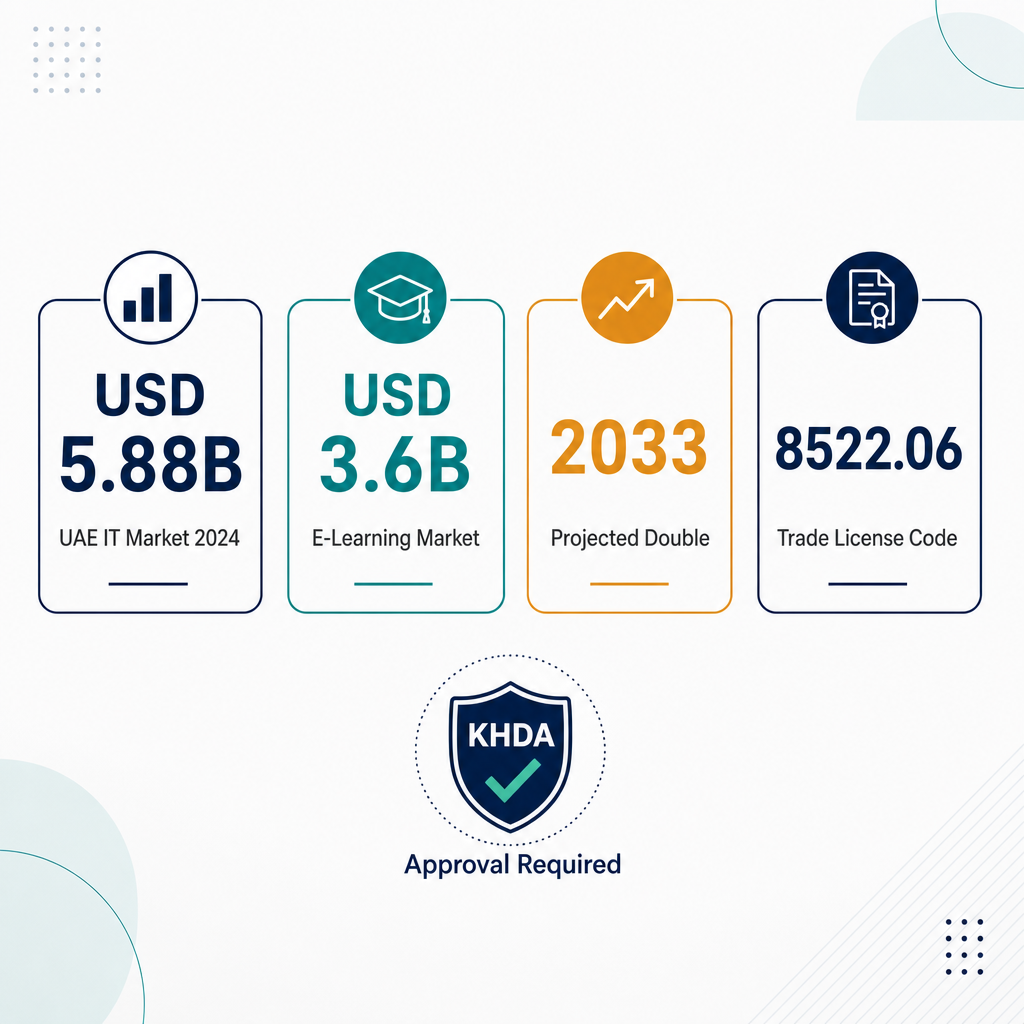
The opportunity is substantial. The UAE IT services market reached USD 5.88 billion in 2024 and is projected to nearly double by 2033, creating sustained demand for trained technicians. Every system deployed across the UAE's expanding digital infrastructure requires a skilled workforce to maintain and repair it.
Additionally, the UAE e-learning and digital training market is valued at USD 3.6 billion, driven by government investment in workforce upskilling and a corporate sector actively seeking certified talent — giving training institute operators a broad and growing addressable market.
How quickly can a computer repair training institute be set up in Dubai
With the right preparation and licensing pathway, setup can be remarkably fast. Using a Fawri license, it is possible to complete the business setup process in as little as 60 minutes, allowing you to begin operations without unnecessary delays.
Prospective operators can also use a free company name check and an online cost calculator to understand their initial investment before committing, making the planning process more transparent and efficient.
Topic Summary
Secure KHDA Approval Before Everything Else
Approval from the Knowledge and Human Development Authority must be in place before your trade license is issued, not after. Skipping or delaying this step stalls the entire setup process.
One License Covers Multiple Teaching Formats
Activity code 8522.06 allows instruction from your own facility, at a client's premises, online, or as a blended mix — all under a single license. This flexibility lets you serve individuals, corporates, and remote GCC students without extra permissions.
Know Exactly What the Code Excludes
This license does not cover post-secondary or university-level education, recreational instruction, driving schools, or job training tied to social work. If your curriculum drifts toward higher education, a different regulatory pathway applies.
Target Four Distinct Student Segments
Fresh graduates, career changers, small business owners, and corporate IT teams each buy training for different reasons and on different cycles. Spreading your offer across these groups reduces dependence on any single revenue stream.
Corporate and Government Contracts Offer Recurring Revenue
Corporate training engagements carry higher value per deal and often repeat annually, while government and semi-government entities actively procure from KHDA-approved providers with verified graduate records. Building toward these channels adds stability beyond individual course sales.
Mainland vs. Free Zone Shapes Your Market Reach
A mainland DET license lets you operate anywhere in the UAE and engage government entities and large corporates without restriction. A free zone setup suits online delivery and international students but may limit direct government contracting.
The Market Timing Is Favorable for New Entrants
The UAE IT services market hit USD 5.88 billion in 2024 and is projected to nearly double by 2033, while the UAE e-learning and digital training sector is valued at USD 3.6 billion. Growing infrastructure means growing demand for qualified repair technicians.
Computer Repair Training Institute Business Setup in Dubai
The UAE IT services market reached USD 5.88 billion in 2024 and is projected to nearly double by 2033. Every system inside that number eventually breaks, and somebody has to be trained to fix it. Activity code 8522.06 is the license for that training.
One detail shapes everything here. Approval from the Knowledge and Human Development Authority has to be in place before your trade license is issued, not after. This guide covers what the code permits, who your students are, how mainland and free zone compare, the setup steps, and what KHDA will want to see.
Key Stats at a Glance
What This License Covers
Code 8522.06 sits under Technical and Vocational Secondary Education, covering programmes that combine theory with practical skills aimed at employment. You deliver structured computer repair training to students preparing for careers in technical support, hardware maintenance or device servicing.
Course content typically spans:
- Hardware diagnostics
- Component replacement
- System troubleshooting
- Networking fundamentals
Where you can teach
Instruction can be delivered from your own facility, at a client's premises, online, or as a blend of all three, and that flexibility sits inside a single license. A provider can run cohort courses at its own centre, deliver a certified programme on-site for a retailer's staff, and sell online refresher modules to working technicians without separate permissions.
What is excluded
The boundaries are specific. This code does not cover technical and vocational education at post-secondary or university level, adult education outside employment purposes, performing arts instruction for recreation, driving schools other than for occupational drivers, or job training forming part of social work. If your plan drifts towards higher education, that is a different regulatory conversation.
Who Your Students Will Be
Four groups, and they buy for different reasons:
- Fresh graduates entering the IT workforce
- Career changers moving into technical work
- Small business owners wanting to service their own kit
- Corporate teams in IT support or facilities management
That spread splits your revenue across unrelated cycles. Individual enrolments, paid per course or certification, are the simplest model and the most seasonal. Corporate contracts training a company's IT or facilities team carry higher value per engagement and often become recurring.
There is a third channel worth building towards. Government and semi-government entities in Dubai regularly procure vocational training for their workforces, and a KHDA-approved provider with a record of certified graduates is what that procurement process looks for. Online and blended delivery adds a fourth dimension, letting you serve students across the UAE and wider GCC without costs rising in step with enrolment.
Mainland or Free Zone
The regulator does not change with the jurisdiction, so this decision is commercial rather than regulatory. A mainland license lets you operate anywhere in the UAE and engage directly with government entities, schools and large corporates without restriction. If your plan leans on corporate contracts or partnerships with government-linked organisations, that reach is worth paying for.
A free zone license gives 100% foreign ownership, a streamlined setup and lower initial costs, which suits a new entrant wanting to get operational quickly, and works particularly well for providers focused on online delivery, international students or a defined local catchment. Either way the choice follows your intended client mix rather than your budget. Let your clients decide it, not the price.
[blockCTACostCalculator]
Step by Step Setup Guide
- Step 1, choose your jurisdiction: Mainland for unrestricted reach into government and large corporate clients, free zone for full ownership, speed and lower entry cost.
- Step 2, design your programme before applying: KHDA assesses the substance of what you teach, so the curriculum outline is not a formality to complete afterwards.
- Step 3, line up your instructors: Their credentials form part of the approval, so identify who is teaching before you submit rather than after.
- Step 4, secure KHDA approval: Submit your detailed programme outline, instructor credentials and evidence of your operational setup. This has to complete before the trade license is issued.
- Step 5, book your company name and prepare your premises: If you are running practical labs, the facility specification matters here rather than later.
- Step 6, collect your trade license and begin enrolment: Visas, banking and workspace expansion follow.
The single biggest cause of delay in this activity is treating KHDA as a step that runs alongside licensing. It runs before it.
Compliance and What You Need in Place
KHDA approval
The Knowledge and Human Development Authority regulates private education and training providers in Dubai, and no business under 8522.06 gets a trade license without its approval. The process asks you to show that your programmes meet quality standards, that your instructors hold appropriate qualifications, and that your facilities, physical or digital, are fit for purpose.
Worth treating that as an asset rather than a hurdle. KHDA registration signals credibility to students and, more importantly, to corporate clients who specifically look for approved providers.
Instructor credentials
Your trainers should hold recognised certifications such as CompTIA A+, Cisco CCNA or equivalent vendor credentials, ideally with industry experience in hardware maintenance, IT support or systems administration. Beyond the certificates they need to teach well and run lab sessions safely, which is a different skill from doing the job.
Facilities for practical work
Computer repair training is hands-on by nature. Students work with physical components, so a facility needs functional workstations, diagnostic tools and enough parts inventory for real practice. Budget for consumables, because components get damaged during teaching and that is the point of them.
The hybrid option
Combining in-person practical sessions with online theory modules lets students work through foundations at their own pace before attending scheduled labs. That model cuts facility cost while keeping the hands-on element that gives the training its value.
Market Opportunity
Two markets support this business and they are both growing. The UAE IT services market reached USD 5.88 billion in 2024 and IMARC Group projects it to nearly double by 2033, which is the demand side: more deployed systems means more technicians needed to keep them running.
The supply side is the training market itself. Ken Research values UAE e-learning and digital training at USD 3.6 billion, driven by government investment in workforce upskilling and a corporate sector actively looking for certified talent.
What makes this a defensible niche is the practical component. Theoretical subjects are being commoditised by online content, but hardware skills need physical practice, which is harder to deliver at scale and harder for a low-cost competitor to replicate. A provider with a proper lab and qualified instructors competes on something that cannot be downloaded.
Conclusion
This is a well-supported activity sitting between two expanding markets, with an unusually flexible delivery model for a licensed education business.
The regulatory path has one non-negotiable feature. KHDA approval comes before the trade license, and it examines your curriculum, your instructors and your facilities rather than just your paperwork. Prepare all three before applying.
Do that and the approval becomes a commercial asset, because being KHDA-approved is exactly what corporate and government buyers screen for.
[blockCTAContact]