
Table of Contents
Frequently Asked Questions
What services can the salon actually offer under this license?
Facials and skincare treatments, manicures and pedicures including nail art and extensions, and make-up application for daily, bridal, and event looks. Brow and lash work, hand and foot massage as part of a treatment, and similar beauty services all sit naturally inside the same scope.
Hair is excluded from this license. Where does the line sit?
Hair washing, cutting, colouring, styling, blowouts, shaving, and beard trimming each fall under different sub-codes in the wider beauty group. A salon offering both nails and hair, or facials and hair, would hold the relevant activities together rather than rely on this one alone.
What does Dubai Municipality look for when approving the physical location?
The DM reviews the salon space itself: health and safety standards, hygiene and sanitation, treatment room setup, ventilation, and the qualifications of practitioners on the floor. Approval is for the premises, not the trade license, and is handled separately from the Meydan Free Zone process.
How does a salon typically build a recurring revenue base?
Two main routes. Memberships and packages, where clients pre-pay for a set number of monthly treatments at a better rate. And retail, where the products used during the service are sold to the client on the way out. Both sit alongside the standard chair ticket.
Is this activity restricted to female clients?
No. The license covers beauty services for women and men. Men's grooming, brow shaping, facials, manicures, and pedicures for male clients all fall within scope. The distinction in the wider beauty group is by service type, not gender.
Topic Summary
Understand the UAE Beauty Market Opportunity
The UAE beauty and personal care market is valued at USD 5.5 billion in 2024 and is forecast to grow steadily through 2033. High-spending residents and year-round tourism keep demand strong for hair, skin, nail, and wellness services.
Know Which License You Actually Need
A standard beauty salon requires a commercial trade license from DET or Meydan Free Zone, plus a DHA health facility permit for your physical premises. The exact activity codes you register determine what services you are legally allowed to offer.
Separate Standard Beauty from Medical Aesthetics
Services like laser hair removal, Botox, and chemical peels fall under DHA medical facility rules and require a licensed medical director and qualified clinical staff. Misclassifying these treatments at setup leads to costly delays and potential compliance violations.
Get DHA Approval for Every Staff Member
Every therapist and technician working in your salon must hold an individual DHA practitioner permit, not just the business itself. Factor this into your hiring timeline and budget before you open.
Choose Mainland or Free Zone Based on Your Model
A mainland DET license gives you full access to retail and commercial locations across Dubai, making it the natural fit for a walk-in salon. A Meydan Free Zone license offers streamlined setup but is less suited to premises that rely on street-level foot traffic.
Follow the Correct Setup Order
Secure your trade license first, then pursue DHA health facility approval for your premises. Reversing this order or skipping steps creates regulatory gaps that are expensive to correct after the fact.
Plan for VAT and Future Service Expansion Early
VAT registration becomes mandatory once your annual turnover crosses the Federal Tax Authority threshold, so build this into your financial planning from day one. If you intend to add medical aesthetic services later, design your premises layout and lease terms to accommodate that expansion from the start.
How to Start a Facial, Nails, and Make-Up Salon Business in Dubai with Meydan Free Zone
Dubai's wellness and beauty sector is one of the most active consumer markets in the UAE. A high-spending resident population and year-round tourist footfall keep demand strong across hair, skin, nail, massage, and wellness services. The market is growing, the regulatory framework is clear, and the opportunity is real.
This guide covers the license types, regulatory requirements, and setup steps you need to open a wellness or beauty salon in Dubai. Follow the right path from the start and you avoid the costly corrections that come from getting the structure wrong.
Key Stats at a Glance
| UAE beauty and personal care market | Valued at USD 5.5 billion in 2024 and forecast to grow steadily through 2033, according to IMARC Group |
|---|---|
| Market growth driver | Rising disposable incomes, tourism growth, and demand for premium personal care services across Dubai and Abu Dhabi |
| Regulatory authority | Dubai Health Authority (DHA) – all beauty and wellness premises operating in Dubai need a DHA health facility license |
| Relevant activity codes | Beauty salon, spa centre, wellness centre – confirm exact codes with DET or Meydan Free Zone before applying |
| Trade license issuing authority | Dubai Department of Economy and Tourism (DET) for mainland; Meydan Free Zone for free zone entities |
Key figures to know before you start
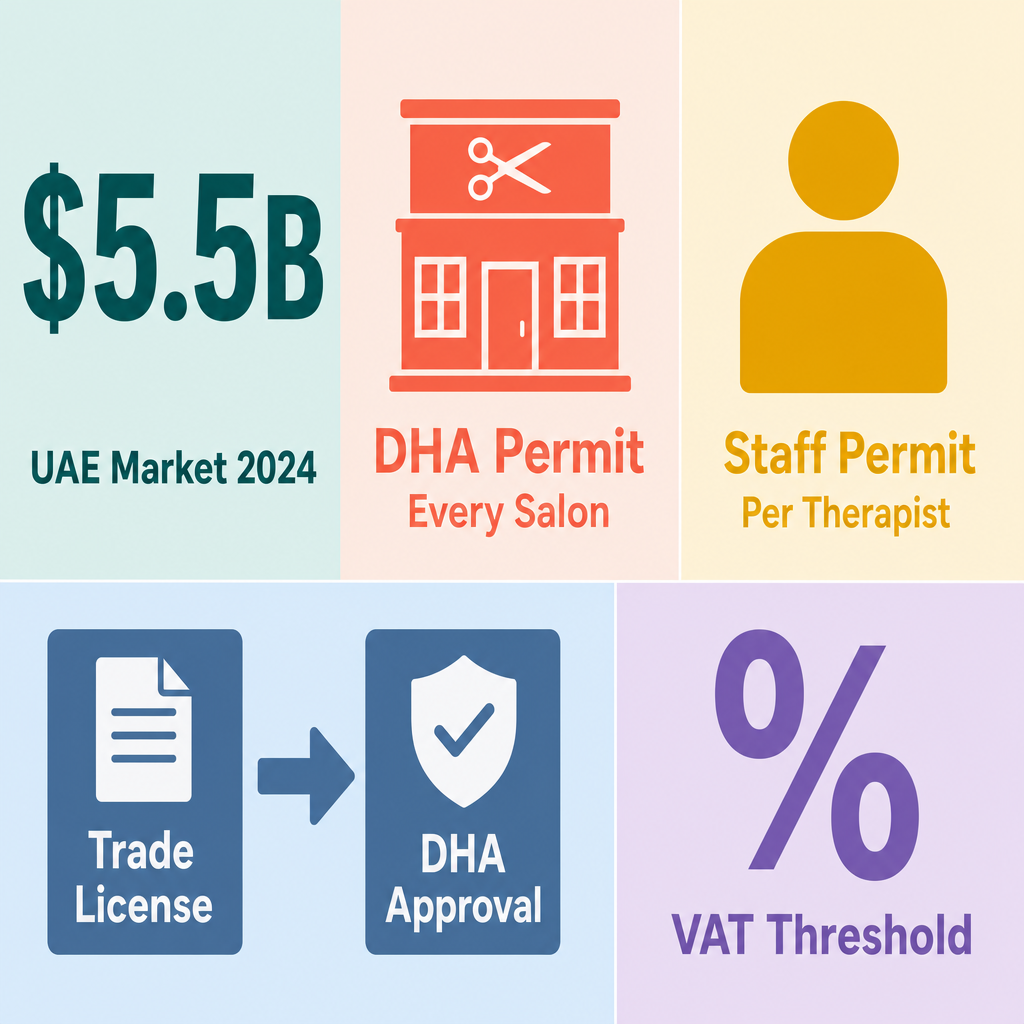
- UAE beauty and personal care market: USD 5.5 billion (2024)
- DHA health facility license: needed for every physical salon or spa in Dubai
- Staff: every therapist and technician needs an individual DHA practitioner permit
- VAT registration: needed once annual turnover reaches the mandatory Federal Tax Authority threshold
- Setup path: trade license plus DHA facility approval, in that order
What This License Covers
A beauty salon or wellness center license in Dubai covers a broad range of personal care and treatment services. The exact scope depends on the activity code you register, so it pays to be precise at the application stage rather than expanding later.
Standard permitted activities include hair cutting, styling, and colouring; facial and skin treatments; nail care; waxing; massage therapy; and general wellness services. These sit under a commercial beauty license issued by DET or Meydan Free Zone, combined with a DHA health facility permit for the physical premises.
The line between standard beauty services and medical aesthetics matters a great deal here. Get it wrong at setup and you face delays, extra costs, and the risk of operating without the correct approvals.
Medical Aesthetics vs Standard Beauty Services
Standard hair, nail, and facial services sit under a commercial beauty license. These do not need clinical staff on-site, but the premises still need DHA facility approval.
Treatments such as laser hair removal, chemical peels, Botox, fillers, and other injectables fall under DHA medical facility rules. These require a separate clinical license, a licensed medical director, and qualified practitioners registered with the DHA. The setup process is longer and the compliance duties are heavier.
If you plan to offer both standard beauty services and medical aesthetics under one roof, you need both license types. Many operators start with a standard beauty license and add the medical aesthetic approval once the business is established. That is a workable approach, but plan for it from the start so your premises layout and lease terms can accommodate it.
The boundary between the two categories is not always obvious. A facial with a chemical exfoliant can tip into regulated territory depending on the product used and the depth of treatment. Check with the DHA before you finalise your service menu, not after you open.
Mainland vs Free Zone: Which Setup Works for a Salon?
This is the biggest choice you will make when setting up. Let your business model decide it, not the price.
| Factor | Mainland (DET) | Free Zone (Meydan Free Zone) |
|---|---|---|
| Physical salon access | Full access to retail and commercial locations across Dubai | Not suited to walk-in treatment premises |
| Client base | Open UAE market, walk-in retail | Mainly consultancy, distribution, or remote service brands |
| Foreign ownership | 100% in most activity categories since 2021 | 100% as standard |
| Office or premises requirement | Physical commercial unit in an approved location | Flexi-desk available for non-treatment business activities |
| DHA facility approval | Needed for any physical treatment premises | Needed if operating a physical treatment space |
| Best suited for | Walk-in salons, spas, and wellness centres | Wellness consultancies, beauty product distributors, online wellness brands |
A mainland license from DET is the standard route for anyone opening a physical salon. It gives you access to walk-in retail locations across Dubai, which is what most salon models need. You can sign a commercial lease in a mall, a high street unit, or a residential tower podium and trade directly with the public.
A free zone setup through Meydan Free Zone works well for wellness consultancies, beauty product distributors, e-commerce brands, or training academies that do not need a physical treatment space. If your model is built around products, online services, or B2B wellness programmes, a free zone entity is a clean and cost-effective structure.
One point that catches founders out: DHA facility approval is needed whatever jurisdiction you choose, if you operate a physical salon. The DHA's remit covers the premises and the treatments, not the legal entity behind the business. A free zone license does not exempt you from DHA oversight.
Free Business Setup Cost Calculator
Calculate NowStep-by-Step Setup Guide
- Step 1, book your trade name: Use the DET e-Services portal for a mainland company, or the Meydan Free Zone portal for a free zone entity. You can check your company name availability online before you submit. The name must not conflict with an existing registration and must follow UAE naming rules.
- Step 2, pick your activity code: Confirm the code covers your intended services before you go further. Beauty salon, spa centre, and wellness centre each carry a different code. If you plan to offer medical aesthetics, you need an additional code. Getting this right now saves you from amending the license later.
- Step 3, get initial approval: Apply for initial approval from DET or Meydan Free Zone before you sign a lease. This confirms your activity is approved and your trade name is reserved. Do not commit to a premises until this step is done.
- Step 4, secure a compliant premises: Find a commercial unit that meets DHA minimum space and hygiene standards. The DHA sets requirements on room dimensions, ventilation, water supply, waste disposal, and treatment area separation. Check these before you negotiate your lease, not after.
- Step 5, apply for your DHA health facility license: Submit floor plans, an equipment list, and staff credentials to the DHA. The DHA will review the application and schedule a premises inspection. Allow enough time for this in your opening timeline.
- Step 6, register your staff with the DHA: Every therapist, technician, and practitioner needs an individual DHA practitioner permit. Verify that their qualifications meet UAE requirements before you hire. Some overseas qualifications need additional assessment or a bridging course before the DHA will issue a permit.
- Step 7, get your trade license issued: Once DHA approval is confirmed, your trade license can be finalised. Then open a UAE business bank account before you start trading. You will need the trade license and DHA facility permit to open a corporate account. If you need support with business banking for free zone companies, Meydan Free Zone's mCore service covers this.
Compliance and What You Need in Place
Getting your license is the start, not the finish. Dubai's beauty and wellness sector carries ongoing compliance duties that you need to manage from day one.
DHA facility inspection
Your premises must pass a DHA inspection before you can open to the public. Inspectors check that the fit-out matches the approved floor plans, that hygiene standards are met, and that the right equipment is in place. Any changes to the premises after approval need to be notified to the DHA.
Staff licensing
Every therapist and technician working on clients needs an individual DHA practitioner permit. This applies to employees and to freelancers working from your premises. Letting an unlicensed practitioner treat clients is a serious breach. The DHA can suspend your facility license for it.
MOHRE registration and Emiratisation
All employees must be registered with the Ministry of Human Resources and Emiratisation (MOHRE). If your headcount reaches the threshold that triggers Emiratisation duties, you need to meet the quota or pay the relevant levy. Check the current threshold with MOHRE before you hire, as it has changed in recent years and varies by business size.
VAT registration
Once your annual taxable turnover reaches the mandatory threshold set by the Federal Tax Authority (FTA), you must register for VAT. Beauty and wellness services are standard-rated at 5%. Keep clean records from the start. If you need help with VAT registration in the UAE, Meydan Free Zone's mAccounting service can handle it.
Annual renewals
Both your trade license and your DHA facility permit need annual renewal. Missing a renewal date means you are technically operating without a valid license, which exposes you to fines and can affect your ability to renew staff permits. Set calendar reminders well in advance of both expiry dates.
Product compliance
Any cosmetic products used in treatments or sold on-site must be registered with the UAE's relevant authorities. Unregistered products used on clients can result in facility suspension. Check product registration status before you stock anything.
Market Opportunity
Dubai's beauty and wellness market has real depth. The resident population skews young, urban, and high-spending. Tourists, particularly from GCC countries, Europe, and South Asia, add consistent demand across premium salons and spas. The city's hotel sector alone generates significant spa and wellness revenue year-round.
Premium positioning works well here. Clients expect quality fit-out, trained staff, and a consistent experience. Competing on price alone is a difficult strategy in a market where international brands and well-funded local operators set a high baseline.
Niche services with strong demand include men's grooming, bridal packages, organic and natural treatments, and wellness programmes combining nutrition, fitness, and beauty. These categories attract repeat clients and command higher margins than standard cut-and-colour services.
If you are considering a remote or hybrid model, such as a wellness consultancy or a beauty product brand, you can start a business remotely through Meydan Free Zone without needing to be in Dubai during the setup process.
The full list of Meydan Free Zone business activities covers wellness consultancy, beauty product distribution, and related service categories for founders who want a free zone structure.
Conclusion
Opening a wellness or beauty salon in Dubai is workable if you get the license type right from the start. Secure DHA approval early, make sure your premises and staff meet the regulatory standards before you open, and keep your annual renewals current. The compliance framework is clear. The market is strong. The founders who run into problems are usually the ones who rushed the setup or picked the wrong activity code.
Speak to the Meydan Free Zone team to confirm the right activity code and setup structure for your salon concept before you commit to a lease.
Ready to Launch Your Business in Dubai?
Let's Connect