Table of Contents
Frequently Asked Questions
What is the Halal Quality & Conformity Certification Services licence in Dubai
The Halal Quality & Conformity Certification Services licence operates under Activity Code 7120.80, which falls within technical testing and analysis services (ISIC Division 71). It authorises businesses to conduct halal quality assessments, conformity auditing, and certification issuance for clients across regulated industries.
It is classified as a professional services licence, not a trading or manufacturing licence. This distinction shapes both the setup requirements and the overall cost structure for businesses entering this space in Dubai.
Who needs a Halal Certification Services licence in Dubai
Any business that issues, audits, or verifies halal conformity for third parties requires this licence. Target clients include food manufacturers, pharmaceutical producers, cosmetics brands, hospitality operators, and logistics or cold-chain providers seeking halal-certified supply chains.
Companies exporting to Muslim-majority markets or supplying within the UAE's halal ecosystem need credible third-party certification. The demand for such services is growing rapidly as the global halal economy expands toward an estimated USD 5 trillion by 2030.
What are the main regulatory standards governing halal certification in the UAE
Halal certification bodies in the UAE must align with standards set by the Emirates Authority for Standardisation and Metrology (ESMA). The governing standards are UAE.S 2055-1, which covers halal food requirements, and UAE.S 2055-2, which governs conformity assessment procedures.
These are mandatory frameworks — they define what a legally recognised halal certificate in the UAE must reference. Compliance is not optional, particularly for businesses whose clients supply government-linked entities or export to regulated markets.
What is EIAC accreditation and why does it matter for halal certification businesses
The Emirates International Accreditation Centre (EIAC) is the body that grants official accreditation to halal certification service providers in the UAE. Without EIAC accreditation, certificates issued by a provider carry limited commercial weight, especially for export-facing clients or those supplying government-linked entities.
Maintaining EIAC standing also has direct implications for licence renewal. Businesses must keep qualified auditors with recognised halal certification credentials on staff as a compliance requirement, not merely a preference.
What business models are available under this licence
Licence holders can operate across several revenue models. Common approaches include fee-based certification per product or category, annual audit retainers, third-party inspection contracts, and consultancy services supporting clients through ESMA or other UAE accreditation processes.
The recurring nature of audit retainers means that annual turnover thresholds for VAT registration with the Federal Tax Authority (AED 375,000) are typically reached within the first operating year, so VAT planning should be factored into the business model from the outset.
What is the commercial opportunity in the UAE halal certification market
The UAE halal food market alone is valued at over USD 20 billion annually, according to IMARC Group, and demand for credible third-party certification is rising sharply. The UAE ranks in the top 10 OIC countries for halal industry development, underlining its strategic position in the global halal economy.
With more than 200 food processing facilities in Dubai requiring halal conformity documentation, and the global halal economy projected to exceed USD 5 trillion by 2030 (Mordor Intelligence estimates the 2023 figure at USD 2.8 trillion), the addressable market for certification services is substantial and growing.
Should a halal certification business set up on the mainland or in a free zone in Dubai
The key trade-off is between market access and setup efficiency. A mainland licence via DED provides direct access to all UAE markets without restrictions. A free zone setup — such as through Meydan Free Zone — offers 100% foreign ownership, faster processing, and lower initial costs.
For a certification consultancy that does not operate a physical testing laboratory, a free zone structure is often the more practical starting point. Businesses that anticipate significant direct contracts with UAE government entities or mainland-based clients may eventually need to consider a mainland presence or a dual-entity structure.
What staffing and compliance requirements apply to halal certification licence holders
Businesses holding this licence must maintain qualified auditors with recognised halal certification credentials on staff. This is a hard compliance requirement that directly affects both licence renewal and the company's standing with EIAC — it cannot be treated as an optional hiring preference.
For food-linked halal oversight, coordination with the Ministry of Climate Change and Environment is also relevant. The Official UAE Government Portal provides a consolidated reference for cross-ministry regulatory obligations that halal service providers must satisfy on an ongoing basis.
Halal Quality & Conformity Certification Services License in Dubai
Dubai sits at the centre of a global halal economy worth trillions, and businesses that verify, audit, and certify halal compliance are in steady demand across food, pharma, cosmetics, and logistics. The market is not speculative. Manufacturers, exporters, hotels, and distributors all need certified halal status to access key markets, and someone has to do the certifying.
This guide covers what the Halal Quality and Conformity Certification Services license covers, who needs it, where to set up, and how to get started.
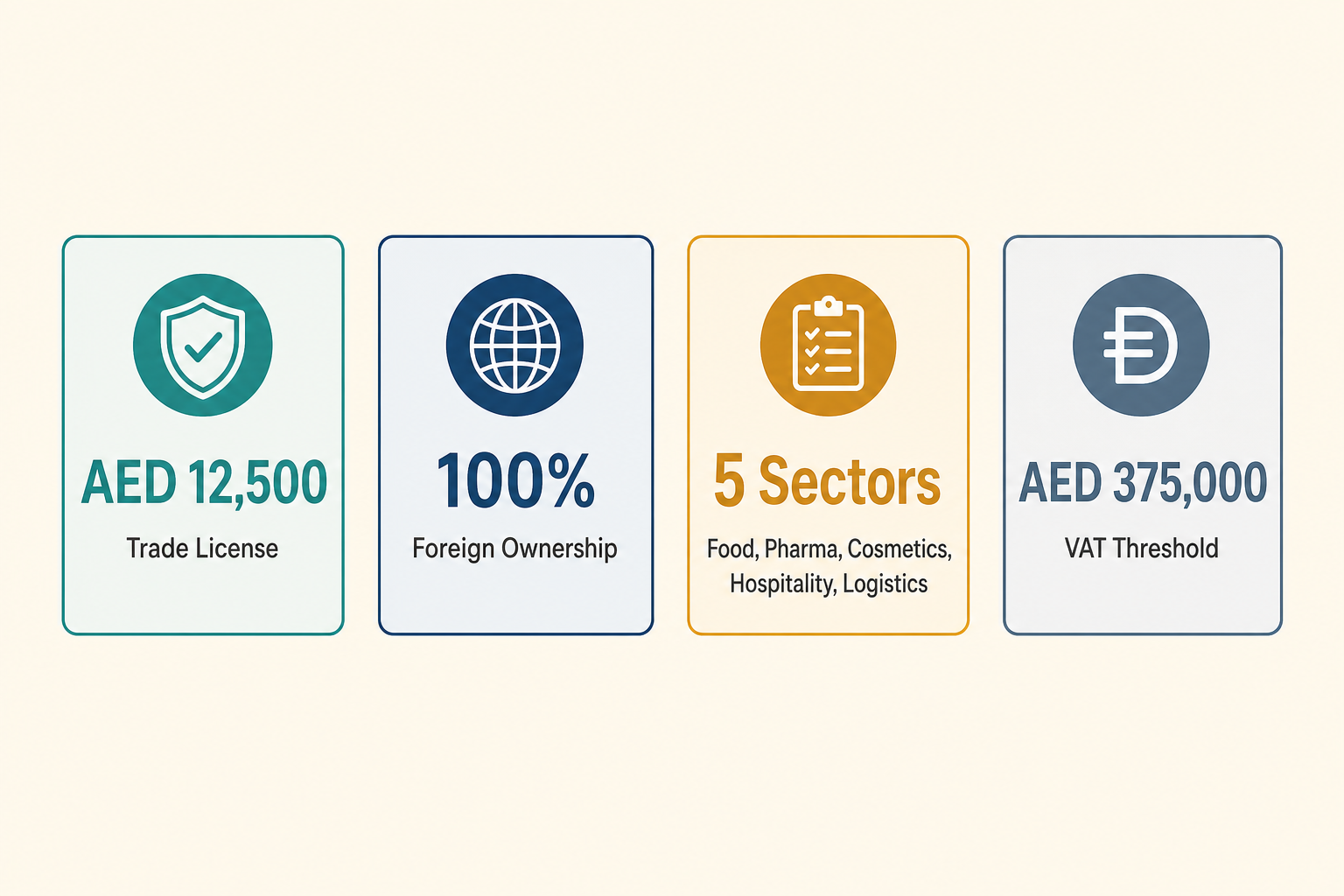
Key Stats at a Glance
| License activity | Halal Quality & Conformity Certification Services |
|---|---|
| Sectors served | Food, pharmaceuticals, cosmetics, hospitality, logistics |
| UAE halal standards body | Emirates Authority for Standardisation and Metrology (ESMA) |
| Foreign ownership | 100% in a free zone – Foreign Ownership rules explained |
| Setup options | Mainland via DET or free zone via Meydan Free Zone |
| VAT registration threshold | AED 375,000 annual turnover – Federal Tax Authority (FTA) |
| Trade license cost | Dubai Trade License from AED 12,500 |
What This License Covers
The Halal Quality and Conformity Certification Services license lets you run a business that audits, inspects, and certifies halal compliance. You are not producing halal goods yourself. You are the body that checks whether others meet the standard and issues the paperwork that says they do.
The sectors you can serve are broad. Food production is the most obvious, but the license also covers pharmaceuticals, cosmetics, hospitality operations, and logistics and supply chain audits. Any business that handles, processes, or moves halal-sensitive products may need your services at some point.
It is worth being clear on what this license is and is not. Halal consultants advise businesses on how to get compliant. Certification bodies assess whether they are compliant and issue a formal certificate. This license covers the certification and conformity assessment function, not general consultancy. That distinction matters when you are talking to clients and when you are dealing with regulators.
UAE halal standards are set by ESMA, the Emirates Authority for Standardisation and Metrology. Any certification work you carry out in the UAE must align with ESMA's published standards. If you are certifying products for export, you may also need to understand the halal standards of the destination market, since requirements vary across the GCC, Southeast Asia, and Europe.
Check the Meydan Free Zone business activities list to confirm the exact activity code for this license before you proceed with any application.
Who Your Clients Will Be
Manufacturers and exporters are your core market. A food producer in the UAE that wants to sell into Malaysia, Indonesia, Saudi Arabia, or the UK Muslim market needs a recognised halal certificate. Without it, buyers will not take the product. Getting that certificate means hiring a body like yours to audit their processes and sign off on compliance.
Hotels, restaurants, and catering companies are another steady source of work. Halal-certified status matters to a large share of the UAE's population and to international Muslim visitors. Hospitality operators want the certificate on the wall, and they need someone to audit them first.
Importers and distributors also need conformity checks on supply chains. A distributor bringing food or cosmetics into the UAE from overseas may need to verify that the upstream production process meets UAE halal standards before the goods clear customs or reach retail shelves.
Government procurement is a fourth channel. Public sector food contracts in the UAE, including those for schools, hospitals, and government canteens, often mandate halal certification. Suppliers bidding for those contracts need certified status, which means they need you.
Nobody here buys on a phone call. Manufacturers and exporters run formal procurement processes. Government bodies want you on an approved vendor list. Build your credentials and your accreditation record before you start pitching.
Mainland vs Free Zone: Which Setup Works for You
Both a mainland license and a free zone license let you carry out halal certification work. The difference is in who you can work with directly and what it costs to get started.
| Factor | Mainland (DET) | Free Zone (Meydan Free Zone) |
|---|---|---|
| Client access | Open UAE market, including government entities | Mainly international and private sector clients |
| Foreign ownership | 100% permitted in most activities – Invest in Dubai | 100% foreign ownership as standard |
| Office requirement | Physical office needed | Flexi-desk options available |
| Setup cost | Generally higher | Lower entry cost |
| Best suited to | Businesses targeting UAE government contracts and local market clients | Internationally focused certification work and export-market clients |
A mainland license from the Dubai Department of Economy and Tourism (DET) lets you work directly with UAE government bodies and bid on public sector contracts. You will need a physical office and the setup costs are higher, but the client access is wider.
A free zone setup through Meydan Free Zone gives you 100% foreign ownership, lower setup costs, and flexible office arrangements. It suits businesses whose clients are manufacturers and exporters targeting overseas markets, or private sector hospitality and food businesses. You can still serve UAE-based private clients from a free zone. What you cannot do easily is contract directly with UAE government entities.
This is the biggest choice you will make when setting up. Let your clients decide it, not the price. If most of your work will be helping UAE food exporters get certified for Southeast Asian markets, a free zone works well. If you want to bid on government food service contracts, go mainland.
If you are not sure yet, you can start a business remotely through Meydan Free Zone while you test the market before committing to a physical office.
Free Business Setup Cost Calculator
Calculate NowHow to Set Up: Step-by-Step
- Step 1, book your trade name: Use the DET e-Services portal for a mainland company, or the Meydan Free Zone portal for a free zone setup. Your name must not conflict with existing registered names. You can check your company name availability before you apply.
- Step 2, confirm your activity code: Make sure the halal certification activity is approved in your chosen jurisdiction before you go further. Picking the wrong code causes delays and may need a restart.
- Step 3, prepare your documents: You will need passport copies for all shareholders and directors, a business plan, and proof of address. Free zone applications are generally simpler to process than mainland ones.
- Step 4, submit and get initial approval: Once you submit, the relevant authority reviews your application. Initial approval confirms your trade name and activity are accepted.
- Step 5, sort your office space: For mainland, you need a physical office with a tenancy contract. For Meydan Free Zone, a flexi-desk arrangement is available and counts as your registered address.
- Step 6, apply for any extra approvals: Depending on the sectors you plan to certify, you may need additional sign-off from ESMA or other relevant bodies. Check this early so it does not hold up your license.
- Step 7, get your trade license: Once all approvals are in place, your trade license is issued. You can then open a corporate bank account. Meydan Free Zone's mCore service includes business banking support to help you through that process.
Compliance and What You Need in Place
Running a halal certification business is not just about having a license. You need to show that the people doing the certifying know what they are doing, and that your processes meet a recognised standard.
Auditor qualificationsYour auditors and certifiers need real credentials. That means relevant training in halal standards, food science, or a related discipline, depending on the sectors you cover. Some clients and some markets will ask to see your auditors' qualifications before they accept your certificate as valid. Build a team with the right background from the start.
AccreditationA trade license lets you operate. Accreditation from a recognised body gives your certificates weight. Clients exporting to regulated markets will often need your certification to come from an accredited body, not just a licensed one. Look at what accreditation is available through UAE or international standards bodies and factor that into your business plan.
ESMA alignmentAll halal certification work in the UAE must align with ESMA standards. ESMA sets the national halal standards framework, and your audit and certification processes need to reflect those requirements. Stay current with any updates ESMA publishes, as standards can be revised.
Annual license renewalYour trade license needs renewing each year. Missing the renewal date leads to fines and can suspend your ability to operate. Set a calendar reminder well before the expiry date.
VAT registrationOnce your annual turnover reaches AED 375,000, you must register for VAT with the Federal Tax Authority. You can register voluntarily before that threshold if it suits your business. The Federal Tax Authority (FTA) website has full guidance on registration and filing duties. Meydan Free Zone's mAccounting service includes VAT registration support if you need help with the process.
Staff approvals for specialist sectorsIf you are certifying pharmaceutical or medical food products, there may be extra approvals needed from sector regulators such as the Dubai Health Authority. Check this before you take on clients in those areas.
Market Opportunity
The global halal economy covers food, finance, pharmaceuticals, cosmetics, travel, and fashion. Dubai's position as a trade hub for the GCC, South Asia, Southeast Asia, and Africa puts it at the centre of halal supply chains. Manufacturers and exporters based in the UAE or using Dubai as a transit point need certification that is recognised in their target markets.
The UAE government treats halal standards as a trade priority. ESMA has invested in building a national halal framework that aligns with international standards, which strengthens the credibility of UAE-issued halal certificates in overseas markets. That is good for your business.
Demand is not limited to large manufacturers. The growth of halal-certified hospitality, the rise of Muslim-focused e-commerce, and increasing scrutiny of supply chain integrity across food and pharma all create work for credible certification bodies. The barrier to entry is real, because you need qualified staff and a credible process. That same barrier protects you once you are established.
For up-to-date market data on the halal industry, Mordor Intelligence publishes sector reports covering the global halal food and certification market.
Conclusion
The halal certification sector in Dubai is regulated, credible, and growing. Export demand is the main driver, backed by a UAE government that treats halal standards as a trade priority. The work is technical, the clients are serious, and the barriers to entry keep the market from being flooded.
Getting the setup right from the start matters. Choose the right jurisdiction for your client base, confirm your activity code, and make sure your team has the qualifications to back up the certificates you issue.
Speak to Meydan Free Zone to confirm the right activity code, compare setup costs, and get your license in place.
Ready to Launch Your Business in Dubai?
Let's ConnectCompliance
THIRD-PARTY APPROVAL
This activity requires pre-approval from the EIAC (Emirates International Accreditation Centre) before a business license can be issued by Meydan Free Zone.
ANTI-MONEY LAUNDERING COMPLIANCE
This business activity is exempt from AML compliance requirements.