
Table of Contents
Topic Summary
Understand What Activity Code 4759.05 Covers
This license lets you retail major appliances like fridges and washing machines, small appliances like air fryers and coffee machines, and smart connected devices directly to customers. It does not cover manufacturing, wholesale distribution, installation, or antiques, which fall under separate codes.
Tap Into a Multi-Billion Dollar UAE Market
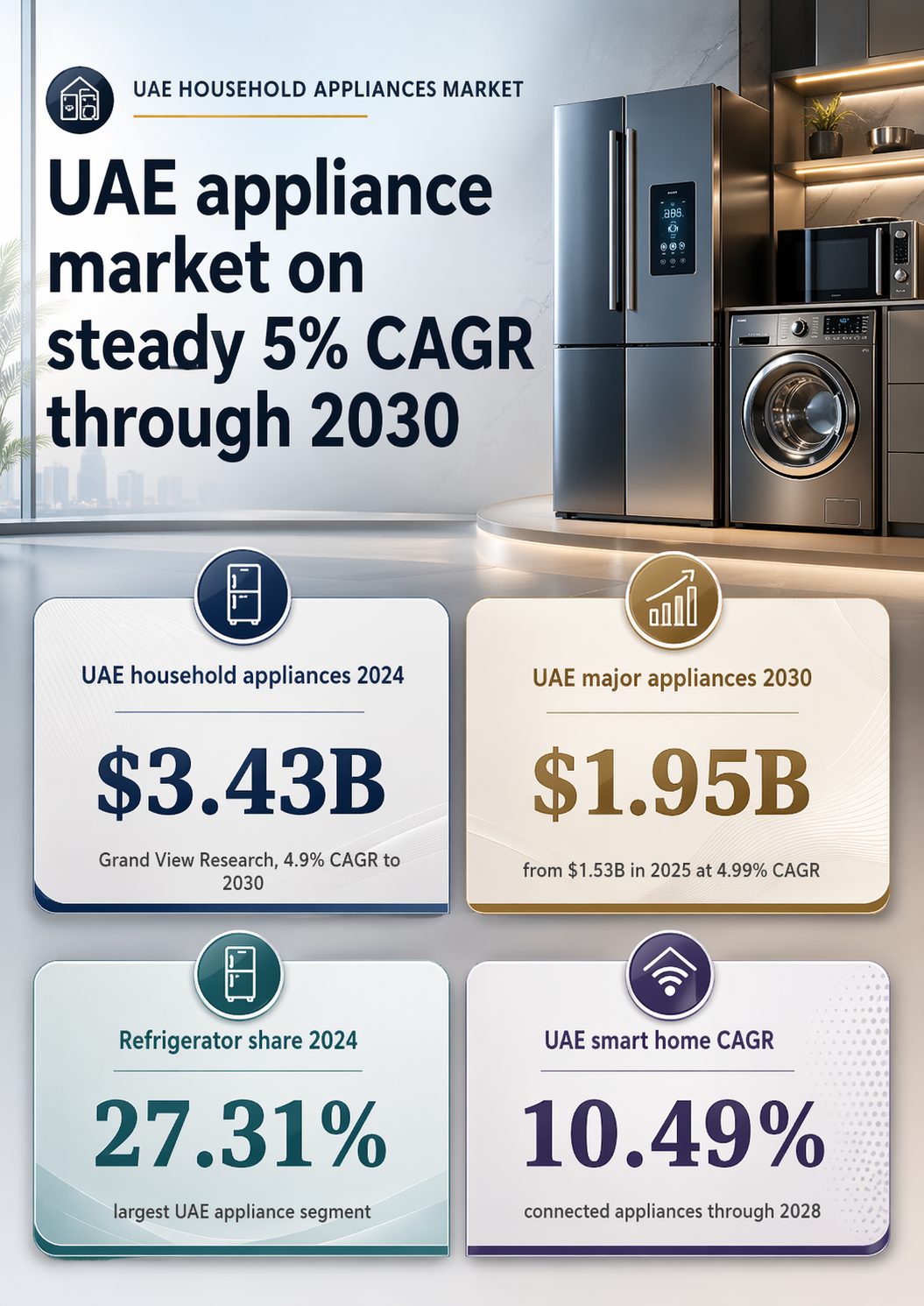
The UAE household appliances market was worth USD 3.43 billion in 2024, with major appliances accounting for 86.1% of that figure. Refrigerators alone took 27.31% of major home appliance revenue, making them a cornerstone product for any new retailer.
Know Your Three Core Customer Groups
You can serve everyday homeowners through a showroom or online store, gift and replacement buyers looking for small kitchen and personal care gadgets, or property developers ordering white goods in bulk to fit out entire residential towers. Each model has distinct pricing, logistics, and sales cycle needs.
Ride the Smart Appliance Growth Wave
The UAE smart home market, which includes connected and app-controlled appliances, is growing at a 10.49% CAGR from 2024 to 2028. Stocking inverter air conditioners, smart ovens, and internet-enabled fridges positions your business in the fastest-expanding segment of the category.
Choose Between Mainland and Free Zone Setup
A mainland DET license suits walk-in retail with a registered shop space, while a Meydan Free Zone license offers 100% foreign ownership, a flexi-desk setup, and the ability to sell online or to business buyers with a fully remote application process. Let your target customer determine which route makes sense.
Enjoy Simplified Compliance Requirements
Activity code 4759.05 requires no third-party regulatory approval, and the business is exempt from anti-money laundering rules. This makes the licensing process more straightforward compared to many other retail categories in the UAE.
How to Start a Retail Sale of Household Appliances Business in Dubai with Meydan Free Zone
A family moving into a villa in Dubai Hills buys a fridge, a washing machine, a split air conditioner and a smart oven in one afternoon. A developer furnishing 400 apartments in Business Bay orders white goods by the container to fit out every kitchen. A homeowner in Abu Dhabi replaces a tired dishwasher and wants it delivered the same week.
Household appliances are one of the biggest ticket categories in UAE retail that people buy again and again. The market keeps growing as new homes are handed over, incomes rise and buyers look for kit that uses less power. This guide covers what activity code 4759.05 lets you sell, who your buyers are, and how to get set up.
Key Stats at a Glance
What This License Covers
Activity code 4759.05 lets you run a specialist retail business selling household appliances straight to customers. The range splits three ways.
- Major appliances: fridges, freezers, washing machines, dishwashers, ovens and air conditioners, both freestanding and built in, across every brand tier
- Small appliances: coffee machines, food processors, vacuum cleaners, microwaves, air fryers, toasters, grills, irons, hair dryers and kitchen gadgets
- Smart and connected: internet-enabled fridges, connected washing machines, inverter air conditioners, smart ovens and app-controlled appliance systems
There is one boundary worth knowing. This code covers retail sale to customers. It does not cover antiques, and it does not cover making, wholesale distribution or installing appliances. Those sit under separate activity codes. If you sell household appliances direct to the person using them, this is your activity.
Who Your Clients Will Be
Three business models sit under this one code, and they sell to different people.
White goods retailers
You run a showroom or an online store selling fridges, washing machines, dishwashers, ovens, freezers and air conditioners. You carry branded stock from names such as LG, Samsung, Bosch, Siemens and Haier, run promotions, offer buy-now-pay-later, and arrange delivery and fitting through partner contractors.
Kitchen and personal care retailers
You sell coffee machines, food processors, vacuum cleaners, microwaves, air fryers, toasters, grills, irons and hair dryers to homeowners and tenants. These are replaced often and bought as gifts, so your year runs on promotion cycles.
Bulk white goods suppliers
You supply white goods in volume to property developers, serviced apartment operators and fit-out teams kitting out new towers. You price by contract, move the logistics, and bundle warranty and fitting into large handover programmes.
Mainland or Free Zone
This is the biggest choice you will make when setting up, so let your buyers decide it rather than the price.
A mainland license from the Department of Economy and Tourism fits a shopfront where customers walk in off the street. A free zone license from Meydan Free Zone fits online selling, supply to developers and fit-out firms, and re-export into the wider region, and it gives you full ownership of the company.
[blockCTACostCalculator]
Step by Step Setup Guide
- Step 1, confirm your activity code: Check that 4759.05, Retail Sale of Household Appliances, is on the Meydan Free Zone approved list, and add related trading codes now if you plan to sell beyond appliances.
- Step 2, book your trade name: Use the Meydan Free Zone portal for a free zone company, or the DET portal for a mainland one.
- Step 3, send in your setup papers: Passport copies for every shareholder and director, plus a short description of what you will trade and who you will sell to.
- Step 4, get your license issued: No third-party approval applies to this activity, so there is no separate regulator to clear before you can trade.
- Step 5, sort stock, delivery and warranty: Line up your supply agreements, your storage, and the contractors who will deliver and fit. Buyers judge appliance sellers on what happens after the sale.
- Step 6, open a bank account and register for VAT: Banks want your license and your compliance papers. Register with the Federal Tax Authority once the turnover threshold applies to you.
Meydan Free Zone supports remote setup, so shareholders outside the UAE can get through the first stage without flying in.
Compliance and What You Need in Place
Third-party approval
None is needed here, which keeps your setup shorter than it is for regulated goods.
Anti-money laundering
This activity is exempt from AML rules, so you do not carry the reporting duties that apply to higher risk trades.
Energy efficiency and labelling
Energy efficiency standards shape what sells here. UAE efficiency rules are one of the forces pushing buyers towards newer models, so check that the ranges you import carry the right labelling before you commit to stock.
Warranty and after-sales
Appliances get delivered, fitted and repaired. Whether you handle that in house or through partner contractors, set the terms in writing with your suppliers, because developer contracts usually ask you to cover warranty and fitting as part of the deal.
VAT and books
Register for VAT with the Federal Tax Authority once your taxable turnover passes the AED 375,000 threshold. High-ticket retail crosses that line quickly, so keep clean books from your first sale.
Market Opportunity
The numbers behind this trade are steady rather than dramatic, which suits a business built on replacement cycles. Grand View Research puts the UAE household appliances market at USD 3.43 billion in 2024, growing at a 4.9% CAGR from 2025 to 2030, with major appliances taking 86.1% of the market in 2024. Spherical Insights values the UAE home appliances market at USD 3.89 billion in 2024 and expects USD 6.70 billion by 2035, a 5.07% CAGR, helped by urban growth, smart appliance take-up and energy efficiency rules. IMARC Group puts the market at USD 3.34 billion in 2024 and forecasts USD 5.00 billion by 2033, a 4.14% CAGR.
Mordor Intelligence looks at major home appliances on their own and values that at USD 1.53 billion in 2025, reaching USD 1.95 billion by 2030 at a 4.99% CAGR. Refrigerators are the single biggest line at 27.31% of 2024 revenue, which makes sense in this climate. Abu Dhabi is set to grow faster than the UAE average at a 6.91% CAGR through 2030.
The fastest moving part of the market is the connected end. IMARC Group puts the UAE smart home market, connected appliances included, at USD 76.4 million in 2024, growing at a 10.49% CAGR from 2024 to 2028. Stocking smart models is where the growth sits.
Conclusion
Retail sale of household appliances is one of the simpler trading activities to license in Dubai. No third-party approval applies, the activity is exempt from AML rules, and the scope is wide enough to cover a showroom, an online store or a bulk supply operation under one code.
What decides your success is the practical side: supply deals, stock choices, and a delivery and warranty setup your buyers trust. Get those right, pick the jurisdiction that matches who you sell to, and the licensing part is routine.
[blockCTAContact]