Table of Contents
Frequently Asked Questions
What activity code covers a Maggots Laboratory in Dubai
A Maggots Laboratory in Dubai is licensed under activity code 8690.9, which sits within the other human health activities category. This code covers specialised biological research and applied laboratory services.
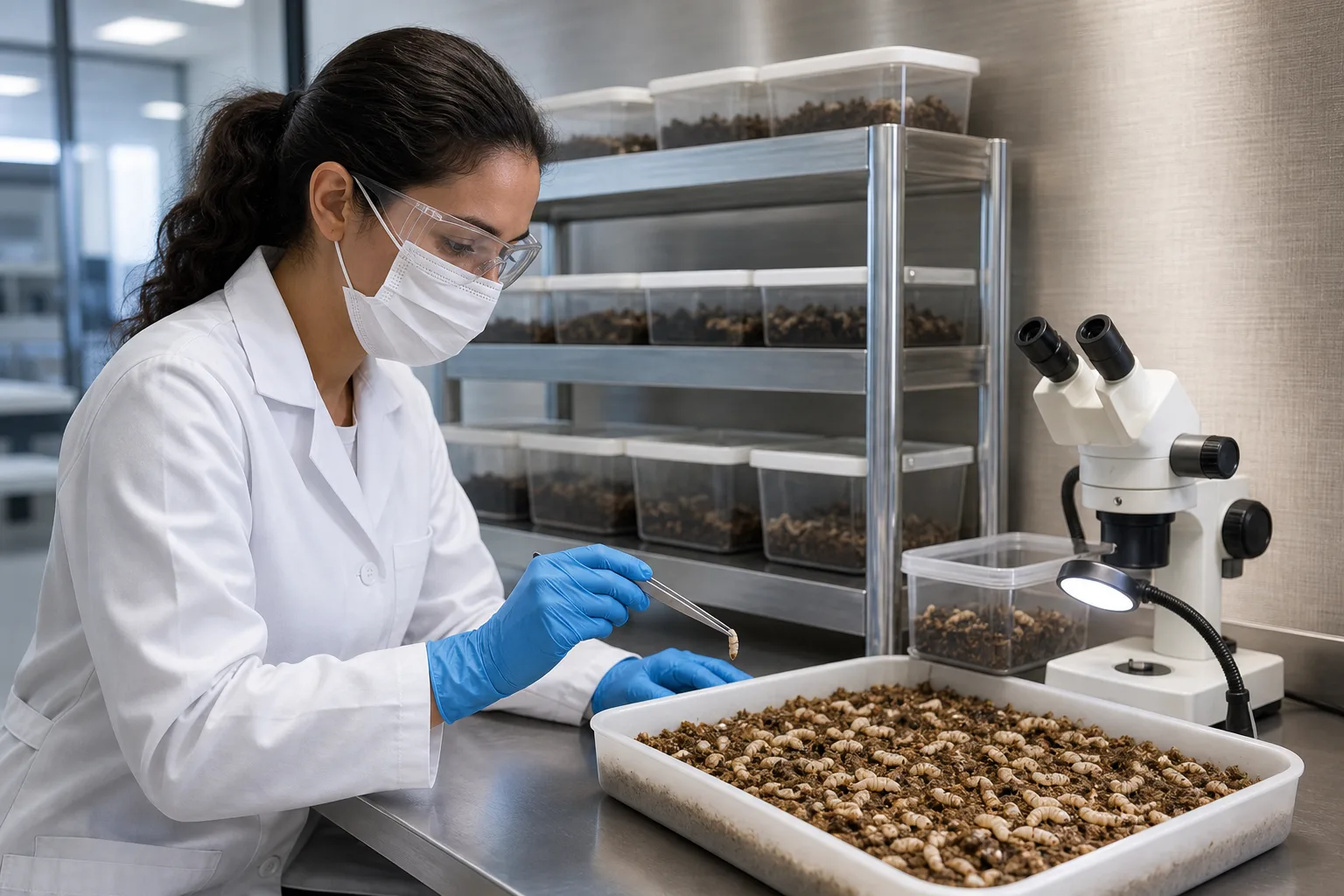
In practice, it encompasses a range of operations including Black Soldier Fly larvae farming, production of protein meal and frass, and medical maggot therapy using sterile Lucilia sericata larvae for wound debridement.
Which regulatory bodies oversee a Maggots Laboratory in the UAE
The regulatory oversight depends on what your laboratory produces. For medical or clinical-grade outputs — such as sterile larvae supplied to wound-care clinics — the Dubai Health Authority (DHA) has oversight, and therapeutically classified preparations may also require registration with the Ministry of Health and Prevention (MOHAP).
Agricultural or feed-grade outputs, including protein meal, frass, and live larvae for aquaculture, fall under the UAE Ministry of Climate Change and Environment (MOCCAE), which also governs import permits for breeding stock and export certification for finished products.
Biosafety protocols, waste handling procedures, and containment standards must be documented at the licence application stage, as these form the basis on which third-party approvals are assessed.
Why is Dubai a strategic location for maggot-based bioconversion and research
Dubai handles over 10 million tonnes of waste annually, making bioconversion through Black Soldier Fly larvae a measurable and commercially relevant diversion pathway aligned with the city's circular economy targets.
The UAE imports over 80% of its food, which makes alternative protein development and circular agriculture a national priority under the UAE Food Security Strategy 2051. This creates genuine policy-backed demand for larvae-derived protein products.
Dubai's position as a regional logistics hub, supported by DP World's infrastructure across 80+ countries, also enables the export of larvae-derived products to markets across the GCC, East Africa, and South Asia.
What are the main commercial applications of a Maggots Laboratory
A Maggots Laboratory can operate across several distinct verticals. The most established include Black Soldier Fly (BSF) larvae farming for organic waste bioconversion, and the production of protein meal and frass for use in aquaculture and livestock feed.
A third significant application is medical maggot therapy (MDT) — the clinical use of sterile larvae for wound debridement. Demand for MDT is growing in GCC hospitals as antibiotic-resistant infections become more prevalent.
The global insect protein market is projected to reach USD 4.3 billion by 2030, driven by aquaculture, livestock feed, and waste bioconversion sectors, according to Mordor Intelligence.
What is the advantage of setting up a Maggots Laboratory through Meydan Free Zone
Setting up through Meydan Free Zone means the licence covers research and laboratory activity without requiring a DED mainland approval. The free zone acts as a single point of contact for initial setup, which simplifies the early stages of the process.
A free zone structure also isolates much of the regulatory complexity associated with external approvals. Once the licence is in place, the operator can then pursue the relevant third-party approvals — such as DHA, MOHAP, or MOCCAE — depending on the specific outputs of the laboratory.
What business model is recommended for a new Maggots Laboratory in Dubai
The most straightforward route to revenue is a B2B model: supplying larvae, processed frass, or protein concentrate directly to farms, aquaculture operators, and organic waste processors. This avoids the complexity of consumer-facing distribution and aligns with the existing procurement structures of agricultural and industrial buyers.
Depending on the founder's focus, the laboratory could also target clinical supply chains by providing sterile larvae to wound-care clinics, though this route requires additional DHA and potentially MOHAP approvals and carries a higher regulatory burden at the outset.
Does a Maggots Laboratory in Dubai need to document biosafety and containment procedures
Yes. Biosafety protocols, waste handling procedures, and containment standards must be documented at the licence application stage. This is not treated as a formality — these documents form the basis on which third-party regulatory approvals, such as those from DHA or MOCCAE, are assessed.
Getting this documentation right at the outset is important. Errors or omissions in the regulatory classification of your outputs can result in delays after the licence has already been issued, which can be costly and disruptive to operations.
What market trends support investment in a Maggots Laboratory in the UAE
Several converging trends support the commercial case. The global insect protein market is projected to reach USD 4.3 billion by 2030, with aquaculture and livestock feed as primary demand drivers. The UAE's own food security agenda reinforces domestic demand for alternative protein sources.
On the waste side, Dubai's circular economy targets and the scale of its municipal waste — over 10 million tonnes annually — create a policy environment that is actively supportive of bioconversion technologies. Medical demand is also rising, with antibiotic-resistant infections increasing clinical interest in maggot debridement therapy across GCC hospitals.
DP World's logistics network further supports the export dimension, giving UAE-based producers access to regional and international markets for larvae-derived products.
How to Open a Maggots Laboratory in Dubai
Maggot-based research and bioconversion is a quiet but growing sector in the UAE, pulled along by waste management, agriculture, aquaculture feed and wound care. The commercial logic holds up: the UAE imports over 80% of its food, Dubai handles more than 10 million tonnes of waste a year, and both facts are policy problems the government is actively spending money on.
This guide covers what activity code 8690.9 permits, which authority regulates what you make, and how to license through Meydan Free Zone. The single most important decision comes early: how your outputs are categorised.
Key Stats at a Glance
| Activity code | 8690.9, other human health activities, covering specialist biological research and applied laboratory services |
|---|---|
| Main applications | Black Soldier Fly larvae farming, protein meal and frass production, and medical maggot therapy using sterile larvae |
| Medical outputs | Overseen by the Dubai Health Authority, with MOHAP registration for therapeutic preparations |
| Agricultural outputs | Overseen by the Ministry of Climate Change and Environment, including import permits and export certificates |
| Documentation | Biosafety, waste handling and containment protocols, submitted at license application stage |
| Waste volume | Dubai handles over 10 million tonnes a year, giving bioconversion a measurable diversion role |
| Food imports | The UAE imports over 80% of its food, under the Food Security Strategy 2051 – Ministry of Economy and Tourism, Establishing companies |
| Market size | Global insect protein market set to reach USD 4.3 billion by 2030 – Mordor Intelligence |
| Export reach | Logistics across more than 80 countries – DP World |
| License time | 3 to 5 working days, with external approvals running separately afterwards |

What This License Covers
Activity code 8690.9 sits within other human health activities and covers specialist biological research and applied laboratory services. In practice a maggots laboratory runs in one or more of three directions:
- Black Soldier Fly larvae farming, converting organic waste into biomass
- Protein meal and frass production, for aquaculture and livestock feed
- Medical maggot therapy, supplying sterile Lucilia sericata larvae for wound debridement
Those three look similar in the lab and completely different to a regulator. Which one you pursue decides which authority governs you, what documentation you file and how long approval takes. Decide before you apply, not after.
Who Your Clients Will Be
Farms, aquaculture operators and waste processors
The most direct route to revenue is business to business: supplying larvae, processed frass or protein concentrate to buyers who already have procurement systems. Demand exists in the UAE and the wider GCC and is not well served domestically yet.
Municipal waste authorities
Bioconversion contracts with Dubai Municipality or Abu Dhabi waste authorities carry serious volume. Procurement cycles are long and they want proven capacity, so this is a second-phase target rather than a launch customer.
Wound-care clinics
Supplying sterile larvae to licensed wound-care facilities is niche but defensible. The clinical evidence for maggot debridement is established, antibiotic-resistant infections are pushing interest up across GCC hospitals, and the region is underserved compared with Europe.
Universities and agri-tech accelerators
Research partnerships, several under government mandate to solve food security, give you a lower-capital entry and credibility you can carry into commercial scale-up later.
Mainland or Free Zone
| Factor | Mainland (DET) | Free Zone (Meydan Free Zone) |
|---|---|---|
| Approval route | DET approval for the activity | License covers research and laboratory activity without DET approval |
| Foreign ownership | Set by DET rules for the activity | 100% yours, with full profit repatriation |
| Premises | Physical unit | Flexi-desk for research-led work, dedicated unit for on-site lab infrastructure |
| Sector approvals | Still needed by output type | Still needed by output type |
This is the biggest choice you will make when setting up, and for a laboratory it is mostly about how much friction you want at the front end.
A Meydan Free Zone license covers research and laboratory activity without needing separate mainland approval from the Department of Economy and Tourism, and the free zone acts as one point of contact through setup. That isolates a good deal of complexity while you get the entity in place. You still pursue the sector approvals afterwards, but you do it from a licensed base rather than from nothing.
Take a flexi-desk if your work is early-stage or research-led. Take a dedicated unit if you will run physical laboratory infrastructure on site, and settle that before you sign anything, because containment standards shape the space.
[blockCTACostCalculator]
Step by Step Setup Guide
- Step 1, confirm your activity: Activity code 8690.9 is the main one. Depending on your scope, a research or laboratory activity may apply alongside it, so confirm before you submit.
- Step 2, prepare your biosafety documentation: Biosafety protocols, waste handling procedures and containment standards go in at application stage. These are what the sector regulators later assess, so treat them as a technical document rather than a form.
- Step 3, submit your setup papers: Trade name reservation, passport copies, and a business plan setting out your scope and intended outputs.
- Step 4, take initial approval and pick your premises: Approval comes quickly. Match your space to your infrastructure, not to your budget optimism.
- Step 5, collect your license: Usually issued within three to five working days once papers are in order.
- Step 6, pursue your sector approvals: DHA, MOHAP or MOCCAE, depending on output. These run alongside your operational setup rather than before it.
- Step 7, apply for visas: Allocation is tied to the premises package you chose, so plan headcount at the same time.
Compliance and What You Need in Place
Medical outputs
If you supply clinical-grade or sterile larvae to wound-care clinics, the Dubai Health Authority governs both the product and the facility. Therapeutically categorised preparations may also need product registration with the Ministry of Health and Prevention. Allow four to twelve weeks for these, depending on how the product is treated and whether clinical-grade standards apply.
Agricultural outputs
Protein meal, frass and live larvae for aquaculture fall under the Ministry of Climate Change and Environment. That covers import permits for breeding stock as well as export certification for what you produce. It runs on its own track with its own timelines.
Biosafety and containment
This is the thread running through everything. Your protocols for containment, waste handling and biosafety are assessed by whichever authority governs your output, so weak documentation here delays approvals everywhere.
Getting the category right
Errors in how your outputs are categorised surface after the license is issued, which is the expensive moment to discover them. If a single product line could read as either feed-grade or therapeutic, resolve that question first.
Market Opportunity
Three forces sit behind this sector, and all three are policy-backed rather than speculative.
Food security
The UAE imports over 80% of its food, and alternative protein and circular agriculture are national priorities under the Food Security Strategy 2051. Mordor Intelligence puts the global insect protein market at USD 4.3 billion by 2030, driven by aquaculture, livestock feed and waste bioconversion.
Waste
Dubai handles over 10 million tonnes a year, and larvae bioconversion is a measurable diversion pathway that fits the city's circular economy targets. That combination, a waste problem and a protein problem solved by the same process, is what makes this more than a curiosity.
Clinical demand
Antibiotic-resistant infections are pushing hospitals across the GCC back towards maggot debridement therapy, an established intervention that the region currently under-supplies.
Export reach
DP World's network reaching more than 80 countries puts GCC, East African and South Asian markets within practical range of a Dubai-based producer.
Conclusion
A maggots laboratory is a niche operation with real applications across medical, agricultural and waste sectors, and the UAE's regulatory environment is workable once you know which authority governs your particular outputs.
The free zone route removes friction from the setup itself. The harder work is categorising your products correctly and building the external approval timelines into your plan from the first week rather than the first crisis. Prepare the biosafety documentation properly and everything downstream moves faster.
[blockCTAContact]