Table of Contents
Frequently Asked Questions
What activity code covers a general building cleaning business in Dubai
A general building cleaning business in Dubai operates under activity code 8121 — General Cleaning of Buildings. This classification covers interior cleaning of offices, residential units, and common areas, as well as exterior and façade cleaning, post-construction cleaning, and general maintenance cleaning for commercial and institutional premises.
It is important to note that this code does not extend to specialist industrial cleaning or hazardous waste handling. Those activities require separate activity classifications and their own licensing process.
How large is the building cleaning and facility management market in Dubai
The UAE facility management and cleaning sector is one of the most resilient service industries in the region. According to Mordor Intelligence, the UAE facility management market is projected to grow at a compound annual growth rate exceeding 7% through the mid-2020s, driven by commercial real estate expansion, government infrastructure projects, and hospitality sector recovery.
Dubai accounts for a significant share of this demand. The emirate's population has exceeded 3.6 million according to the Dubai Statistics Centre, sustaining dense residential and commercial occupancy across hundreds of towers and mixed-use developments. Dubai also hosts over 140,000 hotel rooms, all of which require daily cleaning contracts.
Who are the main customers for a building cleaning business in Dubai
The primary customer base is commercial and institutional rather than residential. Key segments include property developers requiring post-handover and snagging-phase cleaning, building management companies holding long-term contracts for towers and mixed-use developments, and hospitality groups such as hotels, serviced apartments, and resorts that operate on daily cleaning schedules.
Corporate tenants in free zones and business districts also procure cleaning services as part of their facilities spend. The revenue model is predominantly B2B and contract-driven, with recurring monthly contracts providing predictable cash flow and one-off post-construction or deep-cleaning projects offering higher margins.
How long do commercial cleaning contracts typically run in Dubai
In Dubai's commercial sector, cleaning contracts typically run for 12 to 36 months. This long-term contract structure is one of the key commercial advantages of the sector — it creates predictable, recurring revenue rather than reliance on one-off engagements.
Building management companies and developers generally require licensed and insured contractors to qualify for these agreements, which effectively excludes informal operators from the most valuable and stable contracts in the market.
What are the main cost centres when running a building cleaning business in Dubai
The two dominant cost centres are staffing and equipment. Labour costs — including visa processing, accommodation obligations, and compliance with the Ministry of Human Resources and Emiratisation (MOHRE) — typically represent 55 to 65% of total operating costs.
Because labour is such a significant proportion of costs, operators must plan carefully for workforce scaling, visa timelines, and accommodation requirements from the outset. Equipment, insurance, and vehicle or transport costs make up the remainder of the core cost base.
Why is labour compliance particularly important for cleaning businesses in Dubai
Labour compliance is described as the most operationally significant requirement for a cleaning business in Dubai. All employees must be registered with the Ministry of Human Resources and Emiratisation (MOHRE), and operators carry legal obligations around visa sponsorship, accommodation, and employment contracts.
Failure to comply with these requirements can result in regulatory penalties and disqualification from institutional contracts. Large clients such as property developers and hospitality groups typically conduct due diligence on contractors' compliance status before awarding agreements, making MOHRE registration a commercial as well as legal necessity.
Can informal or unlicensed operators compete for building cleaning contracts in Dubai
In practice, no. The regulatory environment in Dubai actively supports formal, licensed operators. Building management companies and property developers typically require contractors to hold a valid trade licence and appropriate insurance as a baseline condition of any contract.
This means informal operators are effectively excluded from the most valuable and stable contracts in the market. Obtaining the correct licence under activity code 8121 and maintaining full regulatory compliance is therefore not just a legal obligation — it is a direct commercial advantage that unlocks access to institutional clients.
What types of cleaning work does activity code 8121 not cover
Activity code 8121 — General Cleaning of Buildings — has a defined scope and does not extend to specialist industrial cleaning or hazardous waste handling. Businesses wishing to operate in those areas must obtain separate activity classifications with their own licensing and compliance requirements.
Operators should confirm the precise scope of their intended services before applying for a licence, as providing services outside the permitted activity classification can create regulatory and contractual liability. If a business intends to offer both general and specialist cleaning, it may need to register multiple activity codes under its trade licence.
How to Start a Building Cleaning Business in Dubai
Towers need cleaning whether the economy is strong or weak. That single fact is what makes this sector worth entering: the demand is embedded in the built environment rather than in consumer confidence, and Dubai keeps adding to the built environment.
The commercial catch is that the good contracts go to licensed, insured operators. Building management companies and developers will not award work to anyone who cannot show the paperwork. This guide covers what activity code 8121 lets you do, who signs the contracts, and how to set up through Meydan Free Zone.
Key Stats at a Glance
What This License Covers
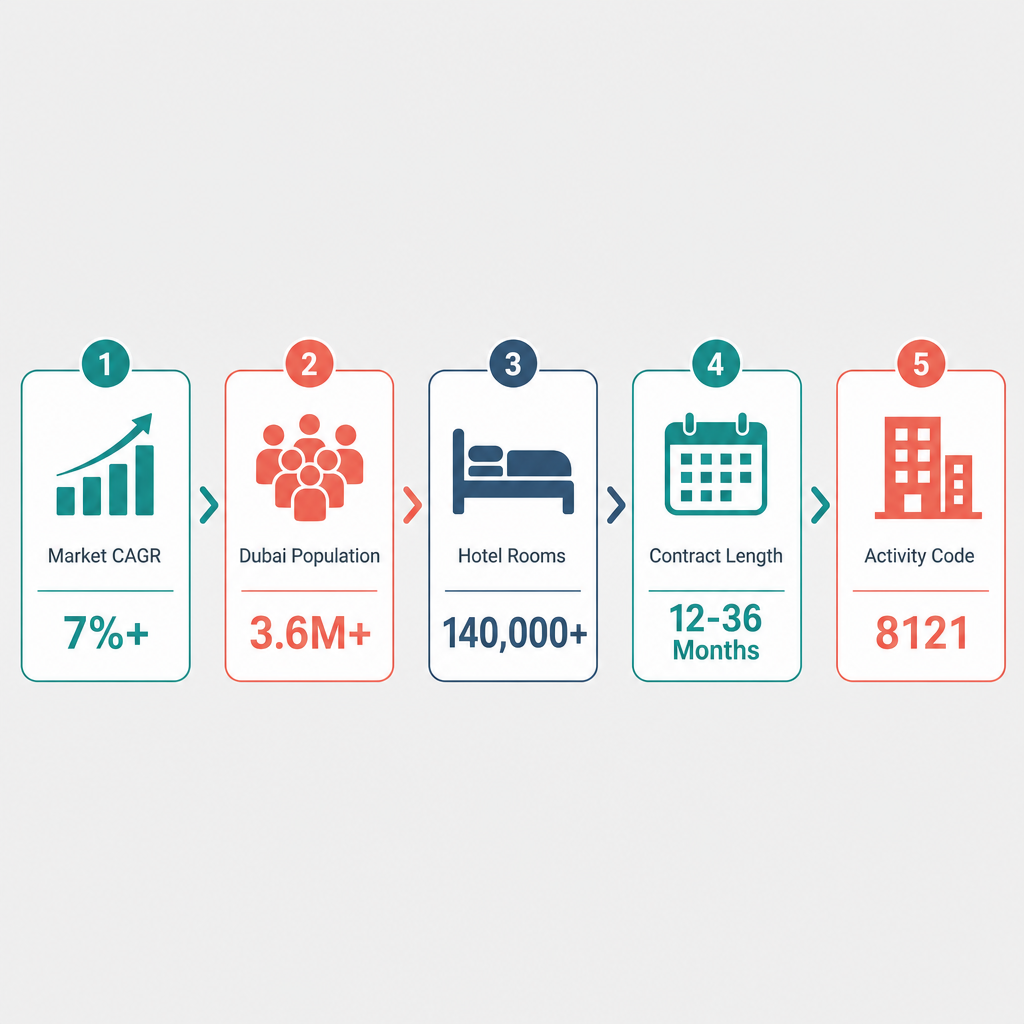
Activity code 8121 covers general cleaning of buildings, and the scope is defined rather than open-ended. It takes in interior cleaning of offices, residential units and common areas, exterior and facade cleaning, post-construction cleaning, and general maintenance cleaning for commercial and institutional premises.
It does not extend to specialist industrial cleaning or hazardous waste handling. Those sit under separate codes with their own licensing. If your plan includes both general and specialist work, you may need more than one activity registered on the license, so settle the scope before you apply rather than after a client asks for something you cannot legally deliver.
Who Your Clients Will Be
This is a business-to-business trade. Residential customers are not the market.
Property developers
Post-handover and snagging-phase cleaning. Project work, tied directly to the delivery pipeline, and it comes in bursts.
Building management companies
Long-term contracts across towers and mixed-use developments. This is the core of a stable cleaning business, and the contracts run 12 to 36 months, which is long enough to plan a workforce around.
Hospitality groups
Hotels, serviced apartments and resorts run daily cleaning schedules. Demanding, but the volume is reliable and the standards you meet there become your reference for everyone else.
Corporate tenants
Companies in free zones and business districts buy cleaning as part of facilities spend.
Recurring monthly contracts give you predictable cash flow. One-off post-construction and deep-cleaning projects carry higher margins but need active selling. A working operation runs both.
Mainland or Free Zone
The free zone structure works well at the start-up stage, when you are building a client base and watching capital. Plan for one thing though: a free zone entity running cleaning contracts on Dubai mainland will typically need a local service agent or a mainland branch to execute them directly. That is standard practice and it does not undermine the free zone route. It is simply a second step once your mainland pipeline justifies it.
[blockCTACostCalculator]
Step by Step Setup Guide
- Step 1, confirm your activity and book your trade name: Select General Cleaning of Buildings under code 8121 and check name availability before you commit.
- Step 2, send in your setup documents: Passport copies, application forms and any declarations asked for.
- Step 3, pay the fee and collect your license: The process is built to move quickly, and remote options are available if you are not yet in the UAE.
- Step 4, sort visas and workspace: Your visa allocation follows your package. A flexi-desk satisfies the physical address need without a full office lease, which is the sensible position until your contract pipeline justifies more.
Compliance and What You Need in Place
Labour
This is the most operationally serious part of running a cleaning business. Every employee must be registered with the Ministry of Human Resources and Emiratisation (MOHRE), with contracts lodged through the Tawjeeh system. Worker welfare standards covering accommodation, health insurance and wage protection are enforced and audited. If you are running large teams, budget for staff accommodation or structured allowances from the start, because labour typically eats 55% to 65% of your operating costs and accommodation is a real part of that.
Health and safety
High-rise facade cleaning needs working-at-height protocols, certified kit and trained operatives. Cleaning chemical handling must meet Dubai Municipality standards. Public liability insurance and workmen compensation cover are both commercially expected and often written into the contract itself. Institutional clients will not award work without evidence of adequate cover, so this is a sales prerequisite as much as a legal one.
VAT
Cleaning services are standard-rated at 5%. Register with the Federal Tax Authority once annual turnover passes AED 375,000, and build compliant invoicing into your systems before the first contract is signed rather than retrofitting it.
Market Opportunity
The UAE facility management and cleaning sector is one of the more resilient service industries in the region. Mordor Intelligence expects the market to grow at above 7% a year through 2028, driven by commercial real estate expansion, government infrastructure projects and hospitality recovery.
Dubai holds a large share of that. The population has passed 3.6 million, which sustains dense residential and commercial occupancy across hundreds of towers and mixed-use developments. Over 140,000 hotel rooms need daily cleaning contracts. Post-construction demand tracks the thousands of new units delivered every year, so the project work arrives as reliably as the recurring work.
The regulatory environment helps a formal operator rather than hindering one. Because building management companies and developers need licensed, insured contractors, informal operators are effectively shut out of the most valuable contracts. Getting the license and the insurance right is not just compliance. It is what puts you on the tender list at all.
Conclusion
Building cleaning in Dubai gives you contract-driven revenue you can actually forecast, provided you structure the business properly from day one. Demand is structural, not cyclical, and institutional clients actively prefer compliant contractors.
Three foundations carry everything else: the right license, compliant staffing from the outset, and a focused business-to-business sales model. Get those in place and the contract lengths in this sector do the rest of the work for you.
Use the cost calculator to estimate your setup costs, then talk to the Meydan Free Zone team to get your license in place on the right footing.
[blockCTAContact]