Table of Contents
Frequently Asked Questions
What is activity code 3811.97 and what does it permit a business to do in Dubai
Activity code 3811.97 covers Construction and Demolition Waste Collection and Transportation Services. It authorises the collection, loading, and transportation of non-hazardous solid waste generated by construction, renovation, and demolition sites.
Permitted services under this code include skip hire and placement, debris haulage by tipper truck, site clearance between project phases, and basic waste segregation at source — separating materials such as concrete rubble, timber, metal, and mixed fill before transfer to an approved facility.
The activity does not extend to hazardous waste disposal, chemical handling, landfill operation, or waste treatment and processing. Those functions require separate and more complex regulatory approvals in Dubai.
Who are the typical customers for a construction waste collection business in Dubai
The primary customer base consists of businesses operating active construction and demolition sites. These include main contractors, specialist demolition firms, fit-out and interior contractors, property developers managing multiple concurrent sites, and civil engineering subcontractors.
These clients share a common need: reliable, permit-compliant waste removal on a schedule that does not disrupt site operations. Operators who can consistently meet that requirement — particularly with full documentation — are well positioned to command a pricing premium.
Developers overseeing large, multi-phase projects are especially valuable clients because they can provide sustained, predictable volume across a project's entire lifecycle rather than one-off spot jobs.
What are the main revenue streams for a C&D waste collection operator in Dubai
There are two primary revenue streams. The first is haulage — charging per load, per trip, or per tonne for collecting and transporting waste from a site to an approved transfer or recycling facility. The second is skip rental — placing skips on site for a defined period and charging a flat fee that includes collection once the skip is full.
A secondary revenue layer is available through material resale. Sorted concrete aggregate, scrap steel, and clean timber offcuts carry resale value with recyclers and material brokers. Operators who invest in basic segregation at the point of collection can recover margin that would otherwise be absorbed as disposal cost.
Contract structure also shapes revenue quality. Spot jobs generate immediate cash flow but require constant business development effort, whereas site-embedded service agreements provide predictable volume and allow more efficient fleet planning.
What capital equipment does a construction waste collection business in Dubai require
The core capital requirements include tipper trucks for debris haulage, skip loaders for placing and collecting skips, and a compliant storage yard where skips and equipment can be held between jobs.
Beyond physical assets, the business also requires administrative infrastructure to manage permit documentation across multiple active sites simultaneously. Regulatory enforcement of waste transport permits has increased materially since 2022, making documentation management a genuine operational function rather than a formality.
Operators who invest in basic on-site segregation capability — even simple sorting at the point of collection — can unlock the secondary material resale revenue stream, which improves overall margin without requiring significant additional equipment.
Why is there a commercial opportunity for SME operators in Dubai's C&D waste market
Despite C&D waste representing a substantial share of Dubai's total municipal solid waste output, specialist SME operators with compliant fleets and proper licensing remain relatively scarce. The majority of the market is currently served by large civil contractors who handle waste removal as a secondary function, not a core business priority.
This creates a structural gap. A focused operator whose entire business model is built around compliant, reliable waste collection can offer a level of service consistency and documentation rigour that generalist contractors typically cannot match.
Dubai's circular economy commitments and tightening municipal enforcement are intensifying pressure on construction sites to divert material from landfill, which further increases demand for specialist licensed operators.
How significant is Dubai's construction waste problem in terms of volume and regulation
Dubai's construction sector continues to expand due to infrastructure growth, urban densification, and a sustained pipeline of large-scale development projects. These activities collectively produce millions of tonnes of C&D waste each year, making it one of the most significant components of the emirate's total solid waste output.
Regulatory pressure has increased alongside this volume. Enforcement of waste transport permits has risen materially since 2022, and Dubai's broader circular economy commitments create a policy environment that actively incentivises diverting C&D material from landfill toward reuse and recycling.
Dubai's Invest in Dubai platform lists waste management among priority growth sectors under the emirate's economic agenda, signalling continued institutional support for the industry.
What is the difference between spot jobs and site-embedded service agreements in this business
Spot jobs are one-off or ad hoc waste collection assignments. They generate immediate cash flow and can be useful for filling fleet capacity, but they require continuous business development effort to maintain a steady pipeline and offer no volume predictability.
Site-embedded service agreements are contracts where the operator becomes the designated waste handler for a developer or contractor across an entire project lifecycle. These arrangements provide predictable, sustained volume over an extended period — often months or years — which allows the operator to size and schedule their fleet efficiently.
A balanced contract mix typically serves growing operators best: spot jobs maintain cash flow during ramp-up, while long-term agreements provide the revenue stability needed to justify fleet investment and staff planning.
What market growth data supports entering the UAE construction waste sector now
According to IMARC Group, the UAE waste management market is on a steady growth trajectory projected to continue through the late 2020s. This growth is supported by government mandates and private sector construction volumes that remain among the highest in the region.
C&D waste accounts for a significant proportion of total solid waste generated in Dubai, yet the specialist operator segment — businesses holding proper licences and running compliant fleets — remains underdeveloped relative to the volume of waste being produced.
The combination of rising enforcement, circular economy policy commitments, and a structurally underserved specialist operator market creates a window for new entrants to establish a defensible position before the segment matures and competition intensifies.
How to Start a Construction Waste Collection Business in Dubai
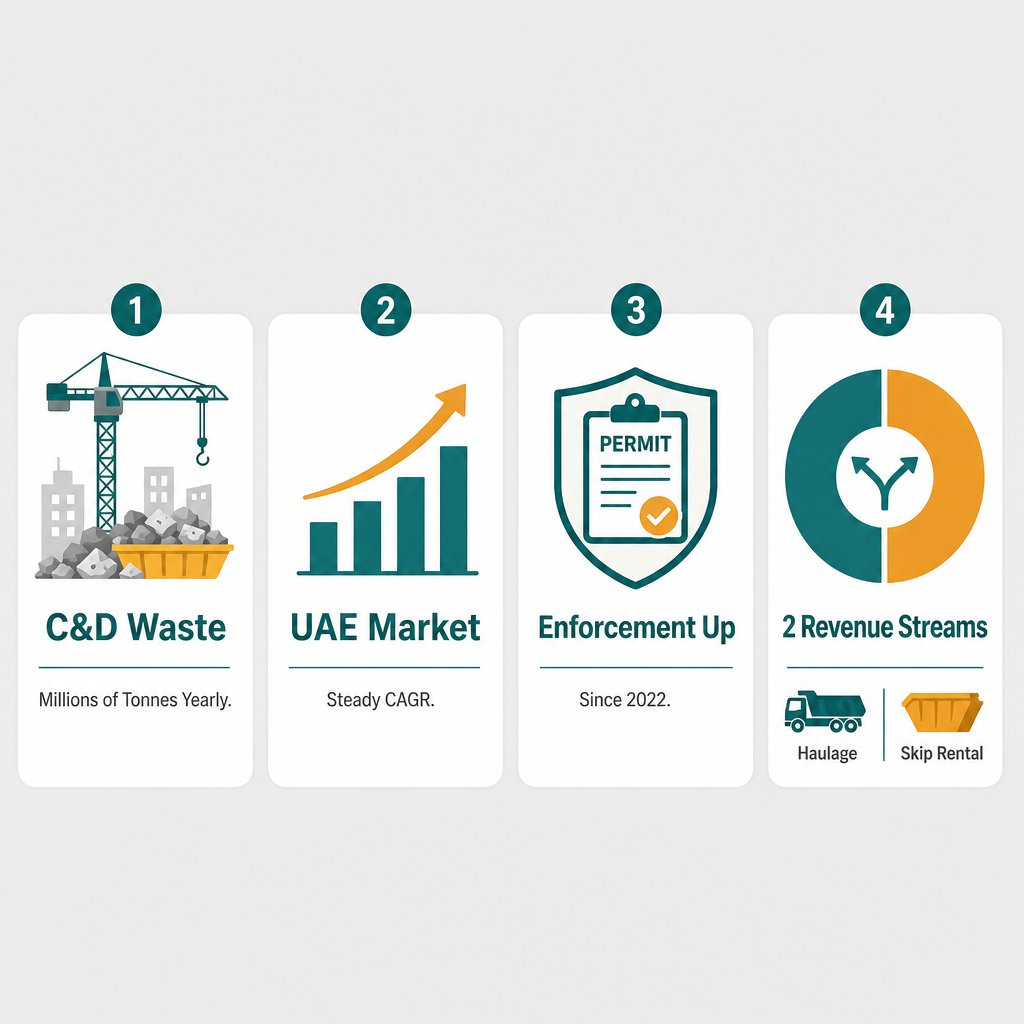
Dubai's building sites produce millions of tonnes of rubble, timber and mixed fill every year, and all of it has to go somewhere. Most of that work is currently handled by large civil contractors who treat waste removal as a side job. That is the gap.
This guide covers what activity code 3811.97 lets you do, who pays for it, and how to get licensed through Meydan Free Zone. The barrier to entry here is not competition. It is compliance, and that is good news once you are through it.
Key Stats at a Glance
What This License Covers
Activity code 3811.97 covers the collection, loading and transport of non-hazardous solid waste generated by construction, renovation and demolition sites. It is a clearly drawn, operationally specific category.
Core services inside it are skip hire and placement, debris haulage by tipper truck, site clearance between project phases, and basic waste segregation at source, meaning separating concrete rubble, timber, metal and mixed fill before transfer.
What it does not reach is hazardous waste disposal, chemical handling, landfill operation, and waste treatment or processing. Those sit behind separate and much heavier regulatory approvals. Stay on your side of that line.
Who Your Clients Will Be
Your buyers fall into five groups:
- Main contractors running active sites
- Specialist demolition firms
- Fit-out and interior contractors
- Property developers managing several concurrent sites
- Civil engineering subcontractors
They all want the same thing: reliable, permit-compliant waste removal on a schedule that does not interrupt the site. Deliver that consistently, with the paperwork to prove it, and you can charge a premium. Developers running large multi-phase projects are the accounts worth winning, because they give you sustained volume across a whole project lifecycle instead of one-off jobs.
Mainland or Free Zone
The choice matters less here than in most activities, because the operational permits are the same either way. Most waste collection operators use a free zone entity for the legal and commercial side while working physically under Dubai Municipality approval. Let your operating plan decide it, not the price. Whichever you pick, the trade license alone does not put a truck on the road.
[blockCTACostCalculator]
Step by Step Setup Guide
- Step 1, confirm the activity: Check that code 3811.97 is listed and select it on your application. Cross-check the full activity list in case your intended scope of work needs a complementary activity alongside it.
- Step 2, pick your license package: A flexi-desk covers the trade license and visa quota at early stage. If you want a yard or a physical office inside the free zone, a larger package applies.
- Step 3, send in your setup documents: Passport copies for all shareholders and directors, the completed application form, and a short description of operations or business plan depending on the activity.
- Step 4, layer on your operational permits: Once the trade license is issued, usually within a few working days, start the Dubai Municipality waste transport permit application and RTA fleet registration in parallel. Allow two to four weeks for municipal approvals.
- Step 5, sort out visas: Meydan Free Zone provides visa eligibility for shareholders and staff, which gives you a clear residency path as you build a team.
Compliance and What You Need in Place
Your waste transport permit
This is the one that decides whether you can trade. Dubai Municipality issues waste transport permits to operators handling construction and demolition materials, and the permit is mandatory before any commercial collection begins. The application wants proof of your trade license, your fleet details, and evidence of compliant disposal arrangements with approved facilities. A trade license on its own does not authorise you to move waste on Dubai's roads.
Your fleet
All commercial heavy vehicles must be registered and inspected through the RTA, which enforces load limits, vehicle standards and route compliance for waste haulage. Non-compliant vehicles face fines and impoundment. A truck sitting in a pound is not earning, and the margin in this business does not absorb that kind of loss twice.
Documentation
Enforcement of waste transport permits has increased materially since 2022. Managing permit documentation across several active sites at once is a real operational function, not filing. Build the admin capacity for it before you need it.
Staff
Labour compliance falls under MOHRE: driver and site staff contracts, Wage Protection System registration, and any Emiratisation ratios that apply. Free zone entities operating physically in Dubai are not exempt from MOHRE duties when their staff work on the mainland.
Kit and yard
Your capital needs are tipper trucks for debris haulage, skip loaders for placing and collecting skips, and a compliant storage yard to hold skips and equipment between jobs.
Market Opportunity
Dubai's construction sector is not slowing down. Infrastructure expansion, urban densification and a steady pipeline of large development projects produce millions of tonnes of construction and demolition waste every year, and it is one of the biggest components of the emirate's total solid waste output.
Yet specialist SME operators with compliant fleets and proper licensing remain scarce. Most of the market is served by large civil contractors handling waste as a secondary function. A focused operator whose entire model is built around compliant, reliable collection can offer service consistency and documentation rigour that generalists simply do not match.
Two forces are tightening at once: rising municipal enforcement, and Dubai's circular economy commitments pushing sites to divert material from landfill. The UAE waste management market is on a steady growth path through the late 2020s, and Invest in Dubai lists waste management among priority growth sectors. That combination gives a new entrant a window to build a defensible position before the segment matures. Revenue comes from haulage charged per load, per trip or per tonne, and from skip rental at a flat fee including collection, with a third layer underneath: sorted concrete aggregate, scrap steel and clean timber offcuts carry resale value with recyclers and material brokers, so basic segregation at collection recovers margin that would otherwise go out as disposal cost.
Conclusion
Construction waste collection in Dubai is a regulated, asset-backed business with real and sustained demand. The competition is thin at the specialist end. The compliance is not.
Get the license structure right, keep a permitted fleet, and build relationships with active sites, and you have a durable, contract-driven business in one of the busiest built environments in the region. Three things decide it: your Dubai Municipality waste transport permit, RTA fleet compliance, and a contract mix that balances spot jobs against site-embedded agreements.
[blockCTAContact]