

Table of Contents
Frequently Asked Questions
What does activity code 6209.12 cover for a cyber security consultancy in Dubai
Activity code 6209.12 — Cyber Security Consultancy is a professional services classification that permits the licence holder to provide advisory, assessment, and planning services related to information security and cyber risk.
Permitted activities include cyber risk assessments and gap analyses, security policy development and review, regulatory compliance advisory (such as ISO 27001, NESA, and GDPR alignment), incident response planning, business continuity frameworks, and security awareness programme design.
It is important to note what the licence does not cover: managed security operations, software development, penetration testing tools supply, and hardware installation all require separate or additional licence classifications.
What is the size and growth rate of the UAE cyber security market
The UAE cyber security market is on a sustained growth trajectory, with projections from IMARC Group indicating a compound annual growth rate (CAGR) exceeding 14% through 2030, placing it among the fastest-growing markets in the Middle East.
This growth is driven by accelerating digital transformation across both public and private sectors, government-led initiatives such as the UAE National Cybersecurity Strategy, and Dubai's ambition to become a global digital economy hub supported by Digital Dubai.
The UAE also ranks among the top five most-targeted nations in the Middle East for cyber attacks, which further intensifies demand for qualified consultancy services.
Who are the main target customers for a cyber security consultancy in Dubai
Financial services and fintech firms are among the most active buyers of cyber security consultancy in Dubai. DIFC-regulated entities operate under specific data protection and operational resilience requirements, creating recurring demand for external advisory support.
The healthcare sector is a growing market, with the Dubai Health Authority (DHA) expanding its digital health mandates, meaning hospitals, clinics, and health-tech providers increasingly need consultants to navigate data governance and security obligations.
SMEs represent a structurally underserved segment, as large system integrators often price themselves out of this market. An independent consultancy can offer competitive rates with direct senior-level engagement. Beyond Dubai, GCC governments and sovereign entities are also increasing cyber budgets materially, making a Dubai-based consultancy well-positioned for regional work.
What government regulations are driving demand for cyber security consultants in the UAE
The UAE National Cybersecurity Strategy, overseen by the Telecommunications and Digital Government Regulatory Authority (TDRA), sets out a framework for protecting critical infrastructure and digital services. It currently covers over 80 federal entities and critical infrastructure operators, creating direct demand for qualified consultants who help organisations align with those standards.
Dubai is home to over 400 financial institutions, each with mandatory security compliance obligations. DIFC-regulated entities face specific data protection and operational resilience requirements that necessitate ongoing external advisory support.
The Dubai Health Authority (DHA) has also expanded its digital health mandates, and compliance with frameworks such as ISO 27001, NESA, and GDPR creates further recurring demand across multiple sectors.
What business models are commercially viable under a cyber security consultancy licence in Dubai
The activity code 6209.12 licence is flexible in terms of commercial structure. Retainer arrangements are a common model, particularly with financial institutions and regulated entities that require ongoing advisory support throughout the year.
Project-based engagements are equally viable, covering discrete assignments such as gap analyses, policy reviews, or incident response planning. Standalone audit mandates are also permitted, making it possible to serve clients on a one-off basis without a long-term commitment.
This flexibility means a consultancy can serve a mix of client types — from SMEs on project work to larger enterprises on retainer — within a single licence structure.
Why is Meydan Free Zone a recommended option for setting up a cyber security consultancy in Dubai
Meydan Free Zone issues professional and consultancy licences and is noted in this context as an efficient setup route for cyber security consultancy businesses in Dubai. Free zones in the UAE generally offer 100% foreign ownership, no personal income tax, and streamlined incorporation processes compared to mainland options.
Operating from a free zone also provides a commercially recognised and credible jurisdiction, which is important when targeting regional clients across the GCC, including government entities and sovereign bodies that value regulatory standing.
The free zone structure is particularly well-suited to independent consultancies and boutique firms looking to serve SMEs, corporates, and financial institutions at competitive rates without the overhead of a large mainland establishment.
How does Dubai's digital transformation agenda create opportunities for cyber security consultants
Dubai's ambition to become a global digital economy hub, supported by Digital Dubai, has accelerated enterprise adoption of cloud computing, artificial intelligence, and connected systems across both public and private sectors.
Each of these technologies expands the attack surface — the range of vulnerabilities an organisation is exposed to — and consequently increases the need for professional advisory services to assess, manage, and mitigate those risks.
This means cyber security consultancy is positioned not as a discretionary spend but as a compliance and operational necessity for enterprises, government entities, and financial institutions operating within Dubai's evolving digital infrastructure.
What distinguishes an independent cyber security consultancy from large system integrators in the Dubai market
Large system integrators typically price themselves out of the SME market, leaving a significant gap for independent consultancies that can offer more accessible rates without sacrificing expertise.
An independent consultancy operating from a free zone can provide direct senior-level engagement — meaning clients interact with experienced practitioners rather than being handed down to junior staff, which is a common differentiator valued by smaller organisations.
This positioning makes independent consultancies particularly competitive in the structurally underserved SME segment, while still being credible enough to serve larger corporates, financial institutions, and regional government clients from a well-recognised Dubai jurisdiction.
How to Start a Cyber Security Consultancy Business in Dubai
Dubai is building one of the most connected economies in the world. Every connected system needs protecting. Demand for cyber security advice is rising fast, and the client base here is well-funded and serious.
This guide covers the license, the setup steps, and the commercial reality of running a cyber security consultancy in Dubai.
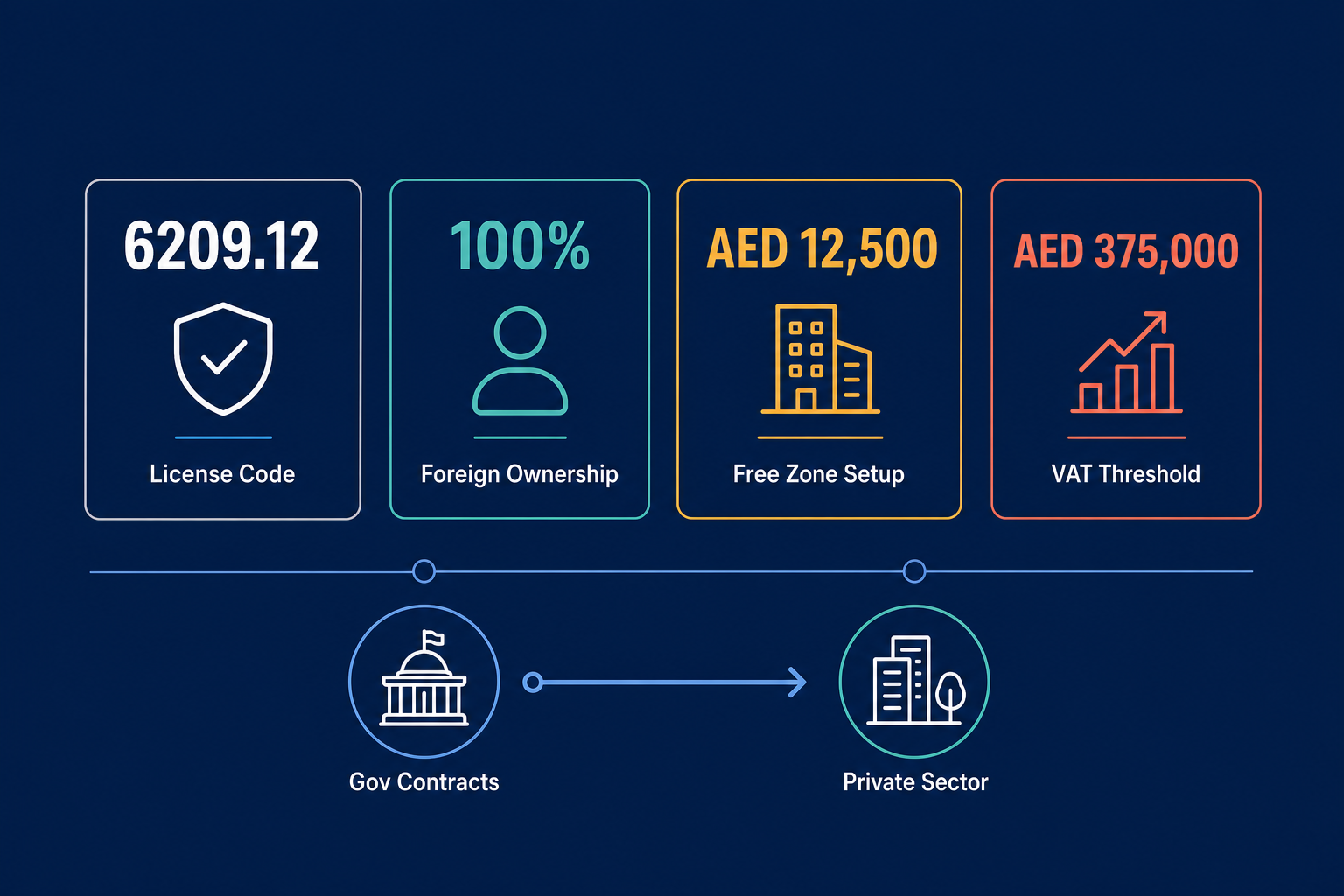
| Activity code | 6209.12 |
|---|---|
| License type | Professional services |
| Foreign ownership | 100% – mainland and free zone |
| Minimum capital | No mandatory minimum for consultancy |
| Regulator | DET (mainland) or Meydan Free Zone |
| VAT threshold | AED 375,000 annual turnover |
What the License Covers
Code 6209.12 is a professional services license. It lets you advise clients on cyber risk. You can review their systems, identify weak points, and help them plan a response to incidents.
In practice, the work covered includes:
- Advising on cyber risk and security strategy
- Checking systems for gaps and exposures
- Planning incident response steps
- Reviewing data handling against legal rules
- Training staff on security awareness
Some work sits outside this code. Penetration testing as a standalone service may need a separate activity. Selling or installing security software needs a trading or technology license. Check the full Business Activities List before you commit to a single code.
If your consultancy will also manage client systems or run a security operations centre, add the relevant IT services code at setup. Adding codes later is possible but takes time and fees.
Who Your Clients Will Be
Dubai's buyer base for cyber security advice is broad. The strongest segments are:
- Banks and financial firms under Central Bank rules
- Healthcare providers handling patient data under DHA rules
- Logistics and supply chain firms with digital systems
- Government suppliers who must pass security checks
- Real estate developers with smart building systems
Small firms are badly served. The big IT groups charge too much for them. A consultancy that prices for SMEs and delivers real work can build a strong client base fast.
Procurement here is formal. Nobody buys on a phone call. Large clients run tenders, want you on their approved vendor list first, and sign long contracts once they trust you. Build your credentials early. Case studies, certifications, and a local reference client matter more than a polished website.
Mainland vs Free Zone
This is the biggest choice you will make at setup. Let your clients decide it, not the price.
| Factor | Mainland (DET) | Free Zone (Meydan Free Zone) |
|---|---|---|
| Client access | Open UAE market, including government | Mainly private sector and international |
| Foreign ownership | 100% for professional services | 100% |
| Office need | Physical office required | Flexi-desk options available |
| Setup cost | Higher, varies by office | Lower, packages from AED 12,500 |
| Government contracts | Yes, direct access | Needs a local agent or branch |
A mainland license from DET lets you work directly with UAE government bodies. If your pipeline includes federal or emirate-level contracts, mainland is the right call.
Meydan Free Zone suits a consultancy focused on private sector clients. Setup is faster, costs less, and you keep 100% ownership. A Dubai Trade License from AED 12,500 covers the basics, and flexi-desk options keep overhead low while you build the business.
You can also start a business remotely through Meydan Free Zone if you are not yet based in Dubai. This is useful if you are testing the market before relocating.
Free Business Setup Cost Calculator
Calculate NowHow to Set Up: Key Steps
The process is straightforward if you prepare your documents first. Here are the main steps:
- Step 1, book your trade name: Use the Meydan Free Zone portal or the DET e-Services portal for a mainland company.
- Step 2, pick your activity code: Confirm code 6209.12 is approved in your chosen jurisdiction before going further.
- Step 3, prepare your documents: You need a passport copy, a short business plan, and proof of relevant skill or experience.
- Step 4, submit your application: Apply through your chosen authority's portal and pay the license fee.
- Step 5, get your license and visa: Once approved, apply for your investor visa and set up your corporate bank account.
Free zone setup at Meydan typically takes a few working days once documents are in order. Mainland approval through DET takes a little longer, depending on the activity and office type.
Budget for the license fee, visa costs, and office or flexi-desk charges. A free zone setup for a sole consultant can come in well under AED 30,000 all-in for year one. Use the cost calculator to get a figure for your specific setup.
For banking, open a corporate account once your license is issued. Some banks ask for 3 to 6 months of trading history before approving. Start the process early.
What You Must Comply With
Cyber security consultancies in Dubai sit under several sets of rules. Know them before you start.
TDRA rules
The Telecommunications and Digital Government Regulatory Authority oversees digital services in the UAE. If your work touches telecoms networks or critical digital systems, check whether TDRA approval applies to your specific service.
Data protection
The UAE Personal Data Protection Law sets out how you handle client data. You must tell clients what data you collect, why you collect it, and how you store it. If you handle health or financial data, extra duties apply under DHA and Central Bank rules.
VAT
Register with the Federal Tax Authority once your annual turnover reaches AED 375,000. Most B2B cyber security services are taxable at 5%. File returns on time. Work without the right registration and you risk fines.
Staff and visas
If you hire locally, you need to follow MOHRE rules on employment contracts and Emiratisation. Each visa is tied to your license and office space. Free zone visas are issued by the free zone authority. Mainland visas go through MOHRE.
Professional indemnity
This is not a legal requirement for all consultancies, but most serious clients will ask for it. Get cover before you pitch to banks or government suppliers.
Corporate tax
The UAE corporate tax rate of 9% applies to taxable income above AED 375,000. Register with the FTA and keep clean books from day one. Corporate tax services in Dubai are available through Meydan's mAccounting package if you need support.
The Market Opportunity
The UAE cyber security market is expanding. Digital transformation across banking, health, and government is creating real demand. New rules on data protection are pushing firms to seek outside advice. Many do not have the internal skill to comply on their own.
The SME segment alone is large. Most small firms have no security plan at all. A consultancy that offers fixed-price reviews and clear deliverables can close deals quickly in this space.
Government-linked entities are also buyers. Smart city projects, digital identity systems, and critical infrastructure all need regular security checks. These contracts are long and well-funded, but they take time to win. Start building relationships early.
Conclusion
Dubai's cyber security market is growing fast. The rules are clear, the license path is well-defined, and the buyers are serious. Get the right code, pick the right jurisdiction, and build your credentials with early clients.
The setup cost is low relative to the contract values on offer. A well-run consultancy here can recover its first-year costs within a few months of trading.
Ready to Launch Your Business in Dubai?
Let's Connect