Table of Contents
Frequently Asked Questions
What does activity code 8299.87 cover for commercial information services in Dubai
Activity code 8299.87 covers a broad range of B2B data functions, including business intelligence, market research, commercial data aggregation, credit information provision, mailing list supply, and B2B data brokerage. If your business collects, structures, and sells verified commercial data to other businesses, this is the relevant activity code.
It is distinct from regulated financial advisory or investment research. Standard commercial information provision under this code does not require a licence from the Central Bank of the UAE or the Securities and Commodities Authority — a straightforward professional or commercial licence is sufficient.
Do I need a special financial or securities licence to operate a commercial information services business in Dubai
No. Commercial information provision under activity code 8299.87 does not require authorisation from the Central Bank of the UAE or the Securities and Commodities Authority (SCA). A standard professional or commercial licence issued through the relevant authority — such as the Dubai Department of Economy and Tourism (DED) for mainland or the chosen free zone authority — is sufficient.
This distinction is important because it significantly reduces regulatory complexity and setup time compared to businesses that provide regulated financial research or investment advice.
What are the main revenue models available for a commercial information services business in Dubai
The activity code accommodates a flexible range of revenue structures. Common models include subscription databases, per-report fees, retainer-based research contracts, and white-label data feeds supplied to third-party platforms or resellers.
Because the activity covers both data aggregation and brokerage, operators can combine recurring subscription income with project-based or transactional revenue, giving the business multiple income streams from the same licence.
Who are the typical target clients for a commercial information services business in Dubai
Target clients are primarily B2B buyers who need third-party data to support decisions. This includes corporates, SMEs, law firms, real estate operators, logistics companies, and government procurement teams operating in or entering the UAE and wider Middle East market.
Companies relocating or expanding into the region are a particularly strong segment, as they require credible local data on market conditions, competitors, and supplier verification. Professional services firms are also a reliable referral and direct-client channel.
What is the market growth outlook for commercial information and data analytics services in the UAE
According to IMARC Group, the UAE data analytics market is projected to grow at a compound annual growth rate (CAGR) exceeding 13% through 2028. This trajectory reflects structural demand rather than a short-term cycle, driven by the UAE's expanding role as a regional business hub.
The Dubai Economic Agenda D33 explicitly positions Dubai as a knowledge-economy city, which directly supports information services as a priority sector. Dubai has also been ranked among the top 20 global cities for digital readiness by Digital Dubai, reinforcing the environment for data-driven businesses.
Should I set up my commercial information services business on the Dubai mainland or in a free zone
The choice depends on your target client base. A mainland licence via the Dubai Department of Economy and Tourism (DET) allows you to contract directly with UAE government entities and onshore corporates, making it the stronger option if your primary clients are local businesses or public sector organisations.
A free zone licence — with Meydan Free Zone cited as a practical option for professional services — offers 100% foreign ownership, faster setup timelines, lower capital requirements, and no currency restrictions. It is better suited to operators focused on regional or international clients rather than direct UAE government work. Full details on both structures are available via the Official UAE Government Portal.
What corporate tax rate applies to a commercial information services business in Dubai
The UAE applies a corporate tax rate of 9% to taxable income above AED 375,000, as administered by the Federal Tax Authority (FTA). Income at or below this threshold is taxed at 0%, which benefits smaller or early-stage operators.
Free zone entities may qualify for preferential tax treatment provided they meet the conditions set out under the UAE Corporate Tax Law, including maintaining adequate substance and not deriving income from mainland UAE sources in a way that disqualifies them. Professional tax advice specific to your structure is recommended before setup.
How competitive is the commercial information services market in Dubai and where does the opportunity lie
The competitive landscape is real but navigable. Global players such as Dun & Bradstreet and Refinitiv hold large enterprise accounts, particularly for standardised credit and financial data products. However, their coverage of regional, Arabic-language, and sector-specific intelligence is limited.
The clearest opportunity for a focused operator lies in regional specificity — building datasets and research products that global providers do not prioritise. Practical client acquisition channels include government tenders, free zone business directories, and referral networks within professional services firms. Invest in Dubai provides sector data and investor-facing tools that are worth reviewing early in the planning process.
Setup a Commercial Information Services Business in Dubai
Dubai's position as a regional trade and finance hub means businesses here run on data, and someone has to supply it. Credit reports, market research, due diligence packages, business intelligence feeds: these are not optional extras for companies operating at scale in the Gulf. They are operational necessities.
This guide covers what a commercial information services license covers, who your clients will be, how to choose the right jurisdiction, and what it takes to get set up and trading.
What This License Covers
A commercial information services license covers the collection, processing, and sale of business data. That includes credit reporting, market research, business intelligence, and data brokering. You are essentially in the business of turning raw commercial information into something a paying client can act on.
Under both the DET mainland framework and the Meydan Free Zone framework, this activity sits within information and data services. The license lets you supply commercial information to other businesses. It does not cover financial advisory, legal services, or licensed credit rating, which each carry their own regulatory requirements.
Before you start, check that your specific activity code is approved in your chosen jurisdiction. Some sub-activities within this space need additional approvals, particularly if you are handling financial data or producing reports that clients use for lending decisions.
| Activity | Commercial Information Services |
|---|---|
| Activity code | 7389.02 (confirm with your chosen jurisdiction before applying) |
| Foreign ownership | 100% – mainland and free zone |
| Setup cost range | From AED 12,500 at Meydan Free Zone |
| Visa allocation | Depends on office package selected |
| VAT registration threshold | AED 375,000 taxable turnover – Federal Tax Authority |
Who Your Clients Will Be
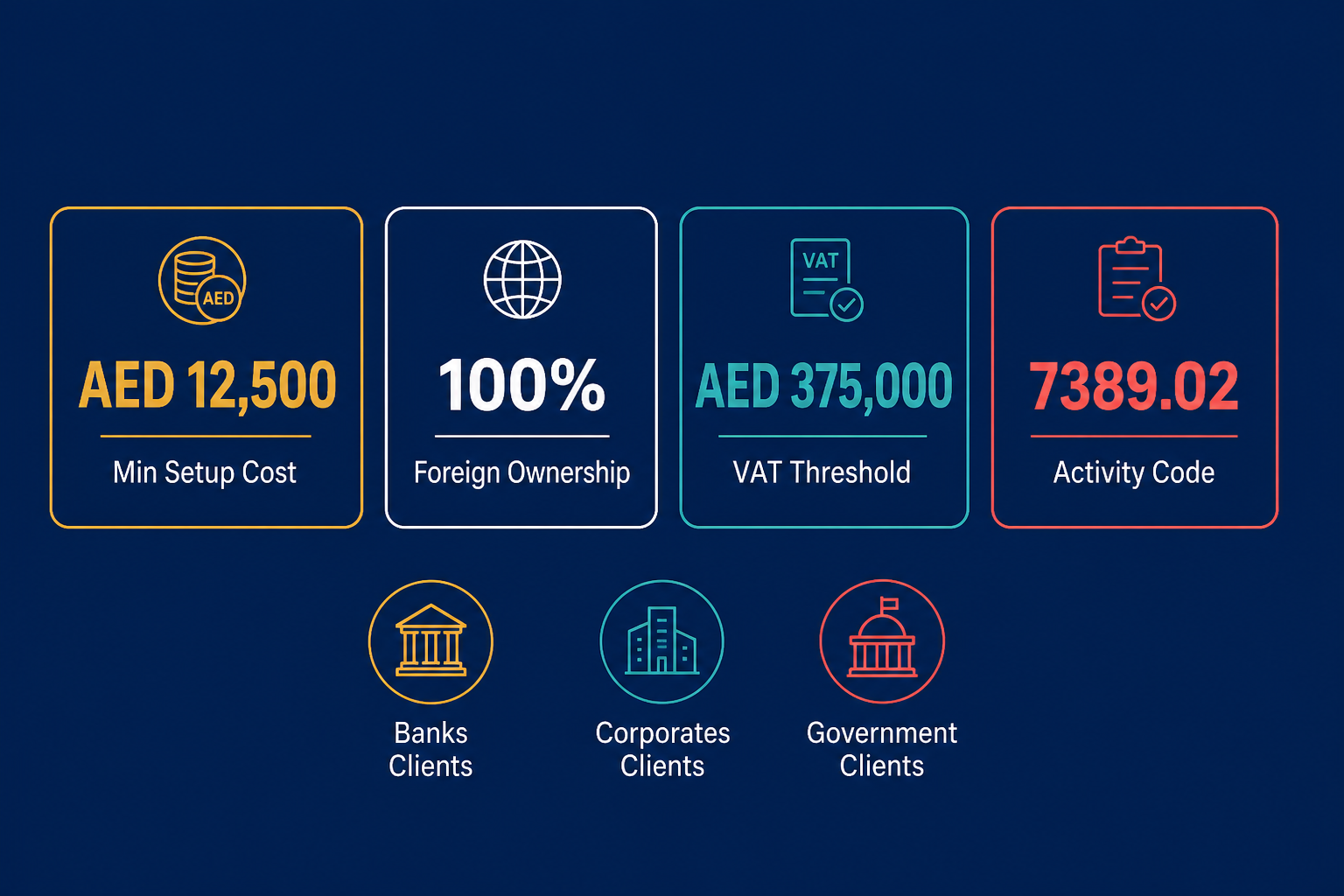
The demand for commercial information in Dubai is broad and consistent. Understanding your likely client base early shapes every decision you make, from how you structure your service to which jurisdiction makes sense.
Banks and financial institutions
Banks, insurers, and credit providers need reliable data on counterparties, borrowers, and market conditions. Credit risk profiling, sector analysis, and supplier verification are all services this client group pays for regularly.
Corporates doing due diligence
Any company running a serious procurement process, considering an acquisition, or onboarding a new partner will want a commercial intelligence report on the other party. This is standard practice for multinationals and large regional groups operating out of Dubai.
Government and semi-government procurement teams
Public sector entities in the UAE run formal procurement processes. They need verified commercial data on vendors before awarding contracts. A mainland license gives you direct access to this client group. A free zone license can still serve them, but the contracting route is less direct.
International firms entering the UAE
Companies moving into the Gulf for the first time often have no local commercial intelligence. They need market sizing, competitor mapping, and regulatory context. This is a strong niche for a well-positioned information services firm, and it is work that can be delivered remotely from a free zone base.
Nobody here buys on a phone call. Larger clients run formal procurement processes, they want you registered as an approved vendor first, and they sign structured agreements once they trust you. Build that pipeline early.
Mainland vs Free Zone: Which Setup Fits
This is the biggest choice you will make when setting up. Let your clients decide it, not the setup fee.
| Factor | Mainland (DET) | Free Zone (Meydan Free Zone) |
|---|---|---|
| Foreign ownership | 100% in most activities | 100% |
| Client access | Open UAE market, including government | Mainly international and private sector clients |
| Office requirement | Physical office needed | Flexi-desk options available |
| Setup speed | Typically longer | Faster, often within days |
| Setup cost | Higher base cost | Lower, from AED 12,500 |
| VAT registration threshold | AED 375,000 taxable turnover | AED 375,000 taxable turnover |
A mainland license from DET lets you work directly with UAE government bodies and semi-government entities. If a significant part of your revenue will come from public sector contracts, that access matters.
Meydan Free Zone gives you 100% foreign ownership, a lower cost base, and a faster setup process. If your clients are mostly private sector, international, or based outside the UAE, a free zone setup is workable and cost-efficient. You can also manage the whole process as a remote business setup without needing to be in Dubai during incorporation.
One practical point: a free zone company can still serve UAE-based private sector clients. The restriction applies mainly to direct government contracting. Many commercial information services firms operate successfully from a free zone base, serving banks, corporates, and international clients without ever needing a mainland license.
Free Business Setup Cost Calculator
Calculate NowStep-by-Step Setup Guide
- Step 1, book your trade name: Use the DET e-Services portal for a mainland company, or the Meydan Free Zone portal for a free zone one. Check your company name availability before you go further. Names must not conflict with existing registered businesses and must not include restricted words.
- Step 2, confirm your activity code: Make sure the code covers your intended services. If you plan to offer both market research and credit data services, you may need more than one activity listed on your license. Confirm this with your chosen jurisdiction before submitting documents.
- Step 3, submit your setup documents and get initial approval: For a free zone setup at Meydan Free Zone, this typically means passport copies, a completed application form, and proof of address. Initial approval usually comes quickly.
- Step 4, sign your office or flexi-desk agreement and pay license fees: Meydan Free Zone offers flexi-desk options that keep your overhead low while you build revenue. You do not need a full physical office to start.
- Step 5, get your license issued: Once fees are paid and documents are in order, your license is issued. Keep a digital and physical copy. You will need it for bank account opening and visa applications.
- Step 6, apply for visas: Your visa allocation depends on your office package. Meydan Free Zone's mResidency service covers the full visa process, including medical fitness testing and Emirates ID registration.
- Step 7, open a corporate bank account: This is often the most time-consuming step. Banks in the UAE want to understand your business model, your data sources, and your client base. Have a clear business plan ready. Meydan Free Zone's business banking support service helps navigate this process.
- Step 8, register for VAT once the threshold is met: You must register with the Federal Tax Authority once your taxable turnover reaches AED 375,000. Voluntary registration is available below that threshold if it suits your client billing structure.
Compliance and Market Opportunity
Commercial information services sits at the intersection of data, finance, and regulation. Getting your compliance right from the start protects your contracts and your name.
TDRA data handling rules
The Telecommunications and Digital Government Regulatory Authority sets the rules for how data is stored, processed, and transferred in the UAE. If you are holding commercial databases, running data pipelines, or transmitting information across borders, TDRA rules apply. Make sure your data infrastructure meets local requirements before you start selling.
UAE Personal Data Protection Law
The UAE Personal Data Protection Law limits what you can do with individual-level data. Commercial information services that deal in company data and aggregated market intelligence are generally lower risk here. But if any of your datasets include personal information, you need a clear legal basis for holding and processing it. Break the rules here and you risk fines and damage to your name with clients who take data governance seriously.
VAT duties
Information services are generally subject to UAE VAT at 5%. Once your taxable turnover crosses AED 375,000, you must register with the Federal Tax Authority. If you are serving clients outside the UAE, some supplies may be zero-rated. Get proper advice on this before you start invoicing. Meydan Free Zone's VAT registration support service can help you set this up correctly from the start.
Corporate tax
The UAE introduced a 9% corporate tax on profits above AED 375,000. Free zone companies can benefit from a 0% rate on qualifying income, subject to meeting substance requirements. Check with a tax adviser whether your specific activities qualify. Meydan Free Zone's corporate tax services cover registration and ongoing compliance.
Market context
Dubai's growth as a regional headquarters hub for multinationals creates steady demand for local commercial intelligence. According to IMARC Group, the broader data and analytics market across the Middle East continues to expand as more international firms establish regional operations and need reliable local data to support their decisions. That trend runs in your favour.
Banks, private equity firms, and corporate treasury teams all need regular data on counterparties. Government digitisation programmes create new procurement cycles. International companies entering the market need orientation data before they commit capital. The pipeline is real and it is consistent.
Scaling with Meydan Free Zone
Once you are trading, Meydan Free Zone's suite of support services helps you scale without building a large back office. mCore covers banking and company administration. mResidency handles visa and residency processing for your team. mAssist covers virtual assistance, meeting rooms in Dubai, and document support. mAccounting covers bookkeeping, VAT, and corporate tax compliance. These are practical tools, not upsells. They let you stay focused on your clients rather than managing paperwork.
Conclusion
Commercial information services is a workable, low-overhead business in Dubai with real demand from financial, corporate, and government clients. The market is there. The setup process is manageable. The key variables are picking the right jurisdiction for your client base and staying on the right side of data regulation from day one.
A free zone setup at Meydan Free Zone suits most founders starting in this space. Lower costs, faster setup, 100% ownership, and a support infrastructure that grows with you. If your client base shifts toward UAE government work, a mainland license is a straightforward addition later.
Check the Meydan Free Zone business activities list to confirm your activity code, then speak to the team to get a cost breakdown and start the setup process.
Ready to Launch Your Business in Dubai?
Let's Connect