
Table of Contents
Topic Summary
Understand Exactly What the License Covers
Activity code 4721.73 permits trading in salted, dried, smoked, and canned preserved fish and seafood. It does not cover manufacturing, so if you plan to cure or smoke fish yourself, you need a different license category.
Secure MOCCAE Approval Before Anything Else
A pre-establishment approval from the Ministry of Climate Change and Environment is required before your trading license is issued. This covers fisheries and food safety authorizations and is non-negotiable regardless of whether you register on the mainland or in a free zone.
Know the Difference Between Trading and Manufacturing
Buying preserved fish and reselling it qualifies as trading under this activity code. Bringing in fresh fish and salting, drying, or smoking it yourself is classified as food manufacturing and requires a separate license.
Map Your Customer Base Before You Launch
Your buyers will range from ethnic specialty grocers serving Emirati and South Asian households to mainstream supermarkets stocking canned tuna and premium gourmet retailers sourcing artisan smoked fish. Each segment has different volume expectations, margin profiles, and product knowledge requirements.
Choose Between Mainland and Free Zone Carefully
A Meydan Free Zone license offers 100% foreign ownership and zero corporate tax on qualifying income, but supplying UAE retailers directly requires working through a mainland distributor or agent. A mainland DET license allows direct local market access but comes with different ownership and tax considerations.
Recognize the Market Size Behind This Niche
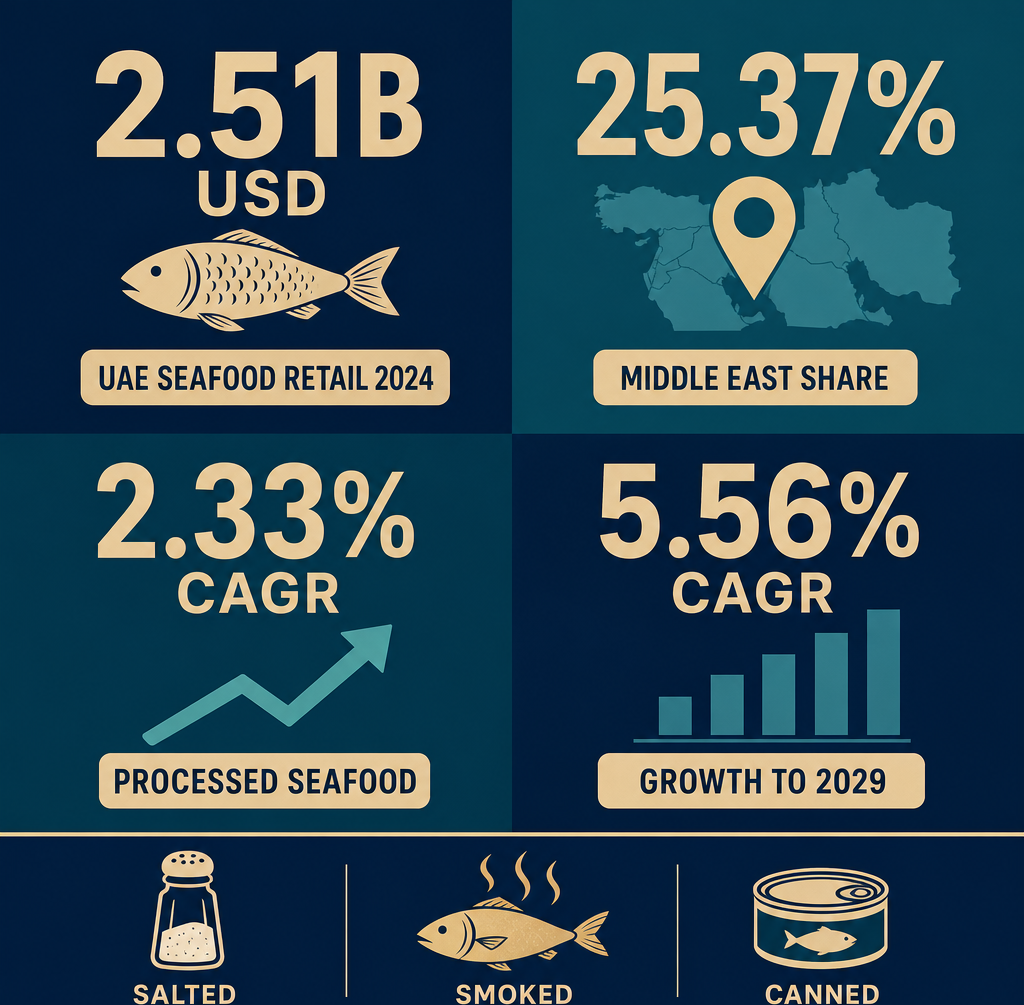
UAE fish and seafood retail reached USD 2.51 billion in 2024 and is growing at a 5.56% CAGR through 2029. The UAE also accounts for over 25% of total Middle East seafood revenue, making it the dominant market in the region.
Product Knowledge Is Your Real Competitive Edge
Knowing which grade of dried fish suits a specific dish, or which curing method a premium buyer expects, is what wins accounts in specialty retail. Cultural fluency across Emirati, Levantine, South Asian, and East Asian preserved fish traditions is a genuine barrier to entry for competitors.
How to Start a Salted and Preserved Fish and Seafood Trading Business in Dubai with Meydan Free Zone
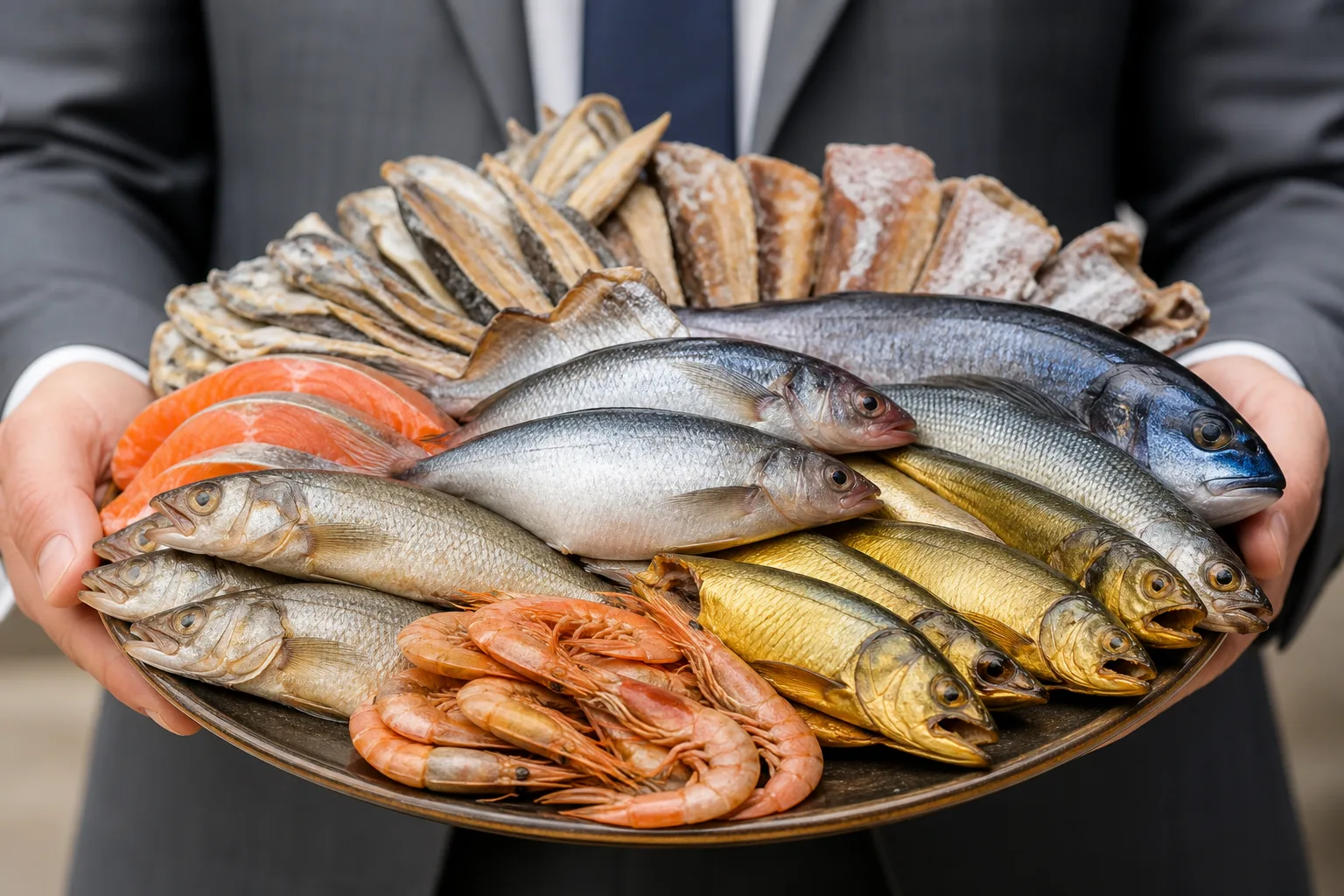
Preserved fish is one of the oldest food categories in the region and still one of the most culturally specific. Salted hammour for machboos, dried mehyawa, dried anchovies for South Asian kitchens, smoked fish for European households, canned tuna in every cupboard. Activity code 4721.73 covers trading in all of it.
This guide covers what the license allows, who buys from you, the approval you need and the steps to get set up. The approval point is unusually clear on this activity and unusually important: a federal authority clears you before the license is issued.
Key Stats at a Glance
| Activity code | 4721.73 |
|---|---|
| Activity name | Salted and Preserved Fish and Seafood Trading |
| What it covers | Trading of salted, dried, smoked and preserved fish and seafood, including processed and value-added formats |
| Third-party approval | Pre-establishment approval from the Ministry of Climate Change and Environment (MOCCAE), covering fisheries and food safety authorisations, before the license is issued |
| AML compliance | This activity is exempt |
| UAE fish and seafood retail | USD 2.51 billion in 2024, growing at 5.56% CAGR through 2029 – Statista |
| UAE share of regional revenue | 25.37% of total Middle East seafood revenue – Mordor Intelligence |
| Processed seafood growth | 2.33% CAGR through 2031 across the Middle East – Mordor Intelligence |
| Traditional products | Salted hammour, dried mehyawa, preserved fish for machboos and harees, dried anchovies and shrimp |
| Contemporary products | Canned tuna and sardines, smoked salmon and trout, cured and value-added preserved seafood |
| Foreign ownership | 100% in Meydan Free Zone, with zero corporate tax on qualifying income |
What This License Covers
Code 4721.73 covers trading in salted and preserved fish and seafood. That runs from traditional preservation, meaning salted, dried and fermented products, through to modern processed formats such as canned fish, smoked salmon and cured or value-added preparations.
The stated exclusions include manufacturing of bakery products, which has no obvious bearing on preserved fish and appears to be inherited from a wider retail class. The boundaries that actually matter are different ones.
Three of those are worth checking. Retail of food in non-specialised stores, where many product lines sell under one roof, sits elsewhere. Wholesale trading to other businesses is excluded, which deserves attention if your plan is supplying supermarkets and retail counters in volume rather than selling to shoppers. And doing the preserving yourself, meaning salting, drying, smoking or canning as a production process, is food manufacturing rather than trading.
That last point is the one most likely to catch a new operator. Buying preserved fish and reselling it is trading. Bringing in fresh fish and curing it is a different business in licensing terms.
Who Your Clients Will Be
Cultural and ethnic specialty retail
Traditional grocery stores and community retailers serving Emirati, Levantine, Egyptian, South Asian and East Asian households. Each community has its own preserved fish traditions, and product knowledge is the barrier to entry: knowing which grade of dried fish a given dish calls for is what earns the account.
Supermarkets and retail counters
Mainstream retail buying canned tuna, sardines, smoked salmon and trout. Volume-driven, price-competitive, and dependent on consistent supply and shelf-life management rather than specialist knowledge.
Premium and gourmet buyers
Specialty stores and gourmet retail buying premium smoked and cured fish and artisan preserved seafood. Smaller volumes, better margins, and buyers who care about origin and curing method.
Mainland or Free Zone
| Factor | Mainland (DET) | Free Zone (Meydan Free Zone) |
|---|---|---|
| Supplying UAE retailers | Direct across the local market | Through a mainland distributor or agent |
| MOCCAE approval | Needed before the license | Needed; free zone registration does not replace it |
| Import of preserved seafood | Standard customs route with food import clearance | Well suited to import, hold and re-export |
| Foreign ownership | Set by DET rules for the activity | 100% yours |
| Corporate tax | 9% above AED 375,000 taxable income | Zero on qualifying income, subject to the conditions |
| Premises | Warehouse with tenancy registered on Ejari | Flexi-desk for the admin side, with ambient and chilled storage held separately |
A mainland license from the Department of Economy and Tourism suits a trader supplying UAE retailers and specialty stores directly, holding stock locally and delivering into shops.
Meydan Free Zone gives you 100% foreign ownership and a lower cost base, and it fits an import and re-export operation or an entity holding international supplier relationships while a local partner handles delivery.
Storage is the practical divider. This category spans ambient shelf-stable goods and chilled products that need temperature control throughout, so the mix you carry determines the warehousing you need whatever license you hold.
[blockCTACostCalculator]
Step by Step Setup Guide
- Step 1, start the MOCCAE approval: Fisheries and food safety authorisations come before the license is issued. Nothing else can move until this is under way.
- Step 2, fix your product range: Traditional preserved, mainstream processed, or premium cured. Each has different sourcing, storage and buyer expertise.
- Step 3, check the retail and wholesale line: If you plan volume supply to supermarkets rather than selling to consumers, confirm which code covers it.
- Step 4, choose your jurisdiction: Mainland through DET for direct supply to UAE retail, or Meydan Free Zone for import and re-export.
- Step 5, book your trade name: Check availability through the DET or Meydan Free Zone portal, following UAE naming conventions.
- Step 6, build sourcing: Traditional preservation suppliers, regional smoked fish producers and international canned and processed brands. Each is a different supply relationship.
- Step 7, set up ambient and chilled storage: Split your warehousing to match the range, with temperature monitoring on anything chilled.
- Step 8, collect your license, open a bank account and register for VAT: Register with the Federal Tax Authority once turnover passes AED 375,000.
Compliance and What You Need in Place
MOCCAE pre-establishment approval
This activity carries pre-establishment approval from the Ministry of Climate Change and Environment, covering fisheries and food safety authorisations. It comes before the license, which makes it the gating item in the whole plan rather than a step to complete later.
Food safety across two storage regimes
Preserved does not mean unregulated. Salted and dried products need humidity control and pest management, chilled smoked products need unbroken temperature control, and canned goods need date and integrity checks. Storage and handling standards apply throughout, and imported product carries clearance documentation with it.
Labelling and species accuracy
Species naming, origin, preservation method and shelf life all have to be declared correctly, with Arabic labelling on retail packs. Species substitution is a known problem in seafood generally and one that inspectors look for.
AML and VAT
This activity is exempt from AML duties. Register with the Federal Tax Authority once turnover passes AED 375,000.
Market Opportunity
The UAE holds a disproportionate share of regional seafood spending, at 25.37% of total Middle East seafood revenue. Domestic fish and seafood retail was worth USD 2.51 billion in 2024 and is growing at 5.56% CAGR through 2029.
Preserved formats sit in a useful position within that. Processed seafood across the Middle East is advancing at 2.33% CAGR through 2031, driven by longer shelf life, convenience and dual-income households buying food that keeps. Slower growth than fresh, but far easier logistics and much lower wastage.
The cultural layer is what makes this market distinctive. Emirati cuisine uses preserved fish in dishes that are cooked regularly rather than occasionally, and every major expatriate community brings its own preserved fish tradition.
That produces several parallel demand streams in one city, each with its own products and its own retail channel, and a trader who understands two or three of them has a position that is hard for a generalist to copy.
Conclusion
Code 4721.73 covers a category with real cultural depth and steady, unglamorous demand. Preserved fish sells through economic cycles because it is a staple rather than a treat.
The approval is the thing to plan around. MOCCAE clearance comes before the license, and it covers both fisheries and food safety, so build the timeline from that date backwards.
After that the business runs on sourcing and product knowledge. Knowing which cure suits which kitchen is what separates a specialist from a shipper. Speak to the Meydan Free Zone team to confirm the right structure for the range you plan to carry.
[blockCTAContact]
Compliance
THIRD-PARTY APPROVAL
This activity requires pre-approval from the Ministry of Climate Change and Environment (MoCCAE) / Dubai Municipality (DM) / The Dubai Maritime Authority (DMA) before a business license can be issued by Meydan Free Zone.
ANTI-MONEY LAUNDERING COMPLIANCE
This business activity is exempt from AML compliance requirements.