

Table of Contents
Frequently Asked Questions
What licence activity code covers a managed cyber security business in Dubai
A managed cyber security services business in Dubai operates under activity code 6202.98 — Managed Cyber Security Services Provider. This code permits a broad operational scope including managed detection and response, 24/7 threat monitoring, security incident response, vulnerability assessments, penetration testing coordination, and SOC services delivered on a managed basis.
This activity code can be licensed through Meydan Free Zone, which is one of the established routes for setting up a technology services business in the UAE.
Which regulatory body oversees cyber security services in the UAE
The Telecommunications and Digital Government Regulatory Authority (TDRA) is the primary regulatory body overseeing cyber security services across the UAE. It coordinates the UAE National Cyber Security Strategy and mandates elevated security standards across critical infrastructure, financial services, and public sector entities.
Providers working with regulated sectors such as financial services or healthcare should also review the sector-specific security requirements issued by those industries' own regulators, in addition to TDRA's overarching framework.
Do managed cyber security providers in the UAE need additional TDRA authorisation
It depends on your service architecture. Pure software, monitoring, and advisory services under activity code 6202.98 generally do not require additional TDRA authorisation beyond your standard business licence.
However, if your model involves operating at the telecommunications layer — for example, managing network infrastructure or providing connectivity-dependent security services — additional TDRA authorisation may be required. It is strongly recommended to confirm your specific service design against TDRA requirements before finalising your product roadmap.
What is the commercial model for a managed cyber security business in Dubai
The most common commercial structure for managed security providers is a recurring revenue model built on monthly retainers or per-seat managed service contracts, often with project-based work layered on top for assessments and incident response engagements.
Typical contract terms run twelve to thirty-six months, and renewal rates tend to be high where service delivery is consistent. This creates predictable cash flow from an early stage — a significant advantage over transactional IT consulting models. Client acquisition costs are also offset by the long lifetime value of each contract.
What is driving demand for managed cyber security services in the UAE
Several converging factors are driving demand. The UAE National Cyber Security Strategy mandates higher security standards across critical sectors, while Digital Dubai's smart city programmes create continuous public sector procurement requirements. The UAE is also ranked among the top three most cyber-targeted nations in the Middle East, increasing urgency among enterprises.
Beyond policy, the rapid pace of digital transformation among UAE enterprises, government entities, and SMEs has outpaced the availability of in-house security expertise, creating sustained demand for outsourced managed security providers.
Which client segments are most valuable for a managed cyber security provider in Dubai
The highest-value client segments identified in the UAE market are financial institutions, healthcare providers, logistics operators, and government contractors — all of which face significant regulatory and operational security obligations.
However, the most underserved and commercially reliable pipeline lies with mid-market businesses and SMEs. These organisations require enterprise-grade protection but lack the budget or internal headcount to build security capabilities in-house, making them natural candidates for managed service engagements.
What services can be offered under a managed cyber security licence in Dubai
Activity code 6202.98 permits a wide range of managed security services. Licensed activities include managed detection and response (MDR), 24/7 threat monitoring, security incident response, vulnerability assessments, penetration testing coordination, and security operations centre (SOC) services delivered on a managed basis.
This broad scope allows providers to build a comprehensive service portfolio suited to both enterprise and SME clients, and to layer project-based work such as assessments on top of recurring managed service contracts.
How fast is the UAE cyber security market growing
According to Mordor Intelligence, the broader Middle East and Africa cyber security market is expanding at a compound annual growth rate (CAGR) exceeding 14%, with the UAE consistently positioned as the region's most active market by spend per capita.
The UAE's combination of government-mandated security standards, smart city investment, and a large base of digitally active enterprises and SMEs means local demand for managed security services is growing ahead of regional averages and well ahead of current local supply capacity.
How to Start a Managed Cyber Security Business in Dubai
Dubai's push to become a digital economy has made cyber security one of the most in-demand professional services in the UAE. Government mandates, rapid cloud adoption, and a financial services sector under constant threat have all driven demand for managed security providers. This guide covers the license you need, where to set up, who your clients will be, and what compliance looks like on the ground.
If you are an experienced security professional or a firm looking to expand into the Middle East, Dubai is a serious market. But the setup decisions you make early, jurisdiction, activity code, and compliance framework, shape everything that follows. Get those right first.
| Activity | Managed Cyber Security Services |
|---|---|
| Jurisdiction options | Mainland (DET) or Meydan Free Zone |
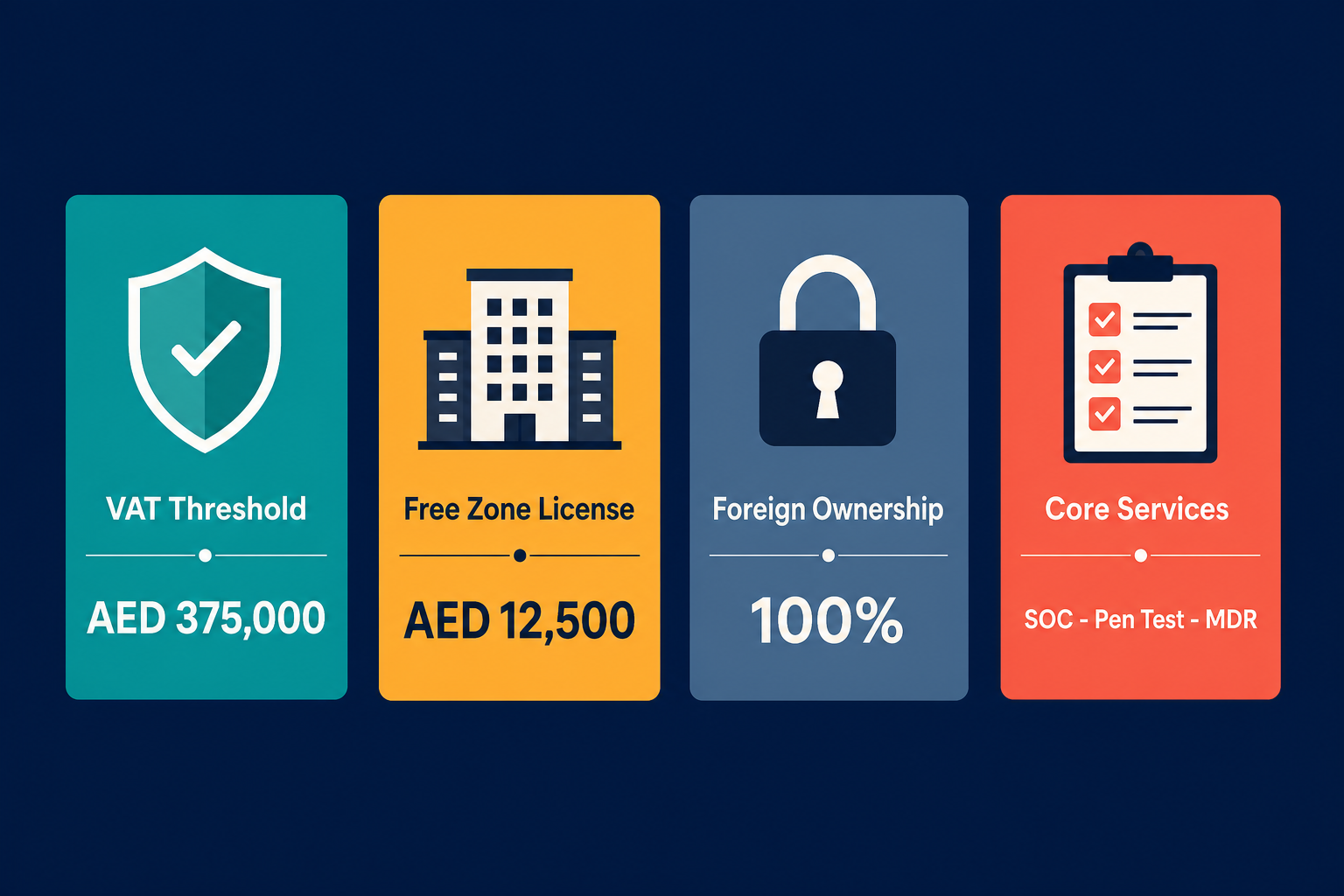
| Foreign ownership | 100% in free zone; 100% mainland permitted for most professional services – Invest in Dubai |
| Key regulator | Telecommunications and Digital Government Regulatory Authority (TDRA) |
| VAT registration threshold | AED 375,000 annual taxable turnover – Federal Tax Authority |
| Market size | UAE cyber security market growing steadily – IMARC Group |
What a Managed Cyber Security License Covers
A managed cyber security license lets you sell security services to businesses on a contracted or ongoing basis. The core activities covered include threat monitoring, incident response, penetration testing, security operations centre (SOC) services, vulnerability assessments, and managed detection and response. If you are running a SOC for clients, doing red team exercises, or managing endpoint protection across a corporate network, this is the right license category.
What falls outside this scope matters just as much. Selling cyber security software as a product, running a training academy, or reselling hardware all need separate activity codes. If you plan to do more than one of these, you need to confirm each code before you set up. Adding codes later is possible but costs time and money.
TDRA oversight
The Telecommunications and Digital Government Regulatory Authority sets the rules for any service that touches telecoms infrastructure. If your managed security work involves monitoring network traffic at an infrastructure level, managing security for telecoms operators, or providing services to government digital systems, you will likely need TDRA registration on top of your trade license. Check this before you sign any client contract, not after.
Why the activity code matters
Enterprise clients in the UAE, especially banks, government entities, and healthcare providers, will ask to see your trade license before they engage you. If the activity on your license does not match the service you are selling, procurement teams will flag it. Some will walk away. Getting the right code from day one removes that friction entirely.
You can browse the full Meydan Free Zone business activities list to confirm the exact code that fits your services before you apply.
Mainland vs Meydan Free Zone: Where to Set Up
This is the biggest choice you will make when setting up. Let your clients decide it, not the price.
| Factor | Mainland (DET) | Free Zone (Meydan Free Zone) |
|---|---|---|
| Client access | Open UAE market including government | Mainly private sector and international clients |
| Foreign ownership | 100% for most professional services | 100% always |
| Office requirement | Physical office required | Flexi-desk options available |
| Setup cost | Generally higher | Lower; trade license from AED 12,500 |
| Setup speed | Slower; more approvals needed | Faster; streamlined process |
| Visa quota | Tied to office space | Flexible packages available |
| Local agent | Not required for most activities | Not required |
Mainland via DET
A mainland license from the Dubai Department of Economy and Tourism lets you work directly with UAE government bodies and semi-government entities. If your target clients include ministries, government-linked corporations, or regulated sectors like banking and healthcare that require a local presence, mainland is the right choice. Nobody in UAE government procurement buys on a phone call. They run formal tenders, they want you on their approved vendor list first, and they sign long contracts once they trust you.
Meydan Free Zone
Meydan Free Zone gives you 100% foreign ownership, a lower cost base, and a faster setup. It works well if your clients are private sector businesses, regional or international companies with UAE operations, or startups and SMEs. You can also operate remotely in the early stages, which keeps overheads low while you build your client base. If you want to explore that option, remote business setup through Meydan Free Zone is a practical route for founders not yet based in Dubai.
The honest answer is this: if you are targeting government contracts, go mainland. If you are targeting private sector and international clients, Meydan Free Zone is faster, cheaper, and gives you everything you need.
Free Business Setup Cost Calculator
Calculate NowStep-by-Step Setup Guide
- Step 1, book your trade name: Use the DET e-Services portal for a mainland company, or the Meydan Free Zone portal for a free zone one. Check your company name availability before you go further. Names cannot imply government affiliation or use restricted terms.
- Step 2, confirm your activity code: Make sure the managed cyber security activity code is approved in your chosen jurisdiction before you apply. If you plan to offer penetration testing, SOC services, and incident response under one license, confirm all three are covered.
- Step 3, submit your setup documents: These typically include passport copies for all shareholders, a business plan summary, and your chosen office arrangement. Meydan Free Zone handles most of this digitally. You get initial approval once documents are verified.
- Step 4, open a corporate bank account: UAE banks are thorough. They will ask about your business model, expected transaction volumes, and client profile. Have clear answers ready. Business banking support through mCore can help you navigate this stage.
- Step 5, get sector-specific approvals before you start: If your services touch telecoms infrastructure or government digital systems, get TDRA registration sorted before you take on your first client. Digital Dubai may also be relevant if you are working with smart city or government technology projects.
- Step 6, set up your operational basics: This includes a company stamp, business cards, and any virtual office or mail management services you need. Meydan Free Zone's mCore package covers these as a bundle.
Compliance and What You Need in Place
Compliance in managed cyber security is not just about your license. Your clients will have their own compliance duties, and they will expect you to help them meet those duties, not add to their risk.
UAE Personal Data Protection Law
The UAE Personal Data Protection Law sets out how personal data must be handled, stored, and processed. As a managed security provider, you will almost certainly handle personal data as part of your work, whether through endpoint monitoring, log analysis, or incident response. You need a clear data handling policy and client data processing agreements in place from day one. This is not optional and it is not something to patch in later.
TDRA registration
If your services involve monitoring or securing telecoms networks, or if you are providing managed security to a telecoms operator, TDRA registration is a legal requirement. The TDRA also oversees digital infrastructure security standards in the UAE. Check whether your specific service scope triggers registration before you start trading.
Staff certifications
Enterprise clients in the UAE, particularly in financial services, government, and healthcare, will ask about your team's qualifications. The certifications they look for include CISSP, CISM, CEH, and ISO 27001 Lead Implementer or Auditor. You do not need these to get a license, but you do need them to win contracts. Budget for them as a cost of doing business.
VAT registration
Once your annual taxable turnover reaches AED 375,000, you must register for VAT with the Federal Tax Authority. Most managed security providers will cross this threshold quickly once they have their first enterprise client. Register early rather than scrambling to catch up. The VAT registration support service through mAccounting can handle this for you.
Corporate tax
The UAE introduced a 9% corporate tax on business profits above AED 375,000. Free zone entities may qualify for preferential rates if they meet the substance and qualifying income criteria. Get proper advice on this before your first full financial year. The corporate tax services available through mAccounting cover registration, filing, and ongoing compliance.
Market Opportunity in Dubai
The UAE cyber security market is growing fast. According to IMARC Group, the regional market is on a strong upward trajectory, driven by government digitalisation programmes, financial sector regulation, and the rapid expansion of cloud infrastructure across the Gulf. Dubai sits at the centre of this. It is the regional headquarters for most international financial institutions, the logistics hub for the wider Middle East, and home to a growing base of technology companies.
Who buys managed security in Dubai
The clients with the biggest budgets and the most consistent demand fall into a few clear sectors.
- Financial services: banks, insurance companies, and payment processors face strict regulatory requirements and constant threat activity.
- Government and semi-government: ministries, utilities, and government-linked corporations all need ongoing security monitoring.
- Logistics and supply chain: Dubai's position as a global trade hub means logistics companies handle sensitive commercial data at scale.
- Healthcare: hospitals and health networks handle patient data and are increasingly targeted by ransomware operators.
Why Dubai works as a base
Dubai gives you access to the wider GCC from a single base. Saudi Arabia, Qatar, Kuwait, and Bahrain are all within a short flight, and many regional procurement decisions are made by teams based in Dubai. A Dubai-registered entity also carries credibility with regional clients in a way that an offshore or non-UAE entity does not.
Realistic timeline
Setup through Meydan Free Zone typically takes one to two weeks once documents are in order. Add another two to four weeks for banking. Your first client contract is a different question. Enterprise sales cycles in this sector run three to six months for a first engagement. Budget for that gap. Having your compliance documentation, certifications, and client-facing materials ready before you start trading shortens the cycle.
According to Mordor Intelligence, the Middle East cyber security market is among the fastest-growing globally, with the UAE consistently identified as the leading market in the region. That trajectory is not slowing down.
Conclusion
A managed cyber security business in Dubai is workable, regulated, and in real demand. The sector is growing, the client base is serious, and the barriers to entry, certifications, compliance frameworks, and proper licensing, are exactly the kind of barriers that protect you once you are established.
The decisions that matter most are the ones you make before you apply. Get your activity code right. Choose your jurisdiction based on who you are selling to. Have your compliance framework ready before you take on your first client. And make sure your team's certifications match what enterprise buyers in this market actually require.
Speak to the Meydan Free Zone team to confirm your activity code and get a cost breakdown before you commit.
Ready to Launch Your Business in Dubai?
Let's Connect