
Table of Contents
Frequently Asked Questions
What does activity code 1812 cover for a printing support services business in Dubai
Activity code 1812 — Service Activities Related To Printing covers the process and finishing side of print production rather than direct printing itself. Licensed activities typically include pre-press preparation, plate-making, colour separation, digital file preparation and proofing, binding, laminating, die-cutting, embossing, and foiling.
This classification positions your business as a supplier to the print industry rather than a competitor within it. You are providing the technical infrastructure that makes print output possible — the preparation before the press runs and the finishing after it.
For licensing and compliance purposes, this activity sits within the industrial and manufacturing services category, and Meydan Free Zone accommodates it under its services licence framework with clear scope boundaries for customs, VAT, and operational compliance.
Is a printing support services business in Dubai considered a print shop
No. A business licensed under activity code 1812 is not a print shop. The distinction is important for both licensing and operational scope. You are not operating printing presses or producing finished printed materials directly for end consumers.
Instead, you provide the technical support services that commercial printers, publishers, and packaging firms outsource — such as pre-press preparation, colour separation, finishing, and binding. This makes you a B2B supplier to the industry rather than a retail or trade print operation.
This distinction also affects what equipment you can import and operate, how your VAT obligations are structured, and how your contracts with clients are framed.
Why is Dubai a strong location for a printing support services business
Dubai serves as the primary regional print hub for GCC, East Africa, and South Asia distribution corridors, making it strategically positioned for both local service delivery and regional re-export of finished work.
The UAE packaging and printing market is projected to grow at a CAGR of over 4% through 2028, driven by retail, e-commerce, and hospitality sectors. Over 600 printing and publishing establishments operate across Dubai alone, creating sustained demand for ancillary support services.
Dubai's logistics infrastructure — including DP World and Jebel Ali — means specialist equipment and finished materials move efficiently across the region. A free zone-based business can import machinery and re-export work to GCC and African markets without the complexity of mainland customs procedures.
Who are the target customers for a printing support services business in Dubai
This is a B2B business model — end consumers are not your market. Your primary customers are commercial print houses, advertising agencies, packaging manufacturers, publishers, and event production companies that need specialist pre-press or finishing capabilities they cannot justify maintaining in-house.
There is a particular gap at the quality end of the market. Many SME print shops in Dubai lack the capital or volume to invest in high-end finishing equipment. Outsourcing to a specialist support provider is both commercially logical and increasingly common for luxury retail packaging, exhibition graphics, and branded real estate collateral.
Government and semi-government entities — requiring official publications, signage, and documentation — also represent a stable, lower-volatility revenue layer that complements the project-driven nature of private sector work.
What licence type is needed to operate printing support services in Dubai's free zones
A services licence is the appropriate framework for printing support services in Meydan Free Zone, with activity code 1812 providing the defined operational scope. Despite the industrial nature of some activities, the classification sits within services rather than a full manufacturing licence for this type of support operation.
The activity code creates clear boundaries for customs classification, VAT treatment, and operational compliance, which simplifies both setup and ongoing regulatory management. It is important to ensure the specific activities you intend to offer — such as binding, laminating, or pre-press preparation — are explicitly listed on your licence.
Does UAE VAT apply to printing support services and when is registration required
UAE VAT at 5% applies to most B2B print support services. VAT registration becomes mandatory once your annual turnover exceeds AED 375,000, as set by the Federal Tax Authority.
For a B2B operation, VAT is generally recoverable by your business clients as input tax, which means it rarely acts as a barrier to commercial relationships. However, accurate invoicing, record-keeping, and timely filing are essential compliance requirements from the point of registration.
It is advisable to consult a UAE-registered tax agent when setting up to ensure your invoicing structure, contract terms, and filing obligations are correctly configured from the outset.
What types of services create the strongest commercial opportunity in Dubai's print support sector
The strongest commercial opportunity lies at the quality and specialist end of the market. High-end finishing services — including foiling, embossing, die-cutting, and premium lamination — are in consistent demand from luxury retail brands, hospitality groups, and real estate developers whose packaging and collateral requirements exceed what commodity printers can deliver.
Pre-press and digital file preparation services are also commercially viable, particularly for clients managing complex multi-language or multi-format print runs common in the GCC market. Colour separation and proofing for large-format or packaging work requires specialist expertise that many print shops prefer to outsource.
Binding and document finishing for government and corporate clients provides a steadier, more predictable revenue stream alongside the higher-margin project work from creative and luxury sectors.
What are the key market growth drivers for printing and packaging services in the UAE
The UAE packaging and printing market is projected to grow at a CAGR of over 4% through 2028, according to IMARC Group. The primary growth drivers are expansion in retail, e-commerce fulfilment packaging, and the hospitality sector — all of which require high volumes of branded and finished print materials.
Dubai's position as a regional logistics and trade hub amplifies domestic demand by creating export opportunities across the GCC, East Africa, and South Asia. Finished print materials and specialist equipment move efficiently through established infrastructure, extending the addressable market well beyond the UAE itself.
Government communications, real estate marketing cycles, and the events and exhibitions industry — anchored by venues and trade shows operating year-round in Dubai — add further structural demand that supports consistent workload across the calendar year.
How to Start a Printing Support Services Business in Dubai
Dubai's construction boom, retail sector, and events industry generate constant demand for printing support services, from large-format signage to document management. Offices need managed print solutions. Exhibition organisers need banners turned around overnight. Retailers need point-of-sale materials produced at scale. The demand is real and it is spread across enough sectors to keep a well-run operation busy year-round.
This guide covers the license, setup steps, and commercial realities you need to know before starting a printing support services business in Dubai.
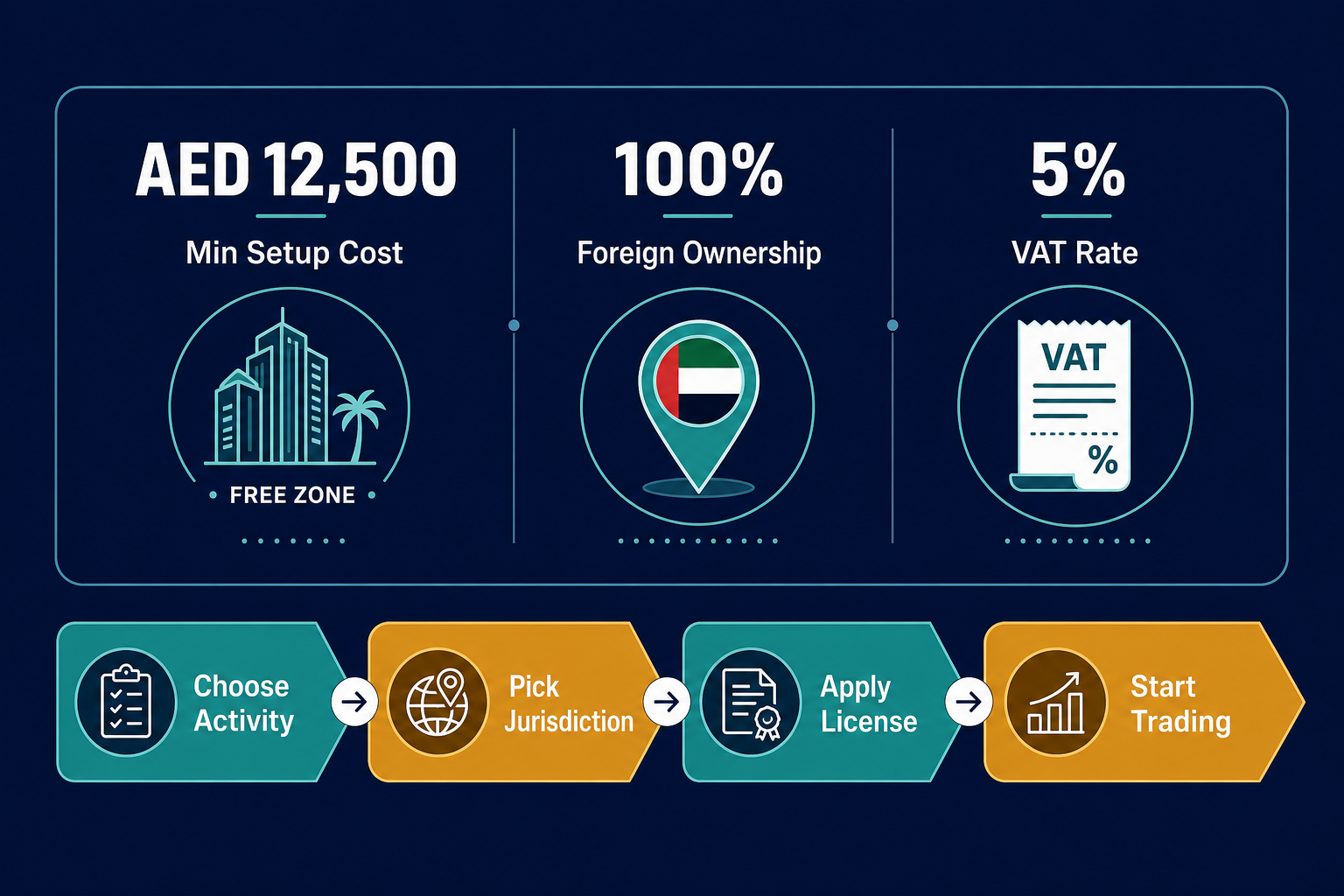
Key Stats at a Glance
| Activity | Printing Support Services |
|---|---|
| Jurisdiction options | Mainland (DET) or Meydan Free Zone |
| Foreign ownership | 100% permitted in both mainland and free zone – see Foreign Ownership rules |
| VAT rate on printing services | 5% – Federal Tax Authority (FTA) |
| Minimum setup cost (free zone) | From AED 12,500 – Dubai Trade License from AED 12,500 |
| Office requirement | Physical office for mainland; flexi-desk available in free zone |
| Key regulator for content | UAE Media Council – uaemc.gov.ae |
What a Printing Support Services License Covers
Getting the activity code right before you apply is not a formality. It determines what you can legally do, who you can invoice, and whether your bank will process certain transactions without asking questions. Pick the wrong code and you may find yourself unable to take on work that falls outside your licensed scope.
A printing support services license covers the operational side of print production. That includes:
- Document printing and reproduction
- Large-format output for banners, signage, and displays
- Finishing services such as lamination, binding, and cutting
- Print management and outsourced document services for corporate clients
- Digital and offset print support
What it does not cover is publishing, advertising production, or media distribution. If you plan to create advertising content for clients, design marketing campaigns, or distribute printed media commercially, those activities need their own licenses. The UAE Media Council oversees advertising content shown or distributed in the UAE, and mixing licensed and unlicensed activity under a single printing support services code creates compliance risk.
Check the Meydan Free Zone business activities list to confirm which code applies to your specific service mix before you submit anything. If your business covers both print support and design or advertising, you may need to add a second activity code at the point of application.
Who Your Clients Will Be
Printing support services in Dubai has a wide client base. That is one of its commercial strengths. You are not dependent on a single sector, and demand does not track any one economic cycle closely.
Corporate offices
Large companies and multinationals operating in Dubai use managed print services to handle internal document production. These are recurring contracts, often renewed annually. They are slower to close but predictable once you are in.
Events and exhibitions
Dubai runs a heavy calendar of trade shows, conferences, and public events. Organisers need large-format signage, branded backdrops, and printed collateral produced fast. Turnaround times are short and margins can be strong, but you need to be able to deliver under pressure.
Retail and hospitality
Retailers need point-of-sale materials, window graphics, and seasonal promotions. Hotels and restaurants need menus, branded packaging, and in-room materials. Both sectors reprint regularly, which means repeat business if your quality and delivery are consistent.
Government and semi-government entities
These clients run formal procurement processes. You need to be on their approved vendor list before you can bid, and the sales cycle is long. Once you are in, though, contracts tend to be high-value and multi-year. A mainland license makes this route more accessible. A free zone license can still work, but it adds a layer of complexity when dealing with government supply chains.
Mainland vs Meydan Free Zone: Which Setup Works for You
This is the biggest choice you will make when setting up. Let your clients decide it, not the license fee.
| Factor | Mainland (DET) | Free Zone (Meydan Free Zone) |
|---|---|---|
| Client access | Open UAE market, including government | Mainly B2B and international clients |
| Foreign ownership | 100% permitted | 100% permitted |
| Office requirement | Physical office required | Flexi-desk options available |
| Setup cost | Higher, due to office and DET fees | Lower – from AED 12,500 |
| Government contracts | Direct access | Requires a local distributor or agent in some cases |
| VAT registration | Mandatory once threshold is met | Mandatory once threshold is met |
A mainland license from the Dubai Department of Economy and Tourism (DET) lets you work directly with UAE government bodies and sell freely across the local market. You need a physical office, and the setup cost is higher. If your business model depends on government supply or retail walk-in trade, mainland is the right call.
Meydan Free Zone suits founders who are targeting corporate clients, events companies, and international businesses operating in the UAE. The setup cost is lower, you can start with a flexi-desk, and you keep 100% ownership without any local partner. If you want to start a business remotely before relocating, Meydan Free Zone supports that too.
The practical difference comes down to your sales pipeline. If your first ten clients are corporate offices and events agencies, go free zone. If you are targeting government tenders or plan to open a walk-in print shop, go mainland.
Free Business Setup Cost Calculator
Calculate NowStep-by-Step Setup Guide
- Step 1, book your trade name: Use the DET e-Services portal for a mainland company, or the Meydan Free Zone portal for a free zone one. Check your company name availability before you go further. Names must not conflict with existing registered businesses and must comply with UAE naming rules.
- Step 2, confirm your activity code: Make sure the printing support services code covers everything you plan to do. If you are adding design or advertising services, confirm whether a second code is needed. Do this before submitting your application.
- Step 3, choose your jurisdiction: Mainland via DET or Meydan Free Zone. Use the client logic above, not the fee comparison, to make this decision.
- Step 4, submit your initial approval application: For mainland, this goes through DET. For Meydan Free Zone, the process is handled online. You will need passport copies, a business plan summary, and details of your proposed activity. Meydan Free Zone's team can guide you through document requirements.
- Step 5, secure your premises: Mainland needs a physical office with a tenancy contract registered through Ejari. Free zone companies can use a flexi-desk at Meydan Free Zone's facilities, which satisfies the address requirement for your license.
- Step 6, get your trade license issued: Once documents are approved and fees are paid, your license is issued. Keep a digital and physical copy. You will need it for bank account opening, visa applications, and supplier agreements.
- Step 7, open a corporate bank account: This is often the step that takes longest. UAE banks are thorough. Have your license, company documents, and a clear explanation of your business model ready. Business banking support through mCore can help move this forward.
- Step 8, register for VAT if required: The Federal Tax Authority (FTA) sets the registration threshold. Once your taxable turnover meets it, VAT registration is not optional. Set up your accounting from day one so you are not reconstructing records later.
Compliance and What You Need in Place Before You Start
Printing support services is not a heavily regulated sector, but there are a few areas where gaps cause real problems. Deal with these before you start trading, not after your first client asks for an invoice.
VAT
A 5% VAT rate applies to most printing services in the UAE. You need to register with the Federal Tax Authority (FTA) once your taxable turnover reaches the registration threshold. Keep clean records from the first transaction. Reconstructing VAT records after the fact is time-consuming and creates risk during audits. If you need help with VAT registration, mAccounting offers VAT registration support services for businesses at this stage.
Staff visas and MOHRE registration
If you employ people, you need to register with the Ministry of Human Resources and Emiratisation (MOHRE). Each employee needs a UAE residence visa and a labour card. Free zone companies process visas through the free zone authority. Mainland companies go through MOHRE directly. Factor visa costs and processing time into your hiring plan.
Equipment import and customs clearance
Specialist printing machinery brought into the UAE is subject to import duties and customs clearance. If you are importing large-format printers, finishing equipment, or any other commercial machinery, customs clearance goes through the Ports, Customs and Free Zone Corporation (PCFC). Get the HS codes for your equipment confirmed before shipping to avoid delays at the port.
Content restrictions
Printed material distributed in the UAE is subject to oversight by the UAE Media Council. This matters if your clients ask you to produce content that touches on political, religious, or social themes. You are the printer, not the publisher, but you can still be held responsible for material that breaches UAE content rules. Know what you are producing and for whom.
Corporate tax
The UAE introduced a 9% corporate tax rate. Most small businesses operating below the taxable income threshold will not pay it, but you need to understand where you stand. Corporate tax services in Dubai through mAccounting can help you assess your position early.
Market Opportunity
Dubai's print market is driven by volume and variety. The events sector alone generates significant demand, with major exhibitions, government summits, and private events running throughout the year. The retail sector is large and competitive, which means brands spend consistently on point-of-sale and in-store materials. Corporate document management is a recurring need across every industry.
The shift toward digital has not eliminated print demand in the UAE. It has changed the mix. Short-run, high-quality, fast-turnaround work has grown as brands move away from large print runs toward more targeted, frequent production. That suits a well-equipped, responsive printing support services business better than it suits large commercial printers with high fixed costs.
Founders who combine print production capability with managed services, such as handling a client's entire document workflow rather than just fulfilling individual print jobs, tend to build stickier, higher-margin client relationships. That is where the real commercial opportunity sits.
Conclusion
Printing support services in Dubai is a workable, in-demand business with clear licensing, predictable compliance, and a broad client base across corporate, retail, and events sectors. The setup process is straightforward once you have the right activity code and jurisdiction confirmed. The compliance duties are manageable. The market is active.
The two decisions that matter most are choosing the right jurisdiction for your target clients and getting your activity code confirmed before you apply. Both are easy to get wrong if you move too fast. Take the time to map your first likely clients, then let that drive your setup choices.
Speak to Meydan Free Zone to confirm the right activity code and get a cost estimate before you commit to a jurisdiction.
Ready to Launch Your Business in Dubai?
Let's ConnectReferences
- Invest in Dubai
- Federal Tax Authority (FTA)
- Ports, Customs and Free Zone Corporation (PCFC)
- UAE Media Council
- Dubai Department of Economy and Tourism (DET) e-Services
- Ministry of Human Resources and Emiratisation (MOHRE)