Table of Contents
Frequently Asked Questions
What does activity code 8230.95 — Real Estate Public Auction Organising — actually permit a licence holder to do
Activity code 8230.95 covers the planning, management, and conduct of competitive bidding events for real estate assets. This includes residential units, commercial properties, plots, and distressed or court-mandated assets.
In practice, the licence holder manages auction event infrastructure: marketing the lots, qualifying bidders, running the bidding process, and coordinating post-auction documentation. It does not grant authority to register property transfers, which remains a function of the Dubai Land Department (DLD).
How is a real estate auction organiser different from a real estate broker
A real estate broker negotiates a bilateral sale between a specific buyer and seller. A real estate auction organiser facilitates an open, competitive bidding process where the asset transfers to the highest qualifying bid.
The commercial and regulatory logic differs accordingly. Auction organisers sit upstream of the property transfer process, coordinating the event itself, while the actual registration of ownership change is handled through DLD-registered mainland channels — often in partnership with registered brokers or legal firms.
Who are the main clients for a real estate public auction business in Dubai
Demand comes from several institutional sources. Banks holding non-performing loan portfolios need licensed operators to dispose of collateral property. Courts require qualified auctioneers for estate and insolvency matters. Developers with unsold inventory use auctions to generate competitive pricing and accelerate inventory clearance.
Law firms, government-linked entities, and compliance-conscious financial institutions are also key clients. These organisations typically run compliance checks on service providers, so holding a credible, professionally structured licence is commercially important when pitching for mandates.
What AML and compliance obligations apply to real estate auction operators in the UAE
UAE Federal Law No. 20 of 2019 on AML/CFT applies to real estate transactions, and auction proceeds are not exempt. Operators must implement customer due diligence procedures, maintain full transaction records, and file suspicious transaction reports where required.
Because auctions can involve high-value asset transfers and multiple bidding parties, the due diligence obligations are material. Operators should build compliant onboarding and record-keeping processes into their business model from the outset, rather than treating AML compliance as an afterthought.
Does VAT apply to real estate auction commissions and service fees in Dubai
Yes. The Federal Tax Authority applies VAT at the standard rate of 5% to auction commissions and service fees charged by the organiser. This is separate from any VAT treatment of the underlying property transaction itself.
VAT registration will be required once the operator's taxable turnover meets the relevant threshold. Operators should factor this into their fee structures and invoicing processes from an early stage to avoid compliance gaps as revenue grows.
Can a Meydan Free Zone licence cover the full property transfer process after an auction
No. A Meydan Free Zone licence covers the organising activity — marketing lots, qualifying bidders, running the competitive bidding event, and coordinating post-auction documentation. It does not, on its own, grant authority to register property transfers.
Property transfer registration remains a mainland DLD function. Auction organisers typically work alongside DLD-registered brokers or legal firms to complete the transaction chain after a successful bid. Structuring these working relationships clearly is an important operational step when setting up the business.
How long does it take to obtain a Real Estate Public Auction Organising licence through Meydan Free Zone
Meydan Free Zone typically issues licences within 3–7 working days. This makes it one of the faster routes to establishing a formally licensed auction organising business in Dubai.
The speed of issuance is commercially relevant because it allows operators to begin building client relationships and pitching for mandates relatively quickly after deciding to enter the market, without extended regulatory delays.
Why is the commercial case for real estate auction organising in Dubai considered structural rather than cyclical
The demand drivers are tied to ongoing institutional processes rather than market sentiment alone. Banks continuously generate non-performing loan portfolios requiring collateral disposal. Courts handle a steady flow of estate and insolvency matters. Developers regularly need to clear inventory at competitive prices.
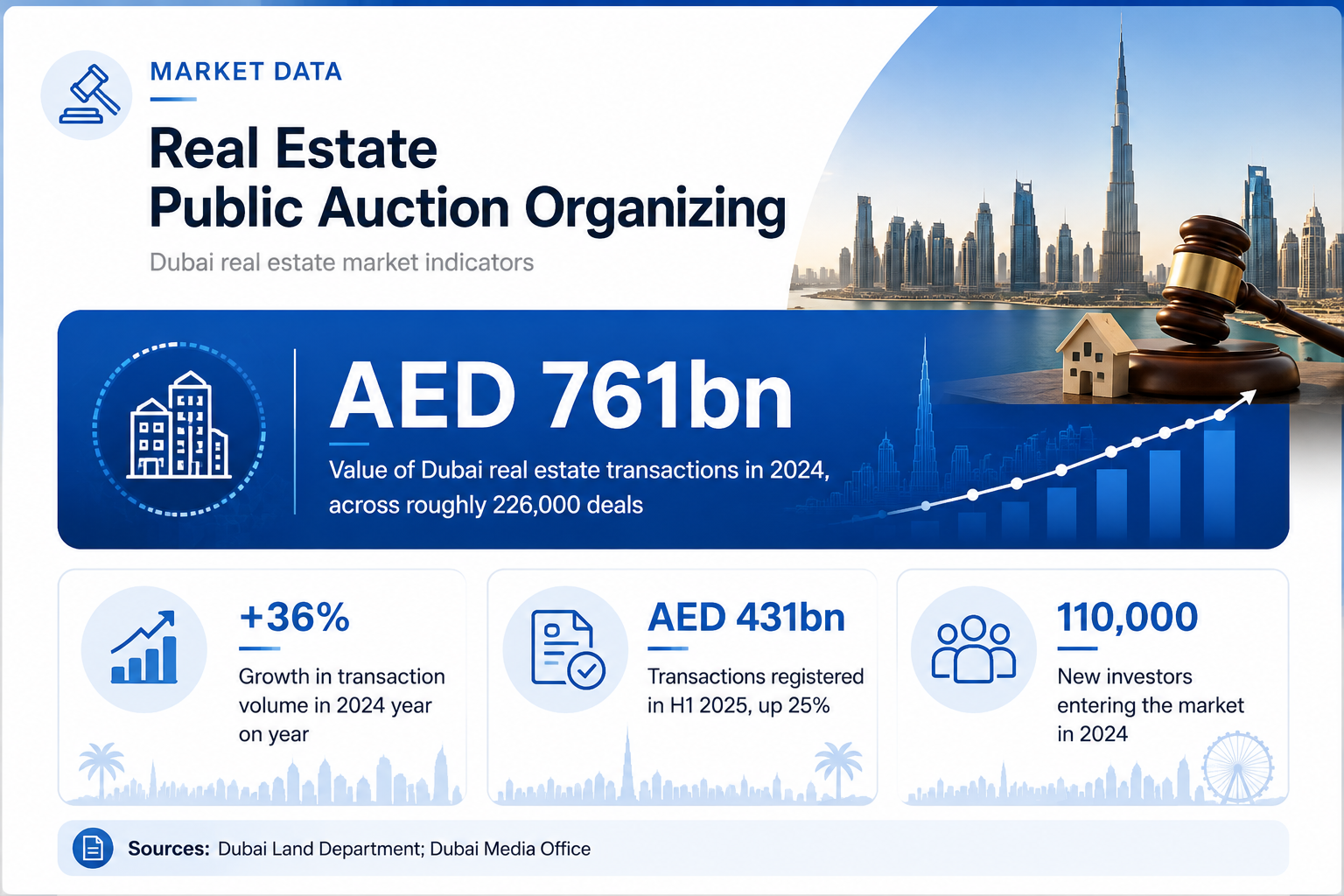
Dubai's real estate market recorded over AED 634 billion in transactions in 2024 and processed more than 180,000 property transactions through the Dubai Land Department in a single year. As transaction volumes grow, so does the pool of assets requiring structured disposal mechanisms — providing a durable, not merely opportunistic, foundation for an auction organising business.
How to Start a Real Estate Public Auction Business in Dubai
Dubai's real estate market transacted over AED 634 billion in 2024, and public auctions are an increasingly structured channel inside that volume. Distressed asset disposal, estate liquidations and developers clearing inventory all generate demand for licensed, professionally organised auction events.
This guide covers what a Real Estate Public Auction Organising license covers, the hard limit on what it does not cover, who instructs this work, and how to set up through Meydan Free Zone.
Key Stats at a Glance
What This License Covers

Activity code 8230.95, real estate public auction organising, covers the planning, management and conduct of competitive bidding events for real estate assets. That includes residential units, commercial properties, plots, and distressed or court-mandated assets.
In practice the license holder runs the auction event infrastructure: marketing the lots, qualifying bidders, running the bidding process, and coordinating post-auction documentation. The limit is the important part. The license does not grant authority to register property transfers, which remains a Dubai Land Department function handled through registered mainland channels. The auction organiser sits upstream of that process, and most operators work alongside DLD-registered brokers or legal firms to complete the transaction chain after a successful bid. Set those working relationships up deliberately, because they are how the business actually delivers a completed sale.
It is also distinct from brokerage: a broker negotiates a bilateral sale between a specific buyer and seller, while an auction organiser facilitates an open, competitive process where the asset goes to the highest qualifying bid.
Who Your Clients Will Be
The pipeline is institutional, which makes this a relationship business rather than a volume one.
- Banks holding non-performing loan portfolios needing collateral disposal
- Courts requiring qualified auctioneers for estate and insolvency matters
- Developers with unsold inventory using auctions to set competitive pricing
- Law firms managing estate matters
- Government-linked entities and compliance-conscious financial institutions
These organisations run compliance checks on their service providers, so a credible, professionally structured license matters commercially when you pitch for mandates. An informal operator does not get through procurement at a bank.
Revenue is mostly commission. The standard structure is a buyer's premium, a percentage added to the hammer price, alongside a seller's commission negotiated with the instructing party, and on high-value commercial or distressed assets those fees are substantial. Secondary lines include event management fees, coordination of independent valuations, and marketing of lots through digital and physical channels, with some operators charging a listing or cataloguing fee per lot whatever the outcome. Because a small number of mandates can carry significant revenue, one operator running several events a month can hold a lean headcount.
Mainland or Free Zone
Let your bidders decide it, not the price. Neither route lets you register transfers under this activity alone, so the structural question is really about positioning and speed. Meydan Free Zone's central Dubai location positions license holders credibly with the law firms, banks and government-linked entities that need a professionally structured counterpart.
[blockCTACostCalculator]
Step by Step Setup Guide
- Step 1, confirm the activity: Check 8230.95 on the Meydan Free Zone business activity list and verify it matches your intended scope of services.
- Step 2, select a license package: mCore suits sole operators with minimal visa needs. mPlus fits teams needing several visas and a larger operational footprint.
- Step 3, send in your documents: Your trade name, passport copies and activity documentation. This stage is completable remotely with no in-person attendance.
- Step 4, take your license and open a bank account: UAE banks want the license, shareholder documents and a business plan summary.
- Step 5, register with the relevant property regulators and build your AML framework: Do this before you run your first auction event, not after.
License issuance typically takes three to seven working days. Bank account opening varies by institution but generally runs two to four weeks for free zone entities.
Compliance and What You Need in Place
DLD and RERA oversight
The Dubai Land Department and its regulatory arm RERA govern all real estate transactions in Dubai, including those conducted through auction. Any operator running auctions that result in property transfers must make sure the post-auction process routes correctly through DLD-registered channels. Getting this wrong does not just create a compliance problem, it leaves your winning bidder unable to complete.
Anti-money laundering
UAE Federal Law No. 20 of 2019 on AML/CFT applies to real estate transactions, and auction proceeds are not exempt. You must run customer due diligence, keep full transaction records and file suspicious transaction reports where required. Because auctions involve high-value asset transfers and multiple bidding parties, the due diligence load is heavy, so build compliant onboarding and record-keeping into the business model at the start rather than bolting it on.
VAT
The Federal Tax Authority applies VAT at the standard 5% rate to auction commissions and service fees charged by the organiser. This is separate from any VAT treatment of the underlying property transaction. Registration is required once taxable turnover meets the relevant threshold, so build it into fee structures and invoicing early rather than patching the gap as revenue grows.
Scope of the license
The free zone license covers the organising activity only. Keep that boundary clear in your client agreements, because the instructing party needs to know who is completing the transfer and under what authority.
Market Opportunity
The demand drivers here are institutional processes rather than market sentiment, which is what makes the case structural rather than cyclical. Banks continuously generate non-performing loan portfolios needing collateral disposal. Courts handle a steady flow of estate and insolvency matters. Developers regularly need to clear inventory at competitive prices. None of those stops when the market cools; several of them accelerate.
The volumes underneath are substantial and growing. Dubai recorded over AED 634 billion in real estate transactions in 2024 and processed more than 180,000 property transactions through the Dubai Land Department in a single year, with Dubai Statistics Center data confirming consistent year-on-year growth in volumes. As transaction volumes grow, so does the pool of assets needing structured disposal mechanisms. IMARC Group's sector analysis places UAE real estate among the fastest-growing globally, which extends the runway further.
Conclusion
Real estate public auction organising is a focused, workable activity in a market where property volumes and institutional demand for transparent disposal are both growing. The regulatory framework is clear, the revenue model is proven, and setup through Meydan Free Zone is efficient.
Three things decide how well it goes: an AML framework built before the first event rather than after, working relationships with DLD-registered brokers or legal firms so the transfer chain completes, and a client base weighted toward banks and courts whose need for disposal does not depend on the market cycle.
[blockCTAContact]