
Table of Contents
Frequently Asked Questions
What does activity code 4773.93 permit a business to do in Dubai
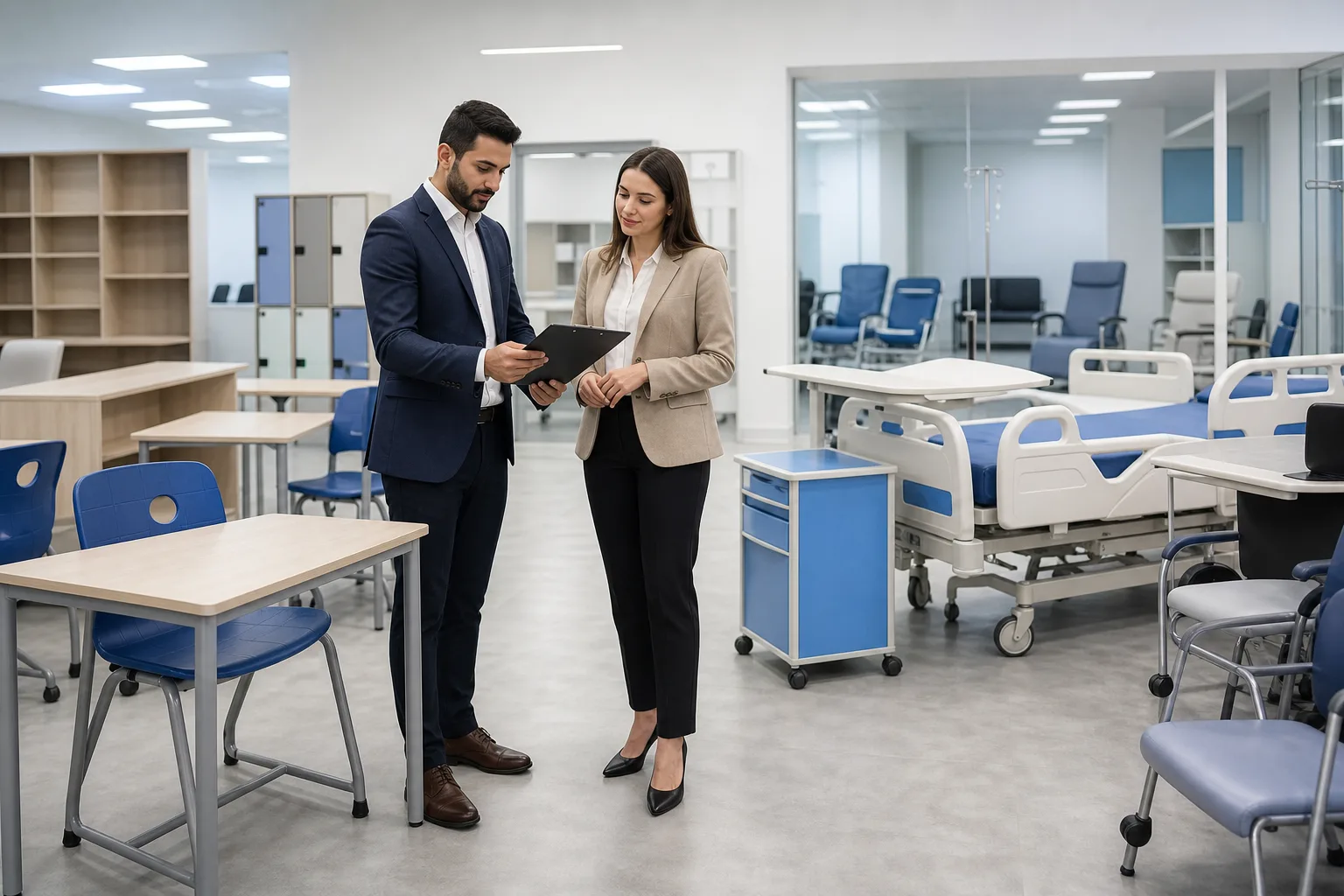
Activity code 4773.93 — Schools, Hospitals & Laboratories Furniture Trading permits the import, stocking, and resale of furniture designed for institutional environments. This covers a wide range of products including hospital ward furniture, examination tables, nurse stations, laboratory benching, classroom seating, library systems, and lecture hall fitouts.
Holding this single licence is commercially efficient because it spans all three verticals — schools, hospitals, and laboratories — allowing a trader to respond to multi-category tenders and supply a single institution across multiple departments without needing additional licence activities or regulatory approvals.
How is institutional furniture different from general furniture trading
Institutional furniture is a distinct category from general furniture trading. Products in this segment must meet institutional-grade durability, hygiene, and safety standards specific to the environments in which they are used.
Hospital and laboratory furniture must align with procurement standards set by the Dubai Health Authority (DHA) and sourcing requirements from the Ministry of Health and Prevention (MOHAP). Educational furniture is shaped by standards applied across private schools and universities operating under the UAE's education framework.
Who are the main buyers of school and hospital furniture in Dubai
The primary buyers are institutional clients operating in Dubai's healthcare and education sectors. These include DHA-approved hospitals, specialist clinics, day surgery centres, medical colleges, private schools, international universities, and vocational training centres.
These buyers operate through structured procurement processes involving approved vendor lists, tender submissions, and multi-stage approval cycles. Positioning as a registered supplier before a project reaches the procurement stage is how most successful traders in this category build their pipeline.
What is the market size and growth outlook for this sector in the UAE and region
The UAE healthcare sector is projected to reach USD 31.2 billion by 2028, according to IMARC Group, driven by hospital expansion and medical tourism. Dubai alone hosts over 1,200 private schools and a growing base of higher education institutions, per data from the Dubai Statistics Center.
The Middle East and Africa commercial furniture market is forecast to grow at a compound annual rate above 5% through 2030, per Mordor Intelligence. Healthcare and education are also identified by Invest in Dubai as two of the emirate's six priority investment sectors under the Dubai Economic Agenda D33.
Can a Dubai-based furniture trader export to other GCC or international markets
Yes. Dubai's logistics infrastructure makes it a natural regional distribution hub for GCC markets, East Africa, and South Asia — all regions experiencing growing institutional construction activity. This re-export dimension is a material part of the business opportunity for traders operating under activity code 4773.93.
DP World handles over 80 million TEUs annually across its global network, with Jebel Ali remaining the region's primary import-export corridor, providing traders with efficient access to international shipping routes.
What is the dominant business model for school and hospital furniture traders in Dubai
The dominant model in this category is import-and-resell. Traders source from manufacturers in countries such as China, Turkey, Italy, and India — all of which have established institutional furniture manufacturing industries — and then supply to end clients in Dubai and across the region.
This model suits the project-based nature of institutional procurement, where large volume orders are placed at construction or fit-out stages, with repeat procurement driven by growth, refurbishment, and replacement cycles over time.
Why is Meydan Free Zone mentioned as a setup option for this type of business
Meydan Free Zone is highlighted in this guide as a practical route to establishing a furniture trading business under activity code 4773.93 in Dubai. Free zones in the UAE generally offer advantages such as 100% foreign ownership, simplified company formation processes, and access to import/export infrastructure.
Setting up through a free zone like Meydan allows traders to hold the relevant licence activity and operate within Dubai's institutional procurement ecosystem, while also benefiting from the emirate's position as a logistics and re-export hub for the wider region.
What regulatory bodies govern procurement standards for hospital and educational furniture in Dubai
Hospital and laboratory furniture procurement in Dubai is aligned with standards set by the Dubai Health Authority (DHA) and sourcing requirements from the Ministry of Health and Prevention (MOHAP). Suppliers targeting public or private healthcare institutions typically need to meet these bodies' vendor and product standards.
For the education sector, furniture procurement standards are applied across private schools and universities operating under the UAE's education framework. Traders who understand and comply with these regulatory requirements are better positioned to qualify for approved vendor lists and participate in formal tender processes.
How to Start a School and Hospital Furniture Trading Business in Dubai
Dubai keeps building hospitals, clinics, schools and universities, and every one of them has to be filled with furniture before it opens. Hospital beds, examination tables, laboratory benching, classroom desks, lecture hall seating. It is bought in bulk, on project timelines, through formal procurement.
This guide covers what activity code 4773.93 lets you trade, who buys it, how to set up your license through Meydan Free Zone, and the customs and tax side you need in place. One license covers three verticals here, which is unusually efficient.
Key Stats at a Glance
| Activity code | 4773.93 |
|---|---|
| What it covers | Trading in furniture for schools, hospitals and laboratories |
| Healthcare market | UAE healthcare sector projected to reach USD 31.2 billion by 2028 – IMARC Group |
| Education base | Dubai hosts over 1,200 private schools – Dubai Statistics Center |
| Furniture market | Middle East and Africa commercial furniture set to grow above 5% a year through 2030 – Mordor Intelligence |
| Port access | DP World handles over 80 million TEUs a year, with Jebel Ali the region's main import-export corridor |
| Customs duty | Typically 5% under the GCC Common External Tariff – PCFC |
| VAT threshold | AED 375,000 taxable turnover a year, voluntary from AED 187,500 – Federal Tax Authority |
| Foreign ownership | 100% in Meydan Free Zone |
What This License Covers

Activity code 4773.93, Schools, Hospitals and Laboratories Furniture Trading, lets you import, stock and resell furniture made for institutional settings. That covers hospital ward furniture, examination tables, nurse stations, laboratory benching and storage, classroom seating and desks, library systems and lecture hall fitouts.
This is a different trade from general furniture. The products have to meet institutional-grade durability, hygiene and safety standards. Hospital and laboratory items follow procurement standards aligned with the Dubai Health Authority and sourcing rules from the Ministry of Health and Prevention. Education furniture follows the standards applied across private schools and universities under the UAE education framework.
One license covers all three verticals. You can bid on a multi-category tender, supply one hospital across several departments, and spread your revenue without adding license activities or extra approvals.
Who Your Clients Will Be
Every buyer here is an institution, and every institution buys through a process.
- DHA-approved hospitals, specialist clinics and day surgery centres
- Medical colleges and laboratories
- Private schools and international universities
- Vocational training centres
They work through approved vendor lists, tender submissions and multi-stage approvals. That means getting registered as a supplier before a project reaches the buying stage is how the good traders build a pipeline. Turning up when the tender is already out is too late.
The dominant model is import and resell. Traders source from makers in China, Turkey, Italy and India, then supply clients in the UAE and the wider region. Project supply, such as a hospital fitout or a school build, brings big order values, long sales cycles and payment tied to project milestones. Catalogue supply to smaller clinics and training centres brings lower order values but steadier cash.
Value-add work is where the margin improves. Traders who offer specification advice, site measurement, delivery coordination, installation and after-sales support stand apart from pure importers and do better on approved vendor lists. Tender pricing is competitive and structured. Direct sales to private operators leave more room to negotiate. Most established firms run both channels at once.
Mainland or Free Zone
| Factor | Mainland (DET) | Free Zone (Meydan Free Zone) |
|---|---|---|
| Who you sell to | Open UAE market | Import, export, re-export and free zone trade |
| Foreign ownership | Set by DET rules for the activity | 100% yours |
| Mainland supply | Direct | Through a mainland distributor, agent or separate entity |
| Customs duty | Payable on entry | Deferred until goods enter the mainland |
| Setup route | Apply through DET | Apply online, remote setup possible |
A free zone trading license lets you import, export, re-export and trade inside the free zone and internationally. To supply the UAE mainland market you would normally work through a mainland distributor or agent, or set up a separate mainland entity. That is a structural choice, not a barrier. Let your clients decide it, not the price.
[blockCTACostCalculator]
Step by Step Setup Guide
- Step 1, pick your activity and license package: Check that 4773.93 is in your license scope. Choose mCore for a lean operation or mPlus if you need several visas and more capacity. Both support trading.
- Step 2, book your trade name and prepare documents: Shareholder passport copies, proof of address, and a basic business plan if asked. Corporate shareholders also need a board resolution and the parent company's registration certificate.
- Step 3, take license issuance and start visas: Once the license is issued, apply for residency visas under your allocation. Emirates ID follows biometric registration, and the full cycle from submission to Emirates ID usually runs four to six weeks.
- Step 4, open a corporate bank account: Most major UAE banks accept Meydan Free Zone companies. Bring your license, shareholder documents, Emirates ID and a clear account of how the business makes money and where the payments will come from.
Setup can be done remotely. You do not need to be in Dubai until the visa and Emirates ID stage.
Compliance and What You Need in Place
Customs and imports
Furniture enters through Jebel Ali or another designated port under the Ports, Customs and Free Zone Corporation. Standard duty on most furniture categories runs at about 5% under the GCC Common External Tariff. As a free zone license holder you can bring goods into the zone with duty deferred until they move to the mainland, which helps your cash flow on large orders.
VAT
Register with the Federal Tax Authority once taxable turnover passes AED 375,000 a year. Voluntary registration opens at AED 187,500. At institutional order sizes most traders cross the mandatory line quickly, so plan for it rather than react to it.
Healthcare product rules
Furniture going into DHA-regulated facilities may need the supplier to hold, or be tied to, a registered healthcare supply entity, depending on how the product is graded. Check your product grading with the DHA before you chase that segment, because finding out mid-tender is expensive.
Standards and paperwork
Institutional buyers ask for evidence, not assurances. Keep durability, hygiene and safety documentation current for every line you carry. It is what gets you onto an approved vendor list.
Market Opportunity
Both of your buying sectors are expanding. IMARC Group projects the UAE healthcare sector to reach USD 31.2 billion by 2028, driven by hospital expansion and medical tourism. Dubai hosts over 1,200 private schools and a growing base of higher education institutions, per Dubai Statistics Center. Invest in Dubai names healthcare and education among the emirate's six priority investment sectors under the Dubai Economic Agenda D33.
The furniture side is growing with them. Mordor Intelligence forecasts the Middle East and Africa commercial furniture market to grow above 5% a year through 2030. New facilities buy at inception, then buy again on refurbishment and replacement cycles, so the demand repeats.
Re-export is the other half of the story. DP World handles over 80 million TEUs a year across its network, and Jebel Ali remains the region's main import-export corridor. That makes Dubai a natural distribution base for GCC markets, East Africa and South Asia, all of which are building institutions of their own.
Conclusion
School, hospital and laboratory furniture trading is a solid, infrastructure-backed activity in Dubai. The demand drivers are clear, the import-and-resell model is well established, and the license path is short.
Three things decide how this goes: getting onto approved vendor lists early, handling your customs and VAT properly, and offering enough service around the product that buyers do not treat you as a price line. One license covering three verticals gives you room to build all three.
[blockCTAContact]
References
- Dubai Health Authority (DHA)
- Ministry of Health and Prevention (MOHAP)
- DP World
- IMARC Group
- Dubai Statistics Center
- Mordor Intelligence
- Invest in Dubai
- Ports, Customs and Free Zone Corporation (PCFC)
- Federal Tax Authority