
Table of Contents
Frequently Asked Questions
What is the activity code for a survival training business in Dubai
Survival training in Dubai is classified under activity code 8549.12, which sits within the specialised, non-academic education and training category. This code covers a broad range of skills-based programmes including wilderness survival, bushcraft, land navigation, rope techniques, emergency preparedness, and crisis response.
You can verify your specific activity classification and confirm current requirements through the Dubai DED eServices portal before proceeding with your licence application.
What type of licence is required to operate a survival training business in Dubai
A survival training business in Dubai requires a Professional Licence, which falls under the Department of Economy and Tourism (DED) on the mainland or an equivalent free zone authority. Both sole establishment and LLC structures are viable depending on your ownership preferences and operational model.
Following the 2021 UAE Companies Law amendments, 100% foreign ownership is permitted on the mainland for most professional activities under this category, meaning no mandatory local sponsor is required — a significant change that has made mainland setup more accessible for foreign founders.
Can a foreign national fully own a survival training company in Dubai
Yes. Under the 2021 UAE Companies Law amendments, 100% foreign ownership is permitted on the mainland for most professional activities, including survival training under code 8549.12. There is no mandatory local sponsor requirement for this activity class under current regulations.
Free zones such as Meydan Free Zone have always offered full foreign ownership as standard. For the most current and activity-specific ownership rules, refer to Invest in Dubai and confirm your classification via the DED eServices portal.
What are the main differences between setting up on the mainland versus a free zone for survival training
The core trade-off is market access versus setup cost. A mainland (DED) licence permits direct contracts with government entities, UAE-based corporates, and public-sector clients without agent restrictions, and allows operations across all seven emirates. However, it requires an Ejari-registered tenancy contract and visa allocation tied to office space size.
A free zone licence — such as through Meydan Free Zone — typically offers lower initial setup costs, simpler banking onboarding, and competitive pricing for service-based professional licences. The key limitation is that physical training delivery on the mainland requires an NOC or branch registration, which adds complexity if your programmes run outside the free zone. For operators whose primary revenue comes from corporate contracts and on-site training across Dubai, the mainland option is generally more practical.
Who are the target customers for a survival training business in Dubai
Dubai's market for survival training spans several well-defined segments. Corporate clients represent a strong primary audience, seeking structured team-building, resilience, and emergency preparedness programmes. Adventure tourism operators and hospitality groups are also active buyers, looking to build experiential packages for guests.
Additional segments include security contractors, private protection firms, and defence-adjacent organisations requiring practical field skills training, as well as Dubai's substantial expatriate outdoor and adventure community, which is both commercially active and growing. The Dubai Department of Economy and Tourism's active promotion of adventure and experiential tourism further supports demand across these groups.
What locations in Dubai are suitable for running survival training programmes
Dubai's geography provides credible and accessible training environments without needing to leave the emirate. Key locations include the Hatta mountain region, the Al Qudra desert, and access points into the Hajar Mountains — all of which offer realistic terrain for wilderness survival, land navigation, rope techniques, and bushcraft instruction.
These environments support a range of programme types from half-day corporate sessions to multi-day immersive courses, and their proximity to Dubai makes logistics straightforward for both operators and clients.
Which regulatory bodies oversee survival training businesses in Dubai
The primary regulatory bodies relevant to a survival training business in Dubai are the Dubai Department of Economy and Tourism (DED), which issues the professional licence; the Dubai Sports Council, which oversees structured physical activity programmes and is a relevant stakeholder for operators in this space; and the Ministry of Human Resources and Emiratisation (MOHRE), which governs employment and labour compliance.
Depending on the scope of your programmes — particularly if they involve first aid certification or defence-adjacent content — additional approvals or stakeholder engagement may be required. It is advisable to confirm requirements with each body during the pre-licensing stage.
What is the VAT registration threshold for a survival training business in Dubai
Businesses in Dubai, including survival training operators, are required to register for VAT once annual turnover reaches AED 375,000. Below this threshold, VAT registration is optional but may still be beneficial depending on your client base and input tax recovery needs.
If your business targets corporate clients or government entities — segments common in survival training — you are likely to reach this threshold relatively quickly. It is recommended to engage a UAE-registered accountant or tax adviser early in your setup process to ensure compliant invoicing and reporting from the outset.
Start a Survival Training Business in Dubai
Dubai has desert an hour from the office and mountains not much further. Companies want their teams tested somewhere uncomfortable, hotels want experiences to sell, and security firms want people who can actually navigate without a phone. Somebody has to teach all of that.
This guide covers what activity code 8549.12 lets you deliver, who buys it, how the mainland and free zone routes differ, and the insurance and instructor standards that matter more here than the paperwork does. Competition is thin. Credibility is what wins the work.
Key Stats at a Glance
| Activity code | 8549.12 |
|---|---|
| Activity name | Survival Training |
| Industry | Specialised education and training |
| License type | Professional or commercial |
| Jurisdiction | Mainland through the Department of Economy and Tourism, or free zone |
| Target market | Corporates, outdoor enthusiasts, military and security personnel, tourists |
| VAT threshold | AED 375,000 annual turnover – Federal Tax Authority |
| Key regulators | Department of Economy and Tourism, Dubai Sports Council, MOHRE |
What This License Covers

Activity code 8549.12 sits within the specialised, non-academic training category. In practice it covers wilderness survival, emergency preparedness, bushcraft, land navigation, rope techniques and crisis response, meaning skills that span civilian, corporate and security contexts.
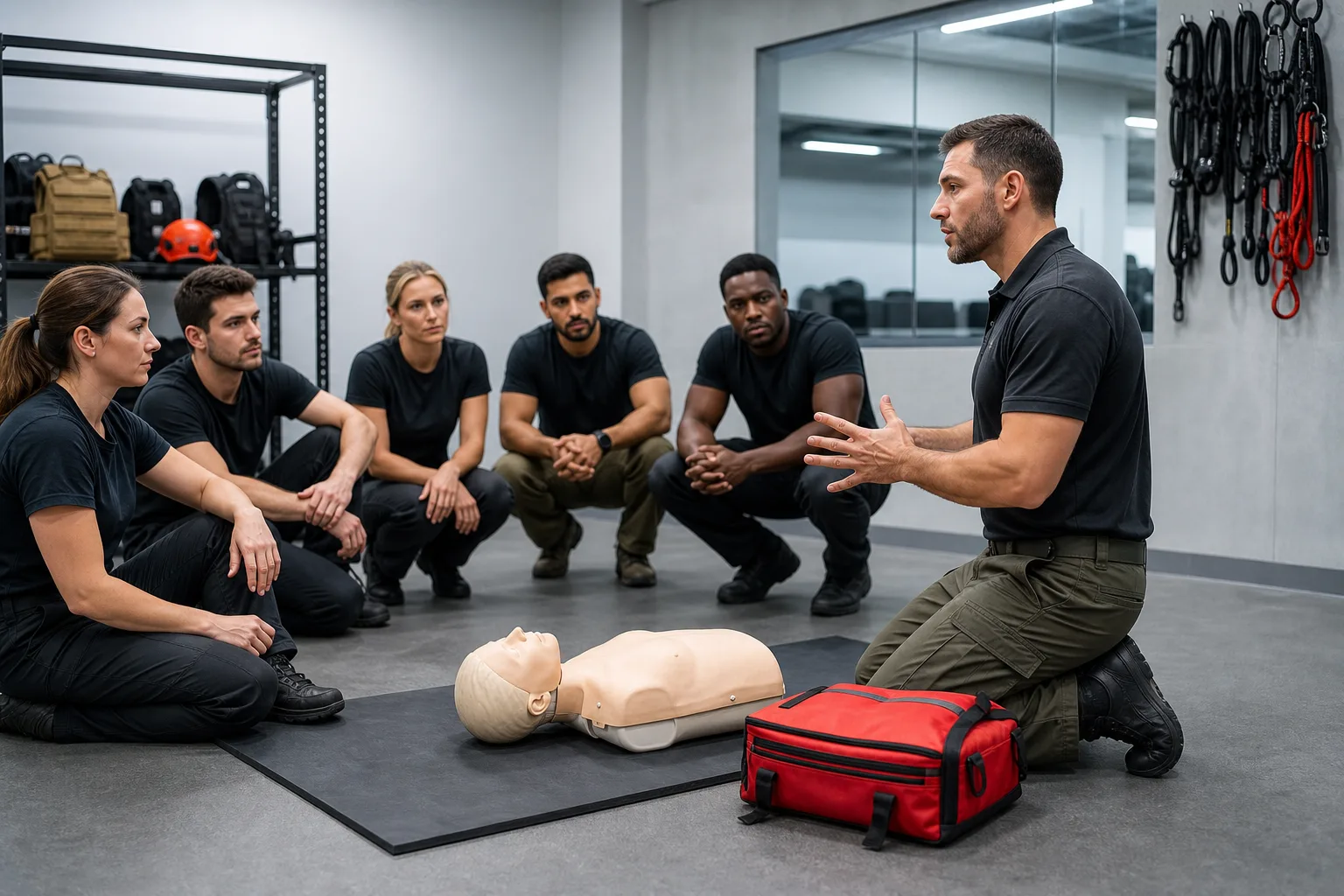
There is useful cross-sell built into that scope. Operators here often bundle first aid certification, rope access and outdoor leadership modules alongside the core programme, which lifts revenue per client without needing extra licenses in most cases.
Who Your Clients Will Be
Four segments buy this work, and they want quite different things from it.
- Corporate clients running structured team-building and resilience programmes
- Adventure tourism operators and hospitality groups building experiential packages
- Security contractors, private protection firms and defence-adjacent organisations
- The expatriate outdoor and adventure community, which is large and commercially active
Corporates are the strongest primary audience because they book in groups and pay on invoice. Security and defence-adjacent buyers want practical field skills rather than a team day out, and they will ask harder questions about your instructors.
Dubai's geography does a lot of the work for you. The Hatta mountain region, the Al Qudra desert and access points into the Hajar Mountains all give credible, realistic terrain without leaving the emirate, and they suit everything from a half-day corporate session to a multi-day immersive course. The Department of Economy and Tourism actively promotes adventure and experiential tourism, which keeps the buying environment receptive.
Mainland or Free Zone
| Factor | Mainland (DET) | Free Zone |
|---|---|---|
| Who you serve | Government entities, UAE corporates and public sector without agent restrictions | B2B training clients, digitally-led delivery |
| Where you can work | All seven emirates | Mainland delivery needs an NOC or branch registration |
| Premises | Ejari-registered tenancy contract | Flexi-desk accepted |
| Visas | Quota tied to office space size | Fixed visa packages |
| Setup cost | Higher | Lower, with simpler banking onboarding |
This decision is market access against setup cost. A mainland license lets you contract directly with government entities and corporates across all seven emirates, but it needs an Ejari tenancy and ties your visa count to floor space. A free zone license costs less to start, banks onboard more easily, and full foreign ownership is standard, but physical training delivered on the mainland needs an NOC or branch registration.
If most of your revenue will come from corporate contracts and on-site delivery across Dubai, mainland is the cleaner structure. If you are building a B2B training consultancy with selective on-ground work, a free zone license is cost-efficient and does the job. Worth knowing either way: following the 2021 UAE Companies Law amendments, 100% foreign ownership is permitted on the mainland for most professional activities in this category, with no mandatory local sponsor. Let your clients decide it, not the price.
[blockCTACostCalculator]
Step by Step Setup Guide
- Step 1, book your trade name: Check availability and secure the name through your chosen authority. Names must follow UAE naming conventions, so no offensive terms and no references to external governments or religions.
- Step 2, get initial approval: Submit activity code 8549.12, a business plan summary and passport copies for all shareholders. This confirms your activity is accepted before you spend anything further.
- Step 3, sort external approvals: Dubai Sports Council approval may apply to structured physical training programmes. Raise this at the initial approval stage rather than assuming it is automatic or unnecessary.
- Step 4, arrange your premises: A flexi-desk works for free zone registration. Mainland needs a tenancy contract registered through Ejari. Indoor training sessions call for suitable space with the right zoning.
- Step 5, confirm your visa allocation: Mainland quotas follow office size. Free zones offer fixed packages, so check the number included before you commit.
- Step 6, take your license and open a bank account: Most UAE banks want the trade license, Emirates ID and tenancy contract. Allow 2 to 4 weeks for onboarding.
- Step 7, register for VAT: Mandatory once projected or actual annual turnover passes AED 375,000. Voluntary registration below that line is available and often helps when dealing with VAT-registered corporate clients.
For non-citizen instructors, work permits go through MOHRE, and Emiratisation quotas apply at scale.
Compliance and What You Need in Place
Instructor credentials
There is currently no single UAE-mandated certification standard for survival training instructors. That sounds like freedom and is actually a trap. Internationally recognised credentials such as NOLS, Wilderness First Responder and BTEC outdoor education qualifications carry real weight with corporate procurement teams and cut your liability risk materially. Build credentialing into your operating standard from day one.
Insurance
Not negotiable. You need commercial general liability and professional indemnity cover for this activity type. UAE-based insurers and Lloyd's-backed brokers are both active here, so get quotes before you run any paid programme, not after.
Heat and risk assessment
Outdoor training in the UAE needs documented risk assessments, and the heat is the specific reason why. Summer sessions carry real physical danger and should be structured around it. This is the part that ends businesses when it goes wrong.
Land use
Dubai Municipality guidelines govern public land use. If you plan to operate in public desert or mountain areas, confirm permissions in advance rather than assuming access is open.
Data
If you run an online booking or client management platform, TDRA data residency and processing guidance is relevant, particularly if you handle personal data of UAE residents at any scale.
Market Opportunity
Dubai's appetite for experiential and specialist training keeps growing, and survival training sits at the junction of outdoor education, corporate wellness and defence-adjacent skills. That combination is unusual, and it means demand comes from several directions rather than one.
Corporate demand is the most reliable. Structured team-building, resilience and emergency preparedness programmes are recurring budget lines for large employers, not one-off spends. Adventure tourism operators and hospitality groups add a second stream, packaging your programmes into guest experiences they sell on.
The security and defence-adjacent segment is the smallest but the highest value, because those buyers need practical field skills taught properly and will pay for instructors with real credentials. Meanwhile Dubai's expatriate outdoor community keeps expanding, which supports open-enrolment courses alongside contracted work. Direct competition remains limited, which is the clearest signal in the whole picture.
Conclusion
Survival training is a low-competition, high-margin professional services category in Dubai. The license path under 8549.12 is short, and the regulatory environment is workable rather than obstructive.
Two decisions matter most. Pick your jurisdiction on how you will actually deliver, meaning mainland for reach and free zone for cost. Then confirm Dubai Sports Council approval early rather than late. Your operational credibility rests on instructor qualifications and proper insurance, not on paperwork.
[blockCTAContact]
Compliance
THIRD-PARTY APPROVAL
This activity requires pre-approval from the DCFAS (Dubai Corporation for Ambulance Services) before a business license can be issued by Meydan Free Zone.
ANTI-MONEY LAUNDERING COMPLIANCE
This business activity is exempt from AML compliance requirements.