

Table of Contents
Frequently Asked Questions
What does activity code 8530.99 permit for a university in Dubai
ISIC code 8530.99 covers post-secondary and higher education not elsewhere classified. Under this activity, permitted services include undergraduate and postgraduate programmes, research centres, executive education units, and online degree delivery.
The scope accommodates both traditional campus-based models and hybrid or fully digital programme structures. It is broad enough for most international university formats entering the UAE market.
Importantly, this activity code establishes your legal commercial and administrative entity in the UAE — it does not, by itself, grant degree-conferring authority. Accreditation from the relevant UAE bodies is a separate and additional requirement.
Is a Meydan Free Zone trade licence the same as university accreditation in the UAE
No — these are two entirely separate things, and conflating them is described as a common and costly mistake. The Meydan Free Zone trade licence establishes your legal commercial entity in the UAE and is the starting point for operations, not the finish line.
Actual degree-conferring authority requires approval from the Knowledge and Human Development Authority (KHDA) for institutions operating physically in Dubai, and from the Commission for Academic Accreditation (CAA) at the federal level for any institution awarding recognised degrees.
Many international institutions use the free zone entity as the corporate vehicle while pursuing KHDA and CAA regulatory approvals in parallel.
What is the role of KHDA in setting up a university in Dubai
The Knowledge and Human Development Authority (KHDA) governs all educational institutions operating physically in Dubai. Any institution delivering instruction to students in Dubai must register with KHDA and comply with its institutional standards.
KHDA oversight applies specifically to student-facing operations and physical campus activities. A free zone entity alone does not satisfy this requirement. Further details are available at khda.gov.ae.
What is the CAA and why does it matter for degree-granting institutions
The Commission for Academic Accreditation (CAA) operates under the UAE Ministry of Education and is the federal body responsible for accrediting institutions that award degrees in the UAE. No institution can confer a recognised degree in the UAE without CAA approval.
The CAA accreditation process is rigorous and phased, involving institutional reviews, site visits, and programme assessments. Full accreditation requirements are published at caa.ae.
Critically, CAA accreditation alone typically takes 18 to 36 months, which must be factored into your financial model well before signing a campus lease or committing to major infrastructure costs.
Can a foreign institution own 100% of a university entity in Dubai through Meydan Free Zone
Yes. Meydan Free Zone permits 100% foreign ownership with no requirement for a UAE national sponsor. This is described as a material advantage for international institutions entering the Dubai higher education market.
This ownership structure applies to the commercial and administrative entity established under the free zone licence. It makes Meydan Free Zone an attractive corporate vehicle for overseas universities looking to establish a legal presence in the UAE before pursuing broader regulatory approvals.
How long does CAA accreditation typically take and how should this affect planning
CAA accreditation typically takes 18 to 36 months from initiation, involving phased reviews, site visits, and programme-level assessments. This is the timeline for accreditation alone, separate from the time needed to establish the free zone entity or secure KHDA registration.
Institutions are strongly advised to build this timeline into their financial model before signing a campus lease or making significant capital commitments. Underestimating the accreditation period is a frequent and expensive planning error in the UAE higher education market.
What are the first steps to setting up a university licence via Meydan Free Zone
The process begins with defining your structure — determining whether you are incorporating the full university entity, a management company, or a branch of an overseas institution. Each option carries different documentation requirements and regulatory implications.
The next step is to reserve your trade name and select activity code 8530.99 through Meydan Free Zone's portal. The chosen name must not conflict with existing educational entities already registered in the UAE.
These initial steps establish the legal commercial foundation from which KHDA registration and CAA accreditation processes can then be pursued in parallel.
How large is the UAE higher education market and what is driving demand
The UAE higher education sector is one of the most commercially viable in the region. There are already 74+ licensed higher education institutions operating in the UAE as of 2023 (KHDA), and the education sector is projected to reach a value of USD 7.5 billion by 2025, according to the Alpen Capital Education Report.
Demand is driven by several structural factors: a young and growing population, government workforce nationalisation targets that increase demand for accredited qualifications, and significant inbound expatriate numbers who seek internationally recognised degrees.
Meydan Free Zone licence fees for this activity start from AED 12,500 per year, making the initial entry cost relatively accessible compared to the scale of the market opportunity.
How to Start a University in Dubai with Meydan Free Zone
Dubai's tertiary education market is growing fast. A free zone license lets you set up a university or higher education body with 100% foreign ownership and no local partner. This guide covers the activity code, the approval steps, and what you need in place before you open.
There are 2 parallel tracks to manage: your Meydan Free Zone trade license and the education approvals from the Ministry of Education and the Commission for Academic Accreditation. Neither track replaces the other. You need both before you teach a single student.
| Activity code | Tertiary Education (confirm exact code with Meydan Free Zone) |
|---|---|
| Ownership | 100% foreign ownership permitted |
| License issuer | Meydan Free Zone |
| Education regulator | Ministry of Education (MOET) |
| Program approval | Commission for Academic Accreditation (CAA) |
| Local partner needed | No |
What This License Covers
The tertiary education activity code covers universities, colleges, and higher education bodies. It lets you teach, enrol students, and award qualifications. It does not cover primary or secondary schooling. Those fall under a different code and a different set of rules.
Under this license, you can run degree programs, postgraduate courses, and professional diplomas. You can also offer short courses that lead to a recognised award. What you cannot do is start teaching before MOET and the CAA have signed off on your programs.
- Universities and degree-awarding bodies
- Colleges offering diplomas and higher certificates
- Postgraduate and research institutions
- Professional higher education providers
Check the full Meydan Free Zone business activities list to confirm the exact code for your type of institution before you apply.
Who Regulates Tertiary Education in Dubai
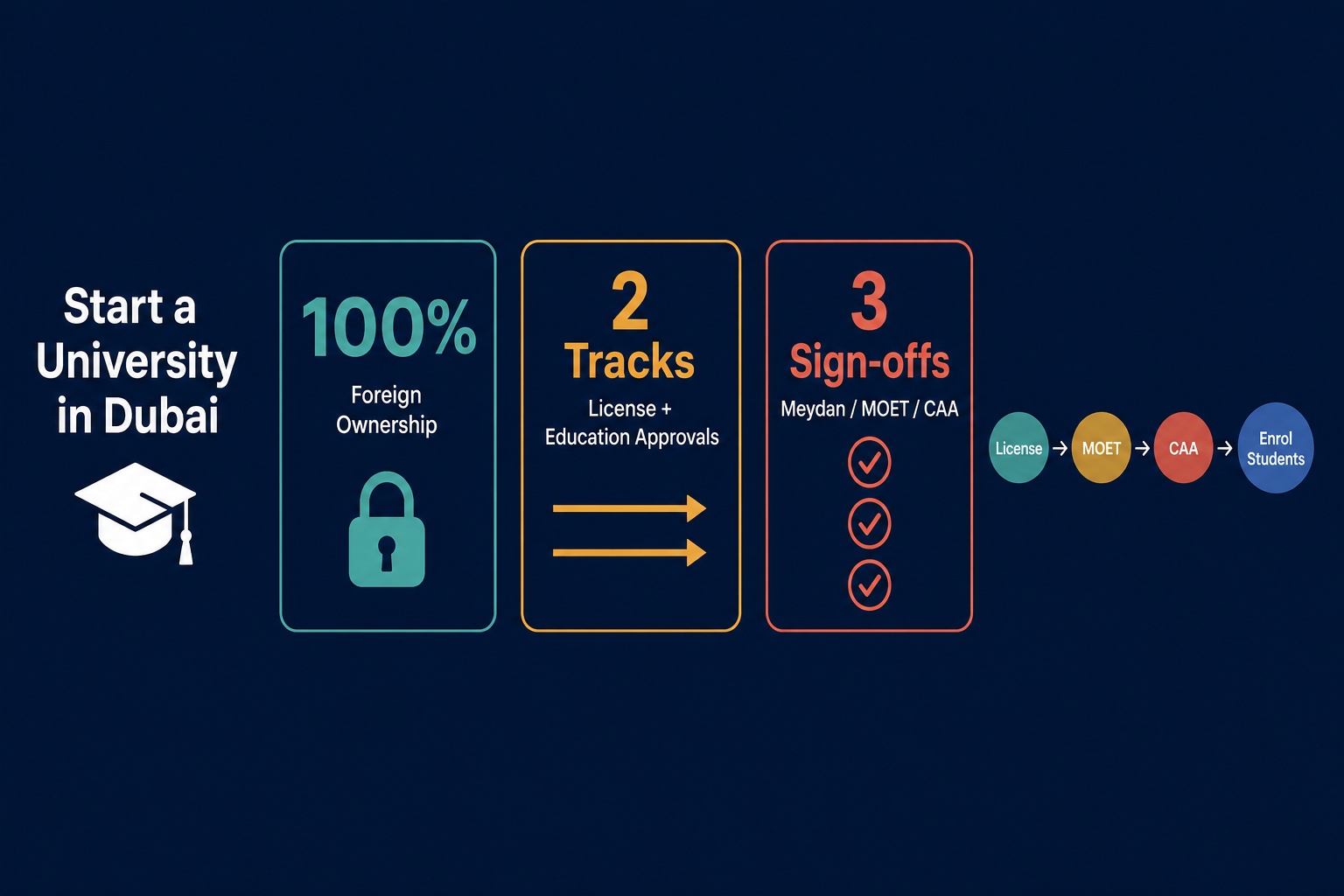
The Ministry of Education sets the rules for all higher education bodies in the UAE. No institution can open without MOET approval. That approval covers your campus, your governance structure, and your academic policies.
The Commission for Academic Accreditation is a separate body. It reviews and approves individual programs. MOET approves the institution. The CAA approves what you teach. You need both.
Meydan Free Zone issues the trade license. That is the commercial layer. It does not grant you the right to teach. The ministry and the CAA do that. Think of the license as the business shell. The education approvals are what make it operational.
- MOET approves the institution itself
- CAA approves each academic program
- Meydan Free Zone issues the trade license
- All 3 approvals must be in place before you enrol students
The CAA also runs renewal cycles. Approval is not permanent. You must show ongoing compliance with their standards. Annual reporting to MOET is also required. Build both into your operations calendar from day one.
The Ministry of Education publishes the current standards for higher education institutions. Read them before you draft your institution proposal.
Mainland vs Free Zone: Which to Choose
Most private universities in Dubai operate under a free zone or dedicated education zone structure. A free zone setup gives you 100% ownership and no need for a local partner. That suits most international founders.
A mainland license from DET lets you work directly with UAE government bodies and local schools. If your funding model depends on government contracts or public school partnerships, mainland is worth considering. For most private universities focused on international students, it is not needed.
| Factor | Mainland (DET) | Free Zone (Meydan Free Zone) |
|---|---|---|
| Ownership | 100% foreign ownership now permitted | 100% foreign ownership |
| Local partner | Not required | Not required |
| Government contracts | Direct access | Requires a local agent or branch |
| Student base | Local and international | Mainly international |
| Setup cost | Higher | Lower starting point |
This is the biggest choice you will make when setting up. Let your student base and funding model decide it, not the price alone.
Free Business Setup Cost Calculator
Calculate NowHow to Set Up: Step by Step
The setup process runs in 2 tracks at once. You handle the commercial setup through Meydan Free Zone. You handle the education approvals through MOET and the CAA. Start both early. The education track takes longer.
- Step 1, book your trade name: Use the Meydan Free Zone portal to check your company name for free and reserve it.
- Step 2, apply for your education license: Select the tertiary education activity code and submit your application through Meydan Free Zone.
- Step 3, draft your institution proposal: Prepare the full proposal that MOET needs, covering governance, facilities, and academic plans.
- Step 4, submit to MOET: Apply for initial approval from the Ministry of Education before any other education step.
- Step 5, apply to the CAA: Submit each program for review and approval by the Commission for Academic Accreditation.
- Step 6, secure your campus: Find premises that meet MOET space and facility rules. Get written confirmation before you sign a lease.
- Step 7, hire academic staff: Recruit qualified staff and gather proof of their credentials. MOET will check these.
- Step 8, show proof of funds: Demonstrate you have enough money to run the institution for at least 1 full year.
- Step 9, get final sign-off: Once MOET and the CAA confirm approval, you can enrol students and begin teaching.
You can start the Meydan Free Zone application and the MOET proposal at the same time. Do not wait for one before starting the other. That is where founders lose months.
If you want to manage the setup from outside the UAE, remote business setup through Meydan Free Zone is available for the commercial license steps.
What You Must Have in Place
The education approvals are strict. MOET and the CAA check your institution against detailed standards. Meet them before you apply, not after.
These are the main requirements:
- A physical campus or approved facility that meets MOET space standards
- Qualified academic staff with verified credentials for each program
- Student welfare and support systems as required by the CAA
- Proof of funds to operate for at least 1 full year
- A governance structure with clear policies and procedures
- Annual reporting systems for ongoing MOET compliance
- A CAA renewal plan built into your academic calendar
Each of these is a real checkpoint, not a formality. MOET will inspect your campus. The CAA will review your curriculum in detail. Gaps at this stage delay your opening date.
For ongoing financial reporting and compliance, accounting services through mAccounting can help you keep the right records from the start.
Staff credentials are a common sticking point. Verify that your academic hires meet CAA requirements before you make offers. Ask for their documents early. Delays in credential checks can push back your whole timeline.
Premises are the other slow step. Finding a space is one thing. Getting written confirmation that it meets MOET standards takes time. Start the site selection process before you finalise your MOET application.
The Market Opportunity
Dubai's higher education sector is expanding. The UAE government has made growing the number of world-class institutions a stated policy goal. Demand from international students is real and rising.
The city's position as a global business hub creates natural demand for business, finance, technology, and professional programs. Employers here recruit from local campuses. That gives well-run institutions a direct pipeline to the job market.
Private higher education in the UAE is a long-term play. The setup costs are real and the approval process is thorough. But the barriers to entry protect those who get through them. Once you are accredited, you are in a small group.
Conclusion
Setting up a university in Dubai needs 2 parallel tracks. You need a Meydan Free Zone trade license and full MOET and CAA approval before you admit any students. Neither track is quick. Both are manageable if you plan them together from the start.
The free zone route gives you 100% ownership and a clear commercial structure. The education approvals give you the right to operate. Get both right and you have a real institution in one of the world's fastest-growing education markets.
Ready to Launch Your Business in Dubai?
Let's ConnectCompliance
ANTI-MONEY LAUNDERING COMPLIANCE
ANTI-MONEY LAUNDERING COMPLIANCE
This business activity is exempt from AML compliance requirements.