Table of Contents
Frequently Asked Questions
What does activity code 6619.82 (Virtual Assets Advisory Services) actually permit a business to do
Activity code 6619.82 covers advisory services related to virtual assets — including crypto strategy consulting, tokenisation advisory, virtual asset portfolio structuring, and compliance guidance for clients navigating the virtual assets landscape.
Critically, it does not permit your firm to hold, transfer, trade, or custody virtual assets on behalf of clients. Those activities fall under a separate Virtual Asset Service Provider (VASP) licence governed by VARA and carry a higher regulatory threshold.
This distinction matters commercially and regulatorily. Advisory sits at a lower compliance burden than exchange or brokerage activity, but it does not sit outside regulation entirely — AML obligations and UBO registration still apply from the point of licence issuance.
Do I need a VASP licence from VARA to run a virtual assets advisory business in Dubai
No — a VASP licence is not required for pure advisory activity. VARA's VASP licensing framework applies to businesses conducting exchange, brokerage, custody, or transfer of virtual assets on behalf of clients.
A firm operating under activity code 6619.82 is advising on virtual assets rather than handling them, which places it in a different regulatory category. However, this does not mean the business is unregulated — AML and CFT obligations apply regardless, and any advisory work with financial structuring implications should be reviewed against Central Bank of the UAE guidance.
If your business model evolves to include execution, custody, or transfer services, you would need to obtain the appropriate VARA licence before conducting those activities.
What is VARA and how does it differ from the SCA
VARA (Virtual Assets Regulatory Authority) was established in 2022 and is the dedicated regulator for all virtual asset activity within the Emirate of Dubai, excluding the DIFC. It was one of the first purpose-built virtual assets regulators globally.
The Securities and Commodities Authority (SCA) operates at the federal level and governs virtual assets in other emirates and certain federal contexts. If your advisory work extends to clients or counterparties outside Dubai, or involves federal financial instruments, SCA guidance becomes relevant alongside VARA's framework.
The DIFC has its own separate framework governed by the DFSA, so firms incorporated there operate under a distinct regime. Most Meydan Free Zone advisory firms will primarily fall under Dubai's VARA framework, but cross-border engagements require careful legal scoping.
Who are the typical clients for a virtual assets advisory business in Dubai
The client profile for virtual assets advisory under activity code 6619.82 is institutional rather than retail. Target clients include family offices, corporate treasuries, investment funds, regional banks, sovereign wealth structures, and businesses exploring tokenisation or digital asset integration.
The UAE's position as a genuine operational hub — not merely an aspirational one — means these clients are actively present and seeking qualified advisors, rather than being a theoretical addressable market.
Because the model is institutional-facing, business development strategy should reflect that: relationship-driven outreach, thought leadership, and engagement with the Web3 and finance communities already operating in the emirate are more relevant than consumer-facing marketing.
What AML and compliance obligations apply to a virtual assets advisory firm in Dubai
AML (Anti-Money Laundering) and CFT (Counter-Financing of Terrorism) obligations apply to virtual assets advisory firms regardless of whether a VASP licence is held. These are non-negotiable from the point of licence issuance.
Firms must complete UBO (Ultimate Beneficial Owner) registration and maintain an internal AML policy. The Central Bank of the UAE has issued guidance on financial advisory crossover, and any firm whose advisory work touches financial structuring should review those standards carefully.
It is advisable to engage a compliance consultant or legal advisor early in the setup process to ensure your internal policies meet the required standards before you begin client-facing activity.
Why is Dubai considered a credible jurisdiction for virtual assets advisory rather than a grey area
Dubai has taken deliberate steps to make virtual assets a regulated, commercially recognised activity rather than leaving it in legal ambiguity. The establishment of VARA in 2022 gave the emirate one of the world's first dedicated virtual assets regulators, creating clear licensing pathways and enforcement frameworks.
Activity code 6619.82 is a formally recognised commercial activity in UAE free zones, meaning advisory firms have a credible legal footing from day one rather than operating in uncertainty. The UAE also ranks among the top 10 countries globally for cryptocurrency adoption, according to Statista, reflecting genuine market depth.
Institutional capital, sovereign wealth structures, and major Web3 ventures are operationally present in the emirate — not just registered there — which reinforces Dubai's status as a functioning hub rather than a nominal one.
What is the role of Meydan Free Zone for virtual assets advisory businesses
Meydan Free Zone is described as one of the most accessible entry points for advisory firms looking to establish a virtual assets business in Dubai. It is a Dubai-based free zone, meaning entities incorporated there fall under VARA's regulatory jurisdiction for virtual asset activity.
Dubai hosts hundreds of registered virtual asset businesses, and Meydan Free Zone has positioned itself as a practical licensing route for advisory-focused firms — particularly those that do not require the more complex VASP licensing framework associated with exchange or custody operations.
For firms whose client engagements are primarily Dubai-based and institutional in nature, incorporating through Meydan Free Zone provides a straightforward path to holding activity code 6619.82 within a recognised regulatory environment.
What is the market growth outlook for virtual assets in the UAE
The UAE's virtual assets market is projected to grow significantly through 2025–2028, driven by two primary forces: increased institutional entry into digital asset markets and the expansion of tokenisation initiatives across real estate, funds, and other asset classes.
The UAE already ranks among the top 10 countries globally for cryptocurrency adoption (Statista), and the regulatory infrastructure established since 2022 has accelerated institutional confidence. Regional banks, investment funds, and corporate treasuries are actively integrating virtual asset strategies rather than treating them as speculative outliers.
For advisory firms, this trajectory represents a growing demand for qualified guidance on strategy, compliance, and structuring — particularly as tokenisation moves from pilot projects to mainstream financial infrastructure across the Gulf region.
How to Start a Virtual Assets Advisory Business in Dubai
Dubai is one of the few places in the world where you can legally advise clients on virtual assets, crypto portfolios, and digital token structures under a clear regulatory framework. The rules exist, the regulator is active, and the market is real.
This guide covers the license you need, the regulator that oversees you, and the practical steps to get your virtual assets advisory business running in Dubai.
Key Stats at a Glance
| Regulator | Virtual Assets Regulatory Authority (VARA) for Dubai; Securities and Commodities Authority (SCA) at federal level |
|---|---|
| Jurisdiction options | Mainland (DET) or free zone (e.g. Meydan Free Zone) |
| Foreign ownership | 100% permitted in free zones |
| Key compliance requirement | AML/CFT framework and designated compliance officer before you start |
| VAT threshold | Registration needed once revenue thresholds are met – check with the Federal Tax Authority (FTA) |
What a Virtual Assets Advisory License Covers
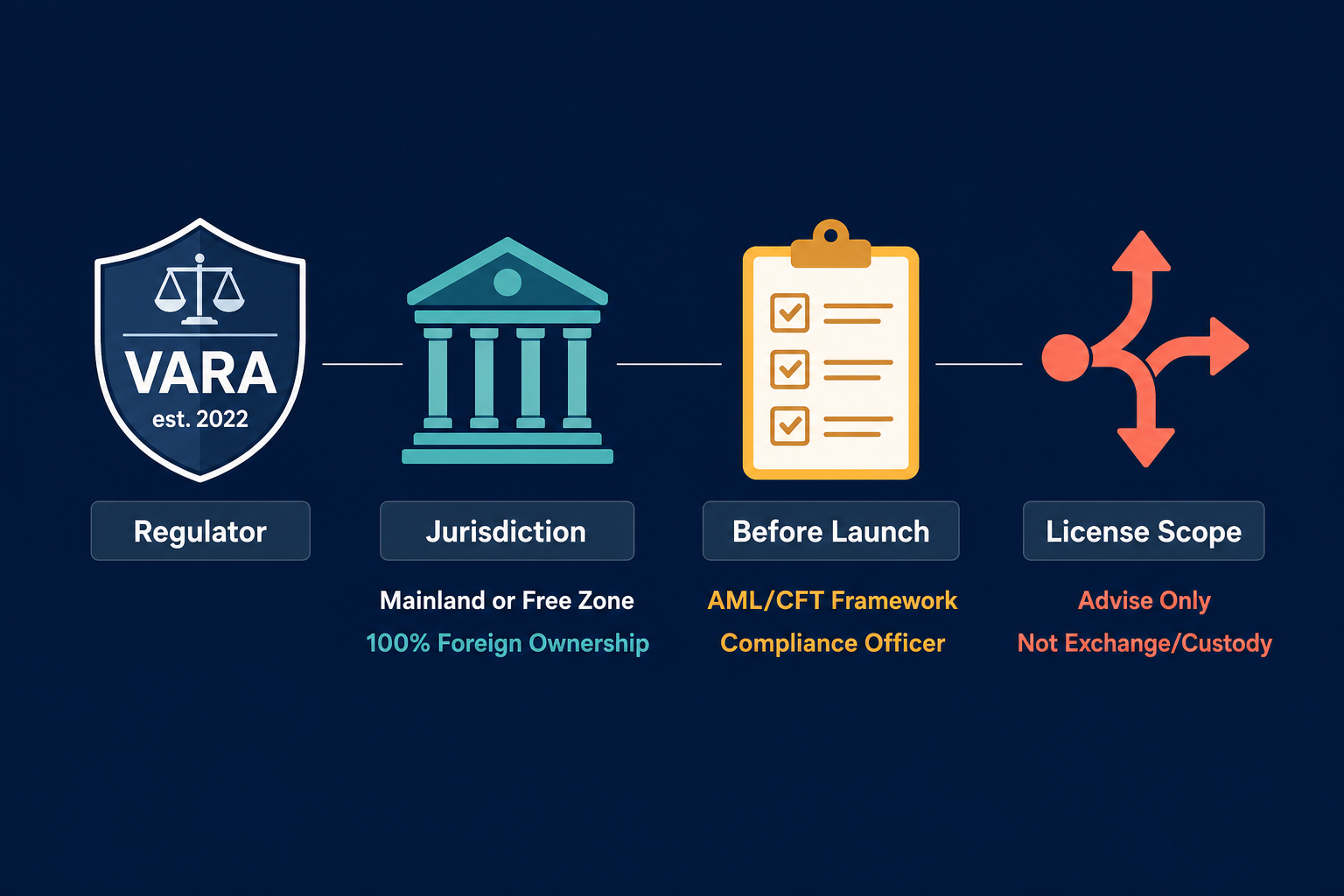
A virtual assets advisory license lets you advise clients on buying, selling, holding, or structuring virtual assets. That includes crypto portfolios, digital tokens, and asset tokenisation strategies. You are paid for your advice and analysis, not for executing trades on a client's behalf.
This is an important distinction. Advisory is not the same as exchange or custody. If you want to operate an exchange, hold client assets, or manage a virtual asset fund, those are separate license categories with their own requirements. Make sure you are applying for the right one before you start.
In Dubai, the Virtual Assets Regulatory Authority (VARA) sets the rules for all regulated virtual asset activity. VARA was established in 2022 and sits under the Dubai World Trade Centre Authority. It is the primary regulator you will deal with, whatever your chosen jurisdiction inside Dubai.
At the federal level, the Securities and Commodities Authority (SCA) governs virtual asset activity across the other six emirates. If your clients are based outside Dubai or you plan to operate across the UAE, you need to understand where SCA's remit begins and VARA's ends. The two frameworks are distinct, and getting this wrong creates real problems.
You can browse the full Business Activities List at Meydan Free Zone to confirm which activity codes apply to virtual assets advisory before you proceed.
Who Your Clients Will Be
The market for virtual assets advisory in Dubai is more established than most people expect. There are several distinct client groups worth understanding before you set up.
High-net-worth individuals and family offices This is the largest immediate market. Many HNWIs in the region are actively exploring digital asset allocation as part of broader portfolio diversification. They want structured advice, not a sales pitch. They also want someone who understands both the asset class and the local regulatory environment.
Corporates and startups Companies tokenising real-world assets, raising capital through digital instruments, or building blockchain-based products need advisory support. This can range from one-off structuring work to ongoing retainer relationships.
Fund managers Traditional fund managers entering the virtual asset space need compliance guidance. They understand financial regulation but often lack specific knowledge of VARA requirements, AML/CFT obligations for digital assets, and how to structure client disclosures correctly.
International clients Dubai's regulatory clarity is a draw in itself. Clients based in jurisdictions with less developed virtual asset frameworks often prefer to work with advisers operating under a recognised regime. This gives your Dubai-based practice a real advantage over competitors in less regulated markets.
Nobody in this space signs up after a cold call. Clients run due diligence on their advisers, check your regulatory status, and want to see a proper compliance framework before they share any portfolio detail. Build your credibility before you chase revenue.
Mainland vs Free Zone: Where to Set Up
This is one of the biggest choices you will make when setting up. Here is how the two options compare.
| Factor | Mainland (DET) | Free Zone (Meydan Free Zone) |
|---|---|---|
| Client access | Open UAE market, including government-linked entities | Mainly international clients; local work via a local agent or branch |
| Foreign ownership | 100% permitted in most activities | 100% permitted |
| Office requirement | Physical office required | Flexi-desk options available |
| Setup speed | Longer, more steps | Fast – can be done remotely |
| Cost | Generally higher | Lower entry cost |
| VARA license required | Yes | Yes |
A mainland license from DET gives you direct access to UAE-based institutional clients and government-linked entities. If your target clients are local corporates or public sector bodies, mainland is the better fit.
Meydan Free Zone suits founders who are building an international advisory practice, want to keep overhead low, and do not need to walk into a government ministry to pitch work. You get 100% foreign ownership, flexible desk arrangements, and a fast setup process. You can even complete the whole thing as a remote business setup if you are not yet based in Dubai.
One point that applies to both: VARA licensing is not optional. Whatever jurisdiction you choose inside Dubai, if you are conducting regulated virtual asset activity, you need VARA authorisation. Your free zone or mainland license is the commercial vehicle. Your VARA license is what lets you operate.
Free Business Setup Cost Calculator
Calculate NowStep-by-Step Setup Guide
- Step 1, book your trade name: Use the DET e-Services portal for a mainland company, or the Meydan Free Zone portal for a free zone one. Pick a name that does not imply banking, investment management, or fund activity unless you hold the relevant authorisations. Use the Company Name Check tool to confirm availability before you go further.
- Step 2, pick your activity code: Confirm the code covers virtual assets advisory specifically. Do not use a generic financial consultancy code and assume it covers this activity. VARA and your free zone authority both need to see the right code on your license.
- Step 3, apply for your free zone or mainland license: For Meydan Free Zone, this is a straightforward online process. You submit your documents, pay the fee, and get your license issued. A Dubai Trade License from AED 12,500 is available for qualifying activities.
- Step 4, apply for your VARA license: VARA operates a two-stage process. You first get an initial approval (sometimes called a Minimum Viable Product authorisation), which lets you operate in a limited capacity while you build out your compliance framework. Full market product authorisation follows once VARA is satisfied with your systems, policies, and personnel.
- Step 5, open a corporate bank account: This is harder in virtual assets than in most sectors. Banks apply enhanced due diligence to any business touching digital assets. Prepare a detailed business plan, a clear explanation of your revenue model, and full documentation of your VARA status. Business banking support through mCore can help you navigate this process and approach the right institutions.
- Step 6, put your AML/CFT framework in place before you start: VARA will not grant full authorisation without it. Your policies need to be written, your compliance officer needs to be appointed, and your client onboarding procedures need to be documented before you take your first client.
Compliance and What You Need in Place
Virtual assets advisory is one of the more compliance-heavy activities you can set up in Dubai. That is not a reason to avoid it. It is a reason to get the foundations right from day one.
Compliance officer VARA needs you to appoint a named compliance officer. This person does not need to be a UAE national, but they do need relevant experience in financial crime compliance, AML, or a related field. In a small advisory firm, this is often a founder. In a larger operation, it is a dedicated hire.
AML/CFT policies You need written policies covering customer due diligence, enhanced due diligence for higher-risk clients, transaction monitoring, and suspicious transaction reporting. These must reflect the specific risks of virtual asset activity, not just copy a generic financial services template.
KYC and client onboarding Every client needs to go through a proper onboarding process. That means identity verification, source of funds checks, and a risk classification. For HNWIs and family offices, this can be a detailed process. Build it into your client engagement from the start, not as an afterthought.
FTA registration Once your revenue crosses the relevant threshold, you need to register with the Federal Tax Authority. VAT applies to advisory fees in most cases. Get this confirmed early so you are not caught out later. Meydan Free Zone's VAT registration support can walk you through the process.
Ongoing VARA reporting VARA expects annual audits, regular compliance reports, and prompt reporting of any suspicious transactions. These are not one-off tasks. Build them into your operating calendar and budget for the cost of an external auditor who understands the virtual assets sector.
Corporate tax The UAE introduced corporate tax in 2023. Advisory businesses are subject to it once they pass the relevant threshold. Get your books in order from the start. Meydan Free Zone's corporate tax services cover registration, filing, and ongoing compliance for free zone businesses.
Market Opportunity
Dubai has made a deliberate effort to become the leading regulated hub for virtual assets in the region. VARA's creation, the licensing framework, and the number of international firms that have already set up here are all evidence that this is a functioning market, not a speculative one.
The client base is growing. Family offices across the Gulf are increasing their digital asset allocations. Regional corporates are exploring tokenisation. International firms are choosing Dubai as their base for Middle East and Africa operations because the regulatory environment is clear and the infrastructure is in place.
Advisory is a good entry point into this market. The capital requirements are lower than for exchange or custody operations. The client relationships tend to be long-term. And the barriers to entry, mainly the compliance overhead and the VARA licensing process, work in your favour once you are through them. Competitors who cut corners on compliance do not last long under VARA's oversight.
The Mordor Intelligence research on digital asset markets consistently shows the Middle East and Africa region growing faster than the global average. Dubai sits at the centre of that growth.
Conclusion
Dubai's virtual assets advisory sector is regulated, growing, and open to foreign founders who set up correctly and take compliance seriously from day one. The framework is clear. The clients are here. The work is real.
The two things that trip people up are choosing the wrong license category and underestimating the compliance build. Get both right at the start and you have a strong foundation.
Speak to the Meydan Free Zone team to confirm your activity code, understand your VARA obligations, and get your business running without delays.
Ready to Launch Your Business in Dubai?
Let's Connect