
Table of Contents
Frequently Asked Questions
What does activity code 4773.35 cover in Dubai
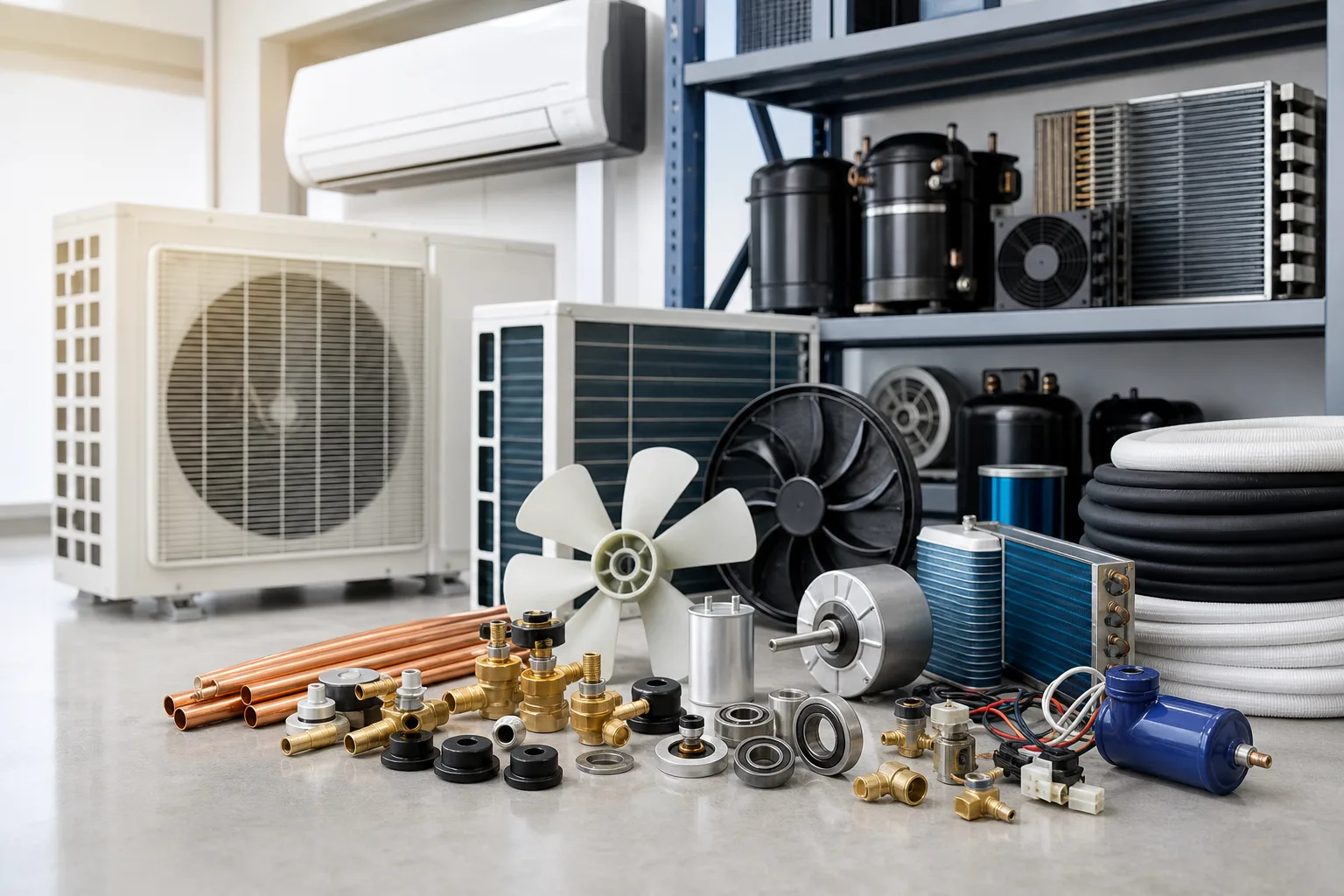
Activity code 4773.35 covers the wholesale and retail trading of components used in air-conditioning and refrigeration systems. This includes AC spare parts such as compressors, fan motors, printed circuit boards, capacitors, refrigerant gases, and expansion valves, as well as refrigeration components like evaporator coils, condensing units, thermostats, and door seals.
It is strictly a trading licence, not a contracting or installation licence. This means the licence holder is authorised to supply parts commercially but not to fit or install them on-site. Ancillary items such as copper pipe fittings, insulation materials, pressure gauges, and manifold sets also fall within scope.
Do you need a technical qualification or engineering licence to trade AC spare parts in Dubai
No. Spare parts trading under activity code 4773.35 does not require professional certification or a technical licence. You do not need to be a licensed engineer or HVAC technician to legally trade components under this activity.
This keeps the compliance burden relatively straightforward compared to contracting or installation activities, which carry additional regulatory requirements. The licence is commercially focused, covering the buying and selling of parts rather than their technical application.
Who are the main customers for an AC refrigeration spare parts trading business in Dubai
The primary customers are trade buyers with predictable procurement cycles, not one-off retail consumers. Key customer segments include HVAC contractors, facilities management (FM) companies, hospitality engineering teams, cold-chain logistics operators, and residential maintenance firms.
These buyers typically purchase on account and return regularly as component wear is continuous. Dubai's climate means AC systems run for ten to eleven months of the year at high load, which accelerates wear and sustains aftermarket demand. This makes the customer base structurally recurring rather than transactional.
What is the typical business model for an AC spare parts trader in Dubai
The most common model is import-stock-sell: source components from manufacturers in China, South Korea, Europe, or the United States; hold inventory in a UAE warehouse or bonded facility; and supply on account to trade customers. This model suits businesses targeting HVAC contractors and FM companies with regular procurement needs.
Drop-shipping and regional distribution agreements are also viable once supplier relationships are established. Margins on spare parts are generally stronger than on full units, with branded compressors and control boards carrying better margins than commodity fittings. Proprietary components for premium brands can command a further premium, making inventory selection a key strategic decision.
Why is Dubai considered a strong location for AC spare parts trading
Dubai's climate creates permanent, non-discretionary demand for cooling. With temperatures exceeding 45°C for months at a time, AC systems operate at high load for ten to eleven months of the year, driving continuous component wear and aftermarket demand. The city hosts over 140 operational hotels and thousands of commercial buildings, all requiring active maintenance supply chains.
Beyond domestic demand, Dubai functions as a regional re-export hub. Through DP World's port and logistics infrastructure, traders in Dubai free zones can distribute components to the GCC, East Africa, and South Asia with competitive transit times and favourable duty structures. DP World handles over 19 million TEUs annually, underpinning this distribution advantage.
What is the VAT registration threshold relevant to spare parts traders in the UAE
The UAE VAT registration threshold is AED 375,000 in taxable turnover. Any trading entity — including AC and refrigeration spare parts traders — that meets or exceeds this threshold is required to register for VAT with the Federal Tax Authority.
For a spare parts business supplying trade customers on account, turnover can accumulate relatively quickly once supplier and customer relationships are established. It is advisable to monitor taxable turnover from the outset and engage a UAE-registered accountant to manage VAT compliance obligations.
What is the growth outlook for the UAE HVAC market
The UAE HVAC market is on a sustained growth trajectory, projected to expand at a compound annual rate through 2028. Key drivers include large-scale real estate development, hospitality infrastructure investment, and industrial cold-chain expansion, according to data from IMARC Group.
Dubai accounts for a significant share of this demand, with district cooling networks, hotel groups, and commercial towers all requiring continuous maintenance supply chains. Because cooling is infrastructure rather than a discretionary purchase in the UAE, the spare parts segment is considered structurally resilient even during broader economic slowdowns.
What is Meydan Free Zone and why is it relevant for setting up this type of trading business
Meydan Free Zone is a Dubai-based free zone through which traders can obtain a compliant commercial licence, including for activity code 4773.35 covering AC and refrigeration spare parts trading. The article identifies it as an efficient route to setting up a licensed trading entity in Dubai.
Free zone licences generally offer advantages such as 100% foreign ownership, streamlined incorporation processes, and access to Dubai's re-export infrastructure. Traders operating from a free zone can supply to international and regional markets, with the ability to sell into the UAE mainland typically requiring a separate arrangement or a distributor relationship.
How to Start an AC Refrigeration Spare Parts Trading Business in Dubai
In Dubai, cooling is not a luxury. It is infrastructure. Temperatures pass 45°C for months at a time, so air-conditioning runs at full load ten or eleven months of the year.
That wears parts out. Constantly. Which makes spare parts one of the steadiest trading categories in the UAE, because people replace components far more often than whole units.
This guide covers activity code 4773.35, Air-Condition, Refrigeration Spare Parts and Components Trading. You will learn what you can sell, who buys it, what the rules ask of you, and how to set up with Meydan Free Zone.
Key Stats at a Glance
| What to know | The detail |
|---|---|
| Market growth | The UAE HVAC market is set to keep growing through 2028, driven by property, hospitality and cold-chain investment. Figures from IMARC Group. |
| Your customer base | Dubai has over 140 hotels and thousands of commercial buildings, all running maintenance contracts. |
| Re-export reach | DP World handles over 19 million TEUs a year, which is what makes Dubai work as a re-export gateway. |
| VAT threshold | Register for VAT once taxable turnover passes AED 375,000. Source: Federal Tax Authority. |
What You Can Sell

Activity code 4773.35 covers wholesale and retail trading of parts used in air-conditioning and refrigeration systems. It is a trading license, not an installation one. You supply the parts. You do not fit them.
AC spare parts. Compressors, fan motors, printed circuit boards, capacitors, refrigerant gases, expansion valves.
Refrigeration components. Evaporator coils, condensing units, thermostats, door seals, temperature controllers.
Everything around them. Copper pipe fittings, insulation materials, pressure gauges, manifold sets and installation tools.
One useful point: you do not need to be a licensed engineer or an HVAC technician to trade these parts. No technical certification is required, which keeps your compliance load light compared with installation work.
Who Buys From You
These are trade buyers on regular ordering cycles, not walk-in customers.
HVAC contractors. They install and service systems and need parts constantly.
Facilities management firms. They maintain whole buildings under contract.
Hotel engineering teams. Large properties with plant running year round.
Cold-chain logistics operators. Refrigerated storage and transport that cannot afford failure.
Residential maintenance firms. Smaller jobs, high volume.
Most of these buy on account and come back regularly, because parts wear out on a predictable cycle. That makes your revenue recurring rather than one off.
How the Business Runs
The standard model. Import, stock, sell. You source from manufacturers in China, South Korea, Europe or the United States, hold stock in a UAE warehouse or bonded facility, and supply trade customers on account.
Other routes. Drop-shipping works, and so do regional distribution agreements, once you have supplier relationships in place.
Where the margin is. Parts pay better than full units. Branded compressors and control boards beat commodity fittings, and proprietary parts for premium brands beat both. What you choose to stock is the decision that shapes your margins.
Beyond Dubai. Through DP World's port and logistics network, a Dubai free zone trader can re-export to the GCC, East Africa and South Asia on good transit times and duty terms.
[blockCTACostCalculator]
Two Things That Need Attention
Most of this activity is simple to comply with. Two areas are not.
Refrigerant gases. The UAE has signed the Montreal Protocol, which governs trade in ozone-depleting substances. Some refrigerants, including older HCFCs, face import controls and ESMA standards requirements. Check which category a refrigerant falls into before you import it. The Ministry of Economy carries current guidance on controlled substances and import restrictions.
Customs paperwork. Getting your HS codes right decides your duty and your clearance. Free zone imports go through Ports, Customs and Free Zone Corporation channels. Get a code wrong and you get delays and possible penalties.
VAT. Register with the Federal Tax Authority once turnover reaches AED 375,000. Most trading businesses pass that quickly, so register early and keep clean invoices from day one.
How to Set Up with Meydan Free Zone, Step by Step
- Step 1, pick your activity: Confirm code 4773.35 from the Meydan Free Zone activity list.
- Step 2, choose your package: A flexi-desk is enough if you are not holding stock in the free zone. If you need warehouse space or several visas, go for a physical office package.
- Step 3, get your papers ready: Passport copy, the application form, and a short overview of your business. A full business plan is not usually needed for standard trading.
- Step 4, submit and pay: Your license usually comes through within a few working days once documents are checked and fees are settled.
- Step 5, sort visas: Investor and staff visas are processed after your license is issued. How many you get depends on your package, and most standard ones include one to three.
- Step 6, open your bank account: UAE banks accept a Meydan Free Zone trading license. Bring your license certificate, shareholder documents, and a clear description of what you trade. Some banks also want an opening deposit or a short business plan.
On storage. If you hold physical stock, you need either free zone warehouse space or a third-party arrangement with a bonded warehouse in Dubai's logistics corridors. Meydan Free Zone's location gives you practical access to both.
On doing it from abroad. Founders outside the UAE can complete setup remotely. Documents go in digitally, and the Emirates ID and visa steps can be handled on a short visit once your license is issued. mResidency handles that side, mAccounting keeps your books and VAT filings straight, and mCore, mAssist and mPlus cover the wider support.
Conclusion
Spare parts trading is high demand and low complexity to license in Dubai. The regulatory path is simple, the customer base is large and stable, and a free zone structure lets you trade regionally from day one.
Refrigerant compliance and VAT registration are the two things to sort early. Both are workable with the right setup.
Use the cost calculator to estimate your costs, then talk to the Meydan Free Zone team to confirm your activity scope and get your license moving.
[blockCTAContact]
References
- IMARC Group
- DP World
- Federal Tax Authority
- Ministry of Economy
- Ports, Customs and Free Zone Corporation (PCFC)