
Table of Contents
Frequently Asked Questions
What business activity code covers an electric scooter rental business in Dubai
The correct activity code for a fleet-based electric scooter rental business in Dubai is 7730.93 — rental of transport equipment without operators, available through Meydan Free Zone.
This classification covers the standard model where you own or lease the scooters and customers hire them independently, typically through a mobile app or fixed docking station. There is no requirement to provide a driver or operator with each unit.
Do I need RTA approval to operate an electric scooter rental business in Dubai
Yes. The Roads and Transport Authority (RTA) governs e-scooter use on public roads and designated zones in Dubai. You must obtain RTA approval for your fleet before deploying a single scooter commercially.
This approval process includes vehicle registration for each scooter, compliance with technical safety standards, and confirmation that your intended operating zones are permitted under the RTA's micro-mobility framework. The RTA publishes its designated riding areas and regulations, which you should review before finalising your fleet size or deployment locations.
Importantly, RTA operational permits and your trade licence are two separate processes — both must be in place before commercial operations begin.
What are the main revenue streams for an electric scooter rental business in Dubai
There are three primary revenue models suited to this type of business. Per-minute pricing is well suited to tourists and casual users in high-footfall areas. Subscription passes cater to regular commuters who use scooters for last-mile metro connectivity.
Corporate contracts with hotels, residential developers, or logistics operators provide predictable recurring income and support larger fleet deployments. These B2B arrangements are particularly valuable for stabilising cash flow alongside variable consumer demand.
Who are the main target customers for a Dubai electric scooter rental business
Demand is driven by several distinct customer groups. Tourists and short-stay visitors exploring compact districts such as Jumeirah and Downtown represent a strong casual-use segment. Residents seeking last-mile connectivity from metro stations are a consistent daily-use audience.
Beyond individual consumers, delivery operators requiring light and agile urban transport, and hospitality venues and master-planned communities seeking managed on-site mobility solutions, represent high-value B2B opportunities with the potential for long-term contracts and larger fleet commitments.
What are the VAT obligations for an electric scooter rental business in Dubai
VAT registration is mandatory once your taxable turnover exceeds AED 375,000 annually. Registration is handled through the Federal Tax Authority. Voluntary registration is available from AED 187,500 if you wish to reclaim input tax before reaching the mandatory threshold.
Rental income from scooter hire is treated as a standard-rated supply at 5%, meaning you will charge VAT on customer payments and file regular VAT returns with the FTA.
What operational infrastructure is required before launching a scooter rental fleet
Three operational elements are prerequisites for RTA approval and cannot be treated as optional. You must have a documented fleet maintenance schedule to ensure scooters meet ongoing safety standards. You also need a workable charging infrastructure plan — either fixed docking stations or a battery-swap logistics system.
Finally, third-party insurance covering rental liability must be in place before deployment. These requirements exist independently of your trade licence and should be arranged in parallel with the incorporation and RTA approval processes.
How does Dubai's regulatory framework support the electric scooter rental market
The RTA has formally integrated micro-mobility into Dubai's transport master plan, establishing designated scooter lanes, registration requirements, and permitted operating zones. This creates a structured, licensed environment rather than an unregulated one.
The existence of clear operational standards is considered a positive market signal — it indicates the sector is open, commercially viable, and ready for licensed operators rather than being restricted. Dubai's urban density, concentrated in corridors well-suited to short-distance electric transport, further supports the commercial case.
What staffing and visa considerations apply to a Dubai scooter rental business
If you intend to hire operational staff — such as fleet technicians, customer service personnel, or logistics coordinators — employment contracts and visa processing fall under the Ministry of Human Resources and Emiratisation.
For businesses incorporated through a free zone such as Meydan Free Zone, visa quotas are determined by the free zone authority at the point of incorporation. It is advisable to confirm your anticipated headcount early in the setup process so the correct visa allocation is built into your licence structure from the outset.
How to Start an Electric Scooters Rental Business in Dubai
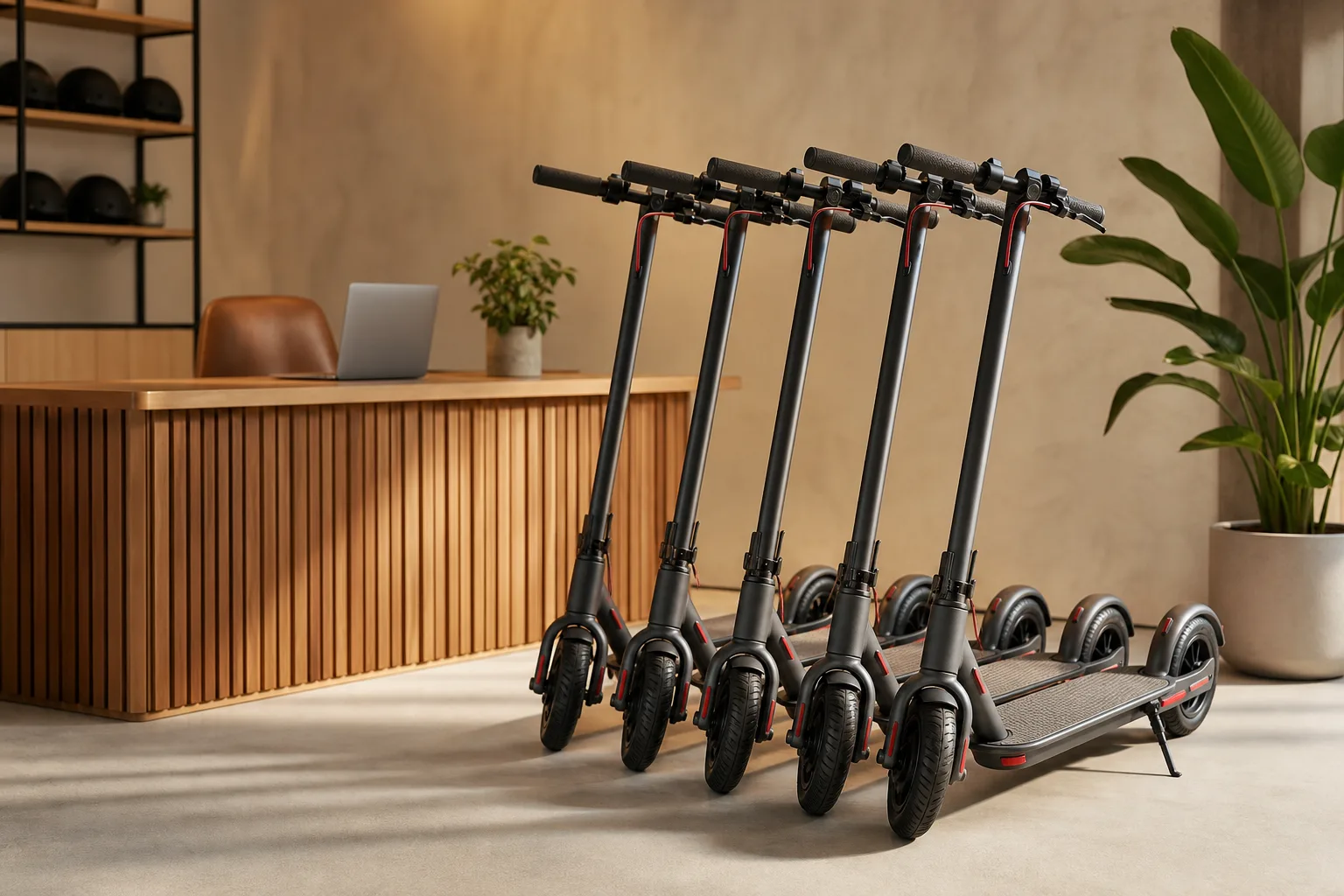
E-scooters in Dubai are not a grey area any more. The RTA has built micro-mobility into the city's transport master plan, with marked lanes, registration rules and defined zones where you can ride. That structure is good news for an operator: it means the sector is open and licensed rather than tolerated.
The demand is already there. Tourists want to get around Downtown and Jumeirah, residents want to cover the last kilometre from the metro, and hotels and communities want managed mobility on their own sites. This guide covers what activity code 7730.93 allows, what the RTA expects, and how to get licensed through Meydan Free Zone.
Key Stats at a Glance
What This License Covers

Activity code 7730.93 is rental of transport equipment without operators. That is the standard fleet model: you own or lease the scooters, and customers hire them themselves through an app or a fixed docking station.
The same code and the same fleet approach cover three-wheelers if you would rather offer something more stable for riders who are nervous on two wheels.
What the license gives you is the right to run the business. What it does not give you is the right to put scooters on Dubai's streets. That comes from the RTA, and it is a separate application with its own requirements. Two instruments, both needed, and in that order.
Who Your Clients Will Be
Four groups, and they behave differently enough to price separately:
- Tourists and short-stay visitors in high-footfall districts, who ride casually and pay by the minute
- Residents using scooters for last-mile connections from metro stations, which is daily, repeat use
- Delivery operators who need light, agile transport around dense areas
- Hotels, venues and master-planned communities wanting managed mobility inside their own developments
That last group is where the steadier money is. A corporate contract with a hotel or a residential developer gives you predictable monthly revenue and justifies a larger fleet, which is much easier to plan around than hoping for good weather and heavy footfall.
The three revenue models map onto those segments. Per-minute pricing suits casual and tourist use. Subscription passes suit commuters. Corporate contracts suit the business-to-business side and stabilise the cash flow that consumer demand alone will not.
Mainland or Free Zone
The regulatory rows are identical whichever route you choose. Your license decides ownership, cost and speed, not whether the RTA will let your fleet out.
[blockCTACostCalculator]
Step by Step Setup Guide
- Step 1, select your activity and package: Choose code 7730.93. mCore suits a lean solo operation, and mPlus fits a larger team needing extra visa allocation.
- Step 2, book your name and send documents: Shareholder passport copies, your proposed trade name and basic incorporation details. You can check name availability before submitting.
- Step 3, get your trade license: Issued digitally by Meydan Free Zone. This is your legal authority to trade under activity 7730.93.
- Step 4, apply for visas if you need them: Founders and staff can be sponsored under the license, with processing handled through the free zone.
- Step 5, open a corporate bank account: Approach banks with your license, a clear business plan and your revenue model. Clarity here speeds approval more than anything else.
- Step 6, register for VAT, then go to the RTA: Handle VAT with the Federal Tax Authority where it applies, then start fleet registration and operational permits with the RTA.
Compliance and What You Need in Place
RTA approval
The RTA governs e-scooter use on public roads and in designated zones. Approval covers registration of each scooter, compliance with technical safety standards, and confirmation that the areas you plan to operate in are permitted. Read the published micro-mobility regulations and designated riding areas before you decide on fleet size or deployment locations, because the map decides your business model.
Maintenance
You need a documented fleet maintenance schedule showing your scooters stay within safety standards. This is a prerequisite for approval, not an internal nicety.
Charging
Work out your charging model early: fixed docking stations, or a battery-swap operation with staff collecting and rotating batteries. It shapes your labour costs, your fleet uptime and where you can deploy.
Insurance
Third-party cover for rental liability must be in place before deployment. You are putting members of the public on vehicles in traffic, so this is not somewhere to economise.
VAT
Register once taxable turnover passes AED 375,000, or voluntarily from AED 187,500 if you want to reclaim input tax while building the fleet. Rental income is standard-rated at 5%, so build it into your pricing rather than absorbing it.
Staff
Fleet technicians, customer service and logistics coordinators all fall under MOHRE for contracts and visas. Free zone visa quotas are set at incorporation, so confirm your expected headcount early and get the right allocation built into your license from the start.
Market Opportunity
The conditions here are unusually favourable. Dubai's population is over 3.6 million and concentrated in exactly the kind of dense corridors where a short electric trip beats a car. Tourist volume adds a second, seasonal layer of demand on top of resident use.
Mordor Intelligence expects global micro-mobility to grow above 12% a year through 2030, with the GCC among the faster-moving regions. What makes Dubai particularly workable is the regulation itself: designated lanes, clear registration rules and defined zones mean you are building inside a framework rather than waiting for one to arrive and change your economics overnight.
Conclusion
This is a commercially sound business with a clear licensing path and a regulator that has already decided micro-mobility belongs in the city.
The discipline that matters is sequencing. Get the trade license first, then the RTA operational approvals, then deploy. Running scooters before that second step is compliance exposure you have no reason to take on, and it is the one mistake in this sector that is entirely avoidable.
[blockCTAContact]