
Table of Contents
Frequently Asked Questions
What exactly is electronic chips programming as a business activity
Electronic chips programming covers the writing, loading, and customisation of firmware and embedded software onto integrated circuits. In practice this includes microcontroller programming, EEPROM and flash memory programming, firmware deployment, and embedded software configuration applied to existing hardware components.
It is important to note that this is a technical service activity, not chip manufacturing. The operator works on hardware that already exists, making it capital-light relative to semiconductor fabrication and far more accessible to independent operators and SMEs.
In Dubai, this activity is registered under activity code 6201.95 and sits at the intersection of IT services and electronics engineering.
Who are the typical customers for a chip programming business in Dubai
The primary customer base is B2B. Key client types include original equipment manufacturers (OEMs), electronics repair workshops, component distributors, and industrial equipment operators who need chips programmed, reprogrammed, or customised before installation or resale.
More specifically, target customers in Dubai include electronics wholesalers and distributors, automotive service centres requiring ECU or module programming, industrial equipment firms maintaining legacy or custom machinery, and smart device assemblers operating in the UAE or exporting regionally.
The breadth of end markets — automotive, IoT, smart metering, industrial automation, and consumer electronics repair — means demand is not concentrated in a single sector.
What is the core revenue model for this type of business
The standard approach is B2B contract services: clients supply the components, the operator programmes them to specification and returns them. This can be structured as a one-off batch job or an ongoing retainer arrangement.
Additional revenue streams include firmware customisation, maintenance reprogramming, and technical consultation for product development teams who need embedded software expertise without hiring in-house engineers.
The model also supports both remote service delivery — where firmware files are exchanged digitally — and on-site work, giving operators flexibility in how they structure engagements and price their services.
Why is Dubai a strategically advantageous location for this business
Dubai functions as a regional re-export and distribution hub for electronics. Components arrive, are programmed or customised to local or client specifications, and are then redistributed — a workflow directly supported by DP World's logistics infrastructure and the Ports, Customs and Free Zone Corporation (PCFC) framework.
Geographic positioning gives operators access to Gulf markets, South Asian electronics supply chains, and African distribution networks from a single base, which is a meaningful commercial advantage for businesses serving regional clients.
Dubai's sustained investment in smart city infrastructure, electric vehicles, and industrial automation — anchored by initiatives such as Digital Dubai — also creates active, ongoing procurement demand for IoT and embedded-system-dependent infrastructure.
What does the market opportunity look like across the Middle East
According to Mordor Intelligence, the Middle East embedded systems market is on a sustained growth trajectory, with automotive, industrial, and defence applications identified as the primary demand drivers — all of which rely on chip-level programming services.
The UAE has been identified as a priority market for embedded systems and IoT deployment under national digital transformation strategies. Digital Dubai's smart city programmes represent active, ongoing procurement of infrastructure that depends on embedded systems.
For a business operating from a Dubai free zone, this regional growth translates into a pipeline of potential clients across multiple verticals rather than dependence on a single industry segment.
What are the practical end markets this service activity covers
The activity code 6201.95 covers a wide range of real-world applications. Key end markets include automotive ECU programming, IoT device firmware, smart metering, industrial automation controllers, and consumer electronics repair.
As Dubai's infrastructure becomes increasingly embedded-system-dependent — from smart building management to connected transport — demand for this service tier grows accordingly. The diversity of applications means operators can choose to specialise in one vertical or serve multiple sectors.
Industrial automation and automotive are currently among the fastest-growing demand segments in the region, making them particularly attractive focus areas for a new operator.
Why does a free zone structure suit this business model
A free zone setup aligns well with the operational profile of a chip programming business for several reasons. 100% foreign ownership is standard in UAE free zones, removing the need for a local partner and giving the operator full control over the business.
There is no retail requirement, which means overheads remain lean — the business does not need a customer-facing shopfront. A modest technical workspace with the appropriate programming equipment is sufficient for most operations.
Free zone licensing also supports the import, value-add, and re-export workflow that is central to serving regional electronics distributors, making it the natural structure for businesses that source components internationally and deliver programmed units back into regional supply chains.
How does this activity differ from semiconductor or chip manufacturing
Electronic chips programming is explicitly a technical service activity performed on hardware that already exists. The operator does not fabricate, design, or produce integrated circuits — that is semiconductor manufacturing, which requires entirely different infrastructure, capital investment, and regulatory frameworks.
Because no physical chip production takes place, the capital requirements are significantly lower. The primary assets are programming hardware, software tools, and technical expertise rather than cleanroom facilities or wafer fabrication equipment.
This distinction makes the activity far more accessible to independent operators and SMEs, and it is why the business model is viable for small teams or even sole operators entering the Dubai market without large upfront investment.
How to Start an Electronic Chips Programming Business in Dubai
You do not need a chip factory to build a business around chips. You need the skills to programme them, and a market that wants the work done.
Dubai has that market. Components come in, get programmed to a client's specification, and go back out into the region. That is a real business, and it costs very little to start.
This guide covers activity code 6201.95, Electronic Chips Programming. You will learn what the work involves, who pays for it, and how to set up with Meydan Free Zone.
Key Stats at a Glance
| What to know | The detail |
|---|---|
| Market growth | The Middle East embedded systems market is growing steadily, with automotive and industrial automation as the main drivers. Figures from Mordor Intelligence. |
| National priority | The UAE is named as a priority market for embedded systems and IoT under national digital transformation plans. |
| Re-export role | Dubai handles a large share of regional electronics re-exports, supported by DP World and PCFC infrastructure. |
| Local demand | Digital Dubai's smart city programmes mean constant buying of infrastructure that runs on embedded systems. |
| Setup cost | Low. No factory, no shopfront, and a flexi-desk or small workshop is enough to start. |
What the Work Actually Is

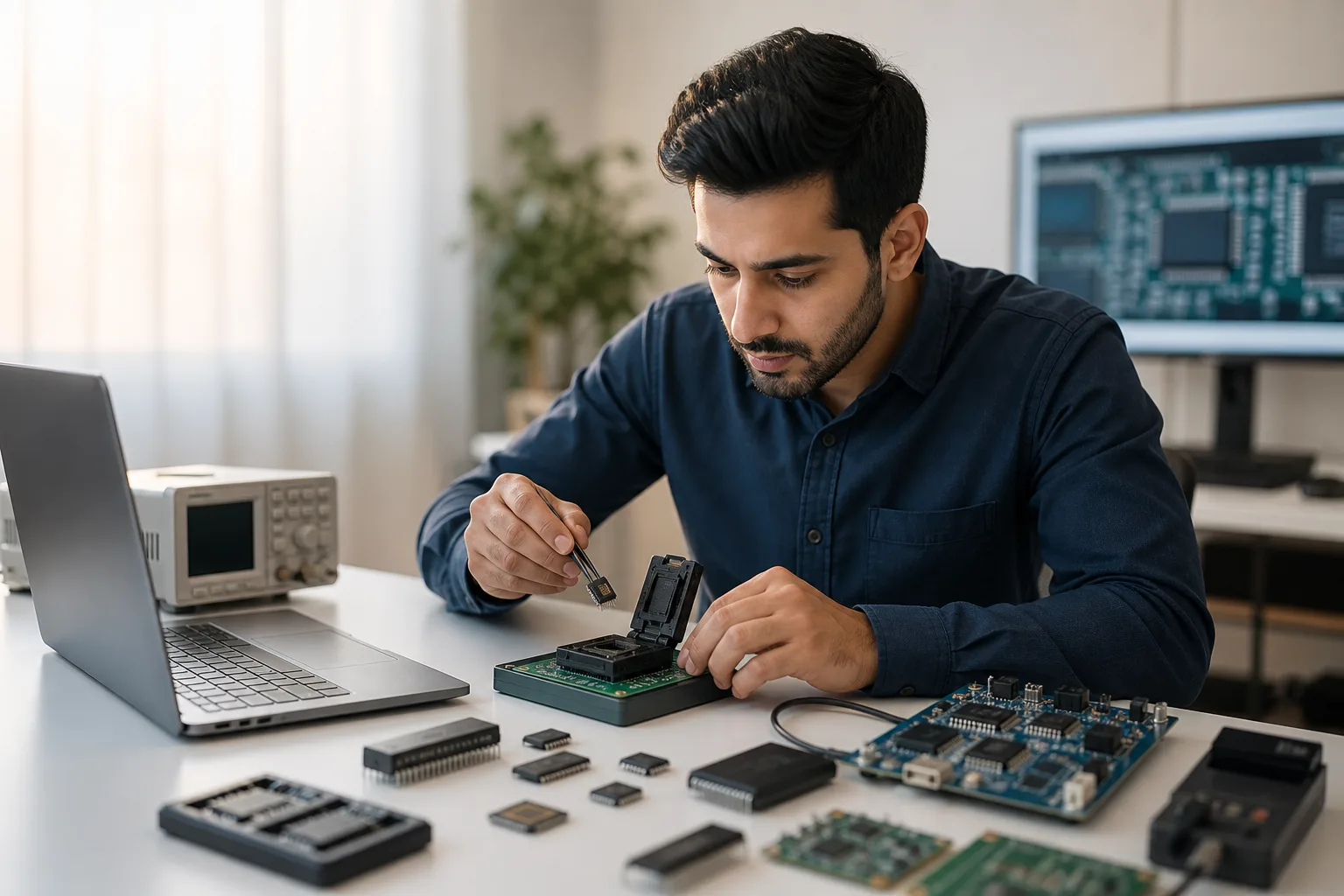
Activity code 6201.95 covers writing, loading and customising firmware and embedded software onto integrated circuits. Day to day that means microcontroller programming, EEPROM and flash memory programming, firmware deployment, and setting up embedded software on hardware that already exists.
The most important thing to understand is what this is not.
| Chips programming (6201.95) | Semiconductor manufacturing | |
|---|---|---|
| What you do | Work on chips that already exist. Load and customise the software on them. | Design and physically produce integrated circuits. |
| What you need | Programming hardware, software tools, and skill. | Cleanrooms, wafer fabrication equipment, and heavy capital. |
| Who it suits | Small teams, and even a single skilled operator. | Large industrial firms. |
That difference is the whole reason this activity is workable for a small operator. You are selling a technical service, not running a factory.
Who Pays For It
This is business to business work.
Electronics wholesalers and distributors. They need stock programmed before it goes out.
Automotive service centres. ECU and module programming, which is steady, skilled work.
Industrial equipment firms. They keep legacy or custom machinery running and need chips reprogrammed for it.
Smart device assemblers. Firms building products in the UAE or exporting across the region.
The end markets are spread wide: automotive ECU programming, IoT device firmware, smart metering, industrial automation controllers, and consumer electronics repair. That spread matters. You are not tied to the fortunes of one sector, and you can specialise in one vertical or serve several.
How You Make Money
Contract work is the core. The client sends you components, you programme them to specification, you send them back. This can be a one-off batch or an ongoing retainer.
Firmware customisation. Tailoring the software to what a particular client needs.
Maintenance reprogramming. Repeat work on equipment already in service.
Technical advice. Product development teams often want embedded software expertise without hiring an engineer full time.
You can deliver remotely, sending firmware files digitally, or work on site at a client's premises. Both fit under this license, which gives you flexibility in how you price and structure jobs.
[blockCTACostCalculator]
Why Dubai Suits This Business
The re-export flow. Components arrive, need programming or customising to local or client specification, then get redistributed. DP World logistics and the Ports, Customs and Free Zone Corporation framework support exactly that import, add value, re-export pattern.
The reach. From one base you can serve Gulf markets, South Asian electronics supply chains and African distribution networks.
The local demand. Dubai keeps investing in smart city infrastructure, electric vehicles and industrial automation. Digital Dubai and the wider national technology agenda are driving purchases of embedded systems and IoT devices across both public and private sectors.
How to Set Up with Meydan Free Zone, Step by Step
Activity 6201.95 sits in the IT and technology services category at Meydan Free Zone. Most operators set up as an FZ-LLC, which works with one shareholder or several, needs no local sponsor, and gives you full foreign ownership from day one. The license covers business to business work inside the UAE and supports international trade.
- Step 1, name and activity: Check your trade name is available and confirm code 6201.95 is correctly applied to your application.
- Step 2, file your papers: Passport copies, a short business plan summary, and the completed application form. Most of this runs remotely.
- Step 3, pay and get your license: Meydan Free Zone issues your trade license and establishment card once your documents are approved and fees are settled.
- Step 4, apply for visas: Your allowance is tied to your license package. Investor visas and employment visas for technical staff both go through the free zone.
- Step 5, open your bank account: With your license and establishment card in hand, approach UAE banks. A clear business plan and a named client pipeline improve your chances a lot.
On premises. You do not need much space. A flexi-desk or small workshop covers most operators at the start, and you only need more room when batch volumes grow, not when headcount does.
On VAT. Register with the Federal Tax Authority once your taxable turnover reaches the mandatory threshold. VAT applies at 5% on relevant supplies, and keeping proper accounts from the start makes this much easier. mAccounting can handle it, mResidency covers visas for you and your team, and mCore, mAssist and mPlus cover the wider support.
Conclusion
Chips programming is skilled work with low overheads, and it fits a free zone setup well. You get full foreign ownership, a solid business to business client base across automotive, industrial and smart infrastructure, and a market that is actively spending on embedded technology.
The setup is simple, the compliance is light, and the demand is built into how the region is developing rather than riding on a trend.
Use the cost calculator to estimate your costs, or talk to the Meydan Free Zone team to confirm you are eligible and get your license structured properly from the start.
[blockCTAContact]
References
- Digital Dubai
- DP World
- Ports, Customs and Free Zone Corporation (PCFC)
- Mordor Intelligence
- Federal Tax Authority