

Table of Contents
Frequently Asked Questions
Can one Meydan Free Zone license cover import, export, and online selling?
Yes, if your business activities match what you sell (product-specific trading) and how you sell (e-commerce or online selling activity). Import and export is the operational motion. Your license scope comes from the activities you pick.
Is an import and export license the same as a general trading license?
Not always. General trading is broad in scope, but the cleaner structure for most online sellers is product-specific trading activities that define your product categories, then layering e-commerce to reflect the online selling channel.
Why does specificity matter more than broad scope for online sellers?
Banks, payment providers, marketplaces, and customs workflows are product-category driven. Broad scope like general trading can trigger extra KYC questions and slow approvals. Defining your product categories upfront cuts follow-up questions and keeps documentation cleaner as you scale.
What online selling models can a Meydan Free Zone license support?
The three main models are: import and stock in the UAE then sell online; import then sell online and export or re-export; or sell online without holding UAE stock while your UAE entity handles sales and payments. Your activity structure stays the same. The fulfilment model is operational.
What is the E-Commerce Starter Add-On and what does it include?
The E-Commerce Starter Add-On costs AED 1,000. It includes seller account setup on Amazon.ae and Noon, one SKU listing per platform, and operational guidance to move from license issuance to live sales efficiently.
How quickly can I get a Meydan Free Zone license for this business model?
Fawri supports license issuance in under 60 minutes, so you can start onboarding suppliers, payment providers, marketplaces, and logistics partners sooner.
How does mPlus help import and export businesses after setup?
mPlus covers the operational layer once the business is live. Residency and visa processing, bookkeeping, VAT and corporate tax support, renewals, and admin workflows through one portal. It also supports customs code registration, as fast as three business days when documentation is ready, so you can move from license issued to inventory moving without gaps.
Topic Summary
One License Can Cover All Three Motions
A single Meydan Free Zone license can legally support import, export, and online selling if business activities are selected correctly. The key is matching your activity choices to how the business actually operates, not just labeling it broadly.
Activity Selection Defines Your Real Scope
Your license scope is shaped by the products you trade, the channel you sell through, and how goods physically move. Meydan Free Zone offers 2,500-plus activities on the Regular route and 1,800-plus on the faster Fawri route, giving founders precise options.
Product-Specific Trading Beats General Trading
General trading sounds convenient but can trigger extra scrutiny from banks and payment providers doing product-category checks. Founders with a defined product line often move faster and face fewer follow-ups by selecting specific trading activities instead.
Customs Registration Is a Separate but Fast Step
Having a trade license does not automatically mean you can clear shipments under your own company name. Customs code registration is a distinct process that can be completed in as few as three business days through mPlus when documentation is ready.
E-Commerce Activity Must Be Explicitly Added
Online selling is not automatically included with a trading license — the relevant e-commerce activity code, such as 4791.00 or 4799.00, must be selected to reflect your selling model. This matters for platform onboarding with marketplaces, payment gateways, and logistics partners.
UAE Trade Growth Makes Timing Urgent
UAE non-oil foreign trade hit AED 3 trillion in 2024, growing at seven times the global average, while the MENA e-commerce market reached AED 126.7 billion. Structuring your license correctly from day one positions you to move quickly in a fast-expanding market.
Setup Can Be Completed in Under 60 Minutes
Meydan Free Zone's Fawri route offers a fully digital setup process that can issue a license in under 60 minutes. Up to three business activity groups can be included under one trade license, covering trading, e-commerce, and related operations together.
Import, Export, and Online Selling business in Dubai with Meydan Free Zone
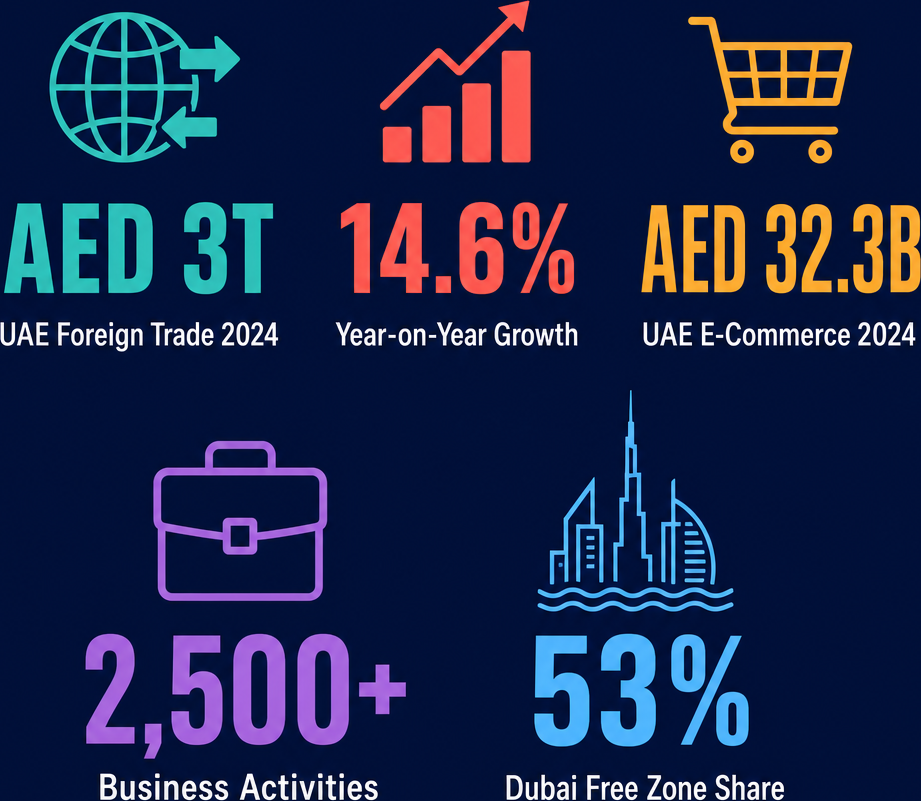
An import and export license is one of those founder phrases that sounds like a single checkbox. In practice, import, export, and online selling are three different motions, and what your license actually covers depends on whether the business activities you select match those motions. The scale is real: UAE non-oil foreign trade hit AED 3 trillion in 2024, a 14.6% year-on-year jump, growing at seven times the global average.
This guide covers how to structure one Meydan Free Zone license to cover all three motions, the difference between product-specific trading and general trading, the online selling models the license can support, and how customs setup fits alongside the license itself.
Key Stats at a Glance
What A Trade License Actually Covers In Dubai
Import, Export, and Online Selling Under One License
Yes, you can structure a single license to support all three motions. But how you structure it matters.
Your license scope is defined by:
- The products you trade, meaning your trading activities
- The channel you sell through, meaning your online selling or e-commerce activity where relevant
- How goods physically move, meaning import and export as operations, supported by customs registration
The numbers show why this matters. UAE non-oil exports surged to AED 561.2 billion in 2024, up 27.6% from 2023, and now account for 18.7% of total foreign trade. The MENA e-commerce market hit AED 126.7 billion in 2024, growing 13% year-on-year on the back of mobile commerce and cross-border transactions. The trade sector was the top contributor to UAE non-oil GDP at 16.8%. Import, export, and online selling are converging, and the license structure needs to reflect that.
Meydan Free Zone is useful here because it gives you a large business activity catalogue of 2,500-plus activities and a fully digital setup process designed to let founders pick activities that mirror how the business will actually operate.
What a Trade License Actually Covers in Dubai
When founders ask, does my license cover this, they are usually checking three real-life pressure points:
Banking and payments
Will your activity scope match what you are getting paid for, so your transactions make sense on paper to your bank and payment providers?
Customs and logistics
Can your company clear shipments under its own name and move goods without scope issues at the border?
Platform onboarding
Will marketplaces, payment gateways, and logistics partners accept your business scope as relevant and compliant when you sign up?
That is why scope clarity matters more than labels. A license does not cover import and export because you said the words import and export.
It covers those motions when:
- Your trading activities match your product categories, and
- Your online selling model is reflected in what the company is licensed to do
Product-Specific Trading vs General Trading
For years, founders used general trading as the default shorthand for an import and export license because it was broad and simple. For online sellers with a defined product line, broad scope can slow things down in the systems that matter most.
Banks and payment providers often run product-category checks, so a wide general scope can trigger more follow-up questions and longer reviews. Tax and government processes also tend to run cleaner when your product categories are defined upfront. The same is true for marketplaces and customs workflows.
When your catalogue is specific, defining your product categories in your trading activities is faster, cleaner, and easier to maintain as you scale. The cleaner structure is:
- Product-specific trading activity for what you sell
- E-commerce activity for how you sell online
This is where Meydan Free Zone becomes useful. The setup is built around specificity. You pick up to three activity groups from 2,500-plus options and structure your license around the exact categories you trade, rather than forcing a one-size-fits-all label.
For example, as a Meydan Free Zone business:
- If you sell women's clothing online: Ladies Garments Trading (4771.83) plus E-Commerce (4790.00)
- If you sell skincare and personal care online: Beauty and Personal Care Requisites Trading (4772.94) plus E-Commerce (4790.00)
- Depending on your online selling model, you may also see 4791.00 or 4799.00 listed as related retail-via-internet variants
To avoid delays downstream, do these things:
- Define your product categories in your trading activities
- Add e-commerce to reflect the online selling channel
- Keep the scope accurate enough that banks, payment providers, and authorities can immediately understand what you do
If your business is focused, specificity is faster, and Meydan Free Zone is set up to support that specificity from day one.
Does an E-Commerce Activity Cover What You Sell Online?
E-commerce activities such as 4790.00 tell the market you sell online. They do not replace the product trading layer that defines what you are actually selling. That is why the clean structure is product-specific trading and e-commerce, not e-commerce alone.
Depending on the exact model, you may also see:
- 4791.00 used where the business is structured around retail sale via the internet or mail order, where orders are placed remotely and fulfilled via delivery
- 4799.00 used for other forms of non-store retail that do not sit neatly under the standard online retail flow
But the logic stays the same. These activities describe the channel. Product-specific trading activities describe the inventory.
Online Selling Models a Meydan Free Zone License Can Support
Once your license scope is structured correctly, the next question is operational: how will you fulfil orders? Most founders fall into one of three models.
Your activity structure stays the same across all three. The fulfilment model is operational.
Dubai Customs Setup for Importing and Exporting Under Your License
Your Meydan Free Zone license defines your commercial scope. But importing and exporting has a customs and documentation layer that decides whether goods can actually move.
Most founders only feel this right before their first shipment lands. The questions become practical, fast:
- Who is clearing the goods: your company, or a freight forwarder acting on your behalf?
- Does the importer of record match your licensed entity?
- Do your product descriptions line up across invoices, packing lists, and shipment documents?
In practice, this means being operationally set up to clear shipments through Dubai Customs and making sure your paperwork reflects the same business your license describes. Customs declarations are product-level by nature, so your license scope should not look like a different business from the one described on your shipment documents.
[blockCTACostCalculator]
Why Meydan Free Zone Works for This Setup
A Meydan Free Zone license does more than register a company name. It gives founders a practical base to trade specific product categories, sell online, and move goods cross-border without rebuilding the structure later.
Built for specificity
With 2,500-plus business activities and the ability to combine up to three activity groups under one license, you define what you sell through product-specific trading activities and add how you sell through an e-commerce activity.
E-Commerce Starter support
The E-Commerce Starter Add-On (AED 1,000) includes seller account setup on Amazon.ae and Noon, one SKU listing per platform, and operational guidance on getting live, helping founders move from setup to sales faster.
Marketplace and logistics partnerships
The Meydan Free Zone partner ecosystem supports selling through Amazon, Noon, eBay, AliExpress, and Sharaf DG, with logistics partners like Cargoz for warehousing and DHL for shipping to operationalise fulfilment.
License in under 60 minutes
Fawri is the fast-track option where your license can be issued in under 60 minutes, so you can start onboarding suppliers, payment providers, marketplaces, and logistics partners sooner.
Customs code registration
Can be completed in as little as three business days through mPlus when documentation is ready, so you move from license issued to inventory moving without gaps.
Ongoing business services
mPlus covers what comes after setup. Residency and visas, bookkeeping, VAT, corporate tax filing, renewals, and admin handled through a single portal.
Key Takeaways
- Yes, one Meydan Free Zone license can cover import, export, and online selling, but only if your activity mix matches how the business actually operates.
- The cleanest structure for most online sellers is product-specific trading activities paired with an e-commerce activity, not a broad general trading label.
- Broad scope can trigger extra KYC and compliance questions from banks, payment providers, and marketplaces. Specific scope is faster and cleaner as you scale.
- Meydan Free Zone lets you combine up to three activity groups under one license from over 2,500 activities, so your license can match your model from day one.
- Customs code registration sits alongside the license, not inside it. Through mPlus, it can be completed in as little as three business days when documentation is ready.
Conclusion
With 79% of UAE e-commerce transactions now happening on smartphones and 58% of online purchases coming from cross-border vendors, the market is not waiting for businesses to figure out their setup. Buyers expect product, payment, and delivery to work seamlessly, and that starts with a license structure that does not create friction downstream.
The founders who move fastest are the ones who get specificity right from day one: product-specific trading activities, e-commerce layered on top, and customs readiness built in. That is what the Meydan Free Zone setup is designed to support.
Use the cost calculator for an estimate, or book a consultation with a setup advisor to structure your import, export, and online selling license correctly from the start.
[blockCTAContact]
References
- Meydan Free Zone
- Meydan Free Zone Fawri
- Meydan Free Zone Business Activities List
- Meydan Free Zone E-Commerce Starter Add-On
- The National on UAE Foreign Trade
- UAE Media Office on Non-Oil Foreign Trade
- Gulf News on UAE Non-Oil GDP
- Ramsha Home on UAE E-Commerce Statistics
- US Department of Commerce on UAE E-Commerce
- Dubai Customs
- Federal Tax Authority