
Table of Contents
Frequently Asked Questions
What is activity code 7120.89 and what does it cover in Dubai
Activity code 7120.89 covers Gold & Precious Metals Testing Laboratories under the ISIC classification system used in Dubai. It encompasses technical testing and analysis of gold, silver, platinum, and other precious metals.
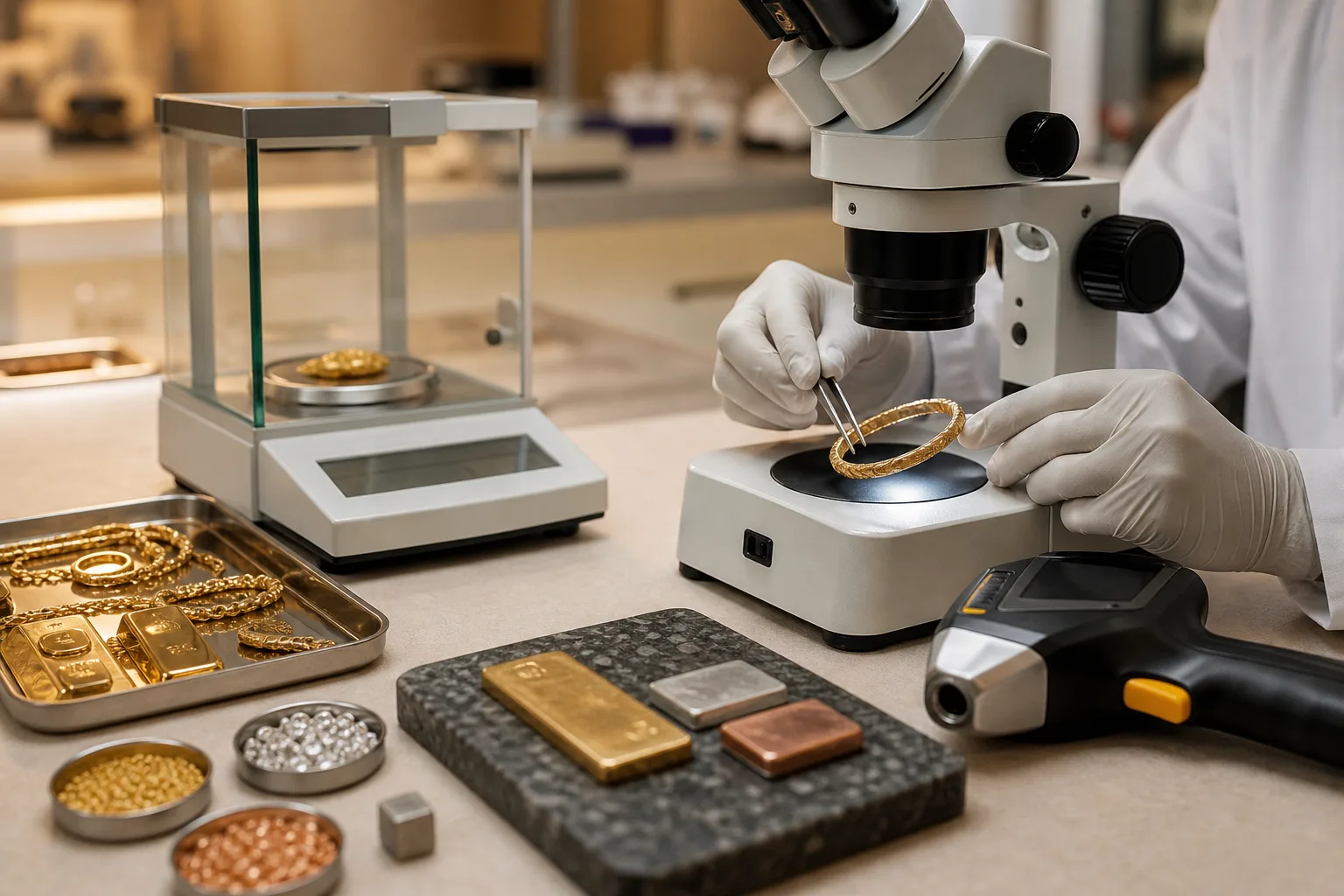
Core services under this code include purity assay, hallmarking verification, and the application of recognised methodologies such as X-ray fluorescence (XRF) and fire assay. This is a precision, instrument-driven technical services category — not jewellery retail or trading.
Who are the typical clients of a precious metals testing laboratory in Dubai
A gold and precious metals testing laboratory in Dubai primarily serves a B2B client base across the broader trade and financial ecosystem. Primary clients include bullion dealers, jewellery manufacturers, pawnbrokers, customs authorities, banks, and commodity traders.
Given Dubai's position at the centre of a global gold trade worth over $75 billion annually, demand comes from both local operators and regional importers and exporters requiring certified verification of metal purity and authenticity.
What is the typical revenue model for a precious metals testing lab
The revenue model for a gold and precious metals testing laboratory typically combines per-sample testing fees with retainer contracts from refineries or jewellery chains. This creates a blend of transactional and recurring income streams.
Additional revenue can be generated through third-party certification services for import and export consignments, which are in consistent demand given the volume of precious metals moving through Dubai's trade corridors.
Should I set up on the mainland or in a free zone for a precious metals testing lab
The right jurisdiction depends on your target client base and ownership preferences. A mainland licence through the Dubai Department of Economy and Tourism (DET) gives you the broadest access to local clients but requires a physical office and compliance with UAE Federal standards.
A free zone licence — particularly through Meydan Free Zone — offers 100% foreign ownership, no currency restrictions, and a simplified setup process. DMCC is a strong alternative if you want direct integration with Dubai's gold trading ecosystem, given its concentration of over 500 registered bullion and commodities firms.
What accreditation is required to operate a precious metals testing laboratory in Dubai
All laboratories must comply with technical benchmarks set by the Emirates Authority for Standardisation and Metrology (ESMA) for precious metals testing. This establishes the baseline regulatory standard for methodology and equipment.
Accreditation through the Emirates International Accreditation Centre (EIAC) is the recognised route to demonstrating competence to both clients and regulators. This accreditation signals that your laboratory operates to internationally accepted standards and is typically required by institutional clients such as banks and customs authorities.
What are the AML/CFT obligations for a precious metals testing laboratory in Dubai
Precious metals testing entities in Dubai may fall under Anti-Money Laundering and Counter-Financing of Terrorism (AML/CFT) reporting obligations under UAE Federal Decree-Law No. 20 of 2018. This reflects the high-value nature of the assets being assessed and certified.
Operators are advised to review their specific obligations with the Central Bank of the UAE before commencing operations. Compliance requirements can affect onboarding procedures, record-keeping, and transaction reporting, so early legal review is strongly recommended.
What VAT rate applies to precious metals testing services in Dubai
Testing services in Dubai are subject to the standard UAE VAT rate of 5%. However, zero-rating may apply to certain transactions involving investment-grade metals, depending on the nature of the service and the metal classification.
The applicable treatment is determined by the Federal Tax Authority (FTA). Businesses should obtain specific VAT guidance relevant to their service mix, particularly if they handle both standard testing and services linked to investment-grade bullion transactions.
What are the key steps to obtain a licence for a gold testing laboratory in Dubai
The setup process begins with choosing your jurisdiction — mainland DED, Meydan Free Zone, or DMCC — based on your client base, ownership structure, and accreditation needs. You then reserve a trade name with activity code 7120.89 confirmed as approved.
Next, you submit an initial approval application including a business plan, passport copies, and any required No Objection Certificate (NOC). Once approved, you secure compliant laboratory premises meeting fit-out and safety standards, then apply for EIAC accreditation to validate your laboratory's competence. Equipment imports and reference standards may also require coordination with PCFC or Dubai Customs.
Open a Gold & Precious Metals Testing Laboratory in Dubai
Dubai trades more gold than almost anywhere on earth, and every gram that moves through the market needs to be tested, assayed, and certified. That single fact explains why demand for accredited precious metals testing is structural, not cyclical.
This guide covers what a precious metals testing laboratory license in Dubai actually involves, who your clients will be, where to set up, and what it takes to get operational.
| Sector | Gold & Precious Metals Testing |
|---|---|
| Key regulator | Emirates Authority for Standardisation and Metrology (ESMA) |
| Trade compliance body | Dubai Multi Commodities Centre (DMCC) |
| Laboratory accreditation standard | ISO/IEC 17025 |
| Dubai share of global physical gold trade | Approximately 25% |
| Accreditation timeline | Six to twelve months from application to certificate |
| Setup jurisdiction options | Mainland (DET) or Meydan Free Zone |
| AML classification | Designated Non-Financial Business (DNFB) – AML rules apply |
What This License Covers and Who Regulates It
A precious metals testing laboratory license covers a specific set of technical activities. These are not trading or refining activities. They are measurement and certification services. Getting that distinction right from the start matters, because the wrong activity code will cause problems later.
The core activities this license covers include:
- Assaying gold, silver, platinum, and palladium for purity
- XRF (X-ray fluorescence) testing and fire assay testing
- Hallmarking and issuing purity certificates
- Third-party verification for trade and customs purposes
Who sets the rules
The Emirates Authority for Standardisation and Metrology (ESMA) sets the technical standards that your lab must meet. ESMA recognition is separate from your trade license and runs on its own track. The Dubai Multi Commodities Centre (DMCC) governs gold trade compliance across the emirate, and your clients, particularly refineries and bullion dealers, will expect you to understand how that framework works even if you are not trading yourself.
Accreditation
ISO/IEC 17025 is the international standard for laboratory competence. It is not a legal requirement to open, but it is a practical one. Serious clients, government bodies, and banks involved in trade finance will not use a lab that does not hold it. Start the accreditation process early. It runs in parallel with licensing, not after it. You can check the Meydan Free Zone business activities list to confirm the correct activity code before you proceed.
What this license does not cover
This license does not give you the right to buy, sell, or refine precious metals. If you want to add trading or refining to your operation, those need separate activity codes and separate approvals. Keep them distinct at the setup stage.
Your Clients and the Market Behind Them

Dubai handles roughly 25% of global physical gold trade. That volume does not move without testing. Every shipment that crosses a border, every batch that enters a refinery, and every parcel that a jewellery manufacturer sends to a buyer needs a documented purity certificate from a credible source.
Your client base falls into several clear categories:
- Gold refineries that need third-party verification of incoming and outgoing material
- Bullion dealers who need certified purity for trade finance and settlement
- Jewellery manufacturers checking raw material before production
- Pawnbrokers and second-hand dealers who need fast, reliable spot testing
- Government mints and central bank bullion programmes requiring independent certification
- Large retail jewellery chains running quality control on supplier stock
Export and import compliance
Shipments crossing international borders need documented purity certificates that customs authorities and receiving banks will accept. A Dubai-issued assay certificate from an accredited lab carries real weight in trade finance. Banks use these documents to release letters of credit. That makes your service a functional part of the transaction, not an optional add-on.
Market depth
The UAE gold and precious metals market runs into the tens of billions of dollars annually. According to Mordor Intelligence, global demand for precious metals assay services continues to grow as trade compliance requirements tighten. Dubai sits between African mining supply and Asian manufacturing demand. That geographic position means the volume through this market is not going to shrink. The number of accredited independent labs, however, remains limited. That is the commercial opportunity.
Mainland vs Meydan Free Zone: Where to Set Up
This is the biggest choice you will make when setting up. Let your clients decide it, not the cost.
| Factor | Mainland (DET) | Free Zone (Meydan Free Zone) |
|---|---|---|
| Client access | Direct access to UAE refineries, retailers, and government tenders | Mainly international trade clients; mainland clients via service agreement |
| Foreign ownership | 100% in most categories – Invest in Dubai | 100% as standard |
| Office and lab space | Physical lab premises required | Physical lab premises required – flexi-desk is not enough |
| Setup cost | Higher initial cost | Lower license cost; lab fit-out cost is the same |
| Government tenders | Eligible to bid directly | Requires a mainland entity or agent |
| Re-export certification | Available | Well suited to this use case |
One point applies to both options: a physical lab is not negotiable. Accredited testing operations need proper premises with the right fit-out. A flexi-desk arrangement will not satisfy ESMA, ISO auditors, or your clients. Budget for real space from day one.
Free zone labs can still serve mainland clients through a service agreement structure. This works well for labs whose primary clients are international traders and refineries using Dubai as a transit hub. If your main clients are UAE-based retailers or government bodies, a mainland DET license from the DET e-Services portal is the cleaner route.
Free Business Setup Cost Calculator
Calculate NowStep-by-Step Setup and Compliance Requirements
Setting up a precious metals testing laboratory involves more moving parts than a standard trade license. Run the tracks in parallel where you can. Waiting for one approval before starting the next adds months you do not need to lose.
- Step 1, book your trade name: Use the DET e-Services portal for a mainland company, or the Meydan Free Zone portal for a free zone one. You can check your company name availability before you submit.
- Step 2, select your activity code: Confirm the code covers assaying, hallmarking, and purity certification. Do not proceed until this is confirmed in your chosen jurisdiction.
- Step 3, get initial approval: Submit your application and supporting documents to DET or Meydan Free Zone. This is the formal green light to move forward.
- Step 4, secure lab premises: Find a space that can be fitted out for chemical storage, ventilation, fire suppression, and secure sample handling. Your landlord agreement will be needed for the next steps.
- Step 5, apply for Dubai Civil Defence approval: Chemical storage and fire suppression systems need sign-off. Factor in a security deposit at this stage.
- Step 6, apply for ESMA recognition: Submit your technical documentation and lab specifications to ESMA. This runs alongside the ISO process, not after it.
- Step 7, begin ISO/IEC 17025 accreditation: Appoint an accreditation body, prepare your quality management documentation, and schedule your initial audit. This process typically takes six to twelve months from application to certificate.
- Step 8, register staff with MOHRE: All employees need to be registered with the Ministry of Human Resources and Emiratisation (MOHRE). Qualified assayers and chemists with verifiable credentials are not optional. Auditors will check.
- Step 9, complete AML registration: Precious metals labs fall within UAE anti-money laundering rules for designated non-financial businesses. You must register with the relevant supervisory authority and put AML procedures in place before you start taking clients.
- Step 10, open your business bank account: A trading account with a UAE bank is needed before you can invoice clients. If you need support with this, mCore includes business bank account support for free zone companies.
Costs and Timelines to Expect
There are four main budget lines for this business. Plan for all of them before you commit to anything.
License fees
The license itself is the smallest cost. A Dubai trade license from AED 12,500 is the starting point at Meydan Free Zone. Mainland fees vary by activity and office requirement.
Lab fit-out
This is where the real capital goes. Ventilation systems, chemical storage, fume hoods, fire suppression, and secure sample handling areas all need to meet regulatory standards. Get a specialist fit-out contractor who has done laboratory work before, not a standard office contractor.
Equipment
XRF analysers, fire assay furnaces, analytical balances, and consumables are significant capital items. Source these early. Lead times from reputable suppliers can run to several months.
Accreditation audit costs
ISO/IEC 17025 accreditation involves application fees, document review, and on-site audit costs. Budget for at least one corrective action cycle before you receive your certificate. Six to twelve months is a realistic timeline. Build that into your cash flow plan.
Why Dubai Makes Commercial Sense for This Business
The commercial case for this business in Dubai is not based on optimism. It is based on trade volume, geography, and a client base with no alternative.
Market scale
The UAE gold and precious metals market is valued in the tens of billions annually. Dubai is not a regional gold hub. It is a global one. The volume of physical metal moving through this city every year creates consistent, high-frequency demand for certified assay services. That demand does not depend on economic cycles in the same way that consumer businesses do. Gold trade runs through downturns as well as booms.
Geographic position
Dubai sits between African mining supply and Asian manufacturing demand. That is not a marketing line. It is a logistics fact. Metal mined in sub-Saharan Africa, refined in Europe or the Gulf, and sent to manufacturing operations in India or China passes through Dubai at multiple points. Each of those handoffs needs documentation. Your lab provides it.
Regulatory credibility
A Dubai-issued assay certificate from an accredited lab is accepted by trade finance banks, customs authorities, and commodity exchanges. That credibility is built into the market. You are not starting from zero. You are plugging into an existing framework that your clients already trust.
Barriers to entry
The number of accredited independent precious metals testing labs in Dubai remains small. ISO/IEC 17025 accreditation, ESMA recognition, qualified staff, and proper premises are not easy to put together. That is a barrier to entry. Once you are through it, pricing power follows. If you want to understand the full setup path before committing, remote business setup options are available for the initial stages while you plan your premises.
Conclusion
A precious metals testing laboratory in Dubai is a specialist, regulated business with real technical barriers to entry and a client base that is not going anywhere. The setup process is more involved than a standard trade license, but the complexity is also what keeps competition limited.
Get the activity code right, start the accreditation process early, and plan your lab fit-out before you sign a lease. Those three things will save you more time than anything else in this process.
Talk to Meydan Free Zone about the right license structure for your lab before you commit to premises or equipment. Getting the jurisdiction decision right at the start is far cheaper than changing it later.
Ready to Launch Your Business in Dubai?
Let's ConnectCompliance
THIRD-PARTY APPROVAL
This activity requires pre-approval from the Emirates International Accreditation Centre (EIAC) | Dubai Police (DP) before a business license can be issued by Meydan Free Zone.
ANTI-MONEY LAUNDERING COMPLIANCE
This business activity is exempt from AML compliance requirements.
References
- Invest in Dubai
- Mordor Intelligence
- Ministry of Human Resources and Emiratisation (MOHRE)
- Dubai Department of Economy and Tourism (DET) e-Services