
Table of Contents
Frequently Asked Questions
What does activity code 8129.10 cover in Dubai
Activity code 8129.10 — Other Building and Industrial Cleaning Activities, N.E.C. — is a residual classification covering specialist cleaning operations that fall outside standard janitorial or building exterior categories. The N.E.C. (Not Elsewhere Classified) designation means it applies wherever a cleaning activity is specialist in nature but does not fit a narrower defined code.
In practical terms, covered services include chimney sweeping, boiler and duct cleaning, blast furnace cleaning, industrial tank cleaning, and exterior cladding washing on commercial or industrial structures. It is distinct from domestic cleaning (code 8121) and standard building exterior cleaning (code 8122).
Who are the typical customers for a 8129.10 licence holder in Dubai
The target market for this licence is almost entirely business-to-business (B2B). Typical customers include real estate developers, industrial operators, logistics hubs, manufacturing plants, and facilities management (FM) contractors who subcontract specialist cleaning tasks.
These relationships carry recurring contract potential rather than being one-off retail engagements, which supports more predictable revenue. Operators can position themselves within established FM supply chains, particularly given that FM outsourcing is standard practice among large asset owners in Dubai.
Can a foreign national own 100% of a cleaning business under this activity in Dubai
Yes. 100% foreign ownership is permitted under both mainland and free zone structures in the UAE, as confirmed by the Official UAE Government Portal. This applies to activity code 8129.10 along with most other commercial activities.
On the mainland (DED), full foreign ownership is available following UAE commercial company law reforms. In free zones such as Meydan, 100% ownership has always been a standard feature, often combined with lower setup costs and remote incorporation options.
What is the difference between setting up on the Dubai mainland versus a free zone for this activity
Mainland (DED) registration provides broader geographic access across Dubai and the wider UAE, and makes the business eligible for government contracts — an important consideration given the scale of public infrastructure projects in the emirate.
Free zones such as Meydan typically offer lower initial setup costs, 100% foreign ownership, and the option of remote incorporation. The trade-off is that free zone companies may face restrictions when operating directly on the mainland without a local service agent or branch arrangement. The right choice depends on your target clients, operational footprint, and ownership preferences.
What are the main steps to obtain a licence for activity code 8129.10 in Dubai
The setup process follows the standard Dubai commercial licence pathway. Key steps include: choosing your jurisdiction (mainland DED or a free zone), reserving a trade name and confirming the activity code 8129.10 is correctly listed, and determining the appropriate legal structure — sole establishment, LLC, or free zone company.
Subsequent steps involve securing initial approval from the relevant authority, arranging compliant business premises, and obtaining the final trade licence. Sector-specific considerations, such as equipment documentation or technical credentials, may also be required depending on the scope of services offered.
When is VAT registration required for a cleaning business in Dubai
VAT registration becomes mandatory once a business's taxable turnover exceeds AED 375,000, as set by the Federal Tax Authority (FTA). Businesses approaching this threshold should monitor their turnover carefully and register before it is breached to avoid penalties.
Voluntary registration is available below this threshold, which can be advantageous if your clients are VAT-registered businesses that can reclaim input tax — a common scenario in B2B industrial cleaning contracts.
What is driving demand for specialist industrial cleaning services in Dubai
Demand is driven by several structural factors rather than discretionary spending. Dubai's active infrastructure pipeline — including Expo legacy assets, expanding industrial zones, and logistics corridors — generates recurring post-construction and ongoing maintenance cleaning requirements tied to asset management obligations and regulatory compliance.
Industrial zones including JAFZA, Dubai Industrial Park, and Dubai Industrial City collectively house thousands of facilities, each requiring periodic specialist cleaning. The density of industrial tenants in these zones creates a concentrated, accessible market. Regional FM market growth is further supported by the UAE's sustained real estate and industrial output, according to data from Mordor Intelligence and IMARC Group.
What legal structures are available when registering under activity code 8129.10
Three main legal structures are available depending on your ownership preferences and operational scale. A sole establishment suits individual operators seeking a straightforward setup with full personal liability. A Limited Liability Company (LLC) is common for partnerships or businesses planning to scale, offering liability protection for shareholders.
A free zone company is suitable for those prioritising 100% foreign ownership, lower overheads, or remote setup. Each structure has different implications for visa eligibility, banking, and the ability to trade directly with mainland clients, so the choice should be aligned with your specific business model and growth plans.
Other Building and Industrial Cleaning Activities, N.E.C. License in Dubai
Dubai keeps building, and its industrial estates keep growing. All of that creates steady, large-scale demand for cleaning work that does not fit the normal categories. Activity code 8129.10 is the license that covers it.
This guide explains what the code allows, who it suits, how to set it up, and what the rules and the market look like here.
Key Stats at a Glance
| Activity code | 8129.10 – Other Building and Industrial Cleaning Activities, N.E.C. |
|---|---|
| Market outlook | UAE facility management and cleaning set to grow steadily through 2028 – IMARC Group |
| Construction context | Dubai's construction sector contributed over AED 50 billion to GDP – Dubai Statistics Center |
| Ownership | 100% foreign ownership on the mainland and in free zones – Dubai Municipality, Waste Department |
| Who regulates it | Department of Economy and Tourism, or your free zone authority |
| VAT | Register once taxable turnover passes AED 375,000 – Federal Tax Authority |
| Who buys from you | Developers, industrial operators, logistics hubs, factories, facilities management contractors |

What This License Covers
Code 8129.10 is a catch-all. It picks up specialist cleaning that the normal janitorial and building exterior codes do not cover. The scope is deliberately wide, because the work is industrial and needs technical skill beyond a standard cleaning contract.
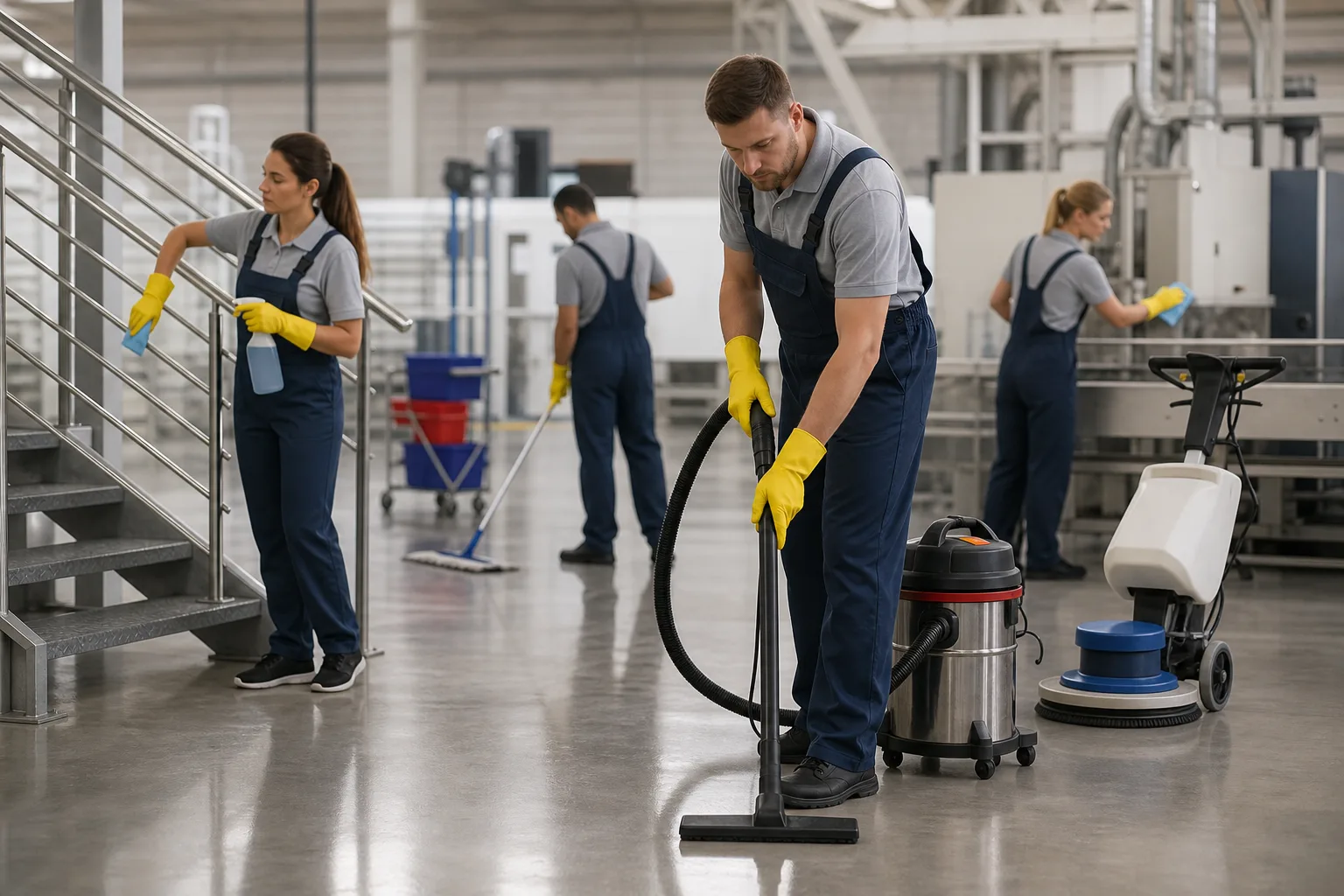
In practice that means chimney sweeping, boiler and duct cleaning, blast furnace cleaning, industrial tank cleaning, and washing the outside cladding on commercial or industrial buildings.
It is not the same as domestic cleaning, which is code 8121, or standard building exterior cleaning, which is code 8122. The N.E.C. tag means Not Elsewhere Classified. Your work is specialist, but it does not fit a narrower code, so it lands here.
Who Your Clients Will Be
Every client is a business. Nobody calls you to clean a flat.
You will work for real estate developers, industrial operators, logistics hubs, manufacturing plants, and facilities management contractors who subcontract the specialist jobs they do not do themselves.
These are contract relationships that repeat, not one-off jobs. That gives you far steadier income than retail cleaning work.
Facilities management outsourcing is normal practice for large asset owners in Dubai, and specialist cleaning gets subcontracted as a matter of routine. That means you can slot into an established supply chain instead of fighting for direct end-client relationships from day one.
Market Opportunity
Dubai's building pipeline is still active. Expo legacy assets, growing industrial estates, and logistics corridors all create post-construction cleaning work and ongoing maintenance cleaning after that.
None of this is discretionary spending. Asset owners clean because their asset management obligations, their regulators, and basic operational need all require it. That is a much better position to sell into than a market where clients can simply skip a year.
Dubai's industrial estates hold thousands of facilities between them, and each one needs periodic specialist cleaning. The tenants are packed close together, so the market is concentrated and easy to reach for an operator with the right kit and credentials.
Mordor Intelligence points to steady growth in the regional facilities management market on the back of UAE real estate and industrial output.
Mainland vs Free Zone
| Factor | Mainland | Free Zone |
|---|---|---|
| Where you can work | All of Dubai and the wider UAE | Free zone and international. Mainland work needs a branch or distributor |
| Foreign ownership | 100% since the 2021 reforms | 100% |
| Setup cost | Usually higher | Lower to start, with flexi-desk available |
| Government contracts | Eligible | Usually needs a mainland branch |
| Setup speed | Standard processing | Often faster, and you can set up remotely |
The mainland gives you reach and makes you eligible for government contracts, which matters given how much public infrastructure work there is here. A free zone such as Meydan Free Zone costs less to enter, gives you full ownership, and lets you incorporate remotely. Let your target clients decide it.
[blockCTACostCalculator]
Step-by-Step Setup Guide
- Step 1, choose your jurisdiction: Mainland for reach and government work, or a free zone for lower cost and a faster, remote setup.
- Step 2, book your trade name and confirm the code: Check that 8129.10 is listed correctly with your authority when you reserve the name.
- Step 3, pick your legal structure: A sole establishment suits one operator, though you carry full personal liability. An LLC suits partnerships and anyone planning to grow, and it protects shareholders. A free zone company suits full foreign ownership, lower overheads, or a remote setup.
- Step 4, get initial approval and sort premises: A mainland operating license usually needs a physical address. Free zones offer flexi-desks that keep your costs down while you find your feet.
- Step 5, submit your documents: Memorandum of Association, tenancy contract with Ejari for mainland, passport copies, and any sector approvals your services need.
- Step 6, pay the fees and collect your license: Register with MOHRE for your visa quota and labour compliance right away.
- Step 7, register for VAT: Register with the Federal Tax Authority if turnover meets or is likely to meet AED 375,000.
Some industrial cleaning work needs extra approvals from Dubai Municipality or a sector regulator. Check what applies to you through the Department of Economy and Tourism before you apply.
Compliance and What You Need in Place
Industrial cleaning carries a heavier compliance load than most commercial work. Plan for it now rather than bolting it on once you are trading.
Worker safety
This job means handling chemicals, entering confined spaces, and working at height. MOHRE standards and UAE Labour Law set the floor. Individual clients and asset owners often set stricter rules on their own sites.
Environment
Chemical waste disposal and industrial effluent must meet Dubai Municipality guidelines. Breaking the rules brings fines and can get your license suspended.
VAT
Standard 5% VAT applies to your B2B cleaning services. Get invoicing and records right from your first transaction so a Federal Tax Authority audit is simple when it comes.
Visas and staffing
Your license sets your visa quota. This is a workforce-heavy business, so map your headcount against your visa slots before you sign contracts you cannot staff.
Renewals
License and labour card renewals are annual. Let them lapse and the administrative fines pile up fast when you have a lot of people on the books.
Conclusion
Code 8129.10 is a practical license for anyone going after Dubai's industrial, logistics, and post-construction cleaning work. The demand is real, it repeats, and the setup is simpler than in heavily regulated sectors.
Two things decide how fast you get trading and turning a profit: picking the right jurisdiction, and planning your compliance early.
Use the cost calculator to estimate what setup will cost, or talk to a Meydan Free Zone adviser to confirm the right structure for how you plan to work.
[blockCTAContact]