
Table of Contents
Frequently Asked Questions
What is activity code 8211.99 and what does it permit in Dubai
Activity code 8211.99 covers the operation, maintenance, and management of public toilet facilities. It falls under the broader classification of support services to buildings and landscape within Dubai's Department of Economy and Tourism (DED) activity framework.
Permitted operational scope includes staffing, routine cleaning, consumable restocking, minor repairs, and hygiene compliance reporting. It is a labour-intensive, compliance-driven activity rather than a passive investment.
You can confirm the permitted scope and verify the classification via the Invest in Dubai business activity portal before submitting any licence application.
Who are the typical clients for a public toilets operation business in Dubai
Clients span both public and private sectors, each carrying different contract structures and compliance expectations. Common client categories include:
- Municipalities and government bodies
- Roads and Transport Authority (RTA) concessions
- Shopping malls and retail destinations
- Event venues and exhibition centres
- Transport hubs such as metro stations and bus depots
- Construction sites and parks
Institutional clients such as municipalities and the RTA typically require formal tendering and may impose additional site-specific approvals beyond the standard trade licence.
What are the main revenue models available to public toilet operators in Dubai
Operators can structure revenue through several distinct channels depending on their contract mix and site locations.
- Government and municipality service contracts — recurring fee-based agreements with public bodies
- Pay-per-use installations — direct consumer revenue at high-footfall locations
- Facility management sub-contracts — bundled cleaning and maintenance packages
- Advertising space — monetising exterior surfaces on portable or permanent units
Operators with a diversified contract portfolio tend to reach the VAT registration threshold of AED 375,000 in annual turnover relatively quickly, making early tax planning important.
Which government bodies regulate public toilet operators in Dubai
Several authorities have overlapping jurisdiction depending on where and how you operate.
- Dubai Department of Economy and Tourism (DED) — issues the primary mainland trade licence
- Roads and Transport Authority (RTA) — requires a separate approval or concession agreement for facilities on RTA-managed land such as metro stations and bus depots
- Dubai Municipality — governs health and hygiene standards, conducts periodic inspections, and requires documented cleaning schedules and staff hygiene certifications
- Ministry of Human Resources and Emiratisation (MOHRE) — oversees compliant staff onboarding, Wages Protection System (WPS) enrolment, and mandatory health insurance
Holding a DED trade licence alone is not sufficient for RTA-managed sites — a separate concession agreement is required.
Why must a public toilet operator choose a mainland DED licence rather than a free zone licence
The choice of jurisdiction has a direct impact on the contracts you can legally pursue. A mainland DED licence is the standard requirement for operators seeking government, municipality, or RTA contracts.
A free zone entity cannot directly tender for government work without establishing a mainland branch. Since the majority of institutional demand in this sector comes from public bodies, setting up exclusively in a free zone would significantly restrict your addressable market.
For operators targeting private clients such as malls or event venues only, a free zone structure may be viable, but most serious operators in this sector opt for a mainland LLC from the outset.
What are the VAT and tax obligations for a public toilets operation business in Dubai
The UAE applies VAT at 5% to commercial service contracts under the Federal Tax Authority (FTA) framework. VAT registration becomes mandatory once annual turnover exceeds AED 375,000.
Operators holding institutional contracts with municipalities, the RTA, or large facility management clients are likely to reach this threshold quickly. Early registration and proper invoicing practices are advisable to avoid penalties.
Voluntary registration is permitted below the mandatory threshold, which can be beneficial if you are reclaiming input VAT on significant startup or operational costs. Consult the Federal Tax Authority or a registered tax agent for guidance specific to your contract structure.
What staff compliance requirements apply to workers employed in this business
All cleaning and maintenance staff must be onboarded through MOHRE-compliant employment contracts. This is not optional — non-compliance carries fines and can directly affect licence renewal.
Key obligations include:
- Enrolment in the Wages Protection System (WPS) to ensure timely salary payments
- Provision of mandatory health insurance for all employees
- Maintaining staff hygiene certifications as required by Dubai Municipality inspection standards
Dubai Municipality also requires operators to keep documented cleaning schedules and consumable logs that can be produced during periodic inspections. Failure to meet inspection benchmarks can result in contract suspension, making staff compliance a core operational risk to manage from day one.
How large is the market opportunity for public toilet operators in Dubai
Dubai's commercial case for private sanitation operators is supported by strong structural demand drivers. The city welcomed over 17 million overnight visitors in 2023 according to the Department of Economy and Tourism, creating sustained pressure on public amenity infrastructure.
The broader UAE facility management market is projected to grow steadily through 2028, driven by infrastructure expansion and the outsourcing of services that were previously managed in-house by government bodies — IMARC Group.
Dubai's established outsourcing culture and continued government investment in public amenities mean this is not a marginal niche. It is a contracted services business with real institutional demand, making it attractive for operators who can meet compliance requirements and build relationships with public-sector procurement teams.
Setup Public Toilets Operation Business in Dubai
Dubai's population keeps growing, tourist numbers keep climbing, and the city has a lot of public space to look after. That combination creates real demand for private companies that run and maintain public toilets. Dubai also likes to outsource this kind of work rather than run it in house, and government money keeps flowing into public amenities.
This guide covers what the Public Toilets Operation activity, code 8211.99, lets you do, who regulates it, how you license it, and what the setup path looks like in practice.
Key Stats at a Glance
| Activity code | 8211.99 |
|---|---|
| What it covers | Operating and maintaining public toilet facilities, part of support services to buildings and landscape |
| Main regulator | Dubai Department of Economy and Tourism (DET) |
| Tourism demand | Dubai welcomed more than 17 million overnight visitors in 2023 – Visit Dubai |
| Market outlook | UAE facility management market set to keep growing through 2028 – IMARC Group |
| VAT | 5% on commercial service contracts, once turnover passes AED 375,000 – Federal Tax Authority |
| Extra approval | RTA approval needed for sites on RTA-managed land – Roads and Transport Authority |
| Foreign ownership | 100% in Meydan Free Zone |
What This License Covers

Activity code 8211.99 covers running and maintaining public toilet facilities. It sits inside the wider group of support services to buildings and landscape on Dubai's DET activity list.
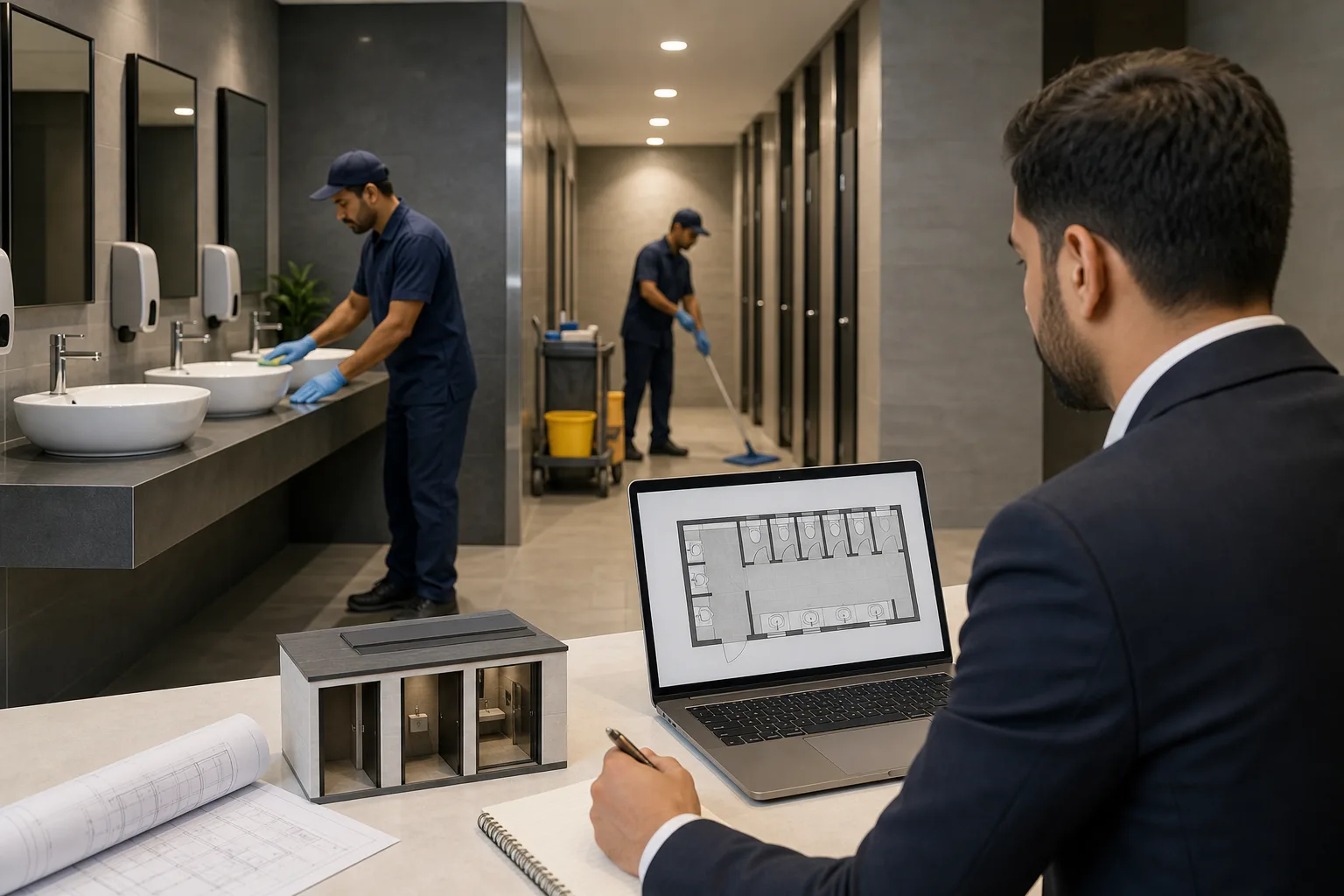
The work itself is hands-on: staffing, daily cleaning, restocking supplies, small repairs, and keeping hygiene records. It is rule-heavy and people-heavy, not something you can run from a distance.
Who Your Clients Will Be
Your clients could be municipalities, RTA concessions, shopping malls, event venues, transport hubs, building sites, and parks. Each one works to its own contract and its own compliance checks, so read every tender carefully before you price it.
Money comes from a few directions:
- Government and municipality service contracts
- Pay-per-use units at busy locations
- Facility management subcontracts bundled with cleaning and maintenance
- Advertising space on your units
Standalone pay-per-use units carry thin margins on their own. Contracts that bundle toilet operation with wider cleaning and maintenance work pay better and last longer. Some operators also offer technical advice on hygiene systems or consumable planning to their bigger clients, which helps them win and keep the account.
Mainland or Free Zone
| Factor | Mainland (DET) | Free Zone (Meydan Free Zone) |
|---|---|---|
| Government tenders | Direct access | Only through a mainland branch |
| Foreign ownership | Set by DET rules for the activity | 100% yours |
| Setup route | Apply through DET | Apply online, cost-efficient packages |
| Best fit for | Businesses that need to tender directly | Lean starts that scale into a mainland branch later |
If your work depends on tendering directly for government or municipality contracts, you need a mainland DET license. If you want to start lean and scale in later, Meydan Free Zone gives you a cost-efficient base and a route to a mainland branch once you are ready to tender. Let your target clients decide it, not the price.
[blockCTACostCalculator]
Step-by-Step Setup Guide
- Step 1, choose your jurisdiction: A mainland DET license is the standard route for public-sector and municipality contracts. A free zone company needs a mainland branch to tender for government work directly.
- Step 2, book your trade name and confirm the activity: Use DET e-Services to book your name and check that code 8211.99 is mapped correctly to your application.
- Step 3, pick your legal structure: An LLC is the usual choice. Rules that came in after 2021 let one owner hold the whole company in most activities.
- Step 4, get your approvals in place: Apply for Dubai Municipality clearance and, if you plan to work on RTA-managed sites, RTA approval too. Run these alongside your DET application rather than after it.
- Step 5, lease office space and register Ejari: You need a registered address. A virtual office works for a service business at this stage.
- Step 6, file your paperwork and pay license fees: Submit the Memorandum of Association and shareholder documents, then pay the DET fees to get your trade license.
- Step 7, register with MOHRE and join WPS: Set up staff contracts, work permits, and the Wages Protection System before you put anyone on the ground.
- Step 8, register for VAT: Sign up with the Federal Tax Authority once your turnover passes the threshold.
A clean mainland setup usually takes two to four weeks. Delays mostly come from municipality approvals or missing paperwork, not the DET process itself.
Compliance and What You Need in Place
DET trade license
Your core commercial approval comes from the Dubai Department of Economy and Tourism. It is the standard route for anyone chasing government or municipality contracts.
RTA approval
Sites on RTA-managed land, such as metro stations, bus depots, and interchanges, need their own approval or concession on top of your trade license. Do not assume your trade license alone covers these sites.
Dubai Municipality hygiene rules
Dubai Municipality checks health and hygiene standards through regular inspections. Keep cleaning schedules, staff hygiene certificates, and consumable logs up to date, because missing a benchmark can get a contract suspended.
VAT and the Federal Tax Authority
Register for VAT once your yearly turnover passes AED 375,000. Institutional contracts get you there fast, so register before your first taxable supply, not after.
MOHRE and your staff
Every cleaning and maintenance worker needs a MOHRE-compliant contract, enrolment in the Wages Protection System, and health insurance. Once your headcount hits the relevant level, Emiratisation duties kick in too. Breaking the rules here brings fines and can hold up your license renewal.
Market Opportunity
Dubai's scale creates the opportunity here. Over 17 million overnight visitors passed through the city in 2023, and that kind of footfall needs clean, well-staffed public facilities across malls, transport hubs, parks, and event venues. The UAE facility management market is set to keep growing through 2028, and outsourced services are a big part of that growth.
Government bodies and private venue operators keep publishing tenders for facility services, so the demand is not a one-off. Labour is your biggest cost, so build recruitment, visas, and Wages Protection System compliance into your pricing from day one. Public liability insurance matters too. Most tenders set a minimum cover level, and you should have it in place before you submit a bid, not after you win one.
Your supply chain matters as well. Sanitary consumables, portable units for events, and sensor-based monitoring for premium sites all need reliable suppliers, because consumable costs eat straight into your margin. Building those supplier relationships early puts you in a stronger position when a bigger tender lands.
Conclusion
Public toilets operation, activity code 8211.99, is a small but workable service business in Dubai, built on the city's scale, tourist numbers, and habit of outsourcing facility work. Getting licensed is the easy part. Winning contracts and running a tight, well-insured team is where the real work sits.
Sort your regulatory approvals, your staffing compliance, and your insurance early, and the rest of the business runs on routine.
[blockCTAContact]