
Table of Contents
Frequently Asked Questions
What is Activity Code 7120.98 and what does it authorise a business to do
Activity Code 7120.98 is the official classification for Quality & Standardization Certificates Issuing Services in Dubai. It falls under the ISIC category of Technical Testing and Analysis.
A business holding this licence is authorised to issue quality and standardisation certificates to other companies, verifying that their products, processes, or systems meet defined national or international standards. Importantly, the licence covers certification issuance, not physical laboratory testing or analysis.
Practical applications include ISO certification support, product conformity assessments, supplier audits, and the preparation of trade compliance documentation for customs and procurement purposes.
Who are the typical clients for a Quality & Standardization Certificates Issuing Services business
This is a purely B2B business model — clients are other businesses, not individual consumers. Target clients include manufacturers, importers, exporters, construction firms, and food producers that require third-party compliance documentation.
A particularly strong segment is UAE-based SMEs that lack in-house compliance or quality management functions and need an external provider to handle certification on their behalf. These businesses often require certificates for regulatory approvals, buyer requirements, or customs clearance.
Larger clients may engage the business on retainer arrangements for ongoing compliance programmes, while smaller clients may commission certificates on a per-engagement basis.
What jurisdiction options are available for setting up this licence in Dubai
Businesses can establish a Quality & Standardization Certificates Issuing Services licence under two main jurisdiction options in Dubai: the Dubai Mainland via the Department of Economy and Tourism (DED), or a Free Zone such as Meydan Free Zone.
The choice of jurisdiction affects factors such as ownership structure, the ability to trade directly with mainland UAE clients, office requirements, and overall setup costs. Mainland licences offer broader market access, while free zone licences can offer streamlined setup processes and cost efficiencies.
Businesses should assess their target client base and operational model before choosing, as each option carries different regulatory and commercial implications.
What are the main revenue streams for a certification issuing business
Revenue in this model typically comes from three primary sources: certification fees charged per individual engagement, annual renewal contracts for clients with ongoing compliance programmes, and audit retainer arrangements with larger corporate clients.
Because the core deliverable is a credible, recognised certificate rather than physical goods or laboratory work, the business is knowledge- and process-intensive with relatively low capital requirements once established.
The recurring nature of compliance requirements — particularly for businesses that export regularly or operate in regulated sectors — means there is strong potential for long-term client relationships and predictable revenue streams.
What is the VAT registration threshold relevant to this business activity
The VAT registration threshold applicable to this business activity in the UAE is AED 375,000 in taxable turnover. Businesses that exceed this threshold are required to register for VAT with the Federal Tax Authority.
Since this is a B2B service business, VAT is typically charged to business clients who may themselves be VAT-registered and able to recover input tax, which reduces the practical friction of VAT compliance in commercial relationships.
Businesses approaching or exceeding this threshold should ensure their invoicing, record-keeping, and filing processes are set up correctly from the outset.
Why is Dubai specifically a strong market for quality and standardisation certification services
Dubai's role as a major re-export and trade hub creates structural, sustained demand for third-party quality verification. Goods moving through Jebel Ali Port, operated by DP World and handling over 14 million TEUs annually, frequently require standardised compliance documentation at multiple points in the supply chain.
Regulatory pressure from UAE authorities on product standards, food safety, and construction materials continues to increase, supporting durable market demand independent of economic cycles. For businesses importing or exporting through GCC trade corridors, third-party quality certificates are often a non-negotiable requirement.
As the UAE's non-oil economy diversifies and regulatory frameworks mature, the addressable market for certification services is expected to grow, with IMARC Group projecting continued expansion in the GCC quality assurance and testing sector through 2028.
What role does ESMA play in the regulatory environment for this business
The Emirates Authority for Standardisation and Metrology (ESMA) is the primary federal body coordinating UAE and Dubai-level product and quality standards. It sets the national standards framework within which certification businesses and their clients operate.
Businesses in trade-heavy sectors — including food, construction, manufacturing, and consumer goods — increasingly require third-party certificates that align with ESMA-recognised standards for customs clearance and procurement compliance. A certification issuing business therefore operates within, and helps clients navigate, this regulatory framework.
Understanding ESMA's standards and how they interact with international frameworks such as ISO is a core competency for any business operating under Activity Code 7120.98.
Is this licence classified as professional or commercial, and why does that distinction matter
The Quality & Standardization Certificates Issuing Services licence can be classified as either a Professional or Commercial licence depending on the jurisdiction and specific structure chosen. This classification matters because it affects ownership rules, permissible activities, and in some cases the regulatory body overseeing the licence.
A professional licence is typically associated with knowledge-based or consultancy-style activities and may allow 100% foreign ownership on the mainland under UAE's updated commercial companies framework. A commercial licence is associated with trading or broader commercial operations.
Given that this activity is fundamentally a knowledge and process business — issuing certificates based on expertise and audit processes rather than selling physical goods — it aligns naturally with a professional licence classification in most setups.
Quality & Standardization Certificates Issuing Services License in Dubai
Dubai's trade and manufacturing base runs on certified compliance. Firms that issue quality certificates sit at the centre of that system. This page covers what the license covers, who needs it, how to set up in Dubai, and why Meydan Free Zone is a workable base for this work.
This license lets you issue quality and standards certificates to businesses and products. The activity code covers product compliance certificates, process audits, and management system approvals. You check whether a product or process meets a set standard, then issue a formal certificate to confirm it.
This is not the same as running a testing lab. A lab runs physical tests. This work is about reviewing, auditing, and certifying that standards are met. The two activities need separate licenses.
| Activity code | 7420.02 |
|---|---|
| Activity name | Quality & Standardization Certificates Issuing Services |
| License type | Professional services |
| Foreign ownership | 100% – Invest in Dubai |
| Jurisdiction options | Mainland (DET) or free zone |
The work you can do under this license includes:
- Issuing product compliance certificates
- Auditing business processes against a standard
- Certifying management systems such as ISO 9001
- Reviewing supplier or trader compliance for third parties
- Issuing conformity marks for UAE market entry
Who Your Clients Will Be
Most clients are firms that need a certificate before they can sell, export, or tender. Without third-party sign-off, they cannot move goods or win contracts.
Your main client groups will be:
- Manufacturers needing product approval before export
- Firms seeking ISO or local standards sign-off
- Traders and importers who need third-party checks
- Government and semi-government bodies that need certified suppliers
- Construction firms seeking materials or process approval
- Food and consumer goods producers entering the UAE market
Demand is steady. Dubai's ports handle enormous trade volumes. Every shipment that needs a conformity mark is a potential client. Manufacturers in the UAE's industrial zones also need regular audits to keep their certifications current.
Government buyers are a strong segment. Many public tenders in the UAE need suppliers to hold valid quality certificates. That creates repeat work. Once a firm holds a certificate, it needs renewal checks on a set cycle.
International firms entering the UAE market also need local certification support. They often do not know which UAE standards apply to their product. You bridge that gap. You check what is needed, run the audit, and issue the certificate.
Mainland vs Free Zone Setup
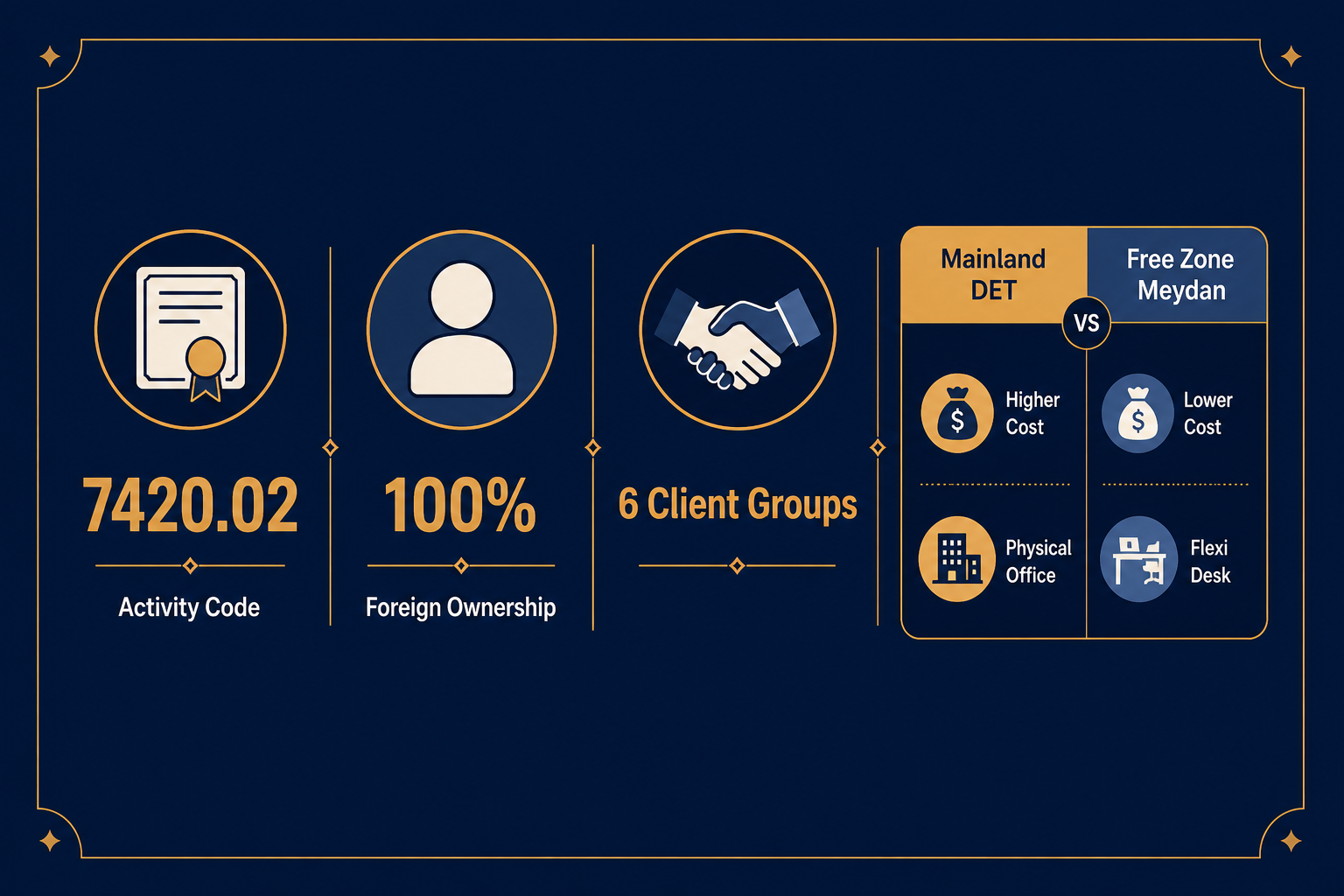
You have 2 main options: a mainland license from DET, or a free zone license from Meydan Free Zone. Each suits a different type of operation.
A mainland license from DET lets you work directly with UAE government bodies and bid on public tenders. You can also serve clients anywhere in the UAE without restriction. You will need a physical office. Setup costs are generally higher.
A free zone license from Meydan Free Zone gives you 100% foreign ownership and lower setup costs. A flexi-desk is enough to start. It suits firms focused on international clients, cross-border trade, or regional export markets. You can still serve UAE-based private sector clients.
| Factor | Mainland (DET) | Free Zone (Meydan Free Zone) |
|---|---|---|
| Client access | Open UAE market, including government | Mainly private sector and international |
| Foreign ownership | 100% in most activities | 100% |
| Office need | Physical office required | Flexi-desk available |
| Setup cost | Higher | Lower – from AED 12,500 |
| VAT registration | Required above AED 375,000 turnover | Required above AED 375,000 turnover |
If your work is mainly for UAE government contracts, go mainland. If your clients are private firms, traders, or overseas businesses, a free zone setup is more workable. Many certification firms start in a free zone and add a mainland branch later as the client base grows.
Free Business Setup Cost Calculator
Calculate NowHow to Get Your License
The setup steps are straightforward. Here is the process for a Meydan Free Zone license:
- Step 1, book your trade name: Use the Meydan Free Zone portal to check and book your company name.
- Step 2, pick your activity code: Confirm code 7420.02 is listed and matches your planned work.
- Step 3, submit your application: Upload passport copies, a business plan, and any relevant training or approval records.
- Step 4, get your license issued: Pay the license fee and receive your trade license.
- Step 5, apply for your visa: Use your license to apply for a UAE residence visa.
- Step 6, open a bank account: Set up a corporate account to start trading.
You can also start a business remotely without visiting Dubai. Meydan Free Zone supports remote setup for most license types.
Documents you will need:
- Passport copy for each shareholder and director
- Business plan or service description
- Proof of relevant training, skill, or prior approval (where required)
- No-objection letter if you are already on a UAE visa
Timeline is typically 3 to 5 working days for a free zone license. Some activities need extra sign-off from a standards body or regulator. Check this before you apply. If your work involves issuing certificates under an internationally recognised scheme, you may need prior approval from that body.
Compliance and Market Opportunity
Running a certification firm in Dubai means keeping up with several sets of rules. The main ones are:
ESMA rules The Emirates Authority for Standardization and Metrology sets UAE national standards. If you certify products for the UAE market, you need to know which ESMA standards apply.
UAE conformity marking Some product types need the ECAS or ESMA conformity mark before sale in the UAE. Issuing these marks needs formal approval. Check with ESMA before you offer this service.
ISO frameworks Many clients want ISO 9001, ISO 14001, or ISO 45001 sign-off. To issue these, you need to be an accredited body or work under one. The UAE Accreditation Centre (UAEAN) handles this.
Record-keeping duties You must keep records of every audit and certificate you issue. Clients may need to show these to regulators. Keep files for at least 5 years.
Staff skill needs Your auditors need real training. Most clients will ask to see your team's credentials before they hire you. Relevant ISO auditor training and sector experience carry weight.
Market Size and Demand
Dubai's trade volumes drive strong demand for this work. The UAE is one of the world's busiest re-export hubs. Every product that passes through needs to meet a standard somewhere in the chain.
Industrial growth adds to this. The UAE's manufacturing sector is expanding. New factories need quality systems set up and certified from day one. That is ongoing work, not a one-time job.
According to IMARC Group, the global quality management software and services market is growing steadily. The Middle East is one of the faster-growing regions. Dubai's position as a regional hub means demand here grows ahead of the broader market.
Port access is a real advantage. Jebel Ali is one of the world's largest ports. Goods moving through it often need certificates for origin, quality, or conformity. Firms based in Dubai can serve this demand directly. Regional export routes into Saudi Arabia, India, and East Africa also pass through here.
The Meydan Free Zone business activities list covers over 2,500 activities. Quality and certification services sit within a broader professional services cluster. That means you can combine this license with related work such as management consulting or training.
Conclusion
Issuing quality and standards certificates is a regulated, high-demand service in Dubai. Real scope exists for firms that have the right skills and setup. The market is driven by trade volume, industrial growth, and a rising need for third-party sign-off across sectors.
A free zone license from Meydan Free Zone gives you a cost-effective base, 100% ownership, and access to a wide private sector and international client base. A Dubai trade license from AED 12,500 is a workable entry point for most founders.
Speak to a Meydan Free Zone advisor to confirm your activity code and get your license sorted.
Ready to Launch Your Business in Dubai?
Let's ConnectCompliance
THIRD-PARTY APPROVAL
This activity requires pre-approval from the EIAC (Emirates International Accreditation Centre) before a business license can be issued by Meydan Free Zone.
ANTI-MONEY LAUNDERING COMPLIANCE
This business activity is exempt from AML compliance requirements.