
Table of Contents
Frequently Asked Questions
What is activity code 8549.94 and what does it cover
Activity code 8549.94 is the official Dubai business activity classification for an Advanced First Aid Training Center. It sits within the broader education and training category and authorises you to deliver first aid, CPR, AED, and emergency response training programmes to corporate and individual clients.
Holding this activity code is the foundation of your trade licence application, whether you set up on the mainland through the Dubai Department of Economy and Tourism (DED) or through a free zone authority. Without the correct activity code, you cannot legally operate training programmes in this space.
Which regulatory bodies oversee a first aid training center in Dubai
There are two main layers of regulation. Your trade licence is issued by either the Dubai DED (mainland) or a relevant free zone authority. This gives you the legal right to operate as a business entity in Dubai.
If your programmes include any clinical or medical training components — which most advanced first aid curricula will — you also require approval from the Dubai Health Authority (DHA). DHA reviews your facility, curriculum, and instructor credentials before granting registration. The Ministry of Health and Prevention (MOHAP) sets national standards for training content and instructor qualifications that apply regardless of DHA involvement.
Understanding which body governs your specific programmes before you structure your offering is essential, as it determines your approval pathway and timeline.
Is 100% foreign ownership permitted for this type of training business in Dubai
Yes. 100% foreign ownership is available for Advanced First Aid Training Centers under both mainland and free zone structures in Dubai. Mainland reforms have removed the previous requirement for a local Emirati partner across most business activities, including education and training classifications.
This makes Dubai particularly attractive for international training providers and individual entrepreneurs who want full control over their business without sharing equity. You should confirm the current ownership rules with the DED or your chosen free zone authority at the time of application, as regulations can be updated.
What are the instructor qualification requirements for delivering regulated first aid training
Instructors must hold internationally recognised certifications aligned with bodies such as the American Heart Association (AHA), Pre-Hospital Trauma Life Support (PHTLS), or ILCOR-aligned qualification frameworks. These are not interchangeable with informal or unaccredited certificates.
Beyond holding the qualification, instructors may be required to undergo DHA credential verification before they are permitted to deliver regulated training programmes in Dubai. Build this verification process into your hiring and onboarding timeline, as it can add weeks to your readiness date.
MOHAP national standards also govern instructor qualification levels, so your staffing plan must satisfy both DHA and MOHAP requirements simultaneously.
What is the minimum space requirement for setting up a training facility
A practical training center for advanced first aid typically requires a minimum of 500 to 1,000 square feet of dedicated space. This range accommodates hands-on practical stations for CPR manikins, AED trainers, and scenario-based exercises alongside a classroom or theory area.
DHA facility inspections will assess whether your space is appropriate for the training activities you intend to deliver. Choosing a location that clearly meets the minimum threshold — rather than one that requires negotiation with inspectors — will smooth your approval process considerably.
What is the difference between setting up on the mainland versus in a free zone for this business
A mainland (DED) licence allows you to contract directly with government entities, walk-in corporate clients, and businesses anywhere across Dubai without restriction. For a B2B training business targeting large employers, construction firms, hotel groups, and public-sector organisations, this unrestricted market access is a significant commercial advantage.
A free zone structure may offer benefits such as streamlined setup processes, certain tax efficiencies, and clustered networking with other businesses, but it can limit your ability to trade directly with clients outside the free zone without additional approvals. Given that the primary revenue model for a first aid training center relies on corporate contracts across diverse sectors, mainland setup is often the more commercially logical choice.
Who are the most reliable client segments for a first aid training center in Dubai
The most structurally reliable clients are corporate HR departments fulfilling mandatory regulatory compliance obligations. Because UAE occupational health and safety legislation requires first aid certification across construction, hospitality, healthcare, logistics, and education sectors, this spending is driven by compliance rather than discretionary budgets — making it far more resilient than optional training expenditure.
Other strong client segments include schools, nurseries, and sports clubs operating under DHA and Dubai Sports Council guidelines; construction contractors meeting site-safety requirements under PCFC and municipal frameworks; and hospitals and clinics requiring annual staff refresher training. Large employers in these categories can often be structured as annual retainer contracts, which significantly improves cash flow predictability.
Are there any trade naming restrictions to be aware of when registering the business
Yes. DED rules prohibit trade names that imply medical diagnosis or treatment services. Your business name must be clearly positioned around training and education rather than clinical or therapeutic services.
Practically, this means avoiding terms like clinic, medical centre, diagnostic, or similar language in your registered trade name. Names that emphasise training, academy, institute, or education are appropriate and will avoid rejection at the naming approval stage. Getting your trade name right before submission saves time and avoids the need to restart the naming process.
Setting Up an Advanced First Aid Training Center in Dubai
Dubai's rapid growth in construction, hospitality, and healthcare has made certified first aid training a legal requirement across dozens of industries. Employers cannot ignore it, and regulators enforce it. That creates steady, recurring demand for training providers who are properly licensed and accredited.
This guide covers the licenses, regulators, and setup steps you need to open a compliant advanced first aid training center in Dubai. It is written for founders who want the facts, not a sales pitch.
Key Stats at a Glance
| Primary regulator | Dubai Health Authority (DHA) |
|---|---|
| Federal regulator | Ministry of Health and Prevention (MOHAP) |
| Trade license authority (mainland) | Dubai Department of Economy and Tourism (DET) |
| Free zone option | Meydan Free Zone |
| Foreign ownership | 100% available on both mainland and free zone |
| Physical facility required | Yes – DHA mandates a fit-for-purpose training space |
| Courses covered | BLS, AED operation, trauma response, workplace first aid |
What the License Covers and Who Regulates It

All health-related training centers in Dubai fall under Dubai Health Authority oversight. That includes any center offering first aid instruction, whether you run basic CPR sessions or full advanced trauma response programs. You need DHA approval before you open, and you need it before you sign a lease or hire a single trainer.
At the federal level, the Ministry of Health and Prevention (MOHAP) sets health standards that apply across all seven emirates. DHA operates within that framework but adds its own Dubai-specific requirements on top. In practice, you deal with DHA for day-to-day approvals and keep MOHAP compliance in the background.
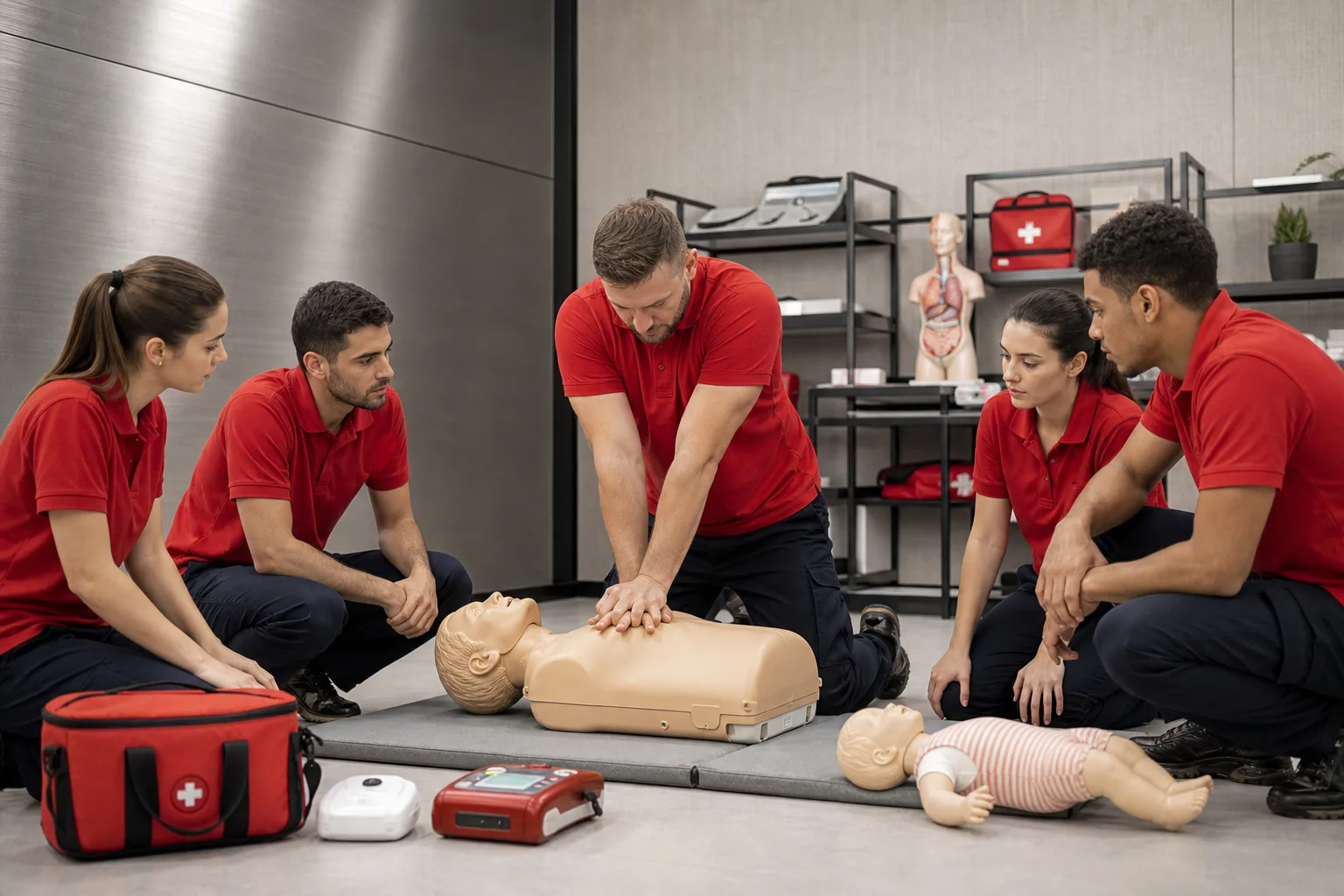
The term "advanced first aid" covers more than basic CPR. A center operating at this level typically delivers:
- Basic Life Support (BLS) for healthcare and non-healthcare providers
- Automated External Defibrillator (AED) training
- Trauma response and wound management
- Workplace first aid certified to recognised international standards
- Paediatric first aid and infant CPR
If you only offer CPR as a standalone course, you are still subject to DHA oversight, but the accreditation process is lighter. The moment you move into trauma response or multi-module programs, DHA treats you as an advanced training center and the requirements go up accordingly.
Confirm your activity code with DET or Meydan Free Zone before you approach DHA. The code needs to reflect health education and training, not general education or consulting. Getting this wrong early delays everything downstream. You can browse the full Meydan Free Zone business activities list to find the right code for your setup.
Mainland vs Free Zone: Which Setup Works Here
This is the biggest choice you will make when setting up. Let your client base decide it, not the cost.
| Factor | Mainland (DET) | Free Zone (Meydan Free Zone) |
|---|---|---|
| Client access | Open UAE market, including government tenders | Mainly private companies and international clients |
| Foreign ownership | 100% available | 100% available |
| Physical facility | Required by DHA – jurisdiction does not change this | Required by DHA – jurisdiction does not change this |
| Government tenders | Yes – direct access | Restricted without a mainland entity |
| Setup speed | Moderate – DET plus DHA approval | Fast trade license, then DHA approval |
| Flexi-desk office | Not applicable – training space needed regardless | Available for admin, but training space still needed |
A mainland license from DET lets you work directly with UAE government bodies, public schools, and municipalities. If you want government contracts, that is where you need to be. Many construction companies, hotel groups, and hospitals also prefer mainland vendors for procurement reasons.
A Meydan Free Zone setup suits trainers who are targeting private sector companies, international organisations, and corporate clients who do not require a mainland entity. Setup is faster, and the admin is lighter. You can still deliver training anywhere in Dubai, but you cannot bid on government tenders directly.
One thing does not change between the two: DHA requires a fit-for-purpose physical training facility whatever your jurisdiction. You cannot run an advanced first aid training center from a flexi-desk. You need a proper space with the right kit, the right layout, and DHA sign-off on both. Budget for that from day one.
On ownership, 100% foreign ownership is now available on the mainland following the 2021 Companies Law changes. That removes one of the traditional reasons to default to a free zone. The real decision is about your client base, not your shareholding structure.
Free Business Setup Cost Calculator
Calculate NowStep-by-Step Setup Guide
- Step 1, book your trade name: Use the DET e-Services portal for a mainland company, or the Meydan Free Zone portal for a free zone one. Check your company name availability before you go further. Names that reference health or medical services may need DHA clearance at this stage.
- Step 2, get initial approval from DHA: Apply to DHA for initial approval before you sign a lease or hire staff. DHA will review your proposed activity, your ownership structure, and your intended facility location. This step takes time. Do not skip it or try to run it in parallel with lease negotiations.
- Step 3, secure your training facility: Find a space that meets DHA's physical requirements. That means enough floor area for practical training, proper ventilation, accessible layout, and storage for manikins, AED trainers, and trauma kits. DHA will inspect it before issuing final approval.
- Step 4, submit trainer credentials and course curricula: DHA needs to see the qualifications of every instructor you plan to use. Credentials must be current, clinically valid, and recognised by DHA. Submit your course outlines at the same time. DHA reviews both together as part of the accreditation process.
- Step 5, get your trade license issued: Once DHA initial approval is in hand, complete the trade license process with DET or Meydan Free Zone. You need the license before DHA will schedule the final inspection.
- Step 6, pass the DHA final inspection and complete center registration: DHA inspects the facility, checks your kit, and confirms your trainers are on site and credentialed. Once satisfied, they register the center and issue the operating certificate. You can now take bookings.
Compliance, Staffing, and Ongoing Requirements
Getting licensed is the start, not the finish. DHA monitors training centers on an ongoing basis, and the rules on staffing and kit are specific.
Trainer qualifications
DHA needs certified instructors with valid clinical credentials. A trainer whose certification has lapsed cannot deliver courses. Keep a renewal calendar and build in buffer time. If a key trainer leaves, you may need to pause certain courses until a replacement is credentialed and approved.
Equipment standards
Manikins, AED trainers, and trauma kits must meet the specifications DHA approves at registration. Do not substitute cheaper alternatives without checking first. DHA inspectors look at kit during renewal inspections, and non-compliant equipment can result in a course being suspended.
Annual renewals
You have two renewals to manage each year: your trade license with DET or Meydan Free Zone, and your DHA center registration. They do not always fall at the same time. Missing either one means you are operating without a valid license, which exposes you to fines and damage to your name. Set calendar reminders three months ahead of each deadline.
Staffing and MOHRE duties
Once you start hiring, the Ministry of Human Resources and Emiratisation (MOHRE) rules apply. If your headcount grows beyond certain thresholds, Emiratisation duties kick in. Check the current thresholds before you hire, not after. Staff contracts, payroll, and WPS compliance all sit under MOHRE, and enforcement is active.
VAT and corporate tax
Training services are generally subject to VAT at 5%. Register with the Federal Tax Authority once your revenue reaches the mandatory threshold. Corporate tax at 9% applies to taxable income above AED 375,000. Both are straightforward to manage with proper bookkeeping from the start. Meydan Free Zone's accounting services can handle this if you do not want to manage it in-house.
Market Opportunity and Client Base
First aid training in Dubai is not discretionary. Employers in construction, hospitality, schools, and events are legally required to have trained staff on site. That means your clients do not need persuading. They need a provider who is DHA-accredited, reliable, and able to issue certificates that hold up to inspection.
The construction sector is the largest single source of demand. Dubai's ongoing infrastructure pipeline means large workforces that need regular refresher training, not just one-off certification. Hotel groups and resort operators are similarly structured, with high staff turnover and annual retraining cycles built into their compliance calendars.
Corporate contracts are where the revenue stabilises. A single agreement with a large employer can cover hundreds of staff across multiple sessions per year. Government tenders, available to mainland operators, add another layer. Schools, government hospitals, and public sector bodies all procure first aid training through formal tender processes.
The market has commodity providers at the bottom end offering basic CPR at low prices. You do not need to compete there. Advanced and accredited programs, delivered by credentialed instructors in a DHA-registered center, command higher fees and attract clients who need the certification to satisfy their own regulators. That is a different market, and it is the one worth building for.
Dubai's healthcare and tourism workforce continues to grow. The IMARC Group tracks first aid training as part of the broader health education market, and demand across the GCC has grown consistently alongside workforce expansion and tightening safety regulation. Dubai sits at the centre of that trend.
Conclusion
Running a first aid training center in Dubai is a regulated, credentialed business with real barriers to entry and steady demand from employers who have no choice but to train their staff. The barriers are the point. They keep out casual operators and protect the value of proper accreditation.
The setup process is manageable if you go in the right order: DHA initial approval first, then your facility, then your trade license, then the final inspection. Trying to run steps in parallel or skipping DHA early in the process costs time and money.
Speak to Meydan Free Zone to confirm the right activity code and jurisdiction for your training center before you approach DHA. Getting the license structure right at the start makes everything else simpler.
Ready to Launch Your Business in Dubai?
Let's ConnectCompliance
THIRD-PARTY APPROVAL
This activity requires pre-approval from the Dubai Corporation for Ambulance Services (DCFAS) / Dubai Health Authority (DHA) before a business license can be issued by Meydan Free Zone.
ANTI-MONEY LAUNDERING COMPLIANCE
This business activity is exempt from AML compliance requirements.