
Table of Contents
Topic Summary
UAE Fodder Demand Is Structurally Locked In
With 2.2 million livestock animals to feed and a domestic alfalfa cultivation ban since 2006, the UAE relies on imports for over 90% of its animal feed. This creates permanent, predictable demand that wholesale traders can build a business around.
A Billion-Dollar Market Still Growing Fast
The UAE animal feed market was valued between USD 1.26 billion and USD 2.64 billion in 2024–2025, with projections reaching USD 3.38 billion by 2033. BlueWeave Consulting identifies the UAE as the fastest-growing country in the Middle East and Africa feed market.
Know Which Fodder Products You Can Trade
The 4620.89 Fodder Trading license covers grains like corn and barley, oilseed meals like soybean and sunflower meal, hay and roughage like alfalfa and Rhodes grass, and agricultural by-products like bran and distillers grains. Understanding your product scope upfront helps you target the right buyers and suppliers.
Source From the Right International Markets
Brazil, Argentina, and India supply over 90% of the UAE's core feed ingredients including corn and soybean meal. Building supplier relationships in these countries is a foundational step for any feed commodity importer entering this market.
Hay Alone Is a 2.5 Million Tonne Annual Opportunity
The UAE imports approximately 2.5 million tonnes of hay each year to supply dairy farms, camel operations, equine facilities, and smallholder livestock owners. Roughage wholesaling is one of the most volume-intensive segments in the entire feed supply chain.
Meydan Free Zone Simplifies Market Entry
Meydan Free Zone offers 100% foreign ownership, zero corporate tax on qualifying income, full profit repatriation, and a fully digital licensing process. For international traders, this is one of the most efficient routes into the UAE's feed import and distribution supply chain.
Import Volumes Are Set to Keep Climbing
Animal feed imports are forecast to reach 363.7 million kilograms by 2028, up from 300.8 million kilograms in 2023. Traders who establish supply chains and distribution networks now are positioned to scale as demand continues to rise.
How to Start a Fodder Trading Business in Dubai with Meydan Free Zone
There are 2.2 million animals bred for livestock farming in the UAE that need to eat today, tomorrow and every day after that. None of them are grazing on local pastures.
In a country where domestic cultivation of key crops like alfalfa was banned in 2006 to preserve underground water reserves, the fodder deficit comes through the wholesale trade, every tonne of it, every time.
The UAE imports over 90 percent of its animal feed raw materials. Fodder in the UAE is a strategic import, and the businesses that wholesale it sit at the foundation of the country's entire food production chain.
The UAE animal feed market was valued at USD 1.26 billion in 2025 with consumption reaching 3.00 million tonnes annually, according to Research and Markets via Yahoo Finance¹. IMARC Group² puts the broader market at USD 2.64 billion in 2024, projecting USD 3.38 billion by 2033.
The country imports approximately 2.5 million tonnes of hay alone each year², sourcing over 90 percent of feed ingredients like corn and soybean meal from Brazil, Argentina, and India¹. Animal feed imports are forecast to climb to 363.7 million kilograms by 2028, up from 300.8 million kilograms in 2023, according to ReportLinker³.
BlueWeave Consulting⁵ identifies the fodder segment as holding the highest market share in the Middle East and Africa animal feed market, and names the UAE as the fastest-growing country in the region.
For wholesale traders looking to import, store, and distribute fodder and feed materials across the UAE, this is a market where demand is structurally locked in and supply is permanently import-dependent.
With 100% foreign ownership, zero corporate tax on qualifying income, full profit repatriation, and a fully digital licensing process, Meydan Free Zone offers one of the most efficient routes into the UAE's feed import supply chain.
Who is this for?
| Audience Segment | Profile |
|---|---|
| Feed Commodity Importers | Traders sourcing grains, oilseeds, hay, and other raw feed materials from international suppliers for wholesale distribution to feed mills, farms, and livestock operations across the UAE and GCC. |
| Fodder and Forage Wholesalers | Businesses importing and distributing alfalfa, Rhodes grass, straw, and other roughage products to dairy farms, camel operations, equine facilities, and smallholder livestock owners. |
| Agricultural By-product Traders | Operators wholesaling feed-grade by-products such as bran, distillers grains, oilseed cake, and food industry residues used as ingredients in compound feed manufacturing. |
4620.89 - Fodder Trading

This is the business of wholesaling animal feed materials. Fodder trading covers the wholesale of agricultural material, waste, residues, and by-products used for animal feed.
This includes unprocessed and semi-processed feed commodities traded in bulk for use by livestock farms, poultry operations, aquaculture facilities, feed mills, and other downstream buyers.
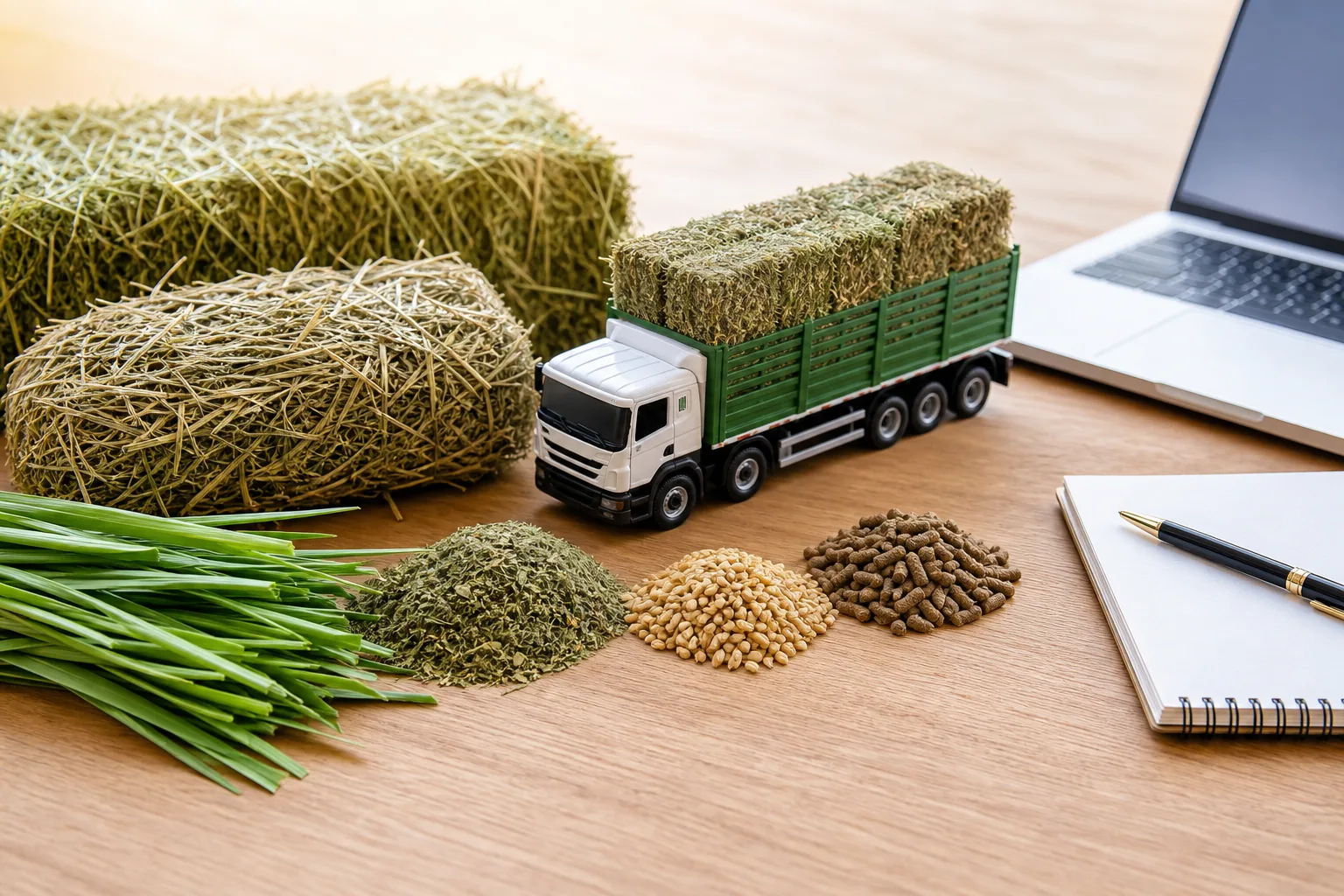
The scope covers grains and seeds traded specifically as feed inputs (corn, barley, sorghum, oats), oilseed meals and cakes (soybean meal, sunflower meal, cottonseed cake), hay and roughage products (alfalfa, Rhodes grass, timothy hay, straw), and agricultural by-products and residues repurposed as animal feed (bran, brewers grains, distillers grains, citrus pulp, food processing waste).
| Category | Scope |
|---|---|
| Grains and oilseed meals | Feed grains and oilseed meals Wholesale of corn, barley, sorghum, oats, soybean meal, sunflower meal, and other grain or oilseed-derived materials traded as animal feed inputs. These form the core energy and protein components of compound feed formulations. UAE SUPPLY CHAIN Over 90% of feed ingredients are imported from Brazil, Argentina, and India; feed imports are projected to reach 363.7 million kg by 2028. |
| Hay and roughage | Hay, forage and roughage Import and wholesale of alfalfa hay, Rhodes grass, timothy hay, straw, and other roughage products. The UAE imports approximately 2.5 million tonnes of hay annually, making this one of the country's largest agricultural import categories. UAE MARKET CONTEXT Since the UAE banned alfalfa cultivation in 2006 to conserve water, hay imports have become a permanent structural requirement for the country's 2.2 million livestock. |
| By-products and residues | Agricultural by-products and residues Trading in feed-grade by-products from food processing, brewing, milling, and oil extraction industries. Includes bran, distillers grains, oilseed cake, molasses, citrus pulp, and surplus bread converted to feed. EMERGING TREND In July 2025, Australian agri-tech company nuaFEEDs opened a UAE factory converting surplus bread waste into premium animal feed, processing 50,000 tonnes annually. |
| Specialty and premium feed | Specialty and premium feed materials Wholesale of premium and specialty feed materials including camel-specific nutrition products, equine feed blends, and high-protein aquaculture feed inputs for the UAE's growing fish farming sector. KEY UAE OPERATORS National Feed, Agrivita, Agthia Group, Al Ghurair Foods, and Al Dahra Agriculture lead the UAE's feed production and distribution ecosystem. |
This activity is specific to wholesale trading in fodder and related feed materials. It does not extend to manufacturing finished feed, retailing packaged feed products, or trading in live animals.
This also excludes the wholesale of textile fibres.
The scope is clear. If you are wholesaling agricultural materials, by-products, or residues that are used to feed animals, you are in.
If you are manufacturing finished feed, retailing packaged products, or trading in live animals, you are not.
Third-Party Approval
No third-party approval is required for this business activity.
Anti-Money Laundering Compliance
This business activity is exempt from AML compliance requirements.
References
- ¹ Research and Markets via Yahoo Finance — UAE Animal Feed Market Outlook to 2029 — https://finance.yahoo.com/news/uae-animal-feed-market-outlook-081700357.html
- ² IMARC Group — UAE Animal Feed Market Size (2024–2033) — cited via OpenPR (2025) — https://www.openpr.com/news/4256670/uae-animal-feed-market-size-is-expected-to-reach-usd-3-376-05
- ³ ReportLinker — UAE Animal Feed Industry Outlook (2024–2028) — https://www.reportlinker.com/clp/country/523474/726420
- ⁴ Mordor Intelligence — GCC Compound Feed Market Size & Share Analysis (2025–2030) — https://www.mordorintelligence.com/industry-reports/gcc-compound-feed-market
- ⁵ BlueWeave Consulting — Middle East and Africa Animal Feed Market Size, Share & Demand (2024–2030) — https://www.blueweaveconsulting.com/report/middle-east-and-africa-animal-feed-market/report-sample